Thank you for visiting SNEWPapers!
Sign up free
Editorial
September 29, 1943
The Northwest Enterprise
Seattle, King County, Washington
What is this article about?
Editorial criticizes the trial of Roy Sheffield in Washington, arguing that using absent witness statements from a justice court in Superior Court violates the 6th Amendment right to confrontation, setting a dangerous precedent despite fair jury verdict and judge.
Clipping
OCR Quality
100%
Excellent
Full Text
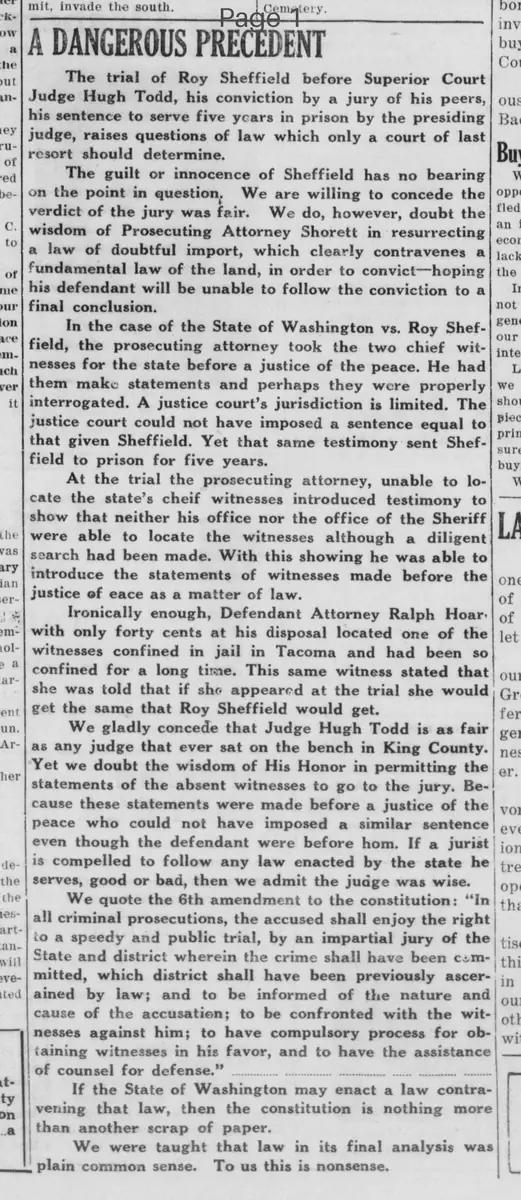
A DANGEROUS PRECEDENT
The trial of Roy Sheffield before Superior Court Judge Hugh Todd, his conviction by a jury of his peers, his sentence to serve five years in prison by the presiding judge, raises questions of law which only a court of last resort should determine.
The guilt or innocence of Sheffield has no bearing on the point in question. We are willing to concede the verdict of the jury was fair.
We do, however, doubt the wisdom of Prosecuting Attorney Shorett in resurrecting a law of doubtful import, which clearly contravenes a fundamental law of the land, in order to convict--hoping his defendant will be unable to follow the conviction to a final conclusion.
In the case of the State of Washington vs. Roy Sheffield, the prosecuting attorney took the two chief witnesses for the state before a justice of the peace. He had them make statements and perhaps they were properly interrogated. A justice court's jurisdiction is limited. The justice court could not have imposed a sentence equal to that given Sheffield. Yet that same testimony sent Sheffield to prison for five years.
At the trial the prosecuting attorney, unable to locate the state's chief witnesses introduced testimony to show that neither his office nor the office of the Sheriff were able to locate the witnesses although a diligent search had been made. With this showing he was able to introduce the statements of witnesses made before the justice of peace as a matter of law.
Ironically enough, Defendant Attorney Ralph Hoar with only forty cents at his disposal located one of the witnesses confined in jail in Tacoma and had been so confined for a long time. This same witness stated that she was told that if she appeared at the trial she would get the same that Roy Sheffield would get.
We gladly concede that Judge Hugh Todd is as fair as any judge that ever sat on the bench in King County. Yet we doubt the wisdom of His Honor in permitting the statements of the absent witnesses to go to the jury. Because these statements were made before a justice of the peace who could not have imposed a similar sentence even though the defendant were before him. If a jurist is compelled to follow any law enacted by the state he serves, good or bad, then we admit the judge was wise.
We quote the 6th amendment to the constitution: "In all criminal prosecutions, the accused shall enjoy the right to a speedy and public trial, by an impartial jury of the State and district wherein the crime shall have been committed, which district shall have been previously ascertained by law; and to be informed of the nature and cause of the accusation; to be confronted with the witnesses against him; to have compulsory process for obtaining witnesses in his favor, and to have the assistance of counsel for defense."
29 If the State of Washington may enact a law contravening that law, then the constitution is nothing more than another scrap of paper.
We were taught that law in its final analysis was plain common sense.
To us this is nonsense.
The trial of Roy Sheffield before Superior Court Judge Hugh Todd, his conviction by a jury of his peers, his sentence to serve five years in prison by the presiding judge, raises questions of law which only a court of last resort should determine.
The guilt or innocence of Sheffield has no bearing on the point in question. We are willing to concede the verdict of the jury was fair.
We do, however, doubt the wisdom of Prosecuting Attorney Shorett in resurrecting a law of doubtful import, which clearly contravenes a fundamental law of the land, in order to convict--hoping his defendant will be unable to follow the conviction to a final conclusion.
In the case of the State of Washington vs. Roy Sheffield, the prosecuting attorney took the two chief witnesses for the state before a justice of the peace. He had them make statements and perhaps they were properly interrogated. A justice court's jurisdiction is limited. The justice court could not have imposed a sentence equal to that given Sheffield. Yet that same testimony sent Sheffield to prison for five years.
At the trial the prosecuting attorney, unable to locate the state's chief witnesses introduced testimony to show that neither his office nor the office of the Sheriff were able to locate the witnesses although a diligent search had been made. With this showing he was able to introduce the statements of witnesses made before the justice of peace as a matter of law.
Ironically enough, Defendant Attorney Ralph Hoar with only forty cents at his disposal located one of the witnesses confined in jail in Tacoma and had been so confined for a long time. This same witness stated that she was told that if she appeared at the trial she would get the same that Roy Sheffield would get.
We gladly concede that Judge Hugh Todd is as fair as any judge that ever sat on the bench in King County. Yet we doubt the wisdom of His Honor in permitting the statements of the absent witnesses to go to the jury. Because these statements were made before a justice of the peace who could not have imposed a similar sentence even though the defendant were before him. If a jurist is compelled to follow any law enacted by the state he serves, good or bad, then we admit the judge was wise.
We quote the 6th amendment to the constitution: "In all criminal prosecutions, the accused shall enjoy the right to a speedy and public trial, by an impartial jury of the State and district wherein the crime shall have been committed, which district shall have been previously ascertained by law; and to be informed of the nature and cause of the accusation; to be confronted with the witnesses against him; to have compulsory process for obtaining witnesses in his favor, and to have the assistance of counsel for defense."
29 If the State of Washington may enact a law contravening that law, then the constitution is nothing more than another scrap of paper.
We were taught that law in its final analysis was plain common sense.
To us this is nonsense.
What sub-type of article is it?
Constitutional
Legal Reform
Crime Or Punishment
What keywords are associated?
Sixth Amendment
Witness Confrontation
Trial Procedure
Constitutional Violation
Sheffield Conviction
Justice Court Testimony
Prosecution Tactics
What entities or persons were involved?
Roy Sheffield
Judge Hugh Todd
Prosecuting Attorney Shorett
Defendant Attorney Ralph Hoar
State Of Washington
Editorial Details
Primary Topic
Critique Of Witness Procedure In State Of Washington Vs. Roy Sheffield
Stance / Tone
Critical Of Prosecution Tactics And Judicial Allowance Of Absent Witness Statements Violating Constitutional Rights
Key Figures
Roy Sheffield
Judge Hugh Todd
Prosecuting Attorney Shorett
Defendant Attorney Ralph Hoar
State Of Washington
Key Arguments
Resurrecting A Law Of Doubtful Import That Contravenes The Constitution To Convict Sheffield
Using Statements From Justice Of The Peace Court, Which Has Limited Jurisdiction, In Superior Court Trial
Allowing Absent Witness Statements Into Evidence Despite Diligent Search Claim, Violating Right To Confrontation
Defense Located A Witness The Prosecution Could Not, Who Claimed Intimidation
Quoting 6th Amendment Right To Be Confronted With Witnesses Against Him
State Law Contravening Constitution Makes It Meaningless
Law Should Be Plain Common Sense, This Procedure Is Nonsense