Thank you for visiting SNEWPapers!
Sign up free
Morning Appeal
Carson City, Ormsby County, Carson City County, Nevada
What is this article about?
English trades and professions face decline due to cheaper imports from America, enabled by advanced machinery, affecting woodworking, coopering, stained glass, labeling, shorthand reporting, and introducing ramie fiber as cotton alternative.
Clipping
OCR Quality
Full Text
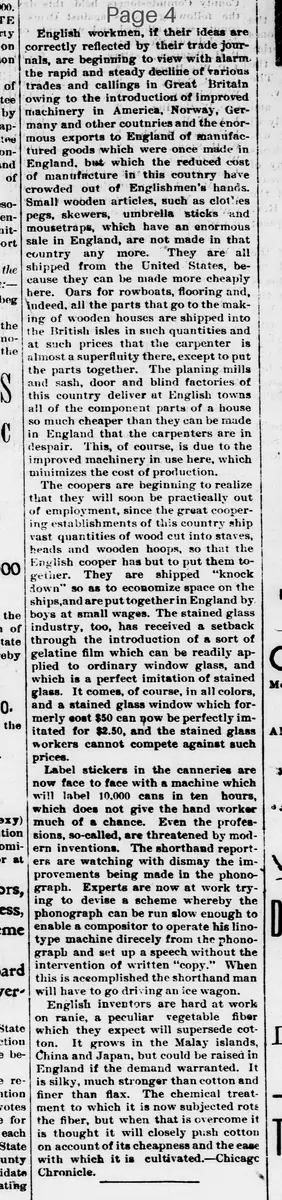
Small wooden articles, such as clothes pegs, skewers, umbrella sticks and mousetraps, which have an enormous sale in England, are not made in that country any more. They are all shipped from the United States, because they can be made more cheaply here. Oars for rowboats, flooring and indeed, all the parts that go to the making of wooden houses are shipped into the British isles in such quantities and at such prices that the carpenter is almost a superfluity there, except to put the parts together. The planing mills and sash, door and blind factories of this country deliver at English towns all of the component parts of a house so much cheaper than they can be made in England that the carpenters are in despair. This, of course, is due to the improved machinery in use here, which minimizes the cost of production.
The coopers are beginning to realize that they will soon be practically out of employment, since the great coopering establishments of this country ship vast quantities of wood cut into staves, heads and wooden hoops, so that the English cooper has but to put them together. They are shipped "knock down" so as to economize space on the ships, and are put together in England by boys at small wages. The stained glass industry, too, has received a setback through the introduction of a sort of gelatine film which can be readily applied to ordinary window glass, and which is a perfect imitation of stained glass. It comes, of course, in all colors, and a stained glass window which formerly cost $50 can now be perfectly imitated for $2.50, and the stained glass workers cannot compete against such prices.
Label stickers in the canneries are now face to face with a machine which will label 10,000 cans in ten hours, which does not give the hand worker much of a chance. Even the professions, so-called, are threatened by modern inventions. The shorthand reporters are watching with dismay the improvements being made in the phonograph. Experts are now at work trying to devise a scheme whereby the phonograph can be run slow enough to enable a compositor to operate his linotype machine directly from the phonograph and set up a speech without the intervention of written "copy." When this is accomplished the shorthand man will have to go driving an ice wagon.
English inventors are hard at work on ramie, a peculiar vegetable fiber which they expect will supersede cotton. It grows in the Malay islands, China and Japan, but could be raised in England if the demand warranted. It is silky, much stronger than cotton and finer than flax. The chemical treatment to which it is now subjected rots the fiber, but when that is overcome it is thought it will closely push cotton on account of its cheapness and the ease with which it is cultivated.-Chicago Chronicle.
What sub-type of article is it?
What keywords are associated?
Where did it happen?
Foreign News Details
Primary Location
Great Britain
Outcome
decline in british trades including woodworking, coopering, stained glass, labeling, and shorthand reporting due to cheaper american imports and machinery; potential supersession of cotton by ramie fiber.
Event Details
English workmen alarmed by decline in trades due to improved machinery in America, Norway, Germany leading to exports of cheaper manufactured goods like wooden articles, house parts, cooperage components, and gelatine film for stained glass imitation; machines threaten labelers and shorthand reporters; English inventors develop ramie fiber to replace cotton.