Thank you for visiting SNEWPapers!
Sign up free
Literary
March 16, 1862
Memphis Daily Appeal
Memphis, Shelby County, Tennessee
What is this article about?
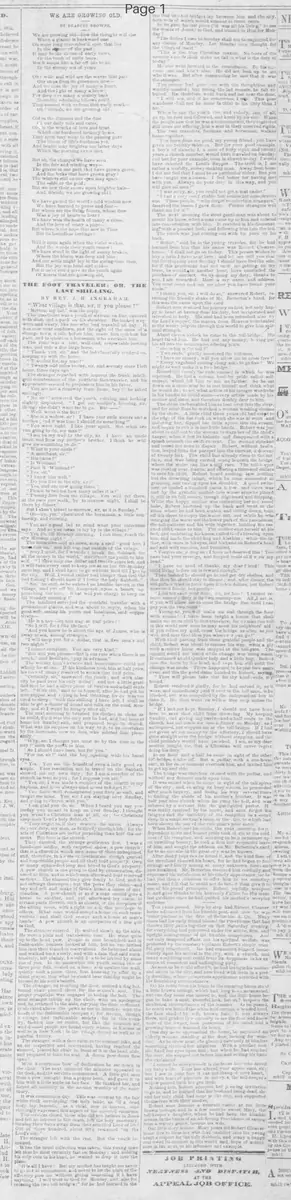
Young Robert Cleaver travels on foot to the city to seek work with his uncle, observes the Sabbath in Merton village, gives his last money to church communion, saves a tollkeeper's child from drowning, and through faithful duty finds employment, success, and marriage over ten years.
Clipping
OCR Quality
85%
Good
Full Text
THE FOOT TRAVELER: OR, THE LAST SHILLING.
BY REV. J. H. INGRAHAM.
"What village is that, sir, if you please?"
"Merton, my lad," was the reply.
The questioner was a youth of sixteen, on foot, covered with dust and a pack on his shoulder. He looked way worn and weary, like one who had traveled all day. It was now near sundown, and the sight of the spire of a strange town a mile before him, made him quicken his pace, and to question a horseman who overtook him.
The rider was a tall, well clad, respectable looking man, and rode a fine large horse.
"Thank you, sir," and the lad cheerfully trudged on, keeping up with the horse.
"Traveled far, my lad?"
"Twenty odd miles to-day, sir, and seventy since I left home, three days ago."
The stranger regarded with interest the frank intelligent countenance of the youthful foot traveler, and his appearance seemed to prepossess him in his favor.
"You are not a runaway from home, boy," he asked smilingly.
"No sir," answered the youth, coloring and looking slightly displeased. "I got my mother's blessing, sir, though she didn't want me to go. But—"
"Well what is the but?"
"She is a widow, sir! I have four little sisters and a brother, and it was time I should do something."
"You were right I like your spirit. But what are you going to do, my man!"
"I am on my way to the city, sir I have an uncle there, and he is my mother's brother I think he will give me something to do."
"What is your uncle's?"
"A merchant, sir."
"His name?"
"Paul R. Wheland."
"Yes sir."
"I know him well."
"Do you live in the city sir?"
"Yes and am now going there."
"Please to tell me how many miles it is?"
"Twenty four from the village. You will get there, at the rate you walk, by to-morrow night. I shall be there by dinner."
"But I shan't travel to-morrow, sir, as it is Sunday."
"Oh—ay, yes," ejaculated the horseman, a little confusedly, and coloring.
"You are a good lad to mind what your catechism says. And so you mean to lay by in the village?"
"Yes sir, till Monday morning. I can then reach the city Monday night."
The horseman said no more, save a civil "good bye, I must ride on," and left him just outside of the village.
"Stay I must, for I wouldn't break the Sabbath for all the money in the world," murmured the youth to himself. "I have only one dollar and twelve cents left and it will take every cent to keep me at an inn till Monday morning and I shall have to go without food till I get to the city. Well, I would rather feel hunger than feel the bad feeling I should have if I broke the holy Sabbath."
"Sir," he said, as he entered an humble tavern in the village, and put off his knapsack upon a bench, approaching the bar. "What will you charge to keep me till Monday morning?"
The landlord surveyed the youthful traveler with a professional glance, and was about to reply, when his good wife, seeing his youth and loneliness, said suggestively—
"It is a boy—let him stay at half price!"
"So I will for I like his face."
"And you know he is about the age of James who is away at sea, among strangers."
"I will keep you for a dollar, that is, five meals and two nights,"
"I cannot complain. You are very kind."
"But will you please—that is our rule when there is no trunk," said Boniface, "pay in advance."
The worthy man's avarice and benevolence could not wholly be at one. If his kindness took him at half price, his love of money resolved to secure that half price.
"Certainly sir," answered the youth and with alacrity he paid over his only dollar and not a little gratified that he had a silver piece of twelve-and-a-half cents left. With this, said he to himself, after he had got his nice supper, and lying in bed thinking, for he was too tired to sleep: with this shilling I have left, I shall be able to get a dinner of bread and milk on the road, Monday, and so I won't be hungry after all.
The next morning he brushed his clothes as clean as he could, for it was the only suit he had, and had been at home his Sunday suit, and prepared to go to church.
What was his surprise on his way to it, to be overtaken by the horseman, now on foot, who saluted him pleasantly.
"Why, sir, I thought you must be by this time in the city!" said the youth to him.
"So I should have been, but for you."
"For me, sir?" said the boy opening wide his hazel eyes.
"Yes. You see the benefit of even a lad's good example. Your resolution not to travel on the Sabbath showed me my own duty: for I am a member of the church as well as you, for I suppose you are."
"Yes, sir, I was made a member of the church in my baptism, and have always tried never to forget it."
"You have well remembered your duty as such, and taught me mine. You see I am staying over Sunday, and going to church with you."
"I am glad you do sir. When I heard you say yesterday you was to keep on over Sunday, I thought you wasn't a Christian man at all, sir for Christians keep their Lord's holy Sabbath."
"They ought to, if they deserve the name. Always do your duty, my man, as faithfully through life for the acts of Christians are better preaching than half the sermons. But here is the church."
They entered the strange gentleman first. It was a handsome edifice, with carpeted aisles, a pew church that is a church in which men some of them unbaptized, and, therefore, in a state of heathenism though genteel and respectable people and all that) hold property. Own so many square-feet long and broad in God's property. A pew church is one given to God by consecration, dedicated to Him, and in which men afterward hold reserved sections. The chancel they give freely to God, and do not infringe thereupon but the pews they claim—and buy and sell and make of God's house a house of merchandise. A pew church is as if a man should give a house to another, and yet afterward lay claim to certain parts therein, such as closets, or the fire place of the sitting room, with a right to—I this privilege to others. What man would accept a house on such reservations and shall God accept such a house at man's hands: A pew church is an occupation of a free gift to God.
The stranger entered—he walked slowly up the aisle. He wore a plain and travel-worn coat. He went quite up to the head pew. People in nice broadcloth and in fashionable bonnets looked at him, but no one invited him into their fenced in reservations. So he turned about and walked back slowly, and with a face that said unobtrusively, but plainly, I would like to be invited by some one of you. In the meanwhile the youth seeing two or three poor folk seated on a bench against the wall, quietly took a place there, first kneeling to offer up a silent prayer, that what he should hear that day might be blessing to his soul's benefit.
The stranger, on reaching the door, noticed a flag bottomed chair placed there for the sexton's seat. The proper proprietor was engaged in tolling the bell. The stout stranger taking up the chair, with an apologetic nod, he returned to the aisle, carrying the chair—efficiently elevated above the pews as not to interfere with the heads of the fashionable occupants for Merton, though a village, had fashionable society for in this country, fashion has no center, but like the common air, well dressed people are found everywhere, in Kansas as well as in New York in the village church as well as in palatial Trinity.
The stranger, with a face calm as the summer lake, and an air respectful and reverential having reached the chancel, placed his chair in front of it in the heat and— and prepared to take his seat. A dozen pew doors flew open.
With a courteous bow of declination he sat down in the chair. The next moment the minister appeared at the desk, and the services commenced. A little girl seated from a pew brought him a prayer book, and gave it to him with a little smile on her face. He thanked her, and forgot all civility in the solemn worship of the sanctuary.
It was communion day. This was evident by the fair white cloth enveloping the holy table, as if a dead body lay beneath, as a child now in heaven, angels strangely expresses this aspect of the covered elements.
The services closed those who did not believe in Jesus and felt no interest in his death, left the holy sanctuary, turning their faces away from their crucified Lord of life! Out of three hundred, about one half remained on the Lord's side."
The stranger left with the rest. But the youth remained.
When the usual collection was taken, this young man felt that he must certainly fast on Monday and holding his only coin in his hand, he waited to drop it into the plate.
"It is all I have! But my mother has taught me never to go to communion, and never to let the plate of the sanctuary pass me without giving something if I have anything. I will trust to God for Monday and also for crossing the two toll bridges," for he had learned in the inn that two toll bridges lay between him and the city.
So he gave his last piece ('it was all his living." to use the words of Jesus.) to God, and trusted to Him for Monday.
The duties I owe to Sunday shall not be neglected for any claims of Monday. Let Monday take thought for the things of itself.
His is the true Christian maxim. No fears of the morrow's goods shall make me fail in what is the duty of to-day.
Haley went forward to the communion. By his side one and the same. He did not look up to see who it was. But after communing he saw that it was the stranger.
This person had gone out with the thoughtless and worldly minded, but seeing the lad remain, he felt rebuked. He therefore went back and sat near the door.
I will see if he communes. I will. This poor wanderer shall not be more faithful to his duty than I am.
When he saw the youth rise and calmly, last of all, go up he rose and followed, and knelt by his side. When the people saw that he was a communicant, they regretted still more not offering him a seat in their reserved rights.
The two travelers, footman and horseman, walked home together.
"You have done me good, my young friend: you have given me healthy lessons. But for your good example a boy's fidelity, I, a man of forty eight, and twenty years a church member, would have traveled on Sunday and but for your example, even in church to day, I would have neglected the Lord's Supper. The truth is, I am rather a worldly, money-making man. Away from home I did not feel that I need be so particular either. But you have taught me a lesson. I feel better for having met with you. Always do your duty in this way, and you will gain all men."
"I was sorry, sir, you could not get a seat cosier."
"I had a very comfortable but somewhat conspicuous one. These people, who forget to entertain strangers," deserved the lesson I gave them. Future strangers will thank me for it."
The next morning the stout gentleman was about to mount his horse, when a man came up to him and entered into conversation with him. It resulted in his dismounting, with a pleased look, and following him into the inn.
The youth was just coming out with his pack on his back.
"Robert," said he to the young traveler, for he had learned from him that his name was Robert Cleaver. "I shall not go on to-day. This person wishes to buy a farm I have near here and let me tell you that but for stopping over Sunday I should have lost the sale for if this gentleman had seen me getting on my horse, he would, in another hour, have concluded the purchase of another. So by doing my duty, thanks to you I am rewarded. Here's my name and address. You must come and see me after you have found your uncle."
"I thank you, sir. I will do so," answered Robert, returning the friendly shake of Mr. Betterton's hand, for this was the name upon the card.
Robert now resumed his journey on foot, not only happy at heart at having done his duty, but invigorated and refreshed in body. His soul had been refreshed also by the Lord's supper: the manna from Heaven vouchsafed to the weary pilgrim through this world to give him spiritual strength.
About eleven o'clock he came to the toll bridge. His heart failed him. He had not any money, having put his all into the communion offering plate.
"Sir, what is the toll?"
"I have no money, will you allow me to cross free?"
"Every vagabond coming along asks to go free! We might as well make it a free bridge."
Robert felt keenly the rude manner in which he was repulsed. He had a certain noble by pride called self respect, which led him to ask no further. So he sat down on a stone near by to rest himself and think what he would do—now what article of his meagre wardrobe in his bundle he could spare—every article made by his mother and sister and therefore doubly dear to him.
The stone curb enabled him to look over into the river, and for some time he watched a woman washing clothes by the shore. A little child three years old had crept to the edge of the flat rock on which she was at work and imitating her, dipped her little apron into the stream, and began to rub it in her little hands. Robert was just about to call out to the woman to warn her of the child's danger, when it lost its balance and disappeared with a splash beneath the swift current. The woman shrieked and tossed her arms in despair. Robert, without hesitation, leaped from the parapet into the current, a descent of twenty feet. The child had already risen to the surface, and was being carried along beneath the bridge where the water ran like a mill race. The toll keeper was leaning over, frantic, and offering a thousand dollars to save his child. Robert heard nothing, saw nothing but the drowning infant, which he soon succeeded in grasping, and raising upon his shoulder. A good swimmer he landed a hundred yards below and there was met by the grateful mother, into whose arms he placed it, still in its full senses, though frightened and dripping.
While the happy mother was embracing her recovered babe, Robert hastened up the bank and went to the stone where he had been seated, and sitting down, took off his shoes to empty the water out, and while he was wringing the water out the lower part of his pantaloons the toll gatherer and his wife together, holding the rescued child, came to him. The mother cast herself at his feet, and embracing his knees, called God's blessing upon him and made the child hug and kiss him: while the father, with tears in his eyes, laid his hand on Robert's head and said with emotion, and humbled.
"Forgive me young sir I have not deserved this! You have had your revenge", and heaped coals of fire on my head."
"I have no need of thanks, my dear friend! This child living before me is reward enough."
They insisted he should go in and get dry clothes, and that then he should stay to dinner: and, after dinner, the toll gatherer tried to force upon him ten dollars, but Robert answered freely but gently—
"I did not save your babe, for hire! I cannot receive money: duty is its own recompense. All I ask is if you will allow me to cross the bridge free until I can pay you the two cents."
"Young sir you will make me sink through the floor with shame! I have been taught a lesson that shall make me more civil to foot travelers, for a man can tell in this world how soon he may need his neighbors' aid. If you refuse my gold, cross the bridge as often as you will and may God bless you wherever you go!"
With kind parting from these grateful people and the child, Robert was about to resume his way., when a gig with a restive horse was stopped at the toll gate. The animal would not stand while change was being made. It contained an elderly Quaker lady and a little boy. Robert caught the horse by the head, and held him still until the change was made. There happened to be just two cents over, and this the good dame handed to Robert, saying.
"Thee will please take that for thy kind service, my friend."
Robert received it gladly, for he had earned it, as it were, and immediately paid it over to the toll man, who blushed but was compelled by the independent boy to take it. He then went on with a free step across the bridge.
"If I had not kept Sunday, I should not have been here to save that child from drowning. My keeping Sunday, and giving my twelve-and-a-half cents to the church, has not made me lose a dinner on Monday, as I anticipated, nor stopped me at the toll-bridge. If I had not given all my money to the offertory, I should have gone straight over the bridge without stopping and the child probably would have perished. I see, as my dear mother taught me that a Christian will never regret doing his duty."
In an hour and a half he came in sight of the other toll bridge a mile off. But a pedlar, with a one-horse-cart, at the same moment overtook him, and invited him to get up and ride.
The bridge was short for crossed with the pedlar and without any demand made upon him.
It was sunset when he came in sight of the tall spires of the city: and, entering its busy streets, he proceeded after much inquiry, and losing his way several times in finding the abode of his mother's brother. It was half past nine o'clock when he rung the bell, and was ushered by a servant into the gas lighted parlor. He was coldly received by his uncle, and soon forgot his fatigues and the incivility of his reception in a sound sleep in a small servant's room on the attic to which he had been shown the room of the rich man's poor sister.
When Robert met his uncle, the next morning his independent spirit and honest pride took alarm at the coldness of his reception, and scorning to be a pensioner upon an unwilling bounty, he took a firm but respectful leave of him and sought the address on Mr. Betterton's card for to no one else in the great city was he known.
After many inquiries he found it, and the kind face of the merchant cheered his heart, for he had began to feel strange and lonely among so many unknown faces, and new localities. Mr. Betterton received him cordially, and expressed his satisfaction at his timely appearance for he had just then a situation to offer him in his counting house, and felt that he could not do better than give it to one of his proved principles. Robert joyfully accepted it, and gave thanks to his heavenly Father for His manifest guidance since he had quitted his mother's weeping embrace.
Ten years passed. Step by step had Robert Cleaver advanced from his humble post, and now he was junior partner in the firm of Betterton & Co. Many times had his early friend blessed the Providence that had thrown their paths together on that Saturday evening for everything had prospered under the active, firm and upright management of his humble companion. And not only temporal affairs, but his spiritual welfare was protected by the constant vigilance. Robert's simple, trustful piety stimulated. He had connected himself, immediately upon his arrival in the city, with a church, and many a rejoicing soul could trace its happiness in this world and hope of acceptance in the next, to his influence and example.
He had married one of his sisters of the church, and now lived with them in a pretty dwelling, whose neat appearance accorded with his flourishing circumstances.
On his route from his home to the counting house stood a little brown cottage, which had long been untenanted. One day some one moved in, and the little house began to take a neat, cheerful look but did not bespeak the straitened circumstances of the inmates. As he passed, he could see behind the white half-curtain, a bent head the face shaded by soft brown hair. It was always there, and gradually his curiosity to see the face and know more of the gentle, for gentleness took possession of his mind and a growing interest warmed his heart.
One day as he approached the house, he perceived an elderly woman standing at the door, looking for some one. As he drew near she glanced carefully at him, but something riveted her attention. With a puzzled look she fixed her eyes upon him but when he had reached the door, she stepped out before him and seizing his hand she exclaimed
"It cannot be mistaken—it is the brave boy who saved my baby's life. Time has altered your appearance much, sir: but I see in your face it has not changed your heart," and with tears of joy in her eyes the toll keeper's widow poured forth her gratitude.
Nothing loth, Robert accepted her pressing invitation to go in, and learned that her husband being dead she and her only child had come to the city, and supported themselves with their needles.
Robert soon became a constant visitor at the little brown cottage, and in a few months sweet Mary, the toll keeper's daughter, whom he had been the humble means, in the hands of an All Seeing Providence of saving from a watery grave, became his wife.
One life is done. Many years did Robert Cleaver bear love to her who had instilled into his young heart a reverence for the holy Sabbath, and many a happy soul owed its comfort in this world and hope of acceptance in the next, to his influence and example.
BY REV. J. H. INGRAHAM.
"What village is that, sir, if you please?"
"Merton, my lad," was the reply.
The questioner was a youth of sixteen, on foot, covered with dust and a pack on his shoulder. He looked way worn and weary, like one who had traveled all day. It was now near sundown, and the sight of the spire of a strange town a mile before him, made him quicken his pace, and to question a horseman who overtook him.
The rider was a tall, well clad, respectable looking man, and rode a fine large horse.
"Thank you, sir," and the lad cheerfully trudged on, keeping up with the horse.
"Traveled far, my lad?"
"Twenty odd miles to-day, sir, and seventy since I left home, three days ago."
The stranger regarded with interest the frank intelligent countenance of the youthful foot traveler, and his appearance seemed to prepossess him in his favor.
"You are not a runaway from home, boy," he asked smilingly.
"No sir," answered the youth, coloring and looking slightly displeased. "I got my mother's blessing, sir, though she didn't want me to go. But—"
"Well what is the but?"
"She is a widow, sir! I have four little sisters and a brother, and it was time I should do something."
"You were right I like your spirit. But what are you going to do, my man!"
"I am on my way to the city, sir I have an uncle there, and he is my mother's brother I think he will give me something to do."
"What is your uncle's?"
"A merchant, sir."
"His name?"
"Paul R. Wheland."
"Yes sir."
"I know him well."
"Do you live in the city sir?"
"Yes and am now going there."
"Please to tell me how many miles it is?"
"Twenty four from the village. You will get there, at the rate you walk, by to-morrow night. I shall be there by dinner."
"But I shan't travel to-morrow, sir, as it is Sunday."
"Oh—ay, yes," ejaculated the horseman, a little confusedly, and coloring.
"You are a good lad to mind what your catechism says. And so you mean to lay by in the village?"
"Yes sir, till Monday morning. I can then reach the city Monday night."
The horseman said no more, save a civil "good bye, I must ride on," and left him just outside of the village.
"Stay I must, for I wouldn't break the Sabbath for all the money in the world," murmured the youth to himself. "I have only one dollar and twelve cents left and it will take every cent to keep me at an inn till Monday morning and I shall have to go without food till I get to the city. Well, I would rather feel hunger than feel the bad feeling I should have if I broke the holy Sabbath."
"Sir," he said, as he entered an humble tavern in the village, and put off his knapsack upon a bench, approaching the bar. "What will you charge to keep me till Monday morning?"
The landlord surveyed the youthful traveler with a professional glance, and was about to reply, when his good wife, seeing his youth and loneliness, said suggestively—
"It is a boy—let him stay at half price!"
"So I will for I like his face."
"And you know he is about the age of James who is away at sea, among strangers."
"I will keep you for a dollar, that is, five meals and two nights,"
"I cannot complain. You are very kind."
"But will you please—that is our rule when there is no trunk," said Boniface, "pay in advance."
The worthy man's avarice and benevolence could not wholly be at one. If his kindness took him at half price, his love of money resolved to secure that half price.
"Certainly sir," answered the youth and with alacrity he paid over his only dollar and not a little gratified that he had a silver piece of twelve-and-a-half cents left. With this, said he to himself, after he had got his nice supper, and lying in bed thinking, for he was too tired to sleep: with this shilling I have left, I shall be able to get a dinner of bread and milk on the road, Monday, and so I won't be hungry after all.
The next morning he brushed his clothes as clean as he could, for it was the only suit he had, and had been at home his Sunday suit, and prepared to go to church.
What was his surprise on his way to it, to be overtaken by the horseman, now on foot, who saluted him pleasantly.
"Why, sir, I thought you must be by this time in the city!" said the youth to him.
"So I should have been, but for you."
"For me, sir?" said the boy opening wide his hazel eyes.
"Yes. You see the benefit of even a lad's good example. Your resolution not to travel on the Sabbath showed me my own duty: for I am a member of the church as well as you, for I suppose you are."
"Yes, sir, I was made a member of the church in my baptism, and have always tried never to forget it."
"You have well remembered your duty as such, and taught me mine. You see I am staying over Sunday, and going to church with you."
"I am glad you do sir. When I heard you say yesterday you was to keep on over Sunday, I thought you wasn't a Christian man at all, sir for Christians keep their Lord's holy Sabbath."
"They ought to, if they deserve the name. Always do your duty, my man, as faithfully through life for the acts of Christians are better preaching than half the sermons. But here is the church."
They entered the strange gentleman first. It was a handsome edifice, with carpeted aisles, a pew church that is a church in which men some of them unbaptized, and, therefore, in a state of heathenism though genteel and respectable people and all that) hold property. Own so many square-feet long and broad in God's property. A pew church is one given to God by consecration, dedicated to Him, and in which men afterward hold reserved sections. The chancel they give freely to God, and do not infringe thereupon but the pews they claim—and buy and sell and make of God's house a house of merchandise. A pew church is as if a man should give a house to another, and yet afterward lay claim to certain parts therein, such as closets, or the fire place of the sitting room, with a right to—I this privilege to others. What man would accept a house on such reservations and shall God accept such a house at man's hands: A pew church is an occupation of a free gift to God.
The stranger entered—he walked slowly up the aisle. He wore a plain and travel-worn coat. He went quite up to the head pew. People in nice broadcloth and in fashionable bonnets looked at him, but no one invited him into their fenced in reservations. So he turned about and walked back slowly, and with a face that said unobtrusively, but plainly, I would like to be invited by some one of you. In the meanwhile the youth seeing two or three poor folk seated on a bench against the wall, quietly took a place there, first kneeling to offer up a silent prayer, that what he should hear that day might be blessing to his soul's benefit.
The stranger, on reaching the door, noticed a flag bottomed chair placed there for the sexton's seat. The proper proprietor was engaged in tolling the bell. The stout stranger taking up the chair, with an apologetic nod, he returned to the aisle, carrying the chair—efficiently elevated above the pews as not to interfere with the heads of the fashionable occupants for Merton, though a village, had fashionable society for in this country, fashion has no center, but like the common air, well dressed people are found everywhere, in Kansas as well as in New York in the village church as well as in palatial Trinity.
The stranger, with a face calm as the summer lake, and an air respectful and reverential having reached the chancel, placed his chair in front of it in the heat and— and prepared to take his seat. A dozen pew doors flew open.
With a courteous bow of declination he sat down in the chair. The next moment the minister appeared at the desk, and the services commenced. A little girl seated from a pew brought him a prayer book, and gave it to him with a little smile on her face. He thanked her, and forgot all civility in the solemn worship of the sanctuary.
It was communion day. This was evident by the fair white cloth enveloping the holy table, as if a dead body lay beneath, as a child now in heaven, angels strangely expresses this aspect of the covered elements.
The services closed those who did not believe in Jesus and felt no interest in his death, left the holy sanctuary, turning their faces away from their crucified Lord of life! Out of three hundred, about one half remained on the Lord's side."
The stranger left with the rest. But the youth remained.
When the usual collection was taken, this young man felt that he must certainly fast on Monday and holding his only coin in his hand, he waited to drop it into the plate.
"It is all I have! But my mother has taught me never to go to communion, and never to let the plate of the sanctuary pass me without giving something if I have anything. I will trust to God for Monday and also for crossing the two toll bridges," for he had learned in the inn that two toll bridges lay between him and the city.
So he gave his last piece ('it was all his living." to use the words of Jesus.) to God, and trusted to Him for Monday.
The duties I owe to Sunday shall not be neglected for any claims of Monday. Let Monday take thought for the things of itself.
His is the true Christian maxim. No fears of the morrow's goods shall make me fail in what is the duty of to-day.
Haley went forward to the communion. By his side one and the same. He did not look up to see who it was. But after communing he saw that it was the stranger.
This person had gone out with the thoughtless and worldly minded, but seeing the lad remain, he felt rebuked. He therefore went back and sat near the door.
I will see if he communes. I will. This poor wanderer shall not be more faithful to his duty than I am.
When he saw the youth rise and calmly, last of all, go up he rose and followed, and knelt by his side. When the people saw that he was a communicant, they regretted still more not offering him a seat in their reserved rights.
The two travelers, footman and horseman, walked home together.
"You have done me good, my young friend: you have given me healthy lessons. But for your good example a boy's fidelity, I, a man of forty eight, and twenty years a church member, would have traveled on Sunday and but for your example, even in church to day, I would have neglected the Lord's Supper. The truth is, I am rather a worldly, money-making man. Away from home I did not feel that I need be so particular either. But you have taught me a lesson. I feel better for having met with you. Always do your duty in this way, and you will gain all men."
"I was sorry, sir, you could not get a seat cosier."
"I had a very comfortable but somewhat conspicuous one. These people, who forget to entertain strangers," deserved the lesson I gave them. Future strangers will thank me for it."
The next morning the stout gentleman was about to mount his horse, when a man came up to him and entered into conversation with him. It resulted in his dismounting, with a pleased look, and following him into the inn.
The youth was just coming out with his pack on his back.
"Robert," said he to the young traveler, for he had learned from him that his name was Robert Cleaver. "I shall not go on to-day. This person wishes to buy a farm I have near here and let me tell you that but for stopping over Sunday I should have lost the sale for if this gentleman had seen me getting on my horse, he would, in another hour, have concluded the purchase of another. So by doing my duty, thanks to you I am rewarded. Here's my name and address. You must come and see me after you have found your uncle."
"I thank you, sir. I will do so," answered Robert, returning the friendly shake of Mr. Betterton's hand, for this was the name upon the card.
Robert now resumed his journey on foot, not only happy at heart at having done his duty, but invigorated and refreshed in body. His soul had been refreshed also by the Lord's supper: the manna from Heaven vouchsafed to the weary pilgrim through this world to give him spiritual strength.
About eleven o'clock he came to the toll bridge. His heart failed him. He had not any money, having put his all into the communion offering plate.
"Sir, what is the toll?"
"I have no money, will you allow me to cross free?"
"Every vagabond coming along asks to go free! We might as well make it a free bridge."
Robert felt keenly the rude manner in which he was repulsed. He had a certain noble by pride called self respect, which led him to ask no further. So he sat down on a stone near by to rest himself and think what he would do—now what article of his meagre wardrobe in his bundle he could spare—every article made by his mother and sister and therefore doubly dear to him.
The stone curb enabled him to look over into the river, and for some time he watched a woman washing clothes by the shore. A little child three years old had crept to the edge of the flat rock on which she was at work and imitating her, dipped her little apron into the stream, and began to rub it in her little hands. Robert was just about to call out to the woman to warn her of the child's danger, when it lost its balance and disappeared with a splash beneath the swift current. The woman shrieked and tossed her arms in despair. Robert, without hesitation, leaped from the parapet into the current, a descent of twenty feet. The child had already risen to the surface, and was being carried along beneath the bridge where the water ran like a mill race. The toll keeper was leaning over, frantic, and offering a thousand dollars to save his child. Robert heard nothing, saw nothing but the drowning infant, which he soon succeeded in grasping, and raising upon his shoulder. A good swimmer he landed a hundred yards below and there was met by the grateful mother, into whose arms he placed it, still in its full senses, though frightened and dripping.
While the happy mother was embracing her recovered babe, Robert hastened up the bank and went to the stone where he had been seated, and sitting down, took off his shoes to empty the water out, and while he was wringing the water out the lower part of his pantaloons the toll gatherer and his wife together, holding the rescued child, came to him. The mother cast herself at his feet, and embracing his knees, called God's blessing upon him and made the child hug and kiss him: while the father, with tears in his eyes, laid his hand on Robert's head and said with emotion, and humbled.
"Forgive me young sir I have not deserved this! You have had your revenge", and heaped coals of fire on my head."
"I have no need of thanks, my dear friend! This child living before me is reward enough."
They insisted he should go in and get dry clothes, and that then he should stay to dinner: and, after dinner, the toll gatherer tried to force upon him ten dollars, but Robert answered freely but gently—
"I did not save your babe, for hire! I cannot receive money: duty is its own recompense. All I ask is if you will allow me to cross the bridge free until I can pay you the two cents."
"Young sir you will make me sink through the floor with shame! I have been taught a lesson that shall make me more civil to foot travelers, for a man can tell in this world how soon he may need his neighbors' aid. If you refuse my gold, cross the bridge as often as you will and may God bless you wherever you go!"
With kind parting from these grateful people and the child, Robert was about to resume his way., when a gig with a restive horse was stopped at the toll gate. The animal would not stand while change was being made. It contained an elderly Quaker lady and a little boy. Robert caught the horse by the head, and held him still until the change was made. There happened to be just two cents over, and this the good dame handed to Robert, saying.
"Thee will please take that for thy kind service, my friend."
Robert received it gladly, for he had earned it, as it were, and immediately paid it over to the toll man, who blushed but was compelled by the independent boy to take it. He then went on with a free step across the bridge.
"If I had not kept Sunday, I should not have been here to save that child from drowning. My keeping Sunday, and giving my twelve-and-a-half cents to the church, has not made me lose a dinner on Monday, as I anticipated, nor stopped me at the toll-bridge. If I had not given all my money to the offertory, I should have gone straight over the bridge without stopping and the child probably would have perished. I see, as my dear mother taught me that a Christian will never regret doing his duty."
In an hour and a half he came in sight of the other toll bridge a mile off. But a pedlar, with a one-horse-cart, at the same moment overtook him, and invited him to get up and ride.
The bridge was short for crossed with the pedlar and without any demand made upon him.
It was sunset when he came in sight of the tall spires of the city: and, entering its busy streets, he proceeded after much inquiry, and losing his way several times in finding the abode of his mother's brother. It was half past nine o'clock when he rung the bell, and was ushered by a servant into the gas lighted parlor. He was coldly received by his uncle, and soon forgot his fatigues and the incivility of his reception in a sound sleep in a small servant's room on the attic to which he had been shown the room of the rich man's poor sister.
When Robert met his uncle, the next morning his independent spirit and honest pride took alarm at the coldness of his reception, and scorning to be a pensioner upon an unwilling bounty, he took a firm but respectful leave of him and sought the address on Mr. Betterton's card for to no one else in the great city was he known.
After many inquiries he found it, and the kind face of the merchant cheered his heart, for he had began to feel strange and lonely among so many unknown faces, and new localities. Mr. Betterton received him cordially, and expressed his satisfaction at his timely appearance for he had just then a situation to offer him in his counting house, and felt that he could not do better than give it to one of his proved principles. Robert joyfully accepted it, and gave thanks to his heavenly Father for His manifest guidance since he had quitted his mother's weeping embrace.
Ten years passed. Step by step had Robert Cleaver advanced from his humble post, and now he was junior partner in the firm of Betterton & Co. Many times had his early friend blessed the Providence that had thrown their paths together on that Saturday evening for everything had prospered under the active, firm and upright management of his humble companion. And not only temporal affairs, but his spiritual welfare was protected by the constant vigilance. Robert's simple, trustful piety stimulated. He had connected himself, immediately upon his arrival in the city, with a church, and many a rejoicing soul could trace its happiness in this world and hope of acceptance in the next, to his influence and example.
He had married one of his sisters of the church, and now lived with them in a pretty dwelling, whose neat appearance accorded with his flourishing circumstances.
On his route from his home to the counting house stood a little brown cottage, which had long been untenanted. One day some one moved in, and the little house began to take a neat, cheerful look but did not bespeak the straitened circumstances of the inmates. As he passed, he could see behind the white half-curtain, a bent head the face shaded by soft brown hair. It was always there, and gradually his curiosity to see the face and know more of the gentle, for gentleness took possession of his mind and a growing interest warmed his heart.
One day as he approached the house, he perceived an elderly woman standing at the door, looking for some one. As he drew near she glanced carefully at him, but something riveted her attention. With a puzzled look she fixed her eyes upon him but when he had reached the door, she stepped out before him and seizing his hand she exclaimed
"It cannot be mistaken—it is the brave boy who saved my baby's life. Time has altered your appearance much, sir: but I see in your face it has not changed your heart," and with tears of joy in her eyes the toll keeper's widow poured forth her gratitude.
Nothing loth, Robert accepted her pressing invitation to go in, and learned that her husband being dead she and her only child had come to the city, and supported themselves with their needles.
Robert soon became a constant visitor at the little brown cottage, and in a few months sweet Mary, the toll keeper's daughter, whom he had been the humble means, in the hands of an All Seeing Providence of saving from a watery grave, became his wife.
One life is done. Many years did Robert Cleaver bear love to her who had instilled into his young heart a reverence for the holy Sabbath, and many a happy soul owed its comfort in this world and hope of acceptance in the next, to his influence and example.
What sub-type of article is it?
Prose Fiction
What themes does it cover?
Moral Virtue
Religious
What keywords are associated?
Sabbath Observance
Christian Duty
Moral Tale
Toll Bridge Rescue
Providence Reward
Communion Offering
Foot Traveler
What entities or persons were involved?
By Rev. J. H. Ingraham.
Literary Details
Title
The Foot Traveler: Or, The Last Shilling.
Author
By Rev. J. H. Ingraham.
Key Lines
"Stay I Must, For I Wouldn't Break The Sabbath For All The Money In The World," Murmured The Youth To Himself.
"It Is All I Have! But My Mother Has Taught Me Never To Go To Communion, And Never To Let The Plate Of The Sanctuary Pass Me Without Giving Something If I Have Anything. I Will Trust To God For Monday And Also For Crossing The Two Toll Bridges,"
"I Did Not Save Your Babe, For Hire! I Cannot Receive Money: Duty Is Its Own Recompense."
"If I Had Not Kept Sunday, I Should Not Have Been Here To Save That Child From Drowning. [...] I See, As My Dear Mother Taught Me That A Christian Will Never Regret Doing His Duty."
Many Years Did Robert Cleaver Bear Love To Her Who Had Instilled Into His Young Heart A Reverence For The Holy Sabbath, And Many A Happy Soul Owed Its Comfort In This World And Hope Of Acceptance In The Next, To His Influence And Example.