Thank you for visiting SNEWPapers!
Sign up free
Story
September 11, 1884
The Pulaski Citizen
Pulaski, Giles County, Tennessee
What is this article about?
Essay on cultivating moral integrity in children by instilling clear principles of right and wrong, warning against moral indirections. Includes anecdote of an Australian man who reformed after returning fraudulent army pension, achieving wealth and position.
Clipping
OCR Quality
95%
Excellent
Full Text
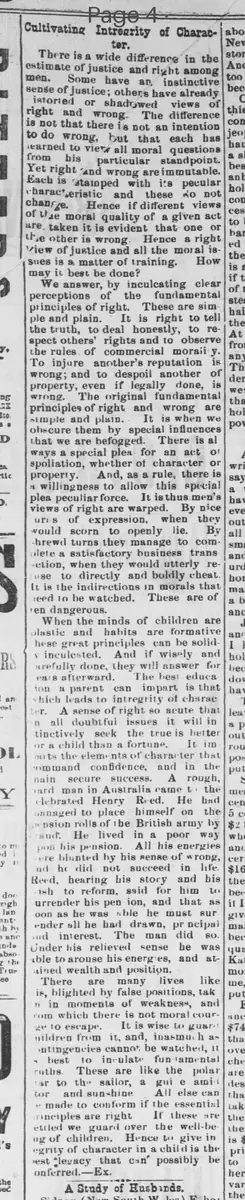
Cultivating Integrity of Character.
There is a wide difference in the estimate of justice and right among men. Some have an instinctive sense of justice; others have already historied or shadowed views of right and wrong. The difference is not that there is not an intention to do wrong, but that each has learned to view all moral questions from his particular standpoint.
Yet right and wrong are immutable. Each is stamped with its peculiar characteristic and these do not change. Hence if different views of the moral quality of a given act are taken it is evident that one or the other is wrong. Hence a right view of justice and all the moral issues is a matter of training. How may it best be done?
We answer, by inculcating clear perceptions of the fundamental principles of right. These are simple and plain. It is right to tell the truth, to deal honestly, to respect others' rights and to observe the rules of commercial morality. To injure another's reputation is wrong; and to despoil another of property, even if legally done, is wrong. The original fundamental principles of right and wrong are simple and plain. It is when we obscure them by special influences that we are befogged. There is always a special plea for an act or spoliation, whether of character or property. And, as a rule, there is willingness to allow this special plea peculiar force. It is thus men's views of right are warped. By nice turns of expression, when they would scorn to openly lie. By shrewd turns they manage to complete a satisfactory business transaction when they would utterly refuse to directly and boldly cheat. It is the indirections in morals that need to be watched. These are often dangerous.
When the minds of children are plastic and habits are formative these great principles can be solidly inculcated. And if wisely and carefully done, they will answer for life's afterward. The best education a parent can impart is that which leads to integrity of character. A sense of right so acute that in all doubtful issues it will instinctively seek the true is better for a child than a fortune. It imparts the elements of character that command confidence, and in the main secure success. A rough, hard man in Australia came to the celebrated Henry Reed. He had managed to place himself on the pension rolls of the British army by fraud. He lived in a poor way upon his pension. All his energies were blunted by his sense of wrong, and he did not succeed in life. Reed, hearing his story and his wish to reform, said for him to surrender his pension, and that as soon as he was able he must surrender all he had drawn, principal and interest. The man did so. Under his relieved sense he was able to arouse his energies, and attained wealth and position. There are many lives like his, blighted by false positions, taken in moments of weakness, and from which there is no moral courage to escape. It is wise to guard children from it, and, inasmuch as contingencies cannot be watched, it is best to insulate fundamental truths. These are like the polar star to the sailor, a guide amid storm and sunshine. All else can be made to conform if the essential principles are right. If these are settled we guard over the well-being of children. Hence to give integrity of character in a child is the greatest legacy that can possibly be conferred. Ex.
There is a wide difference in the estimate of justice and right among men. Some have an instinctive sense of justice; others have already historied or shadowed views of right and wrong. The difference is not that there is not an intention to do wrong, but that each has learned to view all moral questions from his particular standpoint.
Yet right and wrong are immutable. Each is stamped with its peculiar characteristic and these do not change. Hence if different views of the moral quality of a given act are taken it is evident that one or the other is wrong. Hence a right view of justice and all the moral issues is a matter of training. How may it best be done?
We answer, by inculcating clear perceptions of the fundamental principles of right. These are simple and plain. It is right to tell the truth, to deal honestly, to respect others' rights and to observe the rules of commercial morality. To injure another's reputation is wrong; and to despoil another of property, even if legally done, is wrong. The original fundamental principles of right and wrong are simple and plain. It is when we obscure them by special influences that we are befogged. There is always a special plea for an act or spoliation, whether of character or property. And, as a rule, there is willingness to allow this special plea peculiar force. It is thus men's views of right are warped. By nice turns of expression, when they would scorn to openly lie. By shrewd turns they manage to complete a satisfactory business transaction when they would utterly refuse to directly and boldly cheat. It is the indirections in morals that need to be watched. These are often dangerous.
When the minds of children are plastic and habits are formative these great principles can be solidly inculcated. And if wisely and carefully done, they will answer for life's afterward. The best education a parent can impart is that which leads to integrity of character. A sense of right so acute that in all doubtful issues it will instinctively seek the true is better for a child than a fortune. It imparts the elements of character that command confidence, and in the main secure success. A rough, hard man in Australia came to the celebrated Henry Reed. He had managed to place himself on the pension rolls of the British army by fraud. He lived in a poor way upon his pension. All his energies were blunted by his sense of wrong, and he did not succeed in life. Reed, hearing his story and his wish to reform, said for him to surrender his pension, and that as soon as he was able he must surrender all he had drawn, principal and interest. The man did so. Under his relieved sense he was able to arouse his energies, and attained wealth and position. There are many lives like his, blighted by false positions, taken in moments of weakness, and from which there is no moral courage to escape. It is wise to guard children from it, and, inasmuch as contingencies cannot be watched, it is best to insulate fundamental truths. These are like the polar star to the sailor, a guide amid storm and sunshine. All else can be made to conform if the essential principles are right. If these are settled we guard over the well-being of children. Hence to give integrity of character in a child is the greatest legacy that can possibly be conferred. Ex.
What sub-type of article is it?
Biography
Personal Triumph
What themes does it cover?
Moral Virtue
Fortune Reversal
Triumph
What keywords are associated?
Moral Education
Integrity
Reform
Fraud
Personal Success
What entities or persons were involved?
Henry Reed
A Rough, Hard Man In Australia
Where did it happen?
Australia
Story Details
Key Persons
Henry Reed
A Rough, Hard Man In Australia
Location
Australia
Story Details
An essay on the importance of teaching children fundamental principles of right and wrong to cultivate integrity of character, illustrated by the story of a man who fraudulently obtained a British army pension, lived poorly, but reformed by surrendering it and repaying all, leading to renewed energies, wealth, and position.