Thank you for visiting SNEWPapers!
Sign up free
Gazette Of The United States, & Philadelphia Daily Advertiser
Philadelphia, Philadelphia County, Pennsylvania
What is this article about?
Diplomatic correspondence between US Secretary of State Timothy Pickering and British Minister Robert Liston in June-July 1797 denies British involvement in proposed expeditions against Spanish Louisiana and Florida territories. Includes an intercepted April 1797 letter from William Blount plotting a British-Indian attack on Spanish possessions, communicated to Congress on July 3, 1797.
Merged-components note: These two components form a continuous diplomatic correspondence between Liston and Pickering, including the Blount letter, split mid-sentence; overall content pertains to foreign affairs and potential expeditions.
Clipping
OCR Quality
Full Text
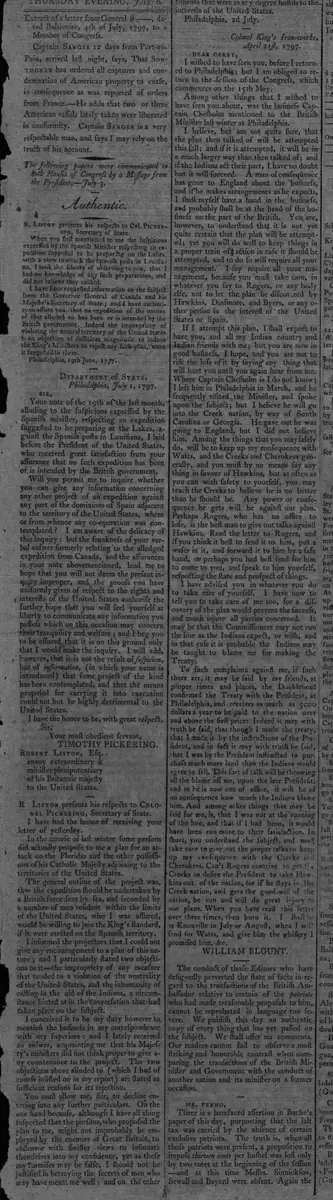
Authentic.
R. Liston presents his respects to Col. Pickering, Secretary of State.
When you first mentioned to me the suspicions expressed by the Spanish Minister respecting an expedition supposed to be preparing on the Lakes, with a view to attack the Spanish posts in Louisiana, I took the liberty of observing to you, that I had no knowledge of any such preparations, and did not believe they existed.
I have since requested information on the subject from the Governor General of Canada and his Majesty's Secretary of State; and I have authority to assure you, that no expedition of the nature of that alluded to has been or is intended by the British government. Indeed the impropriety of violating the neutral territory of the United States an objection of sufficient magnitude to induce the King's Ministers to reject any such plan, were it suggested to them.
Philadelphia, 19th June, 1797.
Department of State,
Philadelphia, July 1, 1797.
SIR,
Your note of the 19th of the last month, alluding to the suspicions expressed by the Spanish minister, respecting an expedition suggested to be preparing at the Lakes, against the Spanish posts in Louisiana, I laid before the President of the United States, who received great satisfaction from your assurance that no such expedition has been or is intended by the British government.
Will you permit me to inquire whether you can give any information concerning any other project of an expedition against any part of the dominions of Spain adjacent to the territory of the United States, where or from whence any co-operation was contemplated? I am aware of the delicacy of this inquiry: but the frankness of your verbal answer formerly relating to the alleged expedition from Canada, and the assurances in your note abovementioned, lead me to hope that you will not deem the present inquiry improper, and the proofs you have uniformly given of respect to the rights and interests of the United States authorize the further hope that you will feel yourself at liberty to communicate any information you possess which on this occasion may concern their tranquility and welfare; and I beg you to be assured that it is on this ground only that I would make the inquiry. I will add, however, that it is not the result of suspicion, but of information, (in which your name is introduced) that some project of the kind has been contemplated, and that the means proposed for carrying it into execution could not but be highly detrimental to the United States.
I have the honor to be, with great respect,
Sir,
Your most obedient servant,
TIMOTHY PICKERING.
Robert Liston, Esq.
envoy extraordinary & minister plenipotentiary of his Britannic majesty to the United States.
R Liston presents his respects to Colonel Pickering, Secretary of State.
I have had the honor of receiving your letter of yesterday.
In the course of last winter some persons did actually propose to me a plan for an attack on the Floridas and the other possessions of his Catholic Majesty adjoining to the territories of the United States.
The general outline of the project was, that the expedition should be undertaken by a British force sent by sea, and seconded by a number of men resident within the limits of the United States, who I was assured, would be willing to join the King's standard, if it were erected on the Spanish territory.
I informed the projectors that I could not give any encouragement to a plan of this nature; and I particularly stated two objections to it-the impropriety of any measure that tended to a violation of the neutrality of the United States, and the inhumanity of calling in the aid of the Indians, a circumstance hinted at in the conversation that had had taken place on the subject.
I conceived it to be my duty however to mention the business in my correspondence with my superiors : and I lately received an answer, acquainting me that his Majesty's ministers did not think proper to give any countenance to the project. The two objections above alluded to (which I had of course insisted on in my report) are stated as sufficient reasons for its rejection.
You must allow me, Sir, to decline entering into any further particulars. On the one hand because, although I have all along suspected that the persons, who proposed the plan to me, might not improbably be employed by the enemies of Great Britain, to endeavor with sinister views to insinuate themselves into my confidence, yet as these my surmises may be false, I should not be justified in betraying the secrets of men who may have meant me well : and on the other hand, because however loose the principles of these speculators may have been on the subject of the law of nations (as it regards the duties of neutrality), none of them in their intercourse with me ever expressed sentiments that were in any degree hostile to the interests of the United States.
Philadelphia, 2d July.
Colonel King's Iron-works,
April 21, 1797.
DEAR CAREY,
I wished to have seen you, before I returned to Philadelphia; but I am obliged to return to the session of the Congress, which commences on the 15th May.
Among other things that I wished to have seen you about, was the business Captain Cheholm mentioned to the British Minister last winter at Philadelphia.
I believe, but am not quite sure, that the plan then talked of will be attempted this fall; and if it is attempted, it will be in a much larger way than then talked of; and if the Indians act their part, I have no doubt but it will succeed. A man of consequence has gone to England about the business, and if he makes arrangements as he expects, I shall myself have a hand in the business, and probably shall be at the head of the business on the part of the British. You are, however, to understand that it is not yet quite certain that the plan will be attempted; yet you will do well to keep things in a proper train of action in case it should be attempted, and to do so will require all your management. I say require all your management, because you must take care, in whatever you say to Rogers, or any body else, not to let the plan be discovered by Hawkins, Dinmore, and Byers, or any other person in the interest of the United States or Spain.
If I attempt this plan, I shall expect to have you, and all my Indian country and Indian friends with me; but you are now in good business, I hope, and you are not to risk the loss of it by saying any thing that will hurt you until you again hear from me.
Where Captain Cheholm is I do not know; I left him in Philadelphia in March, and he frequently visited the Minister, and spoke upon the subject; but I believe he will go into the Creek nation, by way of South Carolina or Georgia. He gave out he was going to England, but I did not believe him. Among the things that you may safely do, will be to keep up my consequence with Watts, and the Creeks and Cherokees generally, and you must by no means say any thing in favour of Hawkins, but as often as you can with safety to yourself, you may teach the Creeks to believe he is no better than he should be. Any power or consequence he gets will be against our plan.
Perhaps Rogers, who has no office to lose, is the best man to give out talks against Hawkins. Read the letter to Rogers, and if you think it best to send it to him, put a wafer in it, and forward it to him by a safe hand, or perhaps you had better send for him to come to you, and speak to him yourself, respecting the state and prospect of things.
I have advised you in whatever you do to take care of yourself. I have now to tell you to take care of me too, for a discovery of the plan would prevent the success, and much injure all parties concerned. It may be that the Commissioners may not run the line as the Indians expect, or wish, and in that case it is probable the Indians may be taught to blame me for making the Treaty.
To such complaints against me, if such there are, it may be said by my friends, at proper times and places, the Doublehead confirmed the Treaty with the President, at Philadelphia, and receives as much as 500 dollars a year to be paid to the nation over and above the first price: Indeed it may with truth be said, that though I made the treaty, that I made it by the instructions of the President, and in fact it may with truth be said, that I was by the President instructed to purchase much more land than the Indians would agree to sell. This sort of talk will be throwing all the blame of me, upon the late President, and as he is now out of office, it will be of no consequence how much the Indians blame him. And among other things that may be said for me, is, that I was not at the running of the line, and that if I had been, it would have been run more to their satisfaction. In short, you understand the subject, and must take care to give out the proper talks to keep up my consequence with the Creeks and Cherokees. Can't Rogers contrive to get the Creeks to desire the President to take Hawkins out of the nation, for if he stays in the Creek nation, and gets the good-will of the nation, he can and will do great injury to our plans. When you have read this letter over three times, then burn it. I shall be at Knoxville in July or August. when I will send for Watts, and give him the whiskey I promised him, &c.
WILLIAM BLOUNT.
What sub-type of article is it?
What keywords are associated?
What entities or persons were involved?
Where did it happen?
Foreign News Details
Primary Location
Louisiana And Floridas
Event Date
1797
Key Persons
Outcome
british government denies involvement in any expeditions against spanish territories; proposed plans rejected due to us neutrality concerns.
Event Details
Diplomatic letters exchanged in Philadelphia between British Minister Liston and US Secretary Pickering address Spanish suspicions of British expeditions from the Lakes against Louisiana posts and proposals for sea-borne attacks on Floridas with US resident and Indian support. Liston assures no such actions intended. Intercepted letter from Blount to Carey outlines a secret plan for British-Indian assault on Spanish possessions, emphasizing secrecy from US and Spanish interests.