Thank you for visiting SNEWPapers!
Sign up free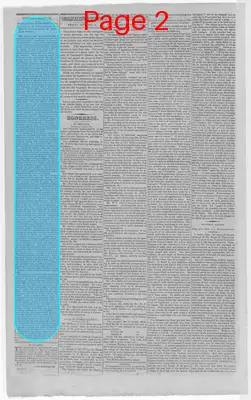
Story
January 30, 1818
Daily National Intelligencer
Washington, District Of Columbia
What is this article about?
In the House of Representatives, Mr. Smyth of Virginia supports Mr. Clay's amendment to commute soldiers' land bounties to money at $1 per acre, arguing it aids soldiers, prevents land speculation in Illinois territory, and boosts treasury revenue by avoiding market oversupply.
Clipping

OCR Quality
98%
Excellent
Full Text
CONGRESSIONAL
OBSERVATIONS OF MR. SMYTH, OF VA.
In the House of Representatives, on the bill for the commutation of Soldiers' Land Bounties.
Mr. Smyth said he preferred the amendment of the honorable Speaker (Mr. Clay) which proposed a commutation in money, to the amendment of the gentleman from Louisiana (Mr. Robertson) which proposed a commutation in stock, if the former could be amended by raising the sum to be given to the soldier for his land to one dollar per acre. The merits of the soldiers had been already amply enforced. They deserved regard, and if we can benefit them, and at the same time greatly promote the public interest, it is expedient to do both. He would, he said, advocate the expediency of passing the bill in the form proposed by the honorable Speaker, with the amendment suggested, on the ground that it would promote the interest of the Illinois territory, and the interest of the treasury.
As to the interest of the Illinois territory, Mr. S. said he would observe, that the accumulation of large quantities of land in the hands of a few persons, he deemed a circumstance most pernicious to the prosperity of any country. He presumed that the gentlemen from Kentucky and Tennessee would be able to confirm that assertion. Where such an accumulation happens, said Mr. S. the lands are kept out of cultivation, and an enormous inequality of landed estate is produced. Experience has proven the superior wisdom of the laws of the United States, which establish the mode of selling the public lands. They are offered as they are wanted—a part at a time, and sold in small quantities, at such a price as prevents engrossing. The lands thus sold are purchased by men who settle on and improve them immediately. But should speculators obtain possession of large quantities of the lands, they will not cultivate them, neither will they sell them immediately; and should they lease the lands, the system of agriculture introduced will be wretched; improvements will be unknown; the people will be abject, and the state will have neither the population nor the resources to which it will be entitled, and which it would have obtained, had the lands been wisely distributed.
The prosperity of the Illinois territory requires that we should, if possible, recover the lands improvidently given away, and that we should adopt that mode of sale best calculated to fill the country with a numerous and industrious people. It is desirable to have a compact population from this place to the Mississippi. The Illinois territory is the only vacancy; and re-purchasing the lands is the only mode likely to produce a dense population in a short time. Neither soldiers nor speculators are well fitted to make new settlements. Should the bill pass, instead of the speculator you will purchase from the soldier, and sell to the settler; but you will do it in a manner more fair and liberal; in short, in a manner dictated by a regard for the public welfare; whereas the speculator, as well in making his purchases as his sales, will be regulated in his conduct solely by the consideration of his own interests.
Let us see, said Mr. S. how the interests of the treasury will be affected. You are selling land; you obtain from the sale a growing revenue; it doubles in about five years. In 1810 you sold lands to the amount of 696,000 dollars; and in the first half of 1815 you sold lands to the amount of 697,000 dollars. Land is the only article you have for sale; and if you think proper, you may be without a competitor in selling unimproved lands. You desire to sell for the price of two dollars per acre, and to have the land settled and improved immediately, thereby to increase your resources. Will you then allow FIVE MILLIONS of acres of the best land to fall into the hands of speculators, at fifty cents per acre? If you do, whatever may be their course, the treasury will be injured. If they sell, they will overstock the market, which you supply; and they will obtain money which you would have obtained. If they hold up the land, they will keep it unproductive, and receive a profit from the rise of its value, which you would have received. And then you will have competitors in the market in selling new lands, which will lessen your revenue from that source. Your interest may be compared to that of a manufacturer, who ought to sacrifice any thing rather than his manufacture, the only article he has for sale. Should he pay for their services with the article which he manufactures his workmen, equally improvident and necessitous as your soldiers, they will sell at a reduced price to dealers, who will undersell the manufacturer. Prudence will instruct him to keep up the article which he manufactures, to prevent its becoming too plenty in the market, and thus to command for it a ready sale, at a good price. Such should be the policy of the government as to new lands. Let us, therefore, preserve our monopoly of the sale of new lands, and use it for the public good. So very important is the object to be attained, that we should make a sacrifice to attain it, if thereby we can benefit the soldier and the territory. But I conceive that, instead of making a sacrifice, we shall benefit the treasury considerably.
The proposition contained in the amendment of the gentleman from Louisiana, to give the soldier six per cent. stock for his land bounty, I disapprove. Those soldiers who reside in the cities, might, perhaps, sell their stock without a loss; but those who reside remote from the cities, would still be preyed upon by speculators, to whom they must and will sell their claims. It is better that we should create stock, if necessary, sell it for the money, and pay the soldier. There is another feature in the amendment of the honorable Speaker, which recommends it to me: the claim of the soldier is made assignable. It was, I conceive, an error ever to have declared that the claim of the soldier should not be assignable; for if any property is made inalienable, or any security for money declared not to be assignable, the one or the other will unquestionably be of less value than if made alienable or assignable. The soldier will sell his claim; and every obstacle which shall be thrown in the way of the purchaser, will have no other effect than to reduce the price which will be received by the soldier. The speculator will indemnify himself for the risk or loss in some cases, by offering a smaller price for the claim of the soldier. Mr. S. concluded by expressing a hope that the amendment of the gentleman from Louisiana would be rejected, and that, with the amendment which he had suggested, the bill would pass.
OBSERVATIONS OF MR. SMYTH, OF VA.
In the House of Representatives, on the bill for the commutation of Soldiers' Land Bounties.
Mr. Smyth said he preferred the amendment of the honorable Speaker (Mr. Clay) which proposed a commutation in money, to the amendment of the gentleman from Louisiana (Mr. Robertson) which proposed a commutation in stock, if the former could be amended by raising the sum to be given to the soldier for his land to one dollar per acre. The merits of the soldiers had been already amply enforced. They deserved regard, and if we can benefit them, and at the same time greatly promote the public interest, it is expedient to do both. He would, he said, advocate the expediency of passing the bill in the form proposed by the honorable Speaker, with the amendment suggested, on the ground that it would promote the interest of the Illinois territory, and the interest of the treasury.
As to the interest of the Illinois territory, Mr. S. said he would observe, that the accumulation of large quantities of land in the hands of a few persons, he deemed a circumstance most pernicious to the prosperity of any country. He presumed that the gentlemen from Kentucky and Tennessee would be able to confirm that assertion. Where such an accumulation happens, said Mr. S. the lands are kept out of cultivation, and an enormous inequality of landed estate is produced. Experience has proven the superior wisdom of the laws of the United States, which establish the mode of selling the public lands. They are offered as they are wanted—a part at a time, and sold in small quantities, at such a price as prevents engrossing. The lands thus sold are purchased by men who settle on and improve them immediately. But should speculators obtain possession of large quantities of the lands, they will not cultivate them, neither will they sell them immediately; and should they lease the lands, the system of agriculture introduced will be wretched; improvements will be unknown; the people will be abject, and the state will have neither the population nor the resources to which it will be entitled, and which it would have obtained, had the lands been wisely distributed.
The prosperity of the Illinois territory requires that we should, if possible, recover the lands improvidently given away, and that we should adopt that mode of sale best calculated to fill the country with a numerous and industrious people. It is desirable to have a compact population from this place to the Mississippi. The Illinois territory is the only vacancy; and re-purchasing the lands is the only mode likely to produce a dense population in a short time. Neither soldiers nor speculators are well fitted to make new settlements. Should the bill pass, instead of the speculator you will purchase from the soldier, and sell to the settler; but you will do it in a manner more fair and liberal; in short, in a manner dictated by a regard for the public welfare; whereas the speculator, as well in making his purchases as his sales, will be regulated in his conduct solely by the consideration of his own interests.
Let us see, said Mr. S. how the interests of the treasury will be affected. You are selling land; you obtain from the sale a growing revenue; it doubles in about five years. In 1810 you sold lands to the amount of 696,000 dollars; and in the first half of 1815 you sold lands to the amount of 697,000 dollars. Land is the only article you have for sale; and if you think proper, you may be without a competitor in selling unimproved lands. You desire to sell for the price of two dollars per acre, and to have the land settled and improved immediately, thereby to increase your resources. Will you then allow FIVE MILLIONS of acres of the best land to fall into the hands of speculators, at fifty cents per acre? If you do, whatever may be their course, the treasury will be injured. If they sell, they will overstock the market, which you supply; and they will obtain money which you would have obtained. If they hold up the land, they will keep it unproductive, and receive a profit from the rise of its value, which you would have received. And then you will have competitors in the market in selling new lands, which will lessen your revenue from that source. Your interest may be compared to that of a manufacturer, who ought to sacrifice any thing rather than his manufacture, the only article he has for sale. Should he pay for their services with the article which he manufactures his workmen, equally improvident and necessitous as your soldiers, they will sell at a reduced price to dealers, who will undersell the manufacturer. Prudence will instruct him to keep up the article which he manufactures, to prevent its becoming too plenty in the market, and thus to command for it a ready sale, at a good price. Such should be the policy of the government as to new lands. Let us, therefore, preserve our monopoly of the sale of new lands, and use it for the public good. So very important is the object to be attained, that we should make a sacrifice to attain it, if thereby we can benefit the soldier and the territory. But I conceive that, instead of making a sacrifice, we shall benefit the treasury considerably.
The proposition contained in the amendment of the gentleman from Louisiana, to give the soldier six per cent. stock for his land bounty, I disapprove. Those soldiers who reside in the cities, might, perhaps, sell their stock without a loss; but those who reside remote from the cities, would still be preyed upon by speculators, to whom they must and will sell their claims. It is better that we should create stock, if necessary, sell it for the money, and pay the soldier. There is another feature in the amendment of the honorable Speaker, which recommends it to me: the claim of the soldier is made assignable. It was, I conceive, an error ever to have declared that the claim of the soldier should not be assignable; for if any property is made inalienable, or any security for money declared not to be assignable, the one or the other will unquestionably be of less value than if made alienable or assignable. The soldier will sell his claim; and every obstacle which shall be thrown in the way of the purchaser, will have no other effect than to reduce the price which will be received by the soldier. The speculator will indemnify himself for the risk or loss in some cases, by offering a smaller price for the claim of the soldier. Mr. S. concluded by expressing a hope that the amendment of the gentleman from Louisiana would be rejected, and that, with the amendment which he had suggested, the bill would pass.
What sub-type of article is it?
Historical Event
What themes does it cover?
Justice
Moral Virtue
What keywords are associated?
Soldiers Land Bounties
Congressional Debate
Land Speculation
Illinois Territory
Treasury Revenue
What entities or persons were involved?
Mr. Smyth
Mr. Clay
Mr. Robertson
Where did it happen?
House Of Representatives
Story Details
Key Persons
Mr. Smyth
Mr. Clay
Mr. Robertson
Location
House Of Representatives
Event Date
1815
Story Details
Mr. Smyth advocates for a bill amending soldiers' land bounties to $1 per acre in money, opposing stock commutation, to prevent speculation, promote settlement in Illinois territory, and protect treasury revenue from land sales.