Thank you for visiting SNEWPapers!
Sign up free
Story
November 19, 1866
The Daily Empire
Dayton, Montgomery County, Ohio
What is this article about?
A Northern gentleman's account of severe crop failures in North Alabama due to weather and labor issues, leading to economic hardship, food scarcity, and potential famine in the post-war South.
Clipping
OCR Quality
95%
Excellent
Full Text
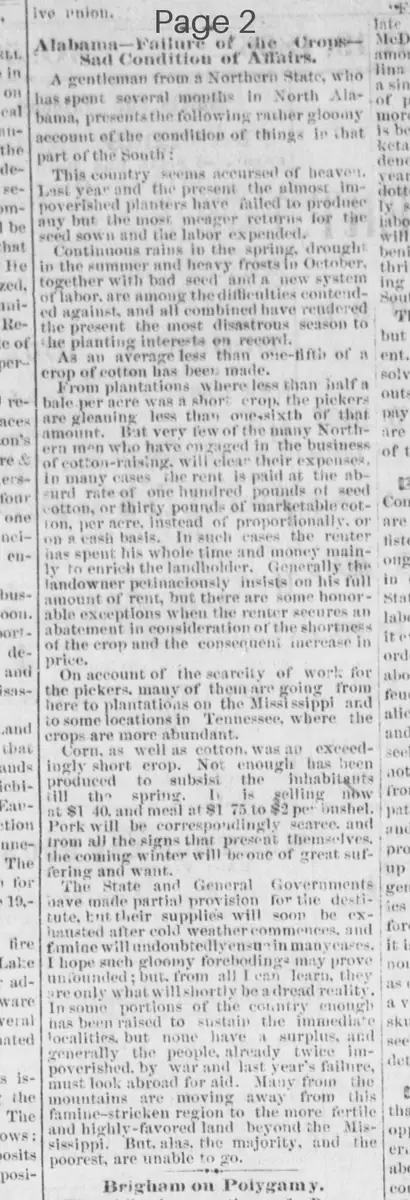
Alabama—Failure of the Crops—Sad Condition of Affairs.
A gentleman from a Northern State, who has spent several months in North Alabama, presents the following rather gloomy account of the condition of things in that part of the South:
This country seems accursed of heaven. Last year and the present the almost impoverished planters have failed to produce any but the most meager returns for the seed sown and the labor expended. Continuous rains in the spring, drought in the summer and heavy frosts in October, together with bad seed and a new system of labor, are among the difficulties contended against, and all combined have rendered the present the most disastrous season to the planting interests on record.
As an average less than one-fifth of a crop of cotton has been made. From plantations where less than half a bale per acre was a short crop, the pickers are gleaning less than one-sixth of that amount. But very few of the many Northern men who have engaged in the business of cotton-raising, will clear their expenses. In many cases the rent is paid at the absurd rate of one hundred pounds of seed cotton, or thirty pounds of marketable cotton, per acre. Instead of proportionally, or on a cash basis. In such cases the renter has spent his whole time and money mainly to enrich the landholder. Generally the landowner pertinaciously insists on his full amount of rent, but there are some honorable exceptions when the renter secures an abatement in consideration of the shortness of the crop and the consequent increase in price.
On account of the scarcity of work for the pickers, many of them are going from here to plantations on the Mississippi and to some locations in Tennessee, where the crops are more abundant.
Corn, as well as cotton, was an exceedingly short crop. Not enough has been produced to subsist the inhabitants until the spring. It is selling now at $1.40, and meal at $1.75 to $2 per bushel. Pork will be correspondingly scarce, and from all the signs that present themselves, the coming winter will be one of great suffering and want.
The State and General Governments have made partial provision for the destitute, but their supplies will soon be exhausted after cold weather commences, and famine will undoubtedly ensue in many cases. I hope such gloomy forebodings may prove unfounded; but, from all I can learn, they are only what will shortly be a dread reality.
In some portions of the country enough has been raised to sustain the immediate localities, but none have a surplus, and generally the people, already twice impoverished, by war and last year's failure, must look abroad for aid. Many from the mountains are moving away from this famine-stricken region to the more fertile and highly-favored land beyond the Mississippi. But, alas, the majority, and the poorest, are unable to go.
A gentleman from a Northern State, who has spent several months in North Alabama, presents the following rather gloomy account of the condition of things in that part of the South:
This country seems accursed of heaven. Last year and the present the almost impoverished planters have failed to produce any but the most meager returns for the seed sown and the labor expended. Continuous rains in the spring, drought in the summer and heavy frosts in October, together with bad seed and a new system of labor, are among the difficulties contended against, and all combined have rendered the present the most disastrous season to the planting interests on record.
As an average less than one-fifth of a crop of cotton has been made. From plantations where less than half a bale per acre was a short crop, the pickers are gleaning less than one-sixth of that amount. But very few of the many Northern men who have engaged in the business of cotton-raising, will clear their expenses. In many cases the rent is paid at the absurd rate of one hundred pounds of seed cotton, or thirty pounds of marketable cotton, per acre. Instead of proportionally, or on a cash basis. In such cases the renter has spent his whole time and money mainly to enrich the landholder. Generally the landowner pertinaciously insists on his full amount of rent, but there are some honorable exceptions when the renter secures an abatement in consideration of the shortness of the crop and the consequent increase in price.
On account of the scarcity of work for the pickers, many of them are going from here to plantations on the Mississippi and to some locations in Tennessee, where the crops are more abundant.
Corn, as well as cotton, was an exceedingly short crop. Not enough has been produced to subsist the inhabitants until the spring. It is selling now at $1.40, and meal at $1.75 to $2 per bushel. Pork will be correspondingly scarce, and from all the signs that present themselves, the coming winter will be one of great suffering and want.
The State and General Governments have made partial provision for the destitute, but their supplies will soon be exhausted after cold weather commences, and famine will undoubtedly ensue in many cases. I hope such gloomy forebodings may prove unfounded; but, from all I can learn, they are only what will shortly be a dread reality.
In some portions of the country enough has been raised to sustain the immediate localities, but none have a surplus, and generally the people, already twice impoverished, by war and last year's failure, must look abroad for aid. Many from the mountains are moving away from this famine-stricken region to the more fertile and highly-favored land beyond the Mississippi. But, alas, the majority, and the poorest, are unable to go.
What sub-type of article is it?
Historical Event
Disaster
Curiosity
What themes does it cover?
Catastrophe
Misfortune
Survival
What keywords are associated?
Crop Failure
Cotton Shortage
Corn Scarcity
Famine
North Alabama
Post War Poverty
Labor Migration
What entities or persons were involved?
Gentleman From A Northern State
Where did it happen?
North Alabama
Story Details
Key Persons
Gentleman From A Northern State
Location
North Alabama
Event Date
Last Year And The Present
Story Details
Crop failures in cotton and corn due to adverse weather, bad seed, and new labor system lead to meager yields, high prices, economic hardship for planters and renters, labor migration, food scarcity, and impending famine in North Alabama, with some seeking aid or relocating.