Thank you for visiting SNEWPapers!
Sign up free
Atlanta Daily World
Atlanta, Fulton County, Georgia
What is this article about?
At the 97th Emancipation Proclamation anniversary in Atlanta, Attorney A. T. Walden urges Negro progress through better housing, youth excellence, and lawful pursuit of equal rights. Rev. Samuel W. Williams takes NAACP presidency, emphasizing cooperation on desegregation and housing disputes. (248 characters)
Merged-components note: Continuation of article across pages based on text content and explicit 'Continued from Page One' indicator.
Clippings
1 of 2
OCR Quality
Full Text
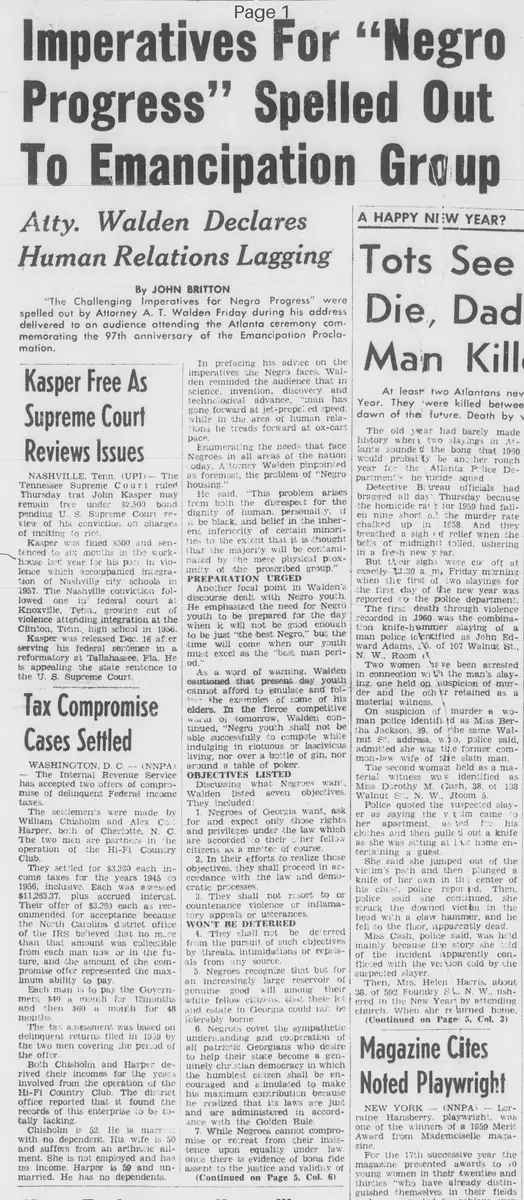
Attorney A. T. Walden Declares A HAPPY NEW YEAR?
"The Challenging Imperatives for Negro Progress" were spelled out by Attorney A. T. Walden Friday during his address delivered to an audience attending the Atlanta ceremony commemorating the 97th anniversary of the Emancipation Proclamation.
In prefacing his advice on the imperatives the Negro faces, Walden reminded the audience that in science, invention, discovery and technological advance, "man has gone forward at jet-propelled speed, while in the area of human relations he treads forward at ox-cart pace."
Enumerating the needs that face Negroes in all areas of the nation today, Attorney Walden pinpointed as foremost, the problem of "Negro housing."
He said, "This problem arises from both the disrespect for the dignity of human personality of being black, and belief in the inherent inferiority of certain minorities to the extent that it is thought that the majority will be contaminated by the mere physical proximity of the proscribed group."
PREPARATION URGED
Another focal point in Walden's discourse dealt with Negro youth.
He emphasized the need for Negro youth to be prepared for the day when it will not be good enough to be just the best Negro," but the time will come when our youth must excel as the "best man period."
As a word of warning, Walden cautioned that present day youth cannot afford to emulate and follow the examples of some of his elders. In the fierce competitive world of tomorrow, Walden continued, "Negro youth shall not be able successfully to compete while indulging in riotous or lascivious living, nor over a bottle of gin, nor around a table of poker."
OBJECTIVES LISTED
Discussing what Negroes want, Walden listed seven objectives.
They included:
1. Negroes of Georgia want, ask for and expect only those rights and privileges under the law which are accorded to their fellow citizens as a matter of course.
2. In their efforts to realize these objectives, they shall proceed in accordance with the law and democratic processes.
3. They shall not resort to or countenance violence or inflammatory appeals or utterances.
WON'T BE DETERRED
4. They shall not be deterred from the pursuit of such objectives by threats, intimidations or reprisals from any source.
5. Negroes recognize that but for an increasingly large reservoir of genuine good will among their white fellow citizens, that their lot and estate in Georgia could not be tolerably borne.
6. Negroes covet the sympathetic understanding and cooperation of all patriotic Georgians who desire to help their state become a genuinely Christian democracy in which the humblest citizen shall be encouraged and stimulated to make his maximum contribution because he realizes that its laws are just and are administered in accordance with the Golden Rule.
7. While Negroes cannot compromise or retreat from their insistence upon equality under law once there is evidence of bona fide assent to the justice and validity of the demands there shall immediately be available open areas and lands for negotiation and collective efforts to determine the best means and techniques by which the desired objective may be attained without any real detriment to any segment of our citizenry.
Imperatives For
(Continued from Page One)
VOTER AID PINPOINTED
Walden told the audience that one most urgent thing for them to do was to aid in putting on the rolls the right some 50,000 persons who should be joining the present 31,000 persons in the continuing fight for freedom.
Other urgent needs as listed by Walden included:
1. Giving moral and financial support to the National Association for the Advancement of Colored People the organization which for 50 years has carried the torchbearer of liberty for the many disadvantaged Negro Americans.
2. The willingness to carry your fair share of civic responsibilities by the contribution of your means and services.
3. Zone our electorate resource in order to build up and strengthen our economic power, which should be made to provide opportunities for youth and afford a sound financial basis for expanding Negro business.
Walden warned Atlanta: "Get your home in order while there is time. It may be later than you think."
During the meeting held at the Wheat Street Baptist Church Friday, the local Atlanta Branch NAACP officers were joined by Bishop J. W. E. Bowen, of the Methodist Episcopal Church.
WILLIAMS ACCEPTS CHALLENGE
In accepting the challenge to lead the fight for equality in 1960, incoming NAACP president, Rev. Samuel W. Williams pleaded for two main things from the organization and the general public.
These two things as he listed them were cooperation and coordination.
He called for a continuing fight for justice in the current problems now facing Atlanta the public housing dispute and school desegregation.
Of desegregation, Rev. Williams recalled that the state had never attempted to do anything but create "separate" schools under the now illegal "separate but equal" doctrine. He said nothing was ever done toward making all schools equal.
Others who attended the meeting Friday afternoon were Revs. E. K. Seay, pastor of Second Mt. Zion Baptist Church, Rev. Amos Holmes NAACP field secretary for Georgia Big Bethel Church Atlanta Youth Council John Wesley Dobbs grandmaster, Prince Hall Mason, Warren Cochran executive director, Butler St YMCA and Bishop J. W. Honey, of the Church of God in Christ. The association president Rev H. I. Bearden presided.
What sub-type of article is it?
What themes does it cover?
What keywords are associated?
What entities or persons were involved?
Where did it happen?
Story Details
Key Persons
Location
Atlanta, Georgia, Wheat Street Baptist Church
Event Date
1960
Story Details
Attorney A. T. Walden addresses Emancipation Proclamation anniversary, outlining imperatives for Negro progress including housing, youth preparation, and seven objectives for equality. Rev. Samuel W. Williams accepts NAACP leadership, calling for cooperation on desegregation and housing issues.