Thank you for visiting SNEWPapers!
Sign up free
The New Hampshire Gazette
Portsmouth, Rockingham County, New Hampshire
What is this article about?
US Senate committee report on British and French violations of neutral US commerce through orders, decrees, and blockades during their war, including the Chesapeake attack. Recommends maintaining embargo with executive power to suspend if belligerents ease restrictions.
Clipping
OCR Quality
Full Text
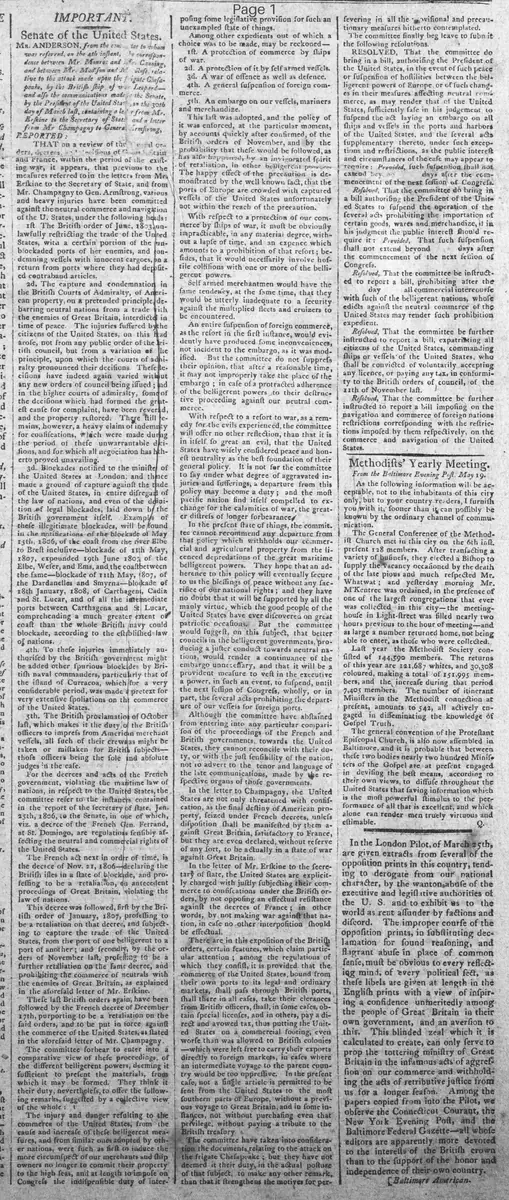
MR. ANDERSON, from the committee to whom
was referred, on the 8th instant, the correspondence
between Mr. Monroe and Mr. Canning,
and between Mr. Madison and Mr. Rose, relative
to the attack made upon the frigate Chesapeake,
by the British ship of war Leopard;
and also the communications made to the Senate,
by the President of the United States on the 30th
day of March last, containing a letter from Mr.
Erskine to the Secretary of State: and a letter
from Mr. Champagny to General Armstrong,
REPORTED:
THAT on a review of the several orders,
decrees, and edicts of Great Britain
and France, within the period of the existing
war, it appears, that previous to the
measures referred to in the letters from Mr.
Erskine to the Secretary of State, and from
Mr. Champagny to Gen. Armstrong, various
and heavy injuries have been committed
against the neutral commerce and navigation
of the U. States, under the following heads:
1st. The British order of June, 1803, unlawfully
restricting the trade of the United
States, with a certain portion of the unblockaded
ports of her enemies, and condemning
vessels with innocent cargoes, on a
return from ports where they had deposited
contraband articles.
2d. The capture and condemnation in
the British Courts of Admiralty, of American
property, on a pretended principle debaring
neutral nations from a trade with
the enemies of Great Britain, interdicted in
time of peace. The injuries suffered by the
citizens of the United States, on this head
arose, not from any public order of the British
council, but from a variation of the
principle, upon which the courts of admiralty
pronounced their decisions. These decisions
have indeed again varied without
any new orders of council being issued; and
in the higher courts of admiralty, some of
the decisions which had formed the greatest
cause for complaint, have been reversed,
and the property restored. There still remains,
however, a heavy claim of indemnity
for confiscations, which were made during
the period of these unwarrantable decisions,
and for which all negociation has hitherto
proved unavailing.
3d. Blockades notified to the minister of
the United States at London, and thence
made a ground of capture against the trade
of the United States, in entire disregard of
the law of nations, and even of the definition of legal blockades, laid down by the
British government itself. Examples of
these illegitimate blockades, will be found
in the notifications of the blockade of May
16th, 1806, of the coast from the river Elbe
to Brest inclusive-blockade of 21st May,
1807, extended 21st June 1807 of the
Elbe, Weser, and Ems, and the coast between
the same-blockade of 11th May. 1807, of
the Dardanelles and Smyrna--blockade of
21st January, 1808, of Carthagena, Cadiz
and St. Lucar, and of all the intermediate
ports between Carthagena and St Lucar,
comprehending a much greater extent of
coast than the whole British navy could
blockade, according to the established law
of nations.
4th. To these injuries immediately authorised
by the British government might
be added other spurious blockades by British
naval commanders, particularly that of
the island of Curacoa, which/for a very
considerable period, was made a pretext for
very extensive depredations on the commerce
of the United States.
5th. The British proclamation of October
16th, 1807, which makes it the duty'of the British
officers to impress from American merchant
vessels, all such of their crews as might be
taken or mistaken for British subjects--
those officers being the sole and absolute
judges in the case.
For the decrees and acts of the French
government, violating the maritime law of
nations, in respect to the United States, the
committee refer to the instances contained
in the report of the secretary of state, Jan.
25th, 1806, to the Senate, in one of which,
viz. a decree of the French Gen. Ferrand,
at St. Domingo, are regulations eminently affecting
the neutral and commercial rights of
the United States.
The French act next in order of time, is
the decree of Nov. 21, 1806-declaring the
British isles in a state of blockade, and professing
to be a retaliation, on antecedent
proceedings of Great Britain, violating the
law of nations.
This decree was followed, first by the British
order of January, 1807, professing to
be a retaliation on that decree, and subjecting
to capture the trade of the United
States, from the port of one belligerent to a
port of another; and secondly, by the orders
of November 11th, professing to be a
further retaliation on the same decree, and
prohibiting the commerce of neutrals with
the enemies of Great Britain, as explained
in the aforesaid letter of Mr. Erskine.
These last British orders again, have been
followed by the French decree of December
17th, purporting to be a retaliation on the
said orders, and to be put in force against
the commerce of the United States, as stated
in the aforesaid letter of Mr. Champagny.
The committee forbear to enter into a
comparative view of these proceedings, of
the different belligerent powers, deeming it
sufficient to present the materials, from
which it may be formed. They think it
their duty, nevertheless, to offer the following
remarks, suggested by a collective view
of the whole :
1
The injury and danger resulting to the
commerce of the United States, from the
cause and increase of these belligerent measures,
and from similar ones adopted by other
nations, were such as first to induce the
more circumspect of our merchants and ship
owners no longer to commit their property
to the high seas, and at length to impose on
Congress the indispensable duty of interposing
some legislative provision for such an
unexampled state of things.
Among other expedients out of which a
choice was to be made, may be reckoned-
1st. A protection of commerce by ships
of war.
2d. A protection of it by self armed vessels.
3d. A war of offence as well as defence.
4th. A general suspension of foreign commerce.
5th. An embargo on our vessels, mariners
and merchandize.
This last was adopted, and the policy of
it was enforced, at the particular moment,
by accounts quickly after confirmed, of the
British orders of November, and by the
probability that these would be followed, as
has also happened, by an invigorated spirit
of retaliation, in other belligerent powers.
The happy effect of the precaution is demonstrated
by the well known fact, that the
ports of Europe are crowded with captured
vessels of the United States unfortunately
not within the reach of the precaution.
With respect to a protection of our commerce
by ships of war, it must be obviously
impracticable, in any material degree, without
a lapse of time, and an expence which
amounts to a prohibition of that resort; besides,
that it would necessarily involve hostile
collisions with one or more of the belligerents.
Self armed merchantmen would have the
same tendency, at the same time, that they
would be utterly inadequate to a security
against the multiplied fleets and cruizers to
be encountered.
An entire suspension of foreign commerce,
as the resort in the first instance, would evidently
have produced some inconveniences,
not incident to the embargo, as it was modified.
But the committee do not suppress
their opinion, that after a reasonable time,
it may not improperly take the place of the
embargo ; in case of a protracted adherence
of the belligerent powers to their destructive
proceeding against our neutral commerce.
With respect to a resort to war, as a remedy
for the evils experienced, the committee
will offer no other reflection, than that it is
in itself so great an evil, that the United
States have wisely considered peace and bona
fide neutrality as the best foundation of their
general policy. It is not for the committee
to say under what degree of aggravated injuries
and sufferings, a departure from this
policy may become a duty; and the most
pacific nation find itself compelled to exchange
for the calamities of war, the greater
distresses of longer forbearance.
In the present state of things, the committee
cannot recommend any departure from
that policy which withholds our commercial
and agricultural property from the licensed
depredations of the great maritime
belligerent powers. They hope that an adherence
to this policy will eventually secure
to us the blessings of peace without any sacrifice
of our national rights; and they have
no doubt that it will be supported by all the
manly virtue, which the good people of the
United States have ever discovered on great
patriotic occasions. But the committee
would suggest, on this subject, that better
councils in the belligerent governments, producing
a juster conduct towards neutral nations,
would render a continuance of the
embargo unnecessary, and that it will be a
provident measure to vest in the executive
a power, in such an event, to suspend, until
the next session of Congress, wholly, or in
part, the several acts prohibiting the departure
of our vessels for foreign ports.
Although the committee have abstained
from entering into any particular comparison
of the proceedings of the French and
British governments, towards the United
States, they cannot reconcile with their duty,
or with the just sensibility of the nation,
not to advert to the tenor and language of
the late communications, made by the respective
organs of those governments.
In the letter to Champagny, the United
States are not only threatened with confiscation,
as the final destiny of American property,
seized under French decrees, unless
disposition shall be manifested by them against
Great Britain, satisfactory to France,
but they are even declared, without reserve
of any sort, to be actually in a state of war
against Great Britain.
In the letter of Mr. Erskine to the secretary
of state, the United States are explicitly
charged with justly subjecting their commerce
to confiscations under the British orders,
by not opposing an effectual resistance
against the decrees of France; in other
words, by not making war against that nation,
in case no other interposition should
be effectual.
There are in this exposition of the British
orders, certain features, which claim particular
attention ; among the regulations of
which they consist, it is provided that the
commerce of the United States, bound from
their own ports to its legal and ordinary
markets, shall pass through British ports,
shall there in all cases, take their clearances
from British officers, shall, in some cases, obtain
special licenses, and in others, pay a direct
and avowed tax, thus putting the United
States on a commercial footing, even
worse than was allowed to British colonies
--which were left free to carry their exports
directly to foreign markets, in cases where
an intermediate voyage to the parent country
would be too oppressive. In the present
case, not a single article is permitted to be
sent from the United States to the most
southern parts of Europe, without a previous
voyage to Great Britain, and in some instances,
not without purchasing even that
privilege, without paying a tribute to the
British treasury.
The committee have taken into consideration
the documents relating to the attack on
the frigate Chesapeake ; but they have not
deemed it their duty, in the actual posture
of that subject, to make any other remark,
than that it strengthens the motives for persevering
in all the provisional and precautionary
measures hitherto contemplated.
The committee finally beg leave to submit
the following resolutions.
RESOLVED, That the committee do
bring in a bill, authorising the President of
the United States, in the event of such peace
or suspension of hostilities between the belligerent
powers of Europe, or of such changes
in their measures affecting neutral commerce,
as may render that of the United
States, sufficiently safe in his judgement to
suspend the act laying an embargo on all
ships and vessels in the ports and harbors
of the United States, and the several acts
supplementary thereto, under such exceptions
and restrictions, as the public interest
and circumstances of the case may appear to
require: Provided, such suspension shall not
extend beyond
90
days after the commencement
of the next session of Congress.
Resolved, That the committee do bring in
a bill authorising the President of the United
States to suspend the operation of the
several acts prohibiting the importation of
certain goods, wares and merchandize, if in
his judgment the public interest should require
it: Provided, That such suspension
shall not extend beyond 90 days after
the commencement of the next session of
Congress.
Resolved, That the committee be instructed
to report a bill, prohibiting after the
21st day
all commercial intercourse
with such of the belligerent nations, whose
edicts against the neutral commerce of the
United States may render such prohibition
expedient.
Resolved, That the committee be further
instructed to report a bill, expatriating all
citizens of the United States, commanding
ships or vessels'of the United States, who
shall be convicted of voluntarily accepting
any licence, or paying any tax, in conformity
to the British orders of council, of the
11th of November last
Resolved, That the committee be further
instructed to report a bill imposing on the
navigation and commerce of foreign nations
restrictions corresponding with the restrictions
imposed by them respectively, on the
commerce and navigation of the United
States.
What sub-type of article is it?
What keywords are associated?
What entities or persons were involved?
Where did it happen?
Foreign News Details
Primary Location
Great Britain And France
Event Date
March 30, 1808
Key Persons
Outcome
heavy injuries to us neutral commerce including captures, condemnations, and blockades; us response via embargo with provisions for suspension; recommendations for retaliatory bills against belligerents.
Event Details
Senate committee reviews correspondence on Chesapeake attack and belligerent edicts violating US neutral rights, listing British orders from 1803-1808 and French decrees from 1806-1807; discusses embargo policy, rejects war, and proposes bills for presidential suspension powers and restrictions on commerce with violators.