Thank you for visiting SNEWPapers!
Sign up free
The Denison Review
Denison, Dow City, Crawford County, Iowa
What is this article about?
Republican leaders launch Iowa campaign on October 7, 1899, in most districts, delivering speeches endorsing McKinley's Philippine and gold standard policies, addressing trusts, and touting state prosperity and debt reduction. Meetings postponed in two districts due to ex-Senator Harlan's death.
Clipping
OCR Quality
Full Text
Republicans Begin Speaking Campaign in All But Two Districts.
Des Moines, Oct. 9. - The Republican campaign in Iowa opened Saturday in all of the congressional districts except the Eleventh and First. In the latter Dolliver's meeting at Mount Pleasant was postponed out of respect for the memory of ex-Senator Harlan. No meeting was arranged for the Eleventh district at this time. Meetings were held as follows: Senator Allison at Marion, Hon. A. B. Cummins at Charles City, Senator Gear at West Liberty, Congressman Henderson at Waterloo, J. C. Burrows also spoke; Congressman Lacey and Hon. George D. Perkins at Grinnell, Congressman Hull at Indianola, Hon. Charles B. Landis of Indiana at Des Moines, Congressmen McPherson and Hepburn at Shenandoah, Governor Shaw and Secretary of State Dobson at Jefferson, Treasurer of State John Herriott at Stuart. The keynotes were support of the president's Philippine policy and enactment by congress of a gold standard law.
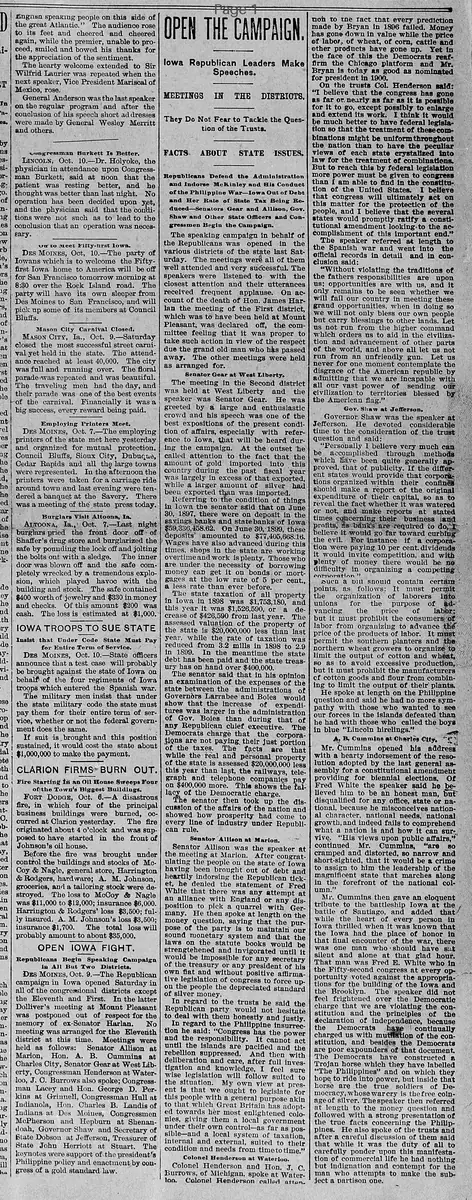
OPEN THE CAMPAIGN.
Iowa Republican Leaders Make Speeches.
MEETINGS IN THE DISTRICTS.
They Do Not Fear to Tackle the Question of the Trusts.
FACTS ABOUT STATE ISSUES.
Republicans Defend the Administration and Indorse McKinley and His Conduct of the Philippine War - Iowa Out of Debt and Her Rate of State Tax Being Reduced - Senators Gear and Allison, Gov. Shaw and Other State Officers and Congressmen Begin the Campaign.
The speaking campaign in behalf of the Republicans was opened in the various districts of the state last Saturday. The meetings were all of them well attended and very successful. The speakers were listened to with the closest attention and their utterances received frequent applause. On account of the death of Hon. James Harlan the meeting of the First district, which was to have been held at Mount Pleasant, was declared off, the committee feeling that it was proper to take such action in view of the respect due the grand old man who has passed away. The other meetings were held as arranged for.
Senator Gear at West Liberty
The meeting in the Second district was held at West Liberty and the speaker was Senator Gear. He was greeted by a large and enthusiastic crowd and his speech was one of the best expositions of the present condition of affairs, especially with reference to Iowa, that will be heard during the campaign. At the outset he called attention to the fact that the amount of gold imported into this country during the past fiscal year was largely in excess of that exported, while a larger amount of silver had been exported than was imported. Referring to the condition of things in Iowa the senator said that on June 30, 1897, there were on deposit in the savings banks and state banks of Iowa $59,336,458.62. On June 30, 1899, these deposits amounted to $77,405,668.16. Wages have also advanced during this time, shops in the state are working overtime and work is plenty. Those who are under the necessity of borrowing money can get it on bonds or mortgages at the low rate of 5 per cent., a less rate than ever before. The state taxation of all property in Iowa in 1898 was $1,753,180, and this year it was $1,526,590, or a decrease of $226,590 from last year. The assessed valuation of the property of the state is $20,000,000 less than last year, while the rate of taxation was reduced from 3.2 mills in 1898 to 2.9 in 1899. In the meantime the state debt has been paid and the state treasury has on hand over $400,000. The senator said that in his opinion an examination of the expenses of the state between the administrations of Governors Larrabee and Boies would show that the increase of expenditures was larger in the administration of Gov. Boies than during that of any Republican chief executive. The Democrats charge that the corporations are not paying their just portion of the taxes. The facts are that while the real and personal property of the state is assessed $20,000,000 less this year than last, the railways, telegraph and telephone companies pay on $400,000 more. This shows the fallacy of the Democratic charge. The senator then took up the discussion of the affairs of the nation and showed how prosperity had come to every line of industry under Republican rule.
Senator Allison at Marion.
Senator Allison was the speaker at the meeting at Marion. After congratulating the people on the state of Iowa having been brought out of debt and heartily indorsing the Republican ticket, he denied the statement of Fred White that there was any attempt at an alliance with England or any disposition to pick a quarrel with Germany. He then spoke at length on the money question, saying that the purpose of the party is to maintain our sound monetary system and that the laws on the statute books would be strengthened and invigorated until it would be impossible for any secretary of the treasury or any president of his own fiat and without positive affirmative legislation of congress to force upon the people the depreciated standard of silver money. In regard to the trusts he said the Republican party would not hesitate to deal with them honestly and justly. In regard to the Philippine insurrection he said: "Congress has the power and the responsibility. It cannot act until the islands are pacified and the rebellion suppressed. And then with deliberation and care, after full investigation and knowledge, I feel sure wise legislation will follow suited to the situation. My own view at present is that we ought to legislate for this people with a general purpose akin to that which Great Britain has adopted towards her most enlightened colonies, giving them a local government under their own control - as far as possible - and a local system of taxation, internal and external, suited to their condition and needs from time to time."
Colonel Henderson at Waterloo.
Colonel Henderson and Hon. J. C. Burrows, of Michigan, spoke at Waterloo. Colonel Henderson called attention to the fact that every prediction made by Bryan in 1896 failed. Money has gone down in value while the price of labor, of wheat, of corn, cattle and other products have gone up. Yet in the face of this the Democrats reaffirm the Chicago platform and Mr. Bryan is today as good as nominated for president in 1900. On the trusts Col. Henderson said: "I believe that the congress has gone as far or nearly as far as it is possible for it to go, except possibly to enlarge and extend its work. I think it would be much better to have federal legislation so that the treatment of these combinations might be uniform throughout the nation than to have the peculiar views of each state crystallized into law for the treatment of combinations. But to reach this by federal legislation more power must be given to congress than I am able to find in the constitution of the United States. I believe that congress will ultimately act on this matter for the protection of the people, and I believe that the several states would promptly ratify a constitutional amendment looking to the accomplishment of this important end." The speaker referred at length to the Spanish war and went into the official records in detail and in conclusion said: "Without violating the traditions of the fathers responsibilities are upon us; opportunities are with us, and it only remains to be seen whether we will fail our country in meeting these grand opportunities, when in doing so we will not only bless our own people but carry blessings to other lands. Let us not run from the higher command which orders us to aid in the civilization and advancement of other parts of the world, and above all let us not run from an unfriendly gun. Let us never for one moment contemplate the disgrace of the American republic by admitting that we are incapable with all our vast power of sending our civilization to territories blessed by the American flag."
Gov. Shaw at Jefferson.
Governor Shaw was the speaker at Jefferson. He devoted considerable time to the consideration of the trust question and said "Personally I believe very much can be accomplished through methods which have been quite generally approved, that of publicity. If the different states would provide that corporations organized within their confines should make a report of the original expenditure of their capital, so as to reveal the fact whether it was watered or not, and make reports at stated times concerning their business and profits, as banks are required to do I believe it would go far toward curbing the evil. For instance if a corporation were paying 10 per cent. dividends it would invite competition, and with plenty of money there would be no difficulty in organizing a competing corporation." Such a plan should contain certain points, as follows: It must permit the organization of laborers into unions for the purpose of advancing the price of labor but it must prohibit the consumers or labor from organizing to advance the price of the products of labor. It must permit the southern planters and the northern wheat growers to organize to limit the output of cotton and wheat, so as to avoid excessive production, but it must prohibit the manufacturers of cotton goods and flour from combining to limit the output of their plants. He spoke at length on the Philippine question and said he had no more sympathy with those who wanted to see our forces in the islands defeated than he had with those who called the boys in blue "Lincoln hirelings."
A. B. Cummins at Charles City.
Mr. Cummins opened his address with a hearty indorsement of the resolution adopted by the last general assembly for a constitutional amendment providing for biennial elections. Of Fred White the speaker said he believed him to be an honest man, but disqualified for any office, state or national, because he misconceives national character, national needs, national growth, and indeed fails to comprehend what a nation is and how it can survive. "His views upon public affairs," continued Mr. Cummins, "are so cramped and distorted, so narrow and short-sighted, that it would be a crime to assign to him the leadership of the magnificent state that marches along in the forefront of the national column." Mr. Cummins then gave an eloquent tribute to the battleship Iowa at the battle of Santiago, and added that while the heart of every person in Iowa thrilled when it was known that the Iowa had the place of honor in that final encounter of the war, there was one man who should have sat silent and alone at that glad hour. That man was Fred E. White who in the Fifty-second congress at every opportunity voted against the appropriations for the building of the Iowa and the Brooklyn. The speaker did not feel frightened over the Democratic charge that we are violating the constitution and the principles of the declaration of independence, because the Democrats have continually charged us with mutilation of the constitution, and besides the Democrats are poor expounders of that document. The Democrats have constructed Trojan horse which they have labelled "The Philippines" and on which they hope to ride into power, but inside that horse are the true soldiers of Democracy, whose warcry is the free coinage of silver. The speaker then referred at length to the money question and followed with a strong presentation of the true facts concerning the Philippines. He also spoke of the trusts and after a careful discussion of them said that while it was the duty of all to carefully ponder upon this manifestation of commercial life he had nothing but indignation and contempt for the man who attempts to make the subject a partisan one.
What sub-type of article is it?
What themes does it cover?
What keywords are associated?
What entities or persons were involved?
Where did it happen?
Story Details
Key Persons
Location
Iowa
Event Date
October 1899
Story Details
The Republican campaign opens in most Iowa congressional districts with speeches by state and national figures supporting the president's Philippine policy, gold standard legislation, defending the administration against trust accusations, and highlighting Iowa's economic prosperity and reduced state debt.