Thank you for visiting SNEWPapers!
Sign up free
The Northwestern Bulletin Appeal
Saint Paul, Minneapolis, Ramsey County, Hennepin County, Minnesota
What is this article about?
Biographical sketch of Walter L. Cohen, African American leader born 1860 in New Orleans. Details his education, career in politics and business, including presidency of People's Industrial Life Insurance Company, advocacy for colored citizens, and appointments under multiple U.S. presidents.
Clipping
OCR Quality
Full Text
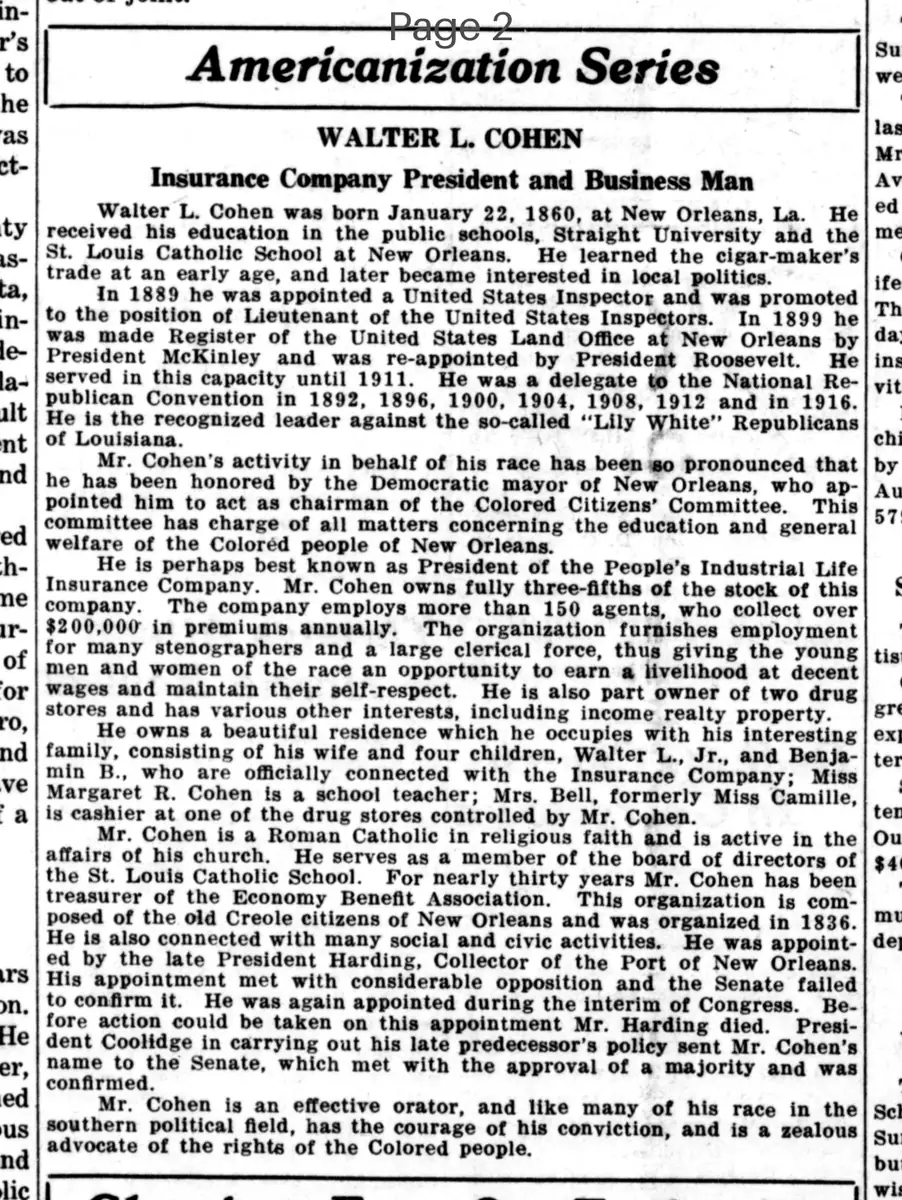
WALTER L. COHEN
Insurance Company President and Business Man
Walter L. Cohen was born January 22, 1860, at New Orleans, La. He received his education in the public schools, Straight University and the St. Louis Catholic School at New Orleans. He learned the cigar-maker's trade at an early age, and later became interested in local politics.
In 1889 he was appointed a United States Inspector and was promoted to the position of Lieutenant of the United States Inspectors. In 1899 he was made Register of the United States Land Office at New Orleans by President McKinley and was re-appointed by President Roosevelt. He served in this capacity until 1911. He was a delegate to the National Republican Convention in 1892, 1896, 1900, 1904, 1908, 1912 and in 1916. He is the recognized leader against the so-called "Lily White" Republicans of Louisiana.
Mr. Cohen's activity in behalf of his race has been so pronounced that he has been honored by the Democratic mayor of New Orleans, who appointed him to act as chairman of the Colored Citizens' Committee. This committee has charge of all matters concerning the education and general welfare of the Colored people of New Orleans.
He is perhaps best known as President of the People's Industrial Life Insurance Company. Mr. Cohen owns fully three-fifths of the stock of this company. The company employs more than 150 agents, who collect over $200,000 in premiums annually. The organization furnishes employment for many stenographers and a large clerical force, thus giving the young men and women of the race an opportunity to earn a livelihood at decent wages and maintain their self-respect. He is also part owner of two drug stores and has various other interests, including income realty property.
He owns a beautiful residence which he occupies with his interesting family, consisting of his wife and four children, Walter L., Jr., and Benjamin B., who are officially connected with the Insurance Company; Miss Margaret R. Cohen is a school teacher; Mrs. Bell, formerly Miss Camille, is cashier at one of the drug stores controlled by Mr. Cohen.
Mr. Cohen is a Roman Catholic in religious faith and is active in the affairs of his church. He serves as a member of the board of directors of the St. Louis Catholic School. For nearly thirty years Mr. Cohen has been treasurer of the Economy Benefit Association. This organization is composed of the old Creole citizens of New Orleans and was organized in 1836.
He is also connected with many social and civic activities. He was appointed by the late President Harding, Collector of the Port of New Orleans. His appointment met with considerable opposition and the Senate failed to confirm it. He was again appointed during the interim of Congress. Before action could be taken on this appointment Mr. Harding died. President Coolidge in carrying out his late predecessor's policy sent Mr. Cohen's name to the Senate, which met with the approval of a majority and was confirmed.
Mr. Cohen is an effective orator, and like many of his race in the southern political field, has the courage of his conviction, and is a zealous advocate of the rights of the Colored people.
What sub-type of article is it?
What themes does it cover?
What keywords are associated?
What entities or persons were involved?
Where did it happen?
Story Details
Key Persons
Location
New Orleans, La.
Event Date
Born January 22, 1860
Story Details
Walter L. Cohen, born in New Orleans in 1860, rose from cigar-maker to prominent businessman and political leader. He served in government roles, led against discriminatory Republicans, headed a colored citizens' committee, and presided over a successful insurance company providing jobs to his race. He was appointed Collector of the Port despite opposition.