Thank you for visiting SNEWPapers!
Sign up free
Ypsilanti Sentinel
Ypsilanti, Washtenaw County, Michigan
What is this article about?
During Lt. Fremont's court-martial in Washington, Gen. Kearney accuses counsel Thomas H. Benton of insulting gestures toward him. Benton retorts he stared down Kearney to defend Fremont from hostile looks. Kearney denies insulting Fremont and later calls Benton's account false in a public card, sparking hopes for a duel.
Clipping
OCR Quality
Full Text
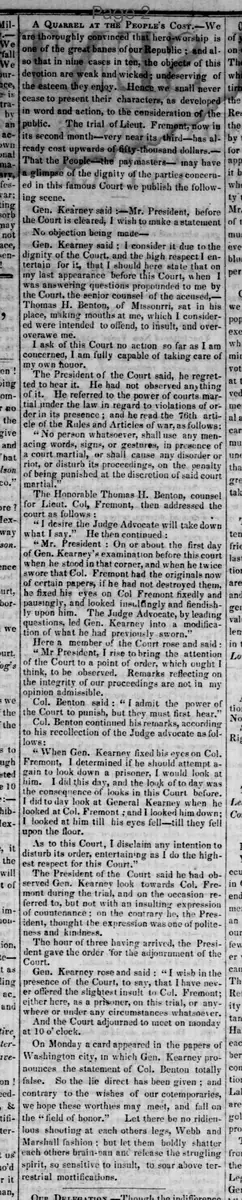
Gen. Kearney said: Mr. President, before the Court is cleared, I wish to make a statement—No objection being made—
Gen. Kearney said; I consider it due to the dignity of the Court, and the high respect I entertain for it, that I should here state that on my last appearance before this Court, when I was answering questions propounded to me by the Court, the senior counsel of the accused,—Thomas H. Benton, of Missouri, sat in his place, making mouths at me, which I considered were intended to offend, to insult, and overawe me.
I ask of this Court no action so far as I am concerned, I am fully capable of taking care of my own honor.
The President of the Court said, he regretted to hear it. He had not observed anything of it. He referred to the power of courts martial under the law in regard to violations of order in its presence; and he read the 76th article of the Rules and Articles of war, as follows:
'No person whatsoever, shall use any menacing words, signs, or gestures, in presence of a court martial, or shall cause any disorder or riot, or disturb its proceedings, on the penalty of being punished at the discretion of said court martial.'
The Honorable Thomas H. Benton, counsel for Lieut. Col. Fremont, then addressed the court as follows:
'I desire the Judge Advocate will take down what I say.' He then continued:
'Mr. President: On or about the first day of Gen. Kearney's examination before this court when he stood in that corner, and when he twice swore that Col. Fremont had the originals now of certain papers, if he had not destroyed them, he fixed his eyes on Col. Fremont fixedly and pausingly, and looked insultingly and fiendishly upon him. The Judge Advocate, by leading questions, led Gen. Kearney into a modification of what he had previously sworn.'
Here a member of the Court rose and said:
'Mr President, I rise to bring the attention of the Court to a point of order, which ought I think, to be observed. Remarks reflecting on the integrity of our proceedings are not in my opinion admissible.'
Col. Benton said: 'I admit the power of the Court to punish, but they must first hear.'
Col. Benton continued his remarks, according to his recollection of the Judge advocate as follows:
'When Gen. Kearney fixed his eyes on Col. Fremont, I determined if he should attempt again to look down a prisoner, I would look at him. I did this day, and the look of to day was the consequence of looks in this Court. before. I did to day look at General Kearney when he looked at Col. Fremont: and I looked him down: I looked at him till his eyes fell—till they fell upon the floor.'
As to this Court, I disclaim any intention to disturb its order, entertaining as I do the highest respect for this Court.'
The President of the Court said he had observed Gen. Kearney look towards Col. Fremont during the trial, and on the occasion referred to. but not with an insulting expression of countenance: on the contrary he. the President, thought the expression was one of politeness and kindness.
The hour of three having arrived, the President gave the order for the adjournment of the Court.
Gen. Kearney rose and said: 'I wish in the presence of the Court, to say, that I have never offered the slightest insult to Col. Fremont; either here, as a prisoner, on this trial, or anywhere or under any circumstances whatsoever.'
And the Court adjourned to meet on monday at 10 o'clock.
On Monday a card appeared in the papers of Washington city, In which Gen. Kearney pronounces the statement of Col. Benton totally false. So the lie direct has been given; and contrary to the wishes of our cotemporaries, we hope these worthies may meet, and fall on the 'field of honor.' Let there be no ridiculous shooting at each others legs, Webb and Marshall fashion: but let them boldly shatter each others brain-pan and release the struggling spirit, so sensitive to insult, to soar above terrestrial mortifications.
What sub-type of article is it?
What themes does it cover?
What keywords are associated?
What entities or persons were involved?
Where did it happen?
Story Details
Key Persons
Location
Washington City
Story Details
During the court-martial trial of Lieut. Col. Fremont, Gen. Kearney accuses Thomas H. Benton of making insulting faces at him while testifying. Benton responds that he stared down Kearney to counter his hostile glares at Fremont. The court president notes no insult observed. After adjournment, Kearney publicly denies Benton's claims as false, leading to calls for a duel between them.