Thank you for visiting SNEWPapers!
Sign up free
The Liberator
Boston, Suffolk County, Massachusetts
What is this article about?
Students at Amherst College, January 15, 1838, announce the reformation of an anti-slavery society auxiliary to the American Anti-Slavery Society, with 50-60 members. They share unanimously adopted resolutions declaring slavery a sin against man and God, advocating immediate abolition via discussion and prayer, criticizing the doctrine of entailed slavery guilt, congressional denial of petition rights, and affirming that emancipation will follow subdued self-interest.
Clipping
OCR Quality
Full Text
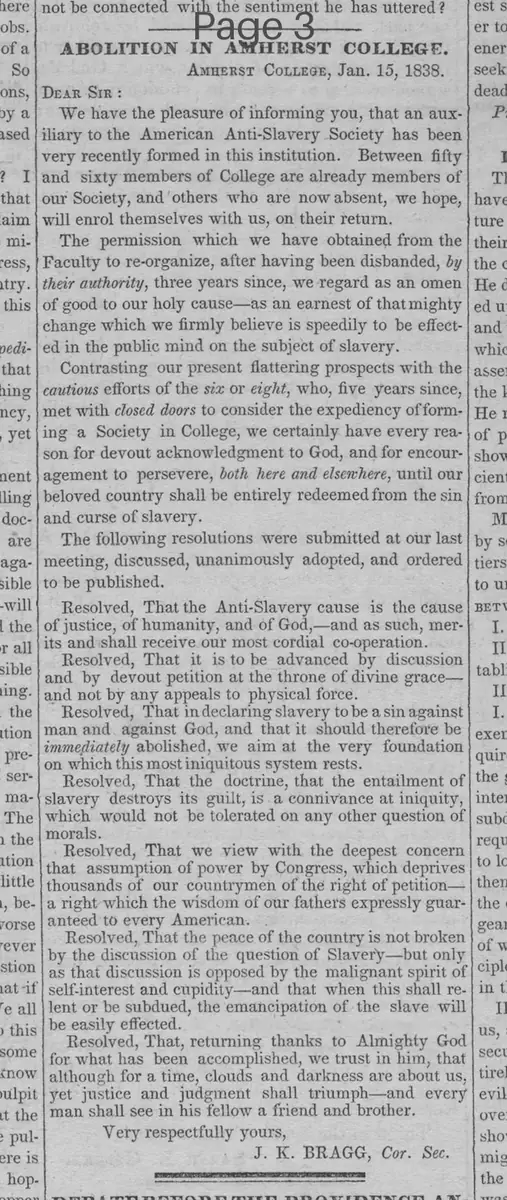
AMHERST COLLEGE, Jan. 15, 1838.
DEAR SIR:
We have the pleasure of informing you, that an auxiliary to the American Anti-Slavery Society has been very recently formed in this institution. Between fifty and sixty members of College are already members of our Society, and others who are now absent, we hope, will enrol themselves with us, on their return.
The permission which we have obtained from the Faculty to re-organize, after having been disbanded, by their authority, three years since, we regard as an omen of good to our holy cause—as an earnest of that mighty change which we firmly believe is speedily to be effected in the public mind on the subject of slavery.
Contrasting our present flattering prospects with the cautious efforts of the six or eight, who, five years since, met with closed doors to consider the expediency of forming a Society in College, we certainly have every reason for devout acknowledgment to God, and for encouragement to persevere, both here and elsewhere, until our beloved country shall be entirely redeemed from the sin and curse of slavery.
The following resolutions were submitted at our last meeting, discussed, unanimously adopted, and ordered to be published.
Resolved, That the Anti-Slavery cause is the cause of justice, of humanity, and of God,—and as such, merits and shall receive our most cordial co-operation.
Resolved, That it is to be advanced by discussion and by devout petition at the throne of divine grace—and not by any appeals to physical force.
Resolved, That in declaring slavery to be a sin against man and against God, and that it should therefore be immediately abolished, we aim at the very foundation on which this most iniquitous system rests.
Resolved, That the doctrine, that the entailment of slavery destroys its guilt, is a connivance at iniquity, which would not be tolerated on any other question of morals.
Resolved, That we view with the deepest concern that assumption of power by Congress, which deprives thousands of our countrymen of the right of petition—a right which the wisdom of our fathers expressly guaranteed to every American.
Resolved, That the peace of the country is not broken by the discussion of the question of Slavery—but only as that discussion is opposed by the malignant spirit of self-interest and cupidity—and that when this shall relent or be subdued, the emancipation of the slave will be easily effected.
Resolved, That, returning thanks to Almighty God for what has been accomplished, we trust in him, that although for a time, clouds and darkness are about us, yet justice and judgment shall triumph—and every man shall see in his fellow a friend and brother.
Very respectfully yours,
J. K. BRAGG, Cor. Sec.
What sub-type of article is it?
What themes does it cover?
What keywords are associated?
What entities or persons were involved?
Letter to Editor Details
Author
J. K. Bragg, Cor. Sec.
Recipient
Dear Sir
Main Argument
an anti-slavery auxiliary society has been reformed at amherst college with 50-60 members, viewing this as a positive omen for abolition. unanimously adopted resolutions affirm the anti-slavery cause as just and divine, advocate immediate abolition through discussion and prayer, criticize entailed slavery doctrine and congressional petition restrictions, and express hope for emancipation and national redemption from slavery.
Notable Details