Thank you for visiting SNEWPapers!
Sign up free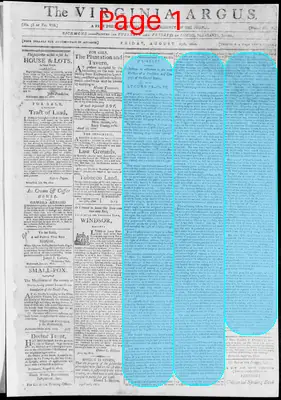
Editorial
August 29, 1800
Virginia Argus
Richmond, Virginia
What is this article about?
In this installment by Lycurgus, reflections on the upcoming US presidential and congressional election use English historical analogies (sedition laws, standing armies, funding systems, Norman law imposition) to warn against government measures that manipulate public opinion through fear and hope, undermining free discussion, elections, and constitutional liberty.
Clipping
OCR Quality
88%
Good
Full Text
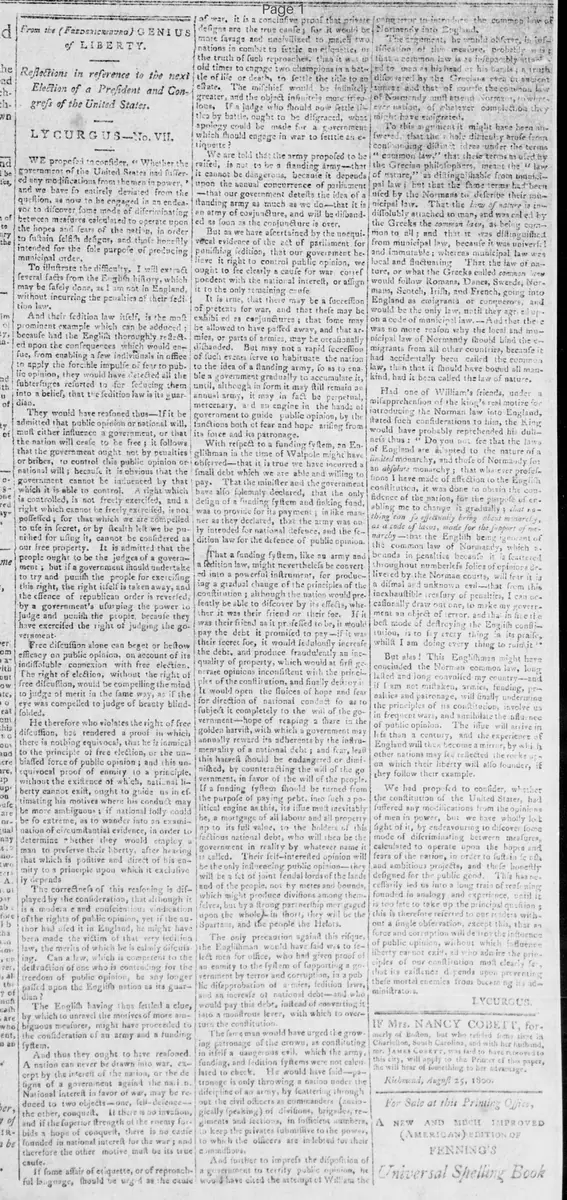
From the [garbled] GENIUS of LIBERTY.
Reflections in reference to the next Election of a President and Congress of the United States.
BY LYCURGUS-NO. VI.
WE proposed to consider. " Whether the government of the United States had suffered any modifications from the men in power, " and we have so entirely deviated from the question, as now to be engaged in an endeavor to discover some mode of discriminating between measures calculated to operate upon the hopes and fears of the nation, in order to sustain selfish designs, and those honestly intended for the sole purpose of producing municipal order.
To illustrate the difficulty, I will extract several facts from the English history, which may be safely done, as I am not in England, without incurring the penalties of their sedition law.
And their sedition law itself is the most prominent example which can be adduced: because had the English thoroughly reflected upon the consequences which would ensue, from enabling a few individuals in office to apply the forcible impulse of fear to public opinion, they would have detected all the subterfuges resorted to for seducing them into a belief, that the sedition law is its guardian.
They would have reasoned thus-If it be admitted that public opinion or national will, must either influence a government, or that the nation will cease to be free; it follows that the government ought not by penalties or bribes, to control this public opinion or national will; because it is obvious that the government cannot be influenced by that which it is able to control. A right which is controlled, is not freely exercised, and a right which cannot be freely exercised, is not possessed; for that which we are compelled to use in secret, or by stealth lest we be punished for using it, cannot be considered as our free property. It is admitted that the people ought to be the judges of a government; but if a government should undertake to try and punish the people for exercising this right, the right itself is taken away, and the essence of republican order is reversed, by a government's usurping the power to judge and punish the people, because they have exercised the right of judging the government.
Free discussion alone can beget or bestow efficacy on public opinion, on account of its indissoluble connexion with free election. The right of election, without the right of free discussion, would be compelling the mind to judge of merit in the same way, as if the eye was compelled to judge of beauty blindfolded.
He therefore who violates the right of free discussion, has rendered a proof in which there is nothing equivocal, that he is inimical to the principle of free election, or the unbiased force of public opinion; and this unequivocal proof of enmity to a principle, without the existence of which, national liberty cannot exist, ought to guide us in estimating his motives where his conduct may be more ambiguous: if national folly could be so extreme, as to wander into an examination of circumstantial evidence, in order to determine -whether they would employ a man to preserve their liberty, after hearing that which is positive and direct of his enmity to a principle upon which it exclusively depends.
The correctness of this reasoning is displayed by the consideration, that although it is a moderate and conscientious vindication of the rights of public opinion, yet if the author had used it in England, he might have been made the victim of that very sedition law, the merits of which he is calmly discussing.
Can a law, which is competent to the destruction of one who is contending for the freedom of public opinion, be any longer passed upon the English nation as its guardian?
The English having thus settled a clue, by which to unravel the motives of more ambiguous measures, might have proceeded to the consideration of an army and a funding system.
And thus they ought to have reasoned. A nation can never be drawn into war, except by the interest of the nation, or the designs of a government against the nation. National interest in favor of war, may be reduced to two objects-one, Self-defence--the other, conquest. If there is no invasion, and if the superior strength of the enemy forbids a hope of conquest, there is no cause founded in national interest for the war; and therefore the other motive must be its true cause.
If some affair of etiquette, or of reproachful language, should be urged as the cause of war, it is a conclusive proof that grievous designs are the true cause: for it would be more savage and uncivilized to match two nations in combat to settle an etiquette, or the truth of such reproaches, than it was in old times to engage two champions in a battle of life or death, to settle the title to an estate. The mischief would be infinitely greater, and the object infinitely more frivolous. If a judge who should now settle titles by battle, ought to be disgraced, what apology could be made for a government which should engage in war to settle an etiquette?
We are told that the army proposed to be raised, is not to be a standing army--that it cannot be dangerous, because it depends upon the annual concurrence of parliament--that our government detests the idea of a standing army as much as we do--that it is an army of conjuncture, and will be disbanded as soon as the conjuncture is over.
But as we have ascertained by the unequivocal evidence of the act of parliament for punishing sedition, that our government believe it right to control public opinion, we ought to see clearly a cause for war, congruent with the national interest, or assign it to the only remaining cause.
It is true, that there may be a succession of pretexts for war, and that these may be exhibited as conjunctures; that some may be allowed to have passed away, and that armies, or parts of armies, may be occasionally disbanded. But may not a rapid succession of such events serve to habituate the nation to the idea of a standing army, so as to enable a government gradually to accumulate it, until, although in form it may still remain an annual army, it may in fact be perpetual, mercenary, and an engine in the hands of government to guide public opinion, by the sanctions both of fear and hope arising from its force and its patronage.
With respect to a funding system, an Englishman in the time of Walpole might have observed--that it is true we have incurred a small debt which we are able and willing to pay. That the minister and the government have also solemnly declared, that the only design of a funding system and sinking fund, was to provide for its payment; in like manner as they declared, that the army was only intended for national defence, and the sedition law for the defence of public opinion.
That a funding system, like an army and a sedition law, might nevertheless be converted into a powerful instrument, for producing a gradual change of the principles of the constitution; although the nation would presently be able to discover by its effects, whether it was their friend or their foe. If it was their friend as it professed to be, it would pay the debt it promised to pay -if it was their secret foe, it would sedulously increase the debt, and produce fraudulently an inequality of property, which would at first generate opinions inconsistent with the principles of the constitution, and finally destroy it. It would open the sluices of hope and fear for direction of national conduct so as to subject it completely to the will of the government--hope of reaping a share in the golden harvest, with which a government may annually reward its adherents by the instrumentality of a national debt; and fear, lest this harvest should be endangered or diminished, by counteracting the will of the government, in favor of the will of the people.
If a funding system should be turned from the purpose of paying debt, into such a political engine as this, its issue must inevitably be, a mortgage of all labour and all property up to its full value, to the holders of this infectious national debt, who will then be the government in reality by whatever name it is called. Their self-interested opinion will be the only influencing public opinion--they will be a set of joint feudal lords of the lands and of the people, not by metes and bounds, which might produce divisions among themselves, but by a strong partnership mortgaged upon the whole-in short, they will be the Spartans, and the people the Helots.
The only precaution against this risque, the Englishman would have said was to select men for office, who had given proof of an enmity to the system of supporting a government by terror and corruption, in a public disapprobation of armies, sedition laws, and an increase of national debt--and who would pay this debt instead of converting it into a monstrous lever, with which to overturn the constitution.
The same man would have urged the growing patronage of the crown, as constituting in itself a dangerous evil, which the army, funding, and sedition systems were not calculated to check. He would have said-patronage is only throwing a nation under the discipline of an army, by scattering throughout the civil officers as commanders (analogically speaking) of divisions, brigades, regiments and sections, in sufficient numbers, to keep the privates submissive to the power, to which the officers are indebted for their commissions.
And further to impress the disposition of a government to terrify public opinion, he would have cited the attempt of William the conqueror to introduce the common law of Normandy into England.
The argument, he would observe, in justification of the measure, probably was; that a common law is so inseparably attached to men as his head to his body; a truth discovered by the Greeks even in ancient times and that of course the common law of Normandy most attend Normans, wherever nation, of whatever complexion they might have emigrated.
To this an Englishman might have answered, that the whole difficulty arose from construing distinct ideas under the terms " common law," that these terms as used by the Grecian philosophers, meant the " law of nature, " as distinguishable from municipal law; but that the same term had been used by the Normans to describe their municipal law. That the law of nature is indissolubly attached to man, and was called by the Greeks the common law, as being common to all; and that it was distinguished from municipal law, because it was universal and immutable: whereas municipal law was local and fluctuating. That the law of nature, or what the Greeks called common law would follow Romans, Danes, Swedes, Normans, Scotch, Irish, and French, going into England as emigrants or conquerors, and would be the only law, until they agreed upon a code of municipal law.--And there then was no more reason why the local and municipal law of Normandy should bind the emigrants from all other countries, because it had accidentally been called the common law, than that it should have bound all mankind, had it been called the law of nature.
Had one of William's friends, under a misapprehension of the king's real motive for introducing the Norman law into England, stated such considerations to him, the King would have probably reprehended his dullness thus : "Do you not see that the laws of England are adopted to the nature of a limited monarchy, and those of Normandy for an absolute monarchy: that whatever professions I have made of affection to the English constitution, it was done to obtain the confidence of the nation, for the purpose of enabling me to change it gradually ; that nothing can so effectually bring about monarchy, as a code of laws, made for the support of monarchy-that the English being ignorant of the common law of Normandy, which abounds in penalties because it is scattered throughout numberless folios of opinions delivered by the Norman courts, will fear it is a dismal and unknown evil--that from this inexhaustible treasury of penalties, I can occasionally draw out one, to make my government an object of terror. and that in such the best mode of destroying the English constitution, is to say every thing in its praise, whilst I am doing every thing to ruin it"
But alas! This Englishman might have concluded the Norman common law, long lasted and long convulsed my country--and if I am not mistaken, armies, funding, sedition and patronage, will finally undermine the principles of its constitution, involve us in frequent wars, and annihilate the influence of public opinion. The issue will arrive in less than a century, and the experience of England will then become a mirror, by which other nations may see reflected the rocks on which their liberty will also founder, if they follow their example.
We had proposed to consider, whether the constitution of the United States, had suffered any modifications from the opinions of men in power, but we have wholly lost sight of it, by endeavouring to discover some mode of discriminating between measures, calculated to operate upon the hopes and fears of the nation, in order to sustain selfish and ambitious projects, and those honestly designed for the public good. This has necessarily led us into a long train of reasoning founded in analogy and experience, until it is too late to take up the principal question this is therefore referred to our readers without a single observation, except this, that as force and corruption will destroy the influence of public opinion, without which influence liberty cannot exist. all who admire the principles of our constitution must clearly see, that its existence depends upon preventing these mortal enemies from becoming the administration.
LYCURGUS.
Reflections in reference to the next Election of a President and Congress of the United States.
BY LYCURGUS-NO. VI.
WE proposed to consider. " Whether the government of the United States had suffered any modifications from the men in power, " and we have so entirely deviated from the question, as now to be engaged in an endeavor to discover some mode of discriminating between measures calculated to operate upon the hopes and fears of the nation, in order to sustain selfish designs, and those honestly intended for the sole purpose of producing municipal order.
To illustrate the difficulty, I will extract several facts from the English history, which may be safely done, as I am not in England, without incurring the penalties of their sedition law.
And their sedition law itself is the most prominent example which can be adduced: because had the English thoroughly reflected upon the consequences which would ensue, from enabling a few individuals in office to apply the forcible impulse of fear to public opinion, they would have detected all the subterfuges resorted to for seducing them into a belief, that the sedition law is its guardian.
They would have reasoned thus-If it be admitted that public opinion or national will, must either influence a government, or that the nation will cease to be free; it follows that the government ought not by penalties or bribes, to control this public opinion or national will; because it is obvious that the government cannot be influenced by that which it is able to control. A right which is controlled, is not freely exercised, and a right which cannot be freely exercised, is not possessed; for that which we are compelled to use in secret, or by stealth lest we be punished for using it, cannot be considered as our free property. It is admitted that the people ought to be the judges of a government; but if a government should undertake to try and punish the people for exercising this right, the right itself is taken away, and the essence of republican order is reversed, by a government's usurping the power to judge and punish the people, because they have exercised the right of judging the government.
Free discussion alone can beget or bestow efficacy on public opinion, on account of its indissoluble connexion with free election. The right of election, without the right of free discussion, would be compelling the mind to judge of merit in the same way, as if the eye was compelled to judge of beauty blindfolded.
He therefore who violates the right of free discussion, has rendered a proof in which there is nothing equivocal, that he is inimical to the principle of free election, or the unbiased force of public opinion; and this unequivocal proof of enmity to a principle, without the existence of which, national liberty cannot exist, ought to guide us in estimating his motives where his conduct may be more ambiguous: if national folly could be so extreme, as to wander into an examination of circumstantial evidence, in order to determine -whether they would employ a man to preserve their liberty, after hearing that which is positive and direct of his enmity to a principle upon which it exclusively depends.
The correctness of this reasoning is displayed by the consideration, that although it is a moderate and conscientious vindication of the rights of public opinion, yet if the author had used it in England, he might have been made the victim of that very sedition law, the merits of which he is calmly discussing.
Can a law, which is competent to the destruction of one who is contending for the freedom of public opinion, be any longer passed upon the English nation as its guardian?
The English having thus settled a clue, by which to unravel the motives of more ambiguous measures, might have proceeded to the consideration of an army and a funding system.
And thus they ought to have reasoned. A nation can never be drawn into war, except by the interest of the nation, or the designs of a government against the nation. National interest in favor of war, may be reduced to two objects-one, Self-defence--the other, conquest. If there is no invasion, and if the superior strength of the enemy forbids a hope of conquest, there is no cause founded in national interest for the war; and therefore the other motive must be its true cause.
If some affair of etiquette, or of reproachful language, should be urged as the cause of war, it is a conclusive proof that grievous designs are the true cause: for it would be more savage and uncivilized to match two nations in combat to settle an etiquette, or the truth of such reproaches, than it was in old times to engage two champions in a battle of life or death, to settle the title to an estate. The mischief would be infinitely greater, and the object infinitely more frivolous. If a judge who should now settle titles by battle, ought to be disgraced, what apology could be made for a government which should engage in war to settle an etiquette?
We are told that the army proposed to be raised, is not to be a standing army--that it cannot be dangerous, because it depends upon the annual concurrence of parliament--that our government detests the idea of a standing army as much as we do--that it is an army of conjuncture, and will be disbanded as soon as the conjuncture is over.
But as we have ascertained by the unequivocal evidence of the act of parliament for punishing sedition, that our government believe it right to control public opinion, we ought to see clearly a cause for war, congruent with the national interest, or assign it to the only remaining cause.
It is true, that there may be a succession of pretexts for war, and that these may be exhibited as conjunctures; that some may be allowed to have passed away, and that armies, or parts of armies, may be occasionally disbanded. But may not a rapid succession of such events serve to habituate the nation to the idea of a standing army, so as to enable a government gradually to accumulate it, until, although in form it may still remain an annual army, it may in fact be perpetual, mercenary, and an engine in the hands of government to guide public opinion, by the sanctions both of fear and hope arising from its force and its patronage.
With respect to a funding system, an Englishman in the time of Walpole might have observed--that it is true we have incurred a small debt which we are able and willing to pay. That the minister and the government have also solemnly declared, that the only design of a funding system and sinking fund, was to provide for its payment; in like manner as they declared, that the army was only intended for national defence, and the sedition law for the defence of public opinion.
That a funding system, like an army and a sedition law, might nevertheless be converted into a powerful instrument, for producing a gradual change of the principles of the constitution; although the nation would presently be able to discover by its effects, whether it was their friend or their foe. If it was their friend as it professed to be, it would pay the debt it promised to pay -if it was their secret foe, it would sedulously increase the debt, and produce fraudulently an inequality of property, which would at first generate opinions inconsistent with the principles of the constitution, and finally destroy it. It would open the sluices of hope and fear for direction of national conduct so as to subject it completely to the will of the government--hope of reaping a share in the golden harvest, with which a government may annually reward its adherents by the instrumentality of a national debt; and fear, lest this harvest should be endangered or diminished, by counteracting the will of the government, in favor of the will of the people.
If a funding system should be turned from the purpose of paying debt, into such a political engine as this, its issue must inevitably be, a mortgage of all labour and all property up to its full value, to the holders of this infectious national debt, who will then be the government in reality by whatever name it is called. Their self-interested opinion will be the only influencing public opinion--they will be a set of joint feudal lords of the lands and of the people, not by metes and bounds, which might produce divisions among themselves, but by a strong partnership mortgaged upon the whole-in short, they will be the Spartans, and the people the Helots.
The only precaution against this risque, the Englishman would have said was to select men for office, who had given proof of an enmity to the system of supporting a government by terror and corruption, in a public disapprobation of armies, sedition laws, and an increase of national debt--and who would pay this debt instead of converting it into a monstrous lever, with which to overturn the constitution.
The same man would have urged the growing patronage of the crown, as constituting in itself a dangerous evil, which the army, funding, and sedition systems were not calculated to check. He would have said-patronage is only throwing a nation under the discipline of an army, by scattering throughout the civil officers as commanders (analogically speaking) of divisions, brigades, regiments and sections, in sufficient numbers, to keep the privates submissive to the power, to which the officers are indebted for their commissions.
And further to impress the disposition of a government to terrify public opinion, he would have cited the attempt of William the conqueror to introduce the common law of Normandy into England.
The argument, he would observe, in justification of the measure, probably was; that a common law is so inseparably attached to men as his head to his body; a truth discovered by the Greeks even in ancient times and that of course the common law of Normandy most attend Normans, wherever nation, of whatever complexion they might have emigrated.
To this an Englishman might have answered, that the whole difficulty arose from construing distinct ideas under the terms " common law," that these terms as used by the Grecian philosophers, meant the " law of nature, " as distinguishable from municipal law; but that the same term had been used by the Normans to describe their municipal law. That the law of nature is indissolubly attached to man, and was called by the Greeks the common law, as being common to all; and that it was distinguished from municipal law, because it was universal and immutable: whereas municipal law was local and fluctuating. That the law of nature, or what the Greeks called common law would follow Romans, Danes, Swedes, Normans, Scotch, Irish, and French, going into England as emigrants or conquerors, and would be the only law, until they agreed upon a code of municipal law.--And there then was no more reason why the local and municipal law of Normandy should bind the emigrants from all other countries, because it had accidentally been called the common law, than that it should have bound all mankind, had it been called the law of nature.
Had one of William's friends, under a misapprehension of the king's real motive for introducing the Norman law into England, stated such considerations to him, the King would have probably reprehended his dullness thus : "Do you not see that the laws of England are adopted to the nature of a limited monarchy, and those of Normandy for an absolute monarchy: that whatever professions I have made of affection to the English constitution, it was done to obtain the confidence of the nation, for the purpose of enabling me to change it gradually ; that nothing can so effectually bring about monarchy, as a code of laws, made for the support of monarchy-that the English being ignorant of the common law of Normandy, which abounds in penalties because it is scattered throughout numberless folios of opinions delivered by the Norman courts, will fear it is a dismal and unknown evil--that from this inexhaustible treasury of penalties, I can occasionally draw out one, to make my government an object of terror. and that in such the best mode of destroying the English constitution, is to say every thing in its praise, whilst I am doing every thing to ruin it"
But alas! This Englishman might have concluded the Norman common law, long lasted and long convulsed my country--and if I am not mistaken, armies, funding, sedition and patronage, will finally undermine the principles of its constitution, involve us in frequent wars, and annihilate the influence of public opinion. The issue will arrive in less than a century, and the experience of England will then become a mirror, by which other nations may see reflected the rocks on which their liberty will also founder, if they follow their example.
We had proposed to consider, whether the constitution of the United States, had suffered any modifications from the opinions of men in power, but we have wholly lost sight of it, by endeavouring to discover some mode of discriminating between measures, calculated to operate upon the hopes and fears of the nation, in order to sustain selfish and ambitious projects, and those honestly designed for the public good. This has necessarily led us into a long train of reasoning founded in analogy and experience, until it is too late to take up the principal question this is therefore referred to our readers without a single observation, except this, that as force and corruption will destroy the influence of public opinion, without which influence liberty cannot exist. all who admire the principles of our constitution must clearly see, that its existence depends upon preventing these mortal enemies from becoming the administration.
LYCURGUS.
What sub-type of article is it?
Constitutional
Press Freedom
Partisan Politics
What keywords are associated?
Public Opinion
Free Discussion
Sedition Law
Standing Army
Funding System
Elections
Liberty
Constitution
English History
Corruption
What entities or persons were involved?
Parliament
William The Conqueror
Walpole
English Government
Lycurgus
Editorial Details
Primary Topic
Discriminating Government Measures That Control Public Opinion Via Fear And Hope From Those For Public Good, In Context Of Us Elections
Stance / Tone
Vigorous Warning Against Corruption And Force Undermining Liberty And Free Elections
Key Figures
Parliament
William The Conqueror
Walpole
English Government
Lycurgus
Key Arguments
Sedition Laws Control Public Opinion, Reversing Republican Order By Punishing Judgment Of Government.
Free Discussion Is Essential For Effective Public Opinion And Free Elections.
Standing Armies, Even Temporary, Can Habituate Nation To Perpetual Military Control.
Wars Often Mask Government Designs Against Liberty When Not For Self Defense Or Conquest.
Funding Systems Can Increase Debt To Create Inequality And Influence Via Hope And Fear.
Crown Patronage Acts As A Civil Army To Enforce Submission.
Imposition Of Norman Law Exemplifies Gradual Constitutional Subversion Through Fear.
Elect Officials Who Oppose Armies, Sedition Laws, And Debt Increases To Preserve Constitution.
English History Warns Us Against Similar Paths To Loss Of Liberty.
Force And Corruption Destroy Public Opinion's Influence, Essential For Liberty.