Thank you for visiting SNEWPapers!
Sign up free
Literary
June 25, 1864
Dayton Daily Empire
Dayton, Montgomery County, Ohio
What is this article about?
A travel essay recounting an encounter with three young English 'fast boys' en route to Wiesbaden, their pro-Southern Civil War sympathies, lively discussions on American politics and poets like Poe and Tennyson, the narrator's admiration for one brilliant but reckless youth, and a subsequent steamboat voyage down the Rhine, noting scenic spots like Bingen and Drachenfels.
Clipping
OCR Quality
95%
Excellent
Full Text
Empire
EUROPE
LXIV.
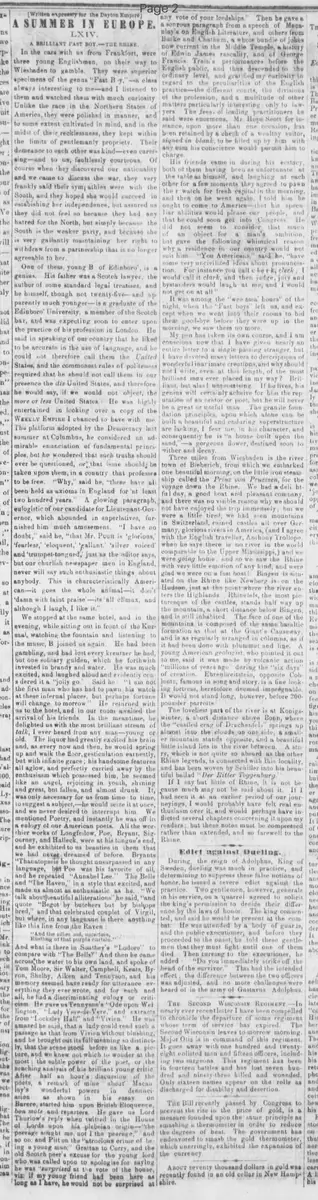
A BRILLIANT FAST BOY.—THE RHINE.
In the cars with us from Frankfort, were three young Englishmen, on their way to Wiesbaden to gamble. They were superior specimens of the genus "Fast Boy,"—a class always interesting to me—and I listened to them and watched them with much curiosity. Unlike the race in the Northern States of America, they were polished in manner, and to some extent cultivated in mind, and in the midst of their recklessness, they kept within the limits of gentlemanly propriety. Their demeanor to each other was kind—even caressing—and to us, faultlessly courteous. Of course when they discovered our nationality and we came to discuss the war, they very frankly said their sympathies were with the South, and they hoped she would succeed in establishing her independence, but assured us they did not feel so because they had any hatred for the North, but simply because the South is the weaker party, and because she is very gallantly maintaining her right to withdraw from a partnership that is no longer agreeable to her.
One of them, young B—— of Edinburgh, is a genius. His father was a Scotch lawyer, the author of some standard legal treatises, and he himself, though not twenty-five—and apparently much younger—is a graduate of the Edinburgh University, a member of the Scotch bar, and was expecting soon to enter upon the practice of his profession in London. He said in speaking of our country that he liked to be accurate in the use of language, and he could not therefore call them the United States, and the commonest rules of politeness required that he should not call them in our presence the disUnited States, and therefore he would say, if we would not object, the more or less United States. He was highly entertained in looking over a copy of the Weekly Empire I chanced to have with me. The platform adopted by the Democracy last summer at Columbus, he considered an admirable enunciation of fundamental principles, but he wondered that such truths should ever be questioned, or that issue should be taken upon them, in a country that professes to be free. "Why," said he, "these have all been held as axioms in England for at least two hundred years." A glowing paragraph, eulogistic of our candidate for Lieutenant-Governor, which abounded in superlatives, furnished him much amusement. "I have no doubt," said he, "that Mr. Pugh is 'glorious,' 'fearless,' 'eloquent,' 'gallant,' 'silver voiced' and 'trumpet-tongued,' just as the editor says, but our churlish newspaper men in England, never will say such enthusiastic things about anybody. This is characteristically American—it goes the whole animal—it don't 'damn with faint praise'—it's all climax, and although I laugh, I like it."
We stopped at the same hotel, and in the evening, while sitting out in front of the Kursaal, watching the fountain and listening to the music, B—— joined us again. He had been gambling, and had lost every kreutzer he had, but one solitary gulden, which he forthwith invested in brandy and water. He was much excited, and laughed aloud and evidently considered it a "jolly go." Said he "I am not the first man who has had to pawn his watch at these infernal places, but perhaps fortune will change to-morrow." He returned with us to the hotel, and in our room awaited the arrival of his friends. In the meantime, he delighted us with the most brilliant stream of talk, I ever heard from any man—young or old. The liquor had greatly excited his brain and, as every now and then, he would spring up and walk the floor, gesticulating earnestly, but with infinite grace: his handsome features all aglow, and perfectly carried away by the enthusiasm which possessed him, he seemed like an angel, rejoicing in youth, shining and great, but fallen, and almost drunk. It was only necessary for us from time to time, to suggest a subject,—he would seize it at once, and we never desired to interrupt him. We mentioned Poetry, and instantly he was off in a eulogy of our American poets. All the worthier works of Longfellow, Poe, Bryant, Sigourney, and Halleck, were at his tongue's end, and he exhibited to us beauties in them that we had never dreamed of before. Bryant's "Thanatopsis" he thought unsurpassed in any language, but Poe was his favorite of all. and he repeated "Annabel Lee." The "Bells" and "The Raven," in a style that excited, and made us almost as enthusiastic as he. "We talk about beautiful alliterations" he said, "and quote 'Begot by butchers but by bishops bred,' and that celebrated couplet of Virgil, but where, in any language is there anything like this line from the Raven:
"And the silken sad, uncertain,
Rustling of that purple curtain."
And what is there in Southey's "Lodore" to compare with "The Bells?" And then he came across "the water" to his own land, and spoke of Tom Moore, Sir Walter, Campbell, Keats, Byron, Shelley, Aiken and Tennyson, and his memory seemed to have ready for utterance everything they ever wrote, and for each and all, he had a discriminating eulogy or criticism. He gave us Tennyson's "Ode upon Wellington," "Lady Vane-de-Vere," and extracts from "Locksley Hall" and "Vivien." He was amazed he said, that a lady could read such a passage as that from Vivien without blushing, and he brought out its full meaning so distinctly that the scene stood before us like a picture, and we knew not which to wonder at the most; the subtle power of the poet, or the searching analysis of his brilliant young critic.
After half an hour's discussion of the poets, a remark of mine about Macaulay's wonderful powers in denunciation as shown in his essay on Barere, started him upon British Eloquence, bon mots and repartees. He gave us Lord Thurlow's reply when twitted in the House of Lords upon his plebeian origin—"the peerage sought me, not I the peerage," and so on and Pitt on the "atrocious crime of being a young man;" Grattan to Corry, and the old Scotch peer's excuse for the young lord who was called upon to apologise for saying he was "surprised at the vote of the house," viz: if my young friend had been here as long as I have, he would not be surprised at any vote of your lordships." Then he gave a sonorous paragraph from a speech of Macaulay's on English Literature, and others from Burke and Chatham, a whole bundle of jokes now current in the Middle Temple, a history of Edwin James' rascality, and of George Francis Train's performances before the English public. and thus descended to the ordinary level, and gratified my curiosity in regard to the peculiarities of the English practice—the different courts, the divisions of the profession, and a multitude of other matters particularly interesting only to lawyers. The fees, of leading practitioners he said were enormous, Mr. Hope Scott for instance, upon more than one occasion, has been retained by a check of a wealthy suitor, signed in blank, to be filled up by him with any sum his conscience would permit him to charge.
His friends came in during his ecstasy, both of them having been as unfortunate at the table as himself, and laughing at each other for a few moments they agreed to pawn their watches for fresh capital in the morning, and then on he went again. I told him he ought to come to America—that his peculiar abilities would please our people, and that he could soon get into Congress. He did not seem to consider that much of an object for a man's ambition, but gave the following whimsical reason why a residence in our country would not suit him. "You Americans," said he, "have some very uncivilized ideas about pronunciation. For instance you call clerk, clerk. I would call it clark, and then judge, jury and bystanders would laugh at me, and I would not get on at all."
It was among the "wee sma' hours" of the night, when the "Fast boys" left us, and except when we went into their rooms to bid them good-bye before they were up in the morning, we saw them no more.
My pen has taken its own course, and I am conscious now that I have given nearly an entire letter to a single passing stranger, but I have devoted many letters to descriptions of wonderful inanimate creations, and why should not I write, even at this length, of the most brilliant man ever placed in my way? Brilliant, but alas! unpromising. If he lives, his genius will certainly achieve for him the reputation of an orator or poet, but he will never be a great or useful man. The granite foundation principles, upon which alone can be built a beautiful and enduring superstructure are lacking, I fear me, in his character, and consequently he is "a house built upon the sand,"—a gorgeous flower, destined soon to wither and decay.
Three miles from Wiesbaden is the river town of Biebrich, from which we embarked one beautiful morning, on the little iron steam ship called the Prinz von Preussen, for the voyage down the Rhine. We had a delightful day, a good boat and pleasant company and there was no visible reason why we should not have enjoyed the trip immensely; but we were a little tired, we had seen mountains in Switzerland, ruined castles all over Germany, glorious rivers in America, (and I agree with the English traveller, Anthony Trollope when he says there is no river in the world comparable to the Upper Mississippi,) and we were going home: and so we saw the Rhine with very little emotion of any kind, and were glad we were on a fast boat! Bingen is situated on the Rhine like Newburg is on the Hudson, just at the point where the river enters the Highlands. Rheinfels, the most picturesque of the castles, stands half way up the mountain, a short distance below Bingen, and is still inhabited. The face of one of the mountains is composed of the same basaltic formation as that at the Giant's Causeway, and is as regularly arranged in columns, as if it had been done with plummet and line. A young American geologist who pointed it out to me, said it was made by volcanic action "millions of years ago during the 'six days' of creation." Ehrenbreitstein, opposite Coblentz, famous in song and story, is a fine looking fortress, heretofore deemed impregnable. It would not stand long, however, before 200 pounder parrotts.
The loveliest part of the river is at Konigswinter, a short distance above Bonn, where the "castled crag of Drachenfels," springs up almost into the clouds on one side, a smaller mountain stands opposite, and a beautiful little island lies in the river between. A story, which is not quite so absurd as the other Rhine legends, is connected with this locality, and has been woven by Schiller into his beautiful ballad "Der Ritter Toggenburg."
If I say but little of Ruins, it is not because much may not be said about it. If I had seen it at an earlier period of our journeyings, I would probably have felt real enthusiasm over it, and would perhaps have inflicted several chapters concerning it upon my readers; but these notes must be compressed rather than extended, and so farewell to the Rhine.
EUROPE
LXIV.
A BRILLIANT FAST BOY.—THE RHINE.
In the cars with us from Frankfort, were three young Englishmen, on their way to Wiesbaden to gamble. They were superior specimens of the genus "Fast Boy,"—a class always interesting to me—and I listened to them and watched them with much curiosity. Unlike the race in the Northern States of America, they were polished in manner, and to some extent cultivated in mind, and in the midst of their recklessness, they kept within the limits of gentlemanly propriety. Their demeanor to each other was kind—even caressing—and to us, faultlessly courteous. Of course when they discovered our nationality and we came to discuss the war, they very frankly said their sympathies were with the South, and they hoped she would succeed in establishing her independence, but assured us they did not feel so because they had any hatred for the North, but simply because the South is the weaker party, and because she is very gallantly maintaining her right to withdraw from a partnership that is no longer agreeable to her.
One of them, young B—— of Edinburgh, is a genius. His father was a Scotch lawyer, the author of some standard legal treatises, and he himself, though not twenty-five—and apparently much younger—is a graduate of the Edinburgh University, a member of the Scotch bar, and was expecting soon to enter upon the practice of his profession in London. He said in speaking of our country that he liked to be accurate in the use of language, and he could not therefore call them the United States, and the commonest rules of politeness required that he should not call them in our presence the disUnited States, and therefore he would say, if we would not object, the more or less United States. He was highly entertained in looking over a copy of the Weekly Empire I chanced to have with me. The platform adopted by the Democracy last summer at Columbus, he considered an admirable enunciation of fundamental principles, but he wondered that such truths should ever be questioned, or that issue should be taken upon them, in a country that professes to be free. "Why," said he, "these have all been held as axioms in England for at least two hundred years." A glowing paragraph, eulogistic of our candidate for Lieutenant-Governor, which abounded in superlatives, furnished him much amusement. "I have no doubt," said he, "that Mr. Pugh is 'glorious,' 'fearless,' 'eloquent,' 'gallant,' 'silver voiced' and 'trumpet-tongued,' just as the editor says, but our churlish newspaper men in England, never will say such enthusiastic things about anybody. This is characteristically American—it goes the whole animal—it don't 'damn with faint praise'—it's all climax, and although I laugh, I like it."
We stopped at the same hotel, and in the evening, while sitting out in front of the Kursaal, watching the fountain and listening to the music, B—— joined us again. He had been gambling, and had lost every kreutzer he had, but one solitary gulden, which he forthwith invested in brandy and water. He was much excited, and laughed aloud and evidently considered it a "jolly go." Said he "I am not the first man who has had to pawn his watch at these infernal places, but perhaps fortune will change to-morrow." He returned with us to the hotel, and in our room awaited the arrival of his friends. In the meantime, he delighted us with the most brilliant stream of talk, I ever heard from any man—young or old. The liquor had greatly excited his brain and, as every now and then, he would spring up and walk the floor, gesticulating earnestly, but with infinite grace: his handsome features all aglow, and perfectly carried away by the enthusiasm which possessed him, he seemed like an angel, rejoicing in youth, shining and great, but fallen, and almost drunk. It was only necessary for us from time to time, to suggest a subject,—he would seize it at once, and we never desired to interrupt him. We mentioned Poetry, and instantly he was off in a eulogy of our American poets. All the worthier works of Longfellow, Poe, Bryant, Sigourney, and Halleck, were at his tongue's end, and he exhibited to us beauties in them that we had never dreamed of before. Bryant's "Thanatopsis" he thought unsurpassed in any language, but Poe was his favorite of all. and he repeated "Annabel Lee." The "Bells" and "The Raven," in a style that excited, and made us almost as enthusiastic as he. "We talk about beautiful alliterations" he said, "and quote 'Begot by butchers but by bishops bred,' and that celebrated couplet of Virgil, but where, in any language is there anything like this line from the Raven:
"And the silken sad, uncertain,
Rustling of that purple curtain."
And what is there in Southey's "Lodore" to compare with "The Bells?" And then he came across "the water" to his own land, and spoke of Tom Moore, Sir Walter, Campbell, Keats, Byron, Shelley, Aiken and Tennyson, and his memory seemed to have ready for utterance everything they ever wrote, and for each and all, he had a discriminating eulogy or criticism. He gave us Tennyson's "Ode upon Wellington," "Lady Vane-de-Vere," and extracts from "Locksley Hall" and "Vivien." He was amazed he said, that a lady could read such a passage as that from Vivien without blushing, and he brought out its full meaning so distinctly that the scene stood before us like a picture, and we knew not which to wonder at the most; the subtle power of the poet, or the searching analysis of his brilliant young critic.
After half an hour's discussion of the poets, a remark of mine about Macaulay's wonderful powers in denunciation as shown in his essay on Barere, started him upon British Eloquence, bon mots and repartees. He gave us Lord Thurlow's reply when twitted in the House of Lords upon his plebeian origin—"the peerage sought me, not I the peerage," and so on and Pitt on the "atrocious crime of being a young man;" Grattan to Corry, and the old Scotch peer's excuse for the young lord who was called upon to apologise for saying he was "surprised at the vote of the house," viz: if my young friend had been here as long as I have, he would not be surprised at any vote of your lordships." Then he gave a sonorous paragraph from a speech of Macaulay's on English Literature, and others from Burke and Chatham, a whole bundle of jokes now current in the Middle Temple, a history of Edwin James' rascality, and of George Francis Train's performances before the English public. and thus descended to the ordinary level, and gratified my curiosity in regard to the peculiarities of the English practice—the different courts, the divisions of the profession, and a multitude of other matters particularly interesting only to lawyers. The fees, of leading practitioners he said were enormous, Mr. Hope Scott for instance, upon more than one occasion, has been retained by a check of a wealthy suitor, signed in blank, to be filled up by him with any sum his conscience would permit him to charge.
His friends came in during his ecstasy, both of them having been as unfortunate at the table as himself, and laughing at each other for a few moments they agreed to pawn their watches for fresh capital in the morning, and then on he went again. I told him he ought to come to America—that his peculiar abilities would please our people, and that he could soon get into Congress. He did not seem to consider that much of an object for a man's ambition, but gave the following whimsical reason why a residence in our country would not suit him. "You Americans," said he, "have some very uncivilized ideas about pronunciation. For instance you call clerk, clerk. I would call it clark, and then judge, jury and bystanders would laugh at me, and I would not get on at all."
It was among the "wee sma' hours" of the night, when the "Fast boys" left us, and except when we went into their rooms to bid them good-bye before they were up in the morning, we saw them no more.
My pen has taken its own course, and I am conscious now that I have given nearly an entire letter to a single passing stranger, but I have devoted many letters to descriptions of wonderful inanimate creations, and why should not I write, even at this length, of the most brilliant man ever placed in my way? Brilliant, but alas! unpromising. If he lives, his genius will certainly achieve for him the reputation of an orator or poet, but he will never be a great or useful man. The granite foundation principles, upon which alone can be built a beautiful and enduring superstructure are lacking, I fear me, in his character, and consequently he is "a house built upon the sand,"—a gorgeous flower, destined soon to wither and decay.
Three miles from Wiesbaden is the river town of Biebrich, from which we embarked one beautiful morning, on the little iron steam ship called the Prinz von Preussen, for the voyage down the Rhine. We had a delightful day, a good boat and pleasant company and there was no visible reason why we should not have enjoyed the trip immensely; but we were a little tired, we had seen mountains in Switzerland, ruined castles all over Germany, glorious rivers in America, (and I agree with the English traveller, Anthony Trollope when he says there is no river in the world comparable to the Upper Mississippi,) and we were going home: and so we saw the Rhine with very little emotion of any kind, and were glad we were on a fast boat! Bingen is situated on the Rhine like Newburg is on the Hudson, just at the point where the river enters the Highlands. Rheinfels, the most picturesque of the castles, stands half way up the mountain, a short distance below Bingen, and is still inhabited. The face of one of the mountains is composed of the same basaltic formation as that at the Giant's Causeway, and is as regularly arranged in columns, as if it had been done with plummet and line. A young American geologist who pointed it out to me, said it was made by volcanic action "millions of years ago during the 'six days' of creation." Ehrenbreitstein, opposite Coblentz, famous in song and story, is a fine looking fortress, heretofore deemed impregnable. It would not stand long, however, before 200 pounder parrotts.
The loveliest part of the river is at Konigswinter, a short distance above Bonn, where the "castled crag of Drachenfels," springs up almost into the clouds on one side, a smaller mountain stands opposite, and a beautiful little island lies in the river between. A story, which is not quite so absurd as the other Rhine legends, is connected with this locality, and has been woven by Schiller into his beautiful ballad "Der Ritter Toggenburg."
If I say but little of Ruins, it is not because much may not be said about it. If I had seen it at an earlier period of our journeyings, I would probably have felt real enthusiasm over it, and would perhaps have inflicted several chapters concerning it upon my readers; but these notes must be compressed rather than extended, and so farewell to the Rhine.
What sub-type of article is it?
Essay
Journey Narrative
What themes does it cover?
Political
Liberty Freedom
War Peace
What keywords are associated?
Travel Narrative
Rhine River
English Gamblers
Civil War Sympathies
American Poetry
Edgar Allan Poe
Alfred Tennyson
Wiesbaden
Biebrich
Literary Details
Title
A Brilliant Fast Boy.—The Rhine.
Form / Style
Personal Travel Essay With Literary Discussion
Key Lines
"And The Silken Sad, Uncertain, Rustling Of That Purple Curtain."
"You Americans," Said He, "Have Some Very Uncivilized Ideas About Pronunciation. For Instance You Call Clerk, Clerk. I Would Call It Clark, And Then Judge, Jury And Bystanders Would Laugh At Me, And I Would Not Get On At All."
Brilliant, But Alas! Unpromising. If He Lives, His Genius Will Certainly Achieve For Him The Reputation Of An Orator Or Poet, But He Will Never Be A Great Or Useful Man.