Thank you for visiting SNEWPapers!
Sign up free
Story
April 22, 1893
The New North West
Deer Lodge, Powell County, Montana
What is this article about?
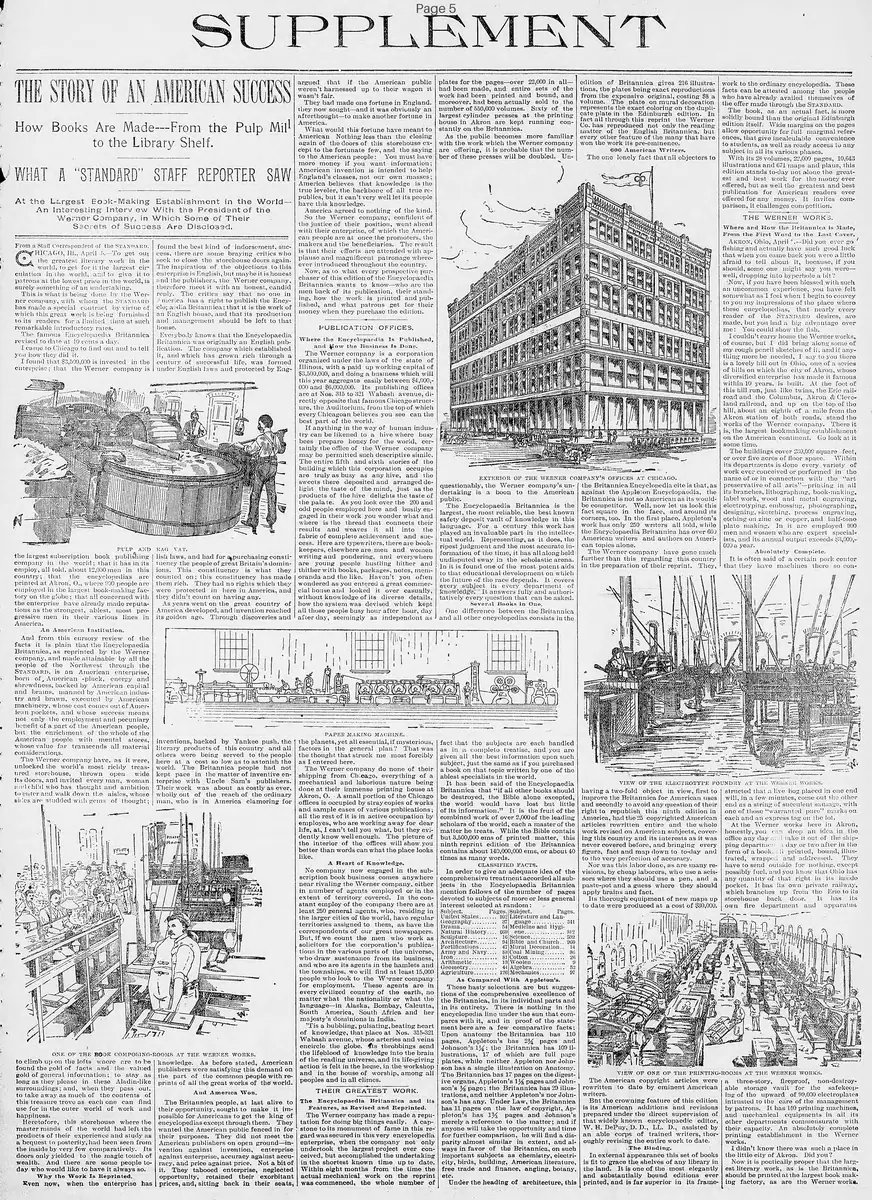
Promotional article on the Werner Company's reprinting of the Encyclopaedia Britannica, an American enterprise making the renowned English encyclopedia affordable and accessible, produced in Chicago and Akron facilities, emphasizing success against British publishers.
Clipping
OCR Quality
92%
Excellent
Full Text
SUPPLEMENT
THE STORY OF AN AMERICAN SUCCESS
How Books Are Made--From the Pulp Mill to the Library Shelf.
WHAT A "STANDARD" STAFF REPORTER SAW
At the Largest Book-Making Establishment in the World
An Interesting Interview With the President of the
Werner Company, in Which Some of Their
Secrets of Success Are Disclosed.
From a Staff Correspondent of the STANDARD.
CHICAGO, Ill., April 5.--To get out
the greatest literary work in the
world, to get for it the largest cir-
culation in the world, and to give it to
patrons at the lowest price in the world, is
surely something of an undertaking.
This is what is being done by the Wer-
ner company, with whom the STANDARD
has made a special contract by virtue of
which this great work is being furnished
to its readers for a limited time at such
remarkable introductory rates.
The famous Encyclopaedia Britannica
revised to date at 10 cents a day.
found the best kind of indorsement, suc-
cess. There are some braying critics who
seek to close the storehouse doors again.
The inspiration of the objections to this
enterprise is English, but maybe it is honest
a nd the publishers. the Werner company.
therefore meet it with an honest, candid
reply. The critics say that no one in
America has a right to publish the Ency-
clopaedia Britannica: that it is the work of
an English house, and that its production
and
managenent should be left to that
house.
Everybody knows that the Encyclopaedia
Britannica was originally an English pub-
lication. The company which established
it, and which has grown rich through a
century of successful life,
was
formed
under English laws and protected by Eng
lish laws, and had for purchasing consti-
tuency the people of Great Britain's domin-
ions.
This
constituency
is
what
they
counted on; this constituency
has made
them rich. They had no rights which they
were protected in here in America, and
they didn't count on having any.
As years went on the great country of
America developed, and invention reached
its golden
age.
Through discoveries and
inventions, backed
by
Yankee push, the
literary products of
this country and all
others
were
being
served
to the people
here at a cost so low as to astonish the
world. The Britannica people had not
kept pace in the matter of inventive en-
terprise with Uncle
Sam's
publishers.
Their work
was
about as costly as ever,
wholly out of the
reach of the ordinary
man, who is in America clamoring
for
And from this cursory review of
the
facts it is plain that the Encyclopaedia
Britannica, as reprinted
by
the Werner
company, and made attainable by all the
people of the Northwest
through the
STANDARD, is an American enterprise,
born of American pluck, energy
and
shrewdness, backed by American capital
and brains, manned by American indus-
try and brawn, executed by American
machinery, whose cost comes out of Amer-
ican pockets, and whose success means
not only the employment and pecuniary
benefit of a part of the American people.
but the enrichment of the whole of the
American people with mental stores,
whose value far transcends all material
considerations.
The Werner company have, as
it
were,
unlocked the world's most richly
treas-
ured
storchouse,
thrown
open
wide
its doors, and invited every man, woman
and child who has thought and ambition
to enter and walk down the aisles, whose
ites are studded with gems of thought;
to climb up on the lofts where are to be
found the gold of facts and the valued
gold of general information; to stay
as
long as they please in these Aladdin-like
surroundings; and, when they
pass out.
to take away as much of the contents of
this treasure trove as each one can find
use for in the outer world of work and
happiness.
Heretofore, this storehouse where the
master minds of the world had left the
products of their experience and study as
a bequest to posterity, had been seen from
the inside by very few comparatively.
Its
doors only yielded to the magic touch of
wealth. And there are some people to-
day who would like to have it always so.
Why the Work Is Reprinted.
Even now, when the enterprise has
knowledge. As before stated, American
publishers were satisfying this demand on
the part of the common people with re-
prints of all the great works of the world.
And America Won,
The Britannica people, at last alive to
their opportunity, sought to make it im-
possible for Americans to get the king of
encyclopedias except through them. They
wanted the American public fenced in for
their purposes. They did not meet the
American publishers on open ground-in-
vention against
invention,
enterprise
against enterprise, accuracy against accu-
racy, and price against price. Not a bit of
it. They tabooed enterprise, neglected
opportunity, retained
their exorbitant
prices, and, sitting back in their seats,
argued that if the American public
weren't harnessed up to their wagon it
wasn't fair.
They had made one fortune in England.
they now sought--and it was obviously an
afterthought--to make another fortune in
America.
What would this fortune have meant to
American? Nothing less than the closing
again of the doors of this storehouse ex-
cept to the fortunate few, and the saying
to the American people: You must have
more money if you want information;
American invention is intended to help
England's classes, not our own masses;
America believes that knowledge is the
true leveler, the backbone of all true re-
publics, but it can't very well let its people
have this knowledge.
America agreed to nothing of the kind.
So the Werner company, confident of
the justice of their position, went ahead
with their enterprise, of which the Ameri-
can people are at once the promoters, the
makers and the beneficiaries. The result
is that their efforts are attended with ap-
plause and magnificent patronage where-
ever introduced throughout the country.
Now, as to what every prospective pur-
chaser of this edition of the Encyclopaedia
Britannica wants to know--who are the
men back of its publication, their stand-
ing, how the work is printed and pub-
lished, and what patrons get for their
money when they purchase the edition.
PUBLICATION OFFICES.
Where the Encyclopaedia Is Published,
and How the Business Is Done.
The Werner company is a corporation
organized under the laws of the state of
Illinois, with a paid up working capital of
$3,500,000, and doing a business which will
this year aggregate easily between $4,000-
000 and $6,000,000. Its publishing offices
are at Nos. 315 to 321 Wabash avenue, di-
rectly opposite that famous Chicago structure,
the Auditorium, from the top of which
every Chicagoan believes you see all the
best part of the world.
If anything in the way of human indus-
try can be likened to a hive where busy
bees prepare honey for the world, cer-
tainly the office of the Werner company
may be permitted such descriptive simile.
The entire fifth and sixth stories of the
building which this corporation occupies
are truly as busy as any hive, and the
sweets there deposited and arranged de-
light the taste of the mind, just as the
products of the hive delight the taste of
the palate. As you look over the 200 and
odd people employed here and busily en-
gaged in their work you wonder what and
where is the thread that connects their
results and weaves it all into the
fabric of complete achievement and success. Here are typewriters, there are book-
keepers, elsewhere are men and women
writing and pondering, and everywhere
are young people hustling hither and
thither with books, packages, notes, mem-
oranda and the like. Haven't you often
wondered as you entered a great commercial
house and looked it over casually,
without knowledge of its diverse details,
how the system was devised which kept
all those people busy hour after hour, day
after day, seemingly as independent as
the planets, yet all essential, if mysterious.
factors in the general plan? That was
the thought that struck me most forcibly
as I entered here.
The Werner company do none of their
shipping from Chicago, everything of a
mechanical and laborious nature being
done at their immense printing house at
Akron, O. A small portion of the Chicago
offices is occupied by stray copies of works
and sample cases of various publications;
all the rest of it is in active occupation by
employes, who are working away for dear
life, at, I can't tell you what, but they evi-
dently know well enough. The picture of
the interior of the offices will show you
better than words can what the place looks
like.
A Heart of Knowledge.
No company now engaged in the sub-
scription book business comes anywhere
near rivaling the Werner company, either
in number of agents employed or in the
extent of territory covered. In the con-
stant employ of the company there are at
least 250 general agents, who, residing in
the larger cities of the world, have regular
territories assigned to them, as have the
correspondents of our great newspapers.
But, if we count the men who work as
solicitors for the corporation's publica-
tions in the various parts of the universe,
who draw sustenance from its business,
and who are its agents in the hamlets and
the townships, we will find at least 15,000
people who look to the Werner company
for employment. These agents are in
every civilized country of the earth, no
matter what the nationality or what the
language--in Alaska, Bombay, Calcutta,
South America, South Africa and her
majesty's dominions in India.
'Tis a bubbling, pulsating, beating heart
of knowledge, that place at Nos. 315-321
Wabash avenue, whose arteries and veins
encircle the globe. Its throbbings send
the lifeblood of knowledge into the brain
of the reading universe, and its life-giving
action is felt in the home, in the workshop
and in the house of worship, among all
peoples and in all climes.
THEIR GREATEST WORK.
The Encyclopaedia Britannica and its
Features, as Revised and Reprinted.
The Werner company has made a repu-
tation for doing big things easily. A cap-
stone to its monument of fame in this re-
gard was secured in this very encyclopedia
enterprise, when the company not only
undertook the largest project ever con-
ceved, but accomplished the undertaking
in the shortest known time up to date.
Within eight months from the time the
actual mechanical work on the reprint
was commenced, the whole number of
plates for the pages--over 22,000 in all--
had been made, and entire sets of the
work had been printed and bound, and
moreover, had been actually sold to the
number of 550,000 volumes. Sixty of the
largest cylinder
presses
at
the printing
house in Akron
are
kept
running
con-
stantly on the Britannica.
As the public becomes
more
familiar
with the work which the Werner company
are
offering, it is probable that the num-
ber of these presses will be doubled. Un-
edition of Britannica gives 216 illustra-
tions, the plates being exact reproductions
from the expensive original, costing $8 a
volume. The plate on mural decoration
represents the exact coloring on the dupli-
cate plate in the Edinburgh edition. In
fact all through this reprint the Werner
Co. has reproduced not only the reading
matter of the English Britannica, but
every other feature of the many that have
won the work its pre-eminence.
Good American Writers.
The one lonely fact that all objectors to
questionably, the Werner company's un-
dertaking
is
a
boon
to the American
public.
The Encyclopaedia Britannica is the
largest, the most reliable, the best known
safety deposit vault of knowledge in this
language. For a century this work has
played an invaluable part in the intellec-
tual world. Representing, as it does, the
ripest judgment and the most accurate in-
formation of the time, it has all along held
undisputed sway in the scholastic arena.
In it is found one of the most potent aids
to that educational development on which
the future of the race depends. It covers
every subject in every department of
knowledge. It answers fully and authori-
tatively every question that can be asked.
Several Books in One,
One difference between the Britannica
and all other encyclopedias consists in the
fact that the subjects are each handled
as
in a complete treatise, and you are
given all the best information upon such
subject, just the same as if you purchased
a book on that topic written by one of the
ablest specialists in the world.
It has been said of the Encyclopaedia
Britannica that "if all other books should
be destroyed, the Bible alone excepted,
the world
would have lost but little
of its information."
It is the fruit of the
combined work of over 2,000 of the leading
scholars of the world, each a master of the
matter he treats. While the Bible contains
but 3,500,000 ems of printed matter, this
ninth reprint edition of the Britannica
contains about 140,000,000 ems, or about 40
times as many words.
CLASSIFIED FACTS.
In order to give an adequate idea of the
comprehensive treatment accorded all sub-
jects in the Encyclopaedia Britannica
mention follows of the number
of
pages
devoted to subjects of more or less
general
interest selected at random:
Subject.
Pages. Subject.
Pages.
United States
102 Literature and Lan-
Geography
37
guage
341
Drama
51
Medicine and Hygi-
Natural History
669
ene..
312
Sculpture
16
Science
592
Architecture
Bible and Church..
960
Fortifications
Mural Decoration.
Army and Navy
Coal Mining
Iron
Cotton
Arithmetic
13
Woolen
Geometry
41
Algebra
Agriculture
126 Mechanics
As Compared With Appleton's.
These hasty selections are but sugges-
tions of the comprehensive excellence of
the Britannica, in its individual parts and
in its entirety. There is nothing in the
encyclopedia line under the sun that com-
pares with it, and in proof of the state-
ment here are a few comparative facts;
Upon anatomy the Britannica
has
110
pages, Appleton's has 2¼ pages and
Johnson's 1½; the Britannica has 109 il-
lustrations, 17 of which are full page
plates, while neither Appleton nor John-
son has a single illustration on Anatomy.
The Britannica has 17 pages on the digest-
ive organs, Appleton's 1½ pages and John-
son's 1¼ page; the Britannica has 29 illus-
trations, and neither Appleton's nor John-
son's has any. Under Law, the Britannica
has 11 pages on the law of copyright, Ap-
pleton's has 1½ pages and Johnson's
merely a reference to the matter; and if
anyone will take the opportunity and time
for further comparison, he will find a dis-
parity almost similar in extent, and al-
ways in favor of the Britannica, on such
important subjects as chemistry, electri-
city, birds, building, American literature,
free trade and finance, angling, botany,
etc.
Under the heading of architecture, this
the Britannica Encyclopedia cites that, as
against the Appleton Encyclopaedia, the
Britannica is not so American as its would-
be competitor. Well, now let us look this
fact square in the face, and around its
corners, too. In the first place, Appleton's
work has only 250 writers all told, while
the Encyclopaedia Britannica has over 600
American writers
and authors on Ameri-
can topics alone.
The Werner company
have gone much
further than this regarding
this country
in the preparation of their reprint. They,
work to the ordinary encyclopedia. These
facts can be attested among the people
who have already availed themselves
of
the offer made through the STANDARD.
The book, as an actual fact, is more
solidly bound than the original Edinburgh
edition itself. Wide margins on the pages
allow opportunity for full marginal refer-
ences, that give incalculable convenience
to students, as well as ready access to any
subject in all its various phases.
With its 28 volumes, 22,000 pages, 10,643
illustrations and 671 maps and plans, this
edition stands to-day not alone the great-
est and best work for the money ever
offered, but as well the greatest and best
publication for American readers ever
offered for any money. It invites com-
parison, it challenges competition.
THE
WERNER WORKS.
Where and How the Britannica is Made,
From the First Word to the Last Cover.
Akron, Ohio, April .--Did you ever go
fishing and actually have such good luck
that when you came back you were a little
afraid to tell about it, because, if you
should, some one might say you were
well, dropping into hyperbole a bit?
Now, if you have been blessed with such
an uncommon experience, you have felt
somewhat as I feel when I begin to convey
to you my impressions of the place where
these encyclopedias, that nearly every
reader of the STANDARD desires,
are
made, but you had a big advantage over
me: You could show the fish.
I couldn't carry home the Werner works,
of course, but I did bring along some of
my rough pencil sketches of it, and if any-
thing more be needed, I say to you there
is a lovely hill out in Ohio, one of a series
of hills on which the city of Akron, whose
diversified enterprise has made it famous
within 10 years, is built. At the foot of
this hill run, just like twins, the Erie rail-
road and the Columbus, Akron & Cleve-
land railroad, and up on the top of the
hill, about an eighth of a mile from the
Akron station of both roads, stand the
works of the Werner company. There it
is, the largest bookmaking establishment
on the American continent. Go look at it
some time.
The buildings cover 280,000 square feet,
or over five acres of floor space.
Within
its departments is done every variety
of
work ever conceived or performed in the
name of or in connection with the "art
preservative of all arts"--printing in all
its branches, lithographing, book-making,
label work, wood and metal engraving,
electrotyping, embossing, photographing,
designing, sketching, process engraving,
etching on zinc or copper, and half-tone
plate making. In it are employed 900
men and women who are expert special-
ist, and its annual output exceeds $5,000,
000 a year.
Absolutely Complete.
It is often said of a certain pork center
that they have machines there so con-
having a two-fold object in view, first to
improve the Britannica for American uses
and secondly to avoid any question of their
right to republish this ninth edition in
America, had the 25 copyrighted American
articles rewritten
entire and the whole
work revised on American subjects, cover-
ing this country and its interests as it was
never covered before, and bringing
every
figure, fact and map down to to-day
and
to the very perfection of accuracy.
Nor was this labor done, as are many re-
visions, by cheap laborers, who use a scis-
sors where they should use a pen, and a
paste-pot and a guess where they should
apply brains and fact.
Its thorough equipment of new maps up
to date were produced at a cost of $90,000.
The American copyright articles were
rewritten to date by
eminent American
writers.
But the crowning feature of this edition
is its American additions and revisions
prepared under the direct supervision of
that widely known encyclopedic editor,
W. H. DePuy, D. D., LL. D., assisted by
an able corps of trained writers, thor-
oughly revising the entire work to date.
The Binding.
In external appearance this set of books
is fit to grace the shelves of any library in
the land. It is one of the most elegantly
and substantially bound editions ever
printed, and is far superior in its frame-
structed that a live hog placed in one end
will, in a few minutes, come out the other
end as a string of succulent sausage, with
one of those "warranted pure" marks on
each and an express tag on the lot.
At the Werner works here in Akron,
honestly, you can drop an idea in the
office any day and take it out of the ship-
ping department a day or two after in the
form of a book, fully printed, bound, illus-
trated, wrapped and addressed.
They
have to send outside for nothing, except
possibly fuel, and you know that Ohio has
any quantity of that right in its inside
pocket. It has its own private railway,
which branches up from the Erie to its
storehouse back door.
It
has
its
own fire department and
apparatus.
a
three-story, fireproof, non-destroy-
able storage vault for the safe keep-
ing of the upward of 90,000 electroplates
intrusted to the care of the management
by patrons. It has 140 printing machines,
and mechanical equipments in all its
other departments commensurate with
their capacity. An absolutely complete
printing
establishment
is
the Werner
works.
I didn't know there was such a place in
the little city of Akron. Did you?
Now it is poetically proper that the larg-
est literary work, as is the Britannica,
should be printed at the largest book mak-
ing factory,
as
are
the
Werner works.
THE STORY OF AN AMERICAN SUCCESS
How Books Are Made--From the Pulp Mill to the Library Shelf.
WHAT A "STANDARD" STAFF REPORTER SAW
At the Largest Book-Making Establishment in the World
An Interesting Interview With the President of the
Werner Company, in Which Some of Their
Secrets of Success Are Disclosed.
From a Staff Correspondent of the STANDARD.
CHICAGO, Ill., April 5.--To get out
the greatest literary work in the
world, to get for it the largest cir-
culation in the world, and to give it to
patrons at the lowest price in the world, is
surely something of an undertaking.
This is what is being done by the Wer-
ner company, with whom the STANDARD
has made a special contract by virtue of
which this great work is being furnished
to its readers for a limited time at such
remarkable introductory rates.
The famous Encyclopaedia Britannica
revised to date at 10 cents a day.
found the best kind of indorsement, suc-
cess. There are some braying critics who
seek to close the storehouse doors again.
The inspiration of the objections to this
enterprise is English, but maybe it is honest
a nd the publishers. the Werner company.
therefore meet it with an honest, candid
reply. The critics say that no one in
America has a right to publish the Ency-
clopaedia Britannica: that it is the work of
an English house, and that its production
and
managenent should be left to that
house.
Everybody knows that the Encyclopaedia
Britannica was originally an English pub-
lication. The company which established
it, and which has grown rich through a
century of successful life,
was
formed
under English laws and protected by Eng
lish laws, and had for purchasing consti-
tuency the people of Great Britain's domin-
ions.
This
constituency
is
what
they
counted on; this constituency
has made
them rich. They had no rights which they
were protected in here in America, and
they didn't count on having any.
As years went on the great country of
America developed, and invention reached
its golden
age.
Through discoveries and
inventions, backed
by
Yankee push, the
literary products of
this country and all
others
were
being
served
to the people
here at a cost so low as to astonish the
world. The Britannica people had not
kept pace in the matter of inventive en-
terprise with Uncle
Sam's
publishers.
Their work
was
about as costly as ever,
wholly out of the
reach of the ordinary
man, who is in America clamoring
for
And from this cursory review of
the
facts it is plain that the Encyclopaedia
Britannica, as reprinted
by
the Werner
company, and made attainable by all the
people of the Northwest
through the
STANDARD, is an American enterprise,
born of American pluck, energy
and
shrewdness, backed by American capital
and brains, manned by American indus-
try and brawn, executed by American
machinery, whose cost comes out of Amer-
ican pockets, and whose success means
not only the employment and pecuniary
benefit of a part of the American people.
but the enrichment of the whole of the
American people with mental stores,
whose value far transcends all material
considerations.
The Werner company have, as
it
were,
unlocked the world's most richly
treas-
ured
storchouse,
thrown
open
wide
its doors, and invited every man, woman
and child who has thought and ambition
to enter and walk down the aisles, whose
ites are studded with gems of thought;
to climb up on the lofts where are to be
found the gold of facts and the valued
gold of general information; to stay
as
long as they please in these Aladdin-like
surroundings; and, when they
pass out.
to take away as much of the contents of
this treasure trove as each one can find
use for in the outer world of work and
happiness.
Heretofore, this storehouse where the
master minds of the world had left the
products of their experience and study as
a bequest to posterity, had been seen from
the inside by very few comparatively.
Its
doors only yielded to the magic touch of
wealth. And there are some people to-
day who would like to have it always so.
Why the Work Is Reprinted.
Even now, when the enterprise has
knowledge. As before stated, American
publishers were satisfying this demand on
the part of the common people with re-
prints of all the great works of the world.
And America Won,
The Britannica people, at last alive to
their opportunity, sought to make it im-
possible for Americans to get the king of
encyclopedias except through them. They
wanted the American public fenced in for
their purposes. They did not meet the
American publishers on open ground-in-
vention against
invention,
enterprise
against enterprise, accuracy against accu-
racy, and price against price. Not a bit of
it. They tabooed enterprise, neglected
opportunity, retained
their exorbitant
prices, and, sitting back in their seats,
argued that if the American public
weren't harnessed up to their wagon it
wasn't fair.
They had made one fortune in England.
they now sought--and it was obviously an
afterthought--to make another fortune in
America.
What would this fortune have meant to
American? Nothing less than the closing
again of the doors of this storehouse ex-
cept to the fortunate few, and the saying
to the American people: You must have
more money if you want information;
American invention is intended to help
England's classes, not our own masses;
America believes that knowledge is the
true leveler, the backbone of all true re-
publics, but it can't very well let its people
have this knowledge.
America agreed to nothing of the kind.
So the Werner company, confident of
the justice of their position, went ahead
with their enterprise, of which the Ameri-
can people are at once the promoters, the
makers and the beneficiaries. The result
is that their efforts are attended with ap-
plause and magnificent patronage where-
ever introduced throughout the country.
Now, as to what every prospective pur-
chaser of this edition of the Encyclopaedia
Britannica wants to know--who are the
men back of its publication, their stand-
ing, how the work is printed and pub-
lished, and what patrons get for their
money when they purchase the edition.
PUBLICATION OFFICES.
Where the Encyclopaedia Is Published,
and How the Business Is Done.
The Werner company is a corporation
organized under the laws of the state of
Illinois, with a paid up working capital of
$3,500,000, and doing a business which will
this year aggregate easily between $4,000-
000 and $6,000,000. Its publishing offices
are at Nos. 315 to 321 Wabash avenue, di-
rectly opposite that famous Chicago structure,
the Auditorium, from the top of which
every Chicagoan believes you see all the
best part of the world.
If anything in the way of human indus-
try can be likened to a hive where busy
bees prepare honey for the world, cer-
tainly the office of the Werner company
may be permitted such descriptive simile.
The entire fifth and sixth stories of the
building which this corporation occupies
are truly as busy as any hive, and the
sweets there deposited and arranged de-
light the taste of the mind, just as the
products of the hive delight the taste of
the palate. As you look over the 200 and
odd people employed here and busily en-
gaged in their work you wonder what and
where is the thread that connects their
results and weaves it all into the
fabric of complete achievement and success. Here are typewriters, there are book-
keepers, elsewhere are men and women
writing and pondering, and everywhere
are young people hustling hither and
thither with books, packages, notes, mem-
oranda and the like. Haven't you often
wondered as you entered a great commercial
house and looked it over casually,
without knowledge of its diverse details,
how the system was devised which kept
all those people busy hour after hour, day
after day, seemingly as independent as
the planets, yet all essential, if mysterious.
factors in the general plan? That was
the thought that struck me most forcibly
as I entered here.
The Werner company do none of their
shipping from Chicago, everything of a
mechanical and laborious nature being
done at their immense printing house at
Akron, O. A small portion of the Chicago
offices is occupied by stray copies of works
and sample cases of various publications;
all the rest of it is in active occupation by
employes, who are working away for dear
life, at, I can't tell you what, but they evi-
dently know well enough. The picture of
the interior of the offices will show you
better than words can what the place looks
like.
A Heart of Knowledge.
No company now engaged in the sub-
scription book business comes anywhere
near rivaling the Werner company, either
in number of agents employed or in the
extent of territory covered. In the con-
stant employ of the company there are at
least 250 general agents, who, residing in
the larger cities of the world, have regular
territories assigned to them, as have the
correspondents of our great newspapers.
But, if we count the men who work as
solicitors for the corporation's publica-
tions in the various parts of the universe,
who draw sustenance from its business,
and who are its agents in the hamlets and
the townships, we will find at least 15,000
people who look to the Werner company
for employment. These agents are in
every civilized country of the earth, no
matter what the nationality or what the
language--in Alaska, Bombay, Calcutta,
South America, South Africa and her
majesty's dominions in India.
'Tis a bubbling, pulsating, beating heart
of knowledge, that place at Nos. 315-321
Wabash avenue, whose arteries and veins
encircle the globe. Its throbbings send
the lifeblood of knowledge into the brain
of the reading universe, and its life-giving
action is felt in the home, in the workshop
and in the house of worship, among all
peoples and in all climes.
THEIR GREATEST WORK.
The Encyclopaedia Britannica and its
Features, as Revised and Reprinted.
The Werner company has made a repu-
tation for doing big things easily. A cap-
stone to its monument of fame in this re-
gard was secured in this very encyclopedia
enterprise, when the company not only
undertook the largest project ever con-
ceved, but accomplished the undertaking
in the shortest known time up to date.
Within eight months from the time the
actual mechanical work on the reprint
was commenced, the whole number of
plates for the pages--over 22,000 in all--
had been made, and entire sets of the
work had been printed and bound, and
moreover, had been actually sold to the
number of 550,000 volumes. Sixty of the
largest cylinder
presses
at
the printing
house in Akron
are
kept
running
con-
stantly on the Britannica.
As the public becomes
more
familiar
with the work which the Werner company
are
offering, it is probable that the num-
ber of these presses will be doubled. Un-
edition of Britannica gives 216 illustra-
tions, the plates being exact reproductions
from the expensive original, costing $8 a
volume. The plate on mural decoration
represents the exact coloring on the dupli-
cate plate in the Edinburgh edition. In
fact all through this reprint the Werner
Co. has reproduced not only the reading
matter of the English Britannica, but
every other feature of the many that have
won the work its pre-eminence.
Good American Writers.
The one lonely fact that all objectors to
questionably, the Werner company's un-
dertaking
is
a
boon
to the American
public.
The Encyclopaedia Britannica is the
largest, the most reliable, the best known
safety deposit vault of knowledge in this
language. For a century this work has
played an invaluable part in the intellec-
tual world. Representing, as it does, the
ripest judgment and the most accurate in-
formation of the time, it has all along held
undisputed sway in the scholastic arena.
In it is found one of the most potent aids
to that educational development on which
the future of the race depends. It covers
every subject in every department of
knowledge. It answers fully and authori-
tatively every question that can be asked.
Several Books in One,
One difference between the Britannica
and all other encyclopedias consists in the
fact that the subjects are each handled
as
in a complete treatise, and you are
given all the best information upon such
subject, just the same as if you purchased
a book on that topic written by one of the
ablest specialists in the world.
It has been said of the Encyclopaedia
Britannica that "if all other books should
be destroyed, the Bible alone excepted,
the world
would have lost but little
of its information."
It is the fruit of the
combined work of over 2,000 of the leading
scholars of the world, each a master of the
matter he treats. While the Bible contains
but 3,500,000 ems of printed matter, this
ninth reprint edition of the Britannica
contains about 140,000,000 ems, or about 40
times as many words.
CLASSIFIED FACTS.
In order to give an adequate idea of the
comprehensive treatment accorded all sub-
jects in the Encyclopaedia Britannica
mention follows of the number
of
pages
devoted to subjects of more or less
general
interest selected at random:
Subject.
Pages. Subject.
Pages.
United States
102 Literature and Lan-
Geography
37
guage
341
Drama
51
Medicine and Hygi-
Natural History
669
ene..
312
Sculpture
16
Science
592
Architecture
Bible and Church..
960
Fortifications
Mural Decoration.
Army and Navy
Coal Mining
Iron
Cotton
Arithmetic
13
Woolen
Geometry
41
Algebra
Agriculture
126 Mechanics
As Compared With Appleton's.
These hasty selections are but sugges-
tions of the comprehensive excellence of
the Britannica, in its individual parts and
in its entirety. There is nothing in the
encyclopedia line under the sun that com-
pares with it, and in proof of the state-
ment here are a few comparative facts;
Upon anatomy the Britannica
has
110
pages, Appleton's has 2¼ pages and
Johnson's 1½; the Britannica has 109 il-
lustrations, 17 of which are full page
plates, while neither Appleton nor John-
son has a single illustration on Anatomy.
The Britannica has 17 pages on the digest-
ive organs, Appleton's 1½ pages and John-
son's 1¼ page; the Britannica has 29 illus-
trations, and neither Appleton's nor John-
son's has any. Under Law, the Britannica
has 11 pages on the law of copyright, Ap-
pleton's has 1½ pages and Johnson's
merely a reference to the matter; and if
anyone will take the opportunity and time
for further comparison, he will find a dis-
parity almost similar in extent, and al-
ways in favor of the Britannica, on such
important subjects as chemistry, electri-
city, birds, building, American literature,
free trade and finance, angling, botany,
etc.
Under the heading of architecture, this
the Britannica Encyclopedia cites that, as
against the Appleton Encyclopaedia, the
Britannica is not so American as its would-
be competitor. Well, now let us look this
fact square in the face, and around its
corners, too. In the first place, Appleton's
work has only 250 writers all told, while
the Encyclopaedia Britannica has over 600
American writers
and authors on Ameri-
can topics alone.
The Werner company
have gone much
further than this regarding
this country
in the preparation of their reprint. They,
work to the ordinary encyclopedia. These
facts can be attested among the people
who have already availed themselves
of
the offer made through the STANDARD.
The book, as an actual fact, is more
solidly bound than the original Edinburgh
edition itself. Wide margins on the pages
allow opportunity for full marginal refer-
ences, that give incalculable convenience
to students, as well as ready access to any
subject in all its various phases.
With its 28 volumes, 22,000 pages, 10,643
illustrations and 671 maps and plans, this
edition stands to-day not alone the great-
est and best work for the money ever
offered, but as well the greatest and best
publication for American readers ever
offered for any money. It invites com-
parison, it challenges competition.
THE
WERNER WORKS.
Where and How the Britannica is Made,
From the First Word to the Last Cover.
Akron, Ohio, April .--Did you ever go
fishing and actually have such good luck
that when you came back you were a little
afraid to tell about it, because, if you
should, some one might say you were
well, dropping into hyperbole a bit?
Now, if you have been blessed with such
an uncommon experience, you have felt
somewhat as I feel when I begin to convey
to you my impressions of the place where
these encyclopedias, that nearly every
reader of the STANDARD desires,
are
made, but you had a big advantage over
me: You could show the fish.
I couldn't carry home the Werner works,
of course, but I did bring along some of
my rough pencil sketches of it, and if any-
thing more be needed, I say to you there
is a lovely hill out in Ohio, one of a series
of hills on which the city of Akron, whose
diversified enterprise has made it famous
within 10 years, is built. At the foot of
this hill run, just like twins, the Erie rail-
road and the Columbus, Akron & Cleve-
land railroad, and up on the top of the
hill, about an eighth of a mile from the
Akron station of both roads, stand the
works of the Werner company. There it
is, the largest bookmaking establishment
on the American continent. Go look at it
some time.
The buildings cover 280,000 square feet,
or over five acres of floor space.
Within
its departments is done every variety
of
work ever conceived or performed in the
name of or in connection with the "art
preservative of all arts"--printing in all
its branches, lithographing, book-making,
label work, wood and metal engraving,
electrotyping, embossing, photographing,
designing, sketching, process engraving,
etching on zinc or copper, and half-tone
plate making. In it are employed 900
men and women who are expert special-
ist, and its annual output exceeds $5,000,
000 a year.
Absolutely Complete.
It is often said of a certain pork center
that they have machines there so con-
having a two-fold object in view, first to
improve the Britannica for American uses
and secondly to avoid any question of their
right to republish this ninth edition in
America, had the 25 copyrighted American
articles rewritten
entire and the whole
work revised on American subjects, cover-
ing this country and its interests as it was
never covered before, and bringing
every
figure, fact and map down to to-day
and
to the very perfection of accuracy.
Nor was this labor done, as are many re-
visions, by cheap laborers, who use a scis-
sors where they should use a pen, and a
paste-pot and a guess where they should
apply brains and fact.
Its thorough equipment of new maps up
to date were produced at a cost of $90,000.
The American copyright articles were
rewritten to date by
eminent American
writers.
But the crowning feature of this edition
is its American additions and revisions
prepared under the direct supervision of
that widely known encyclopedic editor,
W. H. DePuy, D. D., LL. D., assisted by
an able corps of trained writers, thor-
oughly revising the entire work to date.
The Binding.
In external appearance this set of books
is fit to grace the shelves of any library in
the land. It is one of the most elegantly
and substantially bound editions ever
printed, and is far superior in its frame-
structed that a live hog placed in one end
will, in a few minutes, come out the other
end as a string of succulent sausage, with
one of those "warranted pure" marks on
each and an express tag on the lot.
At the Werner works here in Akron,
honestly, you can drop an idea in the
office any day and take it out of the ship-
ping department a day or two after in the
form of a book, fully printed, bound, illus-
trated, wrapped and addressed.
They
have to send outside for nothing, except
possibly fuel, and you know that Ohio has
any quantity of that right in its inside
pocket. It has its own private railway,
which branches up from the Erie to its
storehouse back door.
It
has
its
own fire department and
apparatus.
a
three-story, fireproof, non-destroy-
able storage vault for the safe keep-
ing of the upward of 90,000 electroplates
intrusted to the care of the management
by patrons. It has 140 printing machines,
and mechanical equipments in all its
other departments commensurate with
their capacity. An absolutely complete
printing
establishment
is
the Werner
works.
I didn't know there was such a place in
the little city of Akron. Did you?
Now it is poetically proper that the larg-
est literary work, as is the Britannica,
should be printed at the largest book mak-
ing factory,
as
are
the
Werner works.
What sub-type of article is it?
Personal Triumph
Historical Event
Biography
What themes does it cover?
Triumph
Justice
Moral Virtue
What keywords are associated?
Encyclopaedia Britannica
Werner Company
American Publishing
Book Production
Chicago Offices
Akron Plant
Reprint Edition
Knowledge Access
What entities or persons were involved?
Werner Company
W. H. Depuy
Where did it happen?
Chicago, Ill.; Akron, O.
Story Details
Key Persons
Werner Company
W. H. Depuy
Location
Chicago, Ill.; Akron, O.
Event Date
April 5
Story Details
The Werner Company reprints the Encyclopaedia Britannica, originally English, making it affordable for Americans through innovation and enterprise, produced in their Chicago offices and Akron printing plant, overcoming British objections to democratize knowledge.