Thank you for visiting SNEWPapers!
Sign up free
Gazette Of The United States And Daily Evening Advertiser
Philadelphia, Philadelphia County, Pennsylvania
What is this article about?
In the U.S. House of Representatives on November 25, 1794, Mr. Giles opposed a resolution to censure Democratic Societies for allegedly inciting the western insurrection, arguing it violated free speech and the Constitution. He drew parallels to French excesses and defended the societies' actions. Mr. Boudinot and Mr. Scott supported the censure, emphasizing its targeted nature and the societies' role in unrest.
Clipping
OCR Quality
Full Text
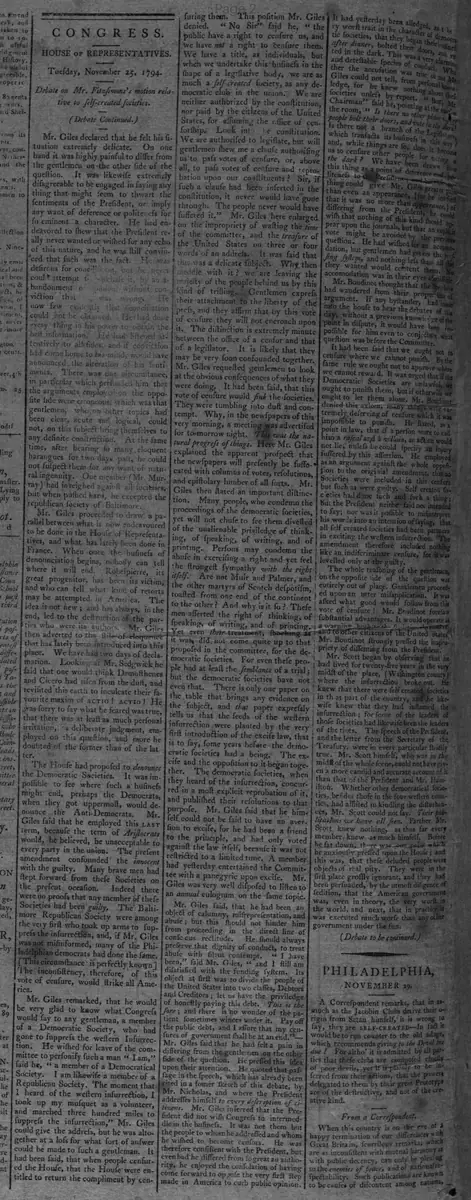
HOUSE OF REPRESENTATIVES.
Tuesday, November 25, 1794.
Mr. Giles declared that he felt his situation extremely delicate. On one hand it was highly painful to differ from the gentlemen on the other side of the question. It was likewise extremely disagreeable to be engaged in saying anything that might seem to thwart the sentiments of the President, or imply any want of deference or politeness for so eminent a character. He had endeavored to show that the President really never wanted or wished for any echo of this nature, and he was still convinced that such was the fact. He was desirous for conciliation, but he never could attempt to sacrifice it, by an abandonment of opinion, without conviction that he was wrong. He now saw evidently that conciliation could not be obtained. He had done everything in his power to obtain the best information. He had listened attentively to all sides, and if conviction had come home to his mind, would have announced the alteration of his sentiments. There was one circumstance, in particular which persuaded him that the arguments employed on the opposite side were erroneous, which was that gentlemen, who, on other topics had been clear, acute and logical, could not, on this subject bring themselves to any definite construction. At the same time, after hearing so many eloquent harangues for two days past, he could not suspect them for any want of natural ingenuity. One member (Mr. Murray) had inveighed against all societies, but when pushed hard, he excepted the republican society of Baltimore.
Mr. Giles proceeded to draw a parallel between what is now endeavored to be done in the House of Representatives, and what has lately been done in France. When once the business of denunciation begins, nobody can tell where it will end. Robespierre, its great progenitor, has been its victim and who can tell what kind of retorts may be attempted in America. The idea is not new; and has always, in the end, led to the destruction of the parties who were its authors. Mr. Giles then adverted to the style of eloquence that has lately been introduced into this place. We have had two days of declamation. Looking at Mr. Sedgwick he said that one would think Demosthenes and Cicero had risen from the dust, and revisited this earth to inculcate their favorite maxim of ACTIO! ACTIO! He was sorry to say what he feared was true, that there was at least as much personal irritation, as deliberate judgment, employed on this question, and more he doubted of the former than of the latter. The House had proposed to denounce the Democratic Societies. It was impossible to see where such a business might end, perhaps the Democrats, when they got uppermost, would denounce the Anti-Democrats. Mr. Giles said that he employed this LAST term, because the term of Aristocrats would, he believed, be unacceptable to every party in the union. The present amendment confounded the innocent with the guilty. Many brave men had stepped forward from these Societies on the present occasion. Indeed there were no proofs that any member of these Societies had been guilty. The Baltimore Republican Society were among the very first who took up arms to suppress the insurrection, and, if Mr. Giles was not misinformed, many of the Philadelphia democrats had done the same. "This circumstance is perfectly known. The inconsistency, therefore, of this vote of censure, would strike all America. Mr. Giles remarked, that he would be very glad to know what Congress would say to any gentleman, a member of a Democratic Society, who had gone to suppress the western Insurrection. He wished for leave of the committee to personify such a man "I am," said he, "a member of a Democratical Society. I am likewise a member of a Republican Society. The moment that I heard of the western insurrection, I took up my musket as a volunteer, and marched three hundred miles to suppress the insurrection," Mr. Giles could give the address, but he was altogether at a loss for what sort of an answer could be made to such a gentleman. It had been said, that when people censured the House, that the House were entitled to return the compliment by censuring them. This position Mr. Giles denied. "No Sir" said he, "the public have a right to censure us, and we have not a right to censure them. We have a right, as individuals, but when we undertake this business in the shape of a legislative body, we are as much a self-created society, as any democratic club in the union." We are neither authorized by the constitution, nor paid by the citizens of the United States, for assuming the office of censorship. Look into the constitution. We are authorized to legislate, but will gentlemen shew me a clause authorising us to pass votes of censure, or, above all, to pass votes of censure and reprobation upon our constituents? Sir, if such a clause had been inserted in the constitution, it never would have gone through. The people never would have [of the committee, and the treasure of the United States on three or four words of an address. It was said that thus was a delicate subject. Why then meddle with it? we are leaving the majesty of the people behind us by this kind of trifling. Gentlemen express their attachment to the liberty of the press, and they affirm that by this vote of censure they will not encroach upon it. The distinction is extremely minute between the office of a censor and that of a legislator. It is likely that they may be very soon confounded together. Mr. Giles requested gentlemen to look at the obvious consequences of what they were doing. It had been said, that this vote of censure would sink the societies. They were tumbling into dust and contempt. Why, in the newspapers of this very morning, a meeting was advertised for to-morrow night. This was the natural progress of things. Here Mr. Giles explained the apparent prospect that the newspapers will presently be stuffed with columns of votes, resolutions, and epistolary lumber of all sorts. Mr. Giles then stated an important distinction. Many people, who condemn the proceedings of the democratic societies, yet will not choose to see them divested of the unalienable privilege of thinking, of speaking, of writing, and of printing. Persons may condemn the abuse in exercising a right and yet feel the strongest sympathy with the right itself. Are not Muir and Palmer, and the other martyrs of Scotch despotism, toasted from one end of the continent to the other? And why is it so? These men asserted the right of thinking, of speaking, of writing, and of printing. Yet even their treatment, shocking as it was, did not come quite up to that proposed in the committee, for the democratic societies. For even these people had at least the semblance of a trial; but the democratic societies have not even that. There is only one paper on the table that brings any evidence on the subject, and that paper expressly tells us that the seeds of the western insurrection were planted by the very first introduction of the excise law, that is to say, some years before the democratic societies had a being. The excise and the opposition to it began together. The democratic societies, when they heard of the insurrection, concurred in a most explicit reprobation of it, and published their resolutions to that purpose. Mr. Giles said that he himself could not be said to have an aversion to excise, for he had been a friend to the principle, and had only voted against the law itself, because it was not restricted to a limited time. A member had yesterday entertained the Committee with a panegyric upon excise. Mr. Giles was very well disposed to listen to an annual eulogium on the same topic. Mr. Giles said, that he had been an object of calumny, misrepresentation, and abuse; but this should not hinder him from proceeding in the direct line of conscious rectitude. He should always preserve that dignity of conduct, to treat abuse with silent contempt. "I have been," said Mr. Giles, "and I still am dissatisfied with the funding system. Its object at first was to divide the people of the United States into two classes, Debtors and Creditors; let us have the privilege of honestly paying this debt. This is the sore; and there is no wonder of the patient sometimes winces under it. Pay off the public debt, and I assure that my censures of government shall be at an end." Mr. Giles said that he had felt a pain in differing from the gentlemen on the other side of the question. He pressed this idea upon their attention. He quoted that passage in the speech, which has already been cited in a former sketch of this debate, by Mr. Nicholas, and where the President addresses himself to every description of citizens. Mr. Giles inferred that the President did not wish Congress to intermeddle in the business. It was not them but the people to whom he addressed and whom he wished to become censors. He was therefore consistent with the President, but even had he differed from so great an authority, he enjoyed the consolation of having come forward to oppose the very first attempt made in America to curb public opinion.
It had yesterday been alleged as the very worst trait in the character of democratic societies that they began their business after dinner, bolted their doors, and [voted?] in the detestable dark. This was a very alarming accusation. Mr. Giles could not know from personal knowledge whether it was true or not. But, said he, pointing at the Chairman, "Is there no other place where people bolt their doors, and vote in the dark? Is there not a branch of the Legislature, which transacts its business in this way and, while things are so, does it become us to censure other people for voting in the dark? We have been drawn into this thing as a point of deference--and politeness to the President--and because nothing could give Mr. Giles greater pain than even an appearance, (for he insisted that it was no more than appearance,) of differing from the President, he could wish that nothing of this kind should appear upon the journals, but that an explicit vote might be avoided by the previous question. He had wished for an accommodation, but gentlemen had got on the prevailing system, and nothing less than all that they wanted would content them. No accommodation was in their eyes admissible. Mr. Boudinot thought that the Speakers had wandered from their proper line of argument. If any bystander, had come into the house to hear the debates of this day, without a previous knowledge of the point in dispute, it would have been impossible for him even to conjecture what question was before the Committee. It had been said that we ought not to censure where we cannot punish. By the same rule we ought not to approve where we cannot reward. It was urged that if the Democratic Societies are unlawful, we ought to punish them, but if otherwise we ought to let them alone. Mr. Boudinot denied this axiom, many things were extremely deserving of censure which it was impossible to punish. He instated, as a point in law, that if a person were to call him a rascal and a villain, an action would not lie, unless he could specify an injury suffered by this assertion. He employed as an argument against the whole opposition to the original amendment, that no Societies were included in this censure but such as were guilty. Self created societies had done such and such a thing; but the President neither said nor intended to say; nor was it possible to misinterpret his words into an intention of saying, that all self created societies had been partners in exciting the western insurrection. The amendment therefore included nothing like an indiscriminate censure, for it was levelled only at the guilty. The whole reasoning of the gentlemen on the opposite side of the question was entirely out of place. Gentlemen proceeded upon an utter misapplication. It was asked what good would follow from this vote of censure! Mr. Boudinot foresaw substantial advantages. It would operate as a warning both to themselves and to other citizens of the United States. Mr. Boudinot strongly pressed the impropriety of dissenting from the President. Mr. Scott began by observing that he had lived for twenty-five years in the very midst of the place, (Washington county) where the insurrection broke out. He knew that there were self created societies in that part of the country, and he likewise knew that they had inflamed the insurrection: for some of the leaders of those societies had likewise been the leaders of the riots. The speech of the President, and the letter from the Secretary of the Treasury, were in every particular strictly true. Mr. Scott himself, who was in the midst of the whole scene, could not have given a more candid and accurate account of it than that of the President and Mr. Hamilton. Whether other democratical societies, besides those in the four western counties, had assisted in kindling the disturbances, Mr. Scott could not say. Their publications we have all seen. Farther Mr. Scott knew nothing, as thus far every member, knew as much himself. Before he sat down, there was one point which he anxiously pressed upon the House; and this was, that these deluded people were objects of real pity. They were in the first place grossly ignorant, and they had been persuaded, by the utmost diligence of sedition, that the American government was, even in theory, the very worst in the world, and next, that in practice it was executed much worse than any other government under the sun.
(Debate to be continued.)
PHILADELPHIA, NOVEMBER 29
What sub-type of article is it?
What keywords are associated?
What entities or persons were involved?
Where did it happen?
Domestic News Details
Primary Location
Philadelphia
Event Date
Tuesday, November 25, 1794
Key Persons
Outcome
debate ongoing; no resolution mentioned. societies defended as having suppressed the insurrection; censure opposed as unconstitutional.
Event Details
Mr. Giles spoke against censuring Democratic Societies for the western insurrection, arguing it confounds innocent and guilty, violates free speech and Constitution, parallels French Reign of Terror. He noted societies' role in suppressing the revolt. Mr. Boudinot defended the targeted censure as a warning. Mr. Scott affirmed societies inflamed the unrest in western counties based on personal knowledge.