Thank you for visiting SNEWPapers!
Sign up free
Alexandria Gazette & Advertiser
Alexandria, Virginia
What is this article about?
News dispatch from Liverpool via ship Robert Fulton arriving in New York on June 27, covering cotton market prices and duty postponement, Irish famine and relief efforts, political reform meetings, anti-slavery discussions with John Randolph's speech, labor disturbances; later updates from ship Atlantic on London stocks, typhus outbreak in Ireland, and commercial restrictions in Baden.
Merged-components note: Merge two adjacent foreign_news components into one story as they continue the 'Latest from Europe' narrative without clear break, focusing on European commercial and political news.
Clipping
OCR Quality
Full Text
FROM LIVERPOOL.
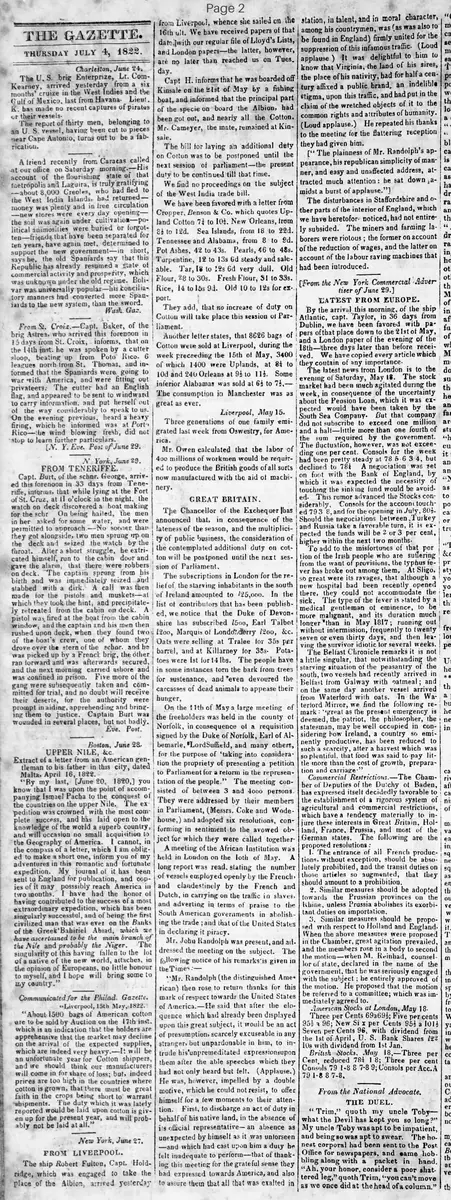
The ship Robert Fulton, Capt. Holdridge, which was engaged to take the place of the Albion, arrived yesterday from Liverpool, whence she sailed on the 16th ult. We have received papers of that date with our regular file of Lloyd's Lists, and London papers—the latter, however, are no later than reached us on Tuesday day.
Capt. H. informs that he was boarded off Kinsale on the 31st of May by a fishing boat, and informed that the principal part of the specie on board the Albion, had been got out, and nearly all the Cotton. Mr. Cameyer, the mate, remained at Kinsale.
The bill for laying an additional duty on Cotton was to be postponed until the next session of parliament—the present duty to be continued till that time.
We find no proceedings on the subject of the West India trade bill.
We have been favored with a letter from Cropper, Benson & Co. which quotes Upland Cotton 7d to 10d. New Orleans, from 8 to 12d. Sea Islands, from 18 to 22d. Tennessee and Alabama, from 8 to 9d. Pot Ashes, 42 to 43s. Pearls, 46 to 48s. Turpentine, 12 to 13s 6d steady and saleable. Tar, 18 to 2s 6d very dull. Old Flour, 28 to 30s. Fresh Flour, 31 to 33s. Rice, 14 to 15s 9d. Old 10 to 12s for export.
They add, that no increase of duty on Cotton will take place this session of Parliament.
Another letter states, that 8626 bags of Cotton were sold at Liverpool, during the week preceding the 15th of May, 3400 of which 1400 were Uplands, at 8½ to 10d and 240 Orleans at 9½ to 11½. Some inferior Alabamas was sold at 6 to 7d.—The consumption in Manchester was as great as ever.
Liverpool, May 15.
Three generations of one family emigrated last week from Oswestry, for America.
Mr. Owen calculated that the labor of 400 millions of workmen would be required to produce the British goods of all sorts now manufactured with the aid of machinery.
GREAT BRITAIN.
The Chancellor of the Exchequer has announced that, in consequence of the lateness of the season, and the multiplicity of public business, the consideration of the contemplated additional duty on cotton will be postponed until the next session of Parliament.
The subscriptions in London for the relief of the starving inhabitants in the south of Ireland amounted to £25,000. In the list of contributors that has been published, we notice that the Duke of Devonshire has subscribed £1500. Earl Talbot £1200, Marquis of Londonderry £1200, &c.
Oats were selling at Tralee for 35s per barrel, and at Killarney for 38s. Potatoes were 1s 1d for 14 lbs. The people have in some instances torn the bark from trees for sustenance, and "even devoured the carcasses of dead animals to appease their hunger."
On the 11th of May a large meeting of the freeholders was held in the county of Norfolk, in consequence of a requisition signed by the Duke of Norfolk, Earl of Albemarle, Lord Suffield, and many others, for the purpose of taking into consideration the propriety of presenting a petition to Parliament for a reform in the representation of the people." The meeting consisted of between 3 and 4000 persons. They were addressed by their members in Parliament, (Messrs. Coke and Wodehouse,) and adopted six resolutions, conforming in sentiment to the avowed object for which they were called together.
A meeting of the African Institution was held in London on the 10th of May. A long report was read, stating the number of vessels employed openly by the French and clandestinely by the French and Dutch, in carrying on the traffic in slaves, and adverting in terms of praise to the South American governments in abolishing the trade; and that of the United States in declaring it piracy.
Mr. John Randolph was present, and addressed the meeting on the subject. The following notice of his remarks is given in the Times:-
"Mr. Randolph (the distinguished American) then rose to return thanks for this mark of respect towards the United States of America.—He said that after the eloquence which had already been displayed upon this great subject, it would be an act of presumption, scarcely excusable in any stranger, but unpardonable in him, to intrude his unpremeditated expressions upon them after the able speeches which they had not only heard but felt. (Applause.) He was, however, impelled by a double motive, which he could not resist, to offer himself for a few moments to their attention. First, to discharge an act of duty in behalf of his native land, in the absence of its official representative—an absence as unexpected by himself as it was unforeseen—and which had cast upon him a duty he felt inadequate to perform—that of thanking this meeting for the grateful sense they had expressed towards America, and also to assure them that all that was exalted in station, in talent, and in moral character, among his countrymen, was (as was also to be found in England) firmly united for the suppression of this infamous traffic. (Loud applause.) It was delightful to him to know that Virginia, the land of his sires, the place of his nativity, had for half a century affixed a public brand, an indelible stigma, upon this traffic, and had put in the claim of the wretched objects of it to the common rights and attributes of humanity. (Loud applause.) He repeated his thanks to the meeting for the flattering reception they had given him.
["The plainness of Mr. Randolph's appearance, his republican simplicity of manner, and easy and unaffected address, attracted much attention: he sat down amidst a burst of applause."]
The disturbances in Staffordshire and other parts of the interior of England, which we have heretofore noticed, had not entirely subsided. The miners and farming laborers were riotous; the former on account of the reduction of wages, and the latter on account of the labour saving machines that had been introduced.
[From the New York Commercial Advertiser of June 29.]
LATEST FROM EUROPE.
By the arrival this morning, of the ship Atlantic, capt. Taylor, in 36 days from Dublin, we have been favored with papers of that place down to the 21st of May, and a London paper of the evening of the 18th—three days later than before received. We have copied every article which they contain of any importance.
The latest news from London is to the evening of Saturday, May 18. The stock market had been much agitated during the week, in consequence of the uncertainty about the Pension Loan, which it was expected would have been taken by the South Sea Company. But that company did not subscribe to exceed one million and a half—little more than one fourth of the sum required by the government. The fluctuation, however, was not exceeding one per cent. Consols for the week had been pretty steady at 78 5-8 3-4, but declined to 78½. A negociation was set on foot with the Bank of England, by which it was expected the necessity of touching the sinking fund would be avoided. This rumor advanced the Stocks considerably, Consols for the account touched 79⅜, and for the opening in July, 80½.
Should the negociations between Turkey and Russia take a favorable turn, it is expected the funds will be 2 or 3 per cent, higher within the next two months.
To add to the misfortunes of that portion of the Irish people who are suffering from the want of provisions, the typhus fever has broke out among them. At Sligo, so great were its ravages, that although a new hospital had been recently opened there, they could not accommodate the sick. The type of the fever is stated by a medical gentleman of eminence, to be more malignant, and its duration much longer than in May 1817; running out without intermission, frequently to twenty seven or even thirty days, and then leaving the survivor idiotic for several weeks.
The Belfast Chronicle remarks it is not a little singular, that notwithstanding the starving situation of the peasantry of the south, two vessels had recently arrived in Belfast from Galway with oatmeal; and on the same day another vessel arrived from Waterford with oats. In the Waterford Mirror, we find the following remark: 'great as the present emergency is deemed, the patriot, the philosopher, the statesman, may be well occupied in considering how Ireland, a country so eminently productive, has been reduced to such a scarcity, after a harvest which was so plentiful, that food was said to pay little more than the cost of growth, preparation and carriage.'
Commercial Restrictions.—The Chamber of Deputies of the Duchy of Baden, has expressed itself decidedly favorable to the establishment of a rigorous system of agricultural and commercial restrictions, which have a tendency materially to injure these interests in Great Britain. Holland, France, Prussia, and most of the German states. The following are the proposed resolutions:
I. The entrance of all French productions, without exception, should be absolutely prohibited, and the transit duties on those articles so augmented, that they should amount to a prohibition.
2. Similar measures should be adopted towards the Prussian provinces on the Rhine, unless Prussia abolishes its exorbitant duties on importation,
3. Similar measures should be proposed with respect to Holland and England.
When the above measures were proposed in the Chamber, great agitation prevailed, and the members rose in a body to second the motion—when M. Reinhard, councillor of state, declared in the name of the government, that he was seriously engaged with the subject; he entirely approved of the motion. He proposed that the motion be referred to a committee; which was immediately agreed to.
American Stocks at London, May 18.
Three per Cents 69½ 69¾; Five per cents 95½ a 96: New Six per Cents 95½ a 101
Seven per Cents 96, with dividend from the 1st of April. U. S. Bank Shares 122 10s with dividend from 1st Jan.
British Stocks, May 18.—Three per Cent. reduced 78½ 18; Three per cent Consols 79 1-8 8 7-8 9; Consols per Acc. 79 1-8 8 7-8,
What sub-type of article is it?
What themes does it cover?
What keywords are associated?
What entities or persons were involved?
Where did it happen?
Story Details
Key Persons
Location
Liverpool, London, Ireland, Norfolk, Staffordshire, Dublin, Sligo, Baden
Event Date
June 27, Sailed May 16; News To May 21
Story Details
Compilation of European news including ship arrivals carrying dispatches, salvage of Albion's cargo, cotton market prices and duty postponement, family emigration to America, labor calculations, Irish famine relief subscriptions and starvation reports, Norfolk reform meeting, London anti-slavery meeting with John Randolph's address praising U.S. efforts, English labor riots, London stock fluctuations, typhus outbreak in Ireland, Irish food scarcity paradoxes, and Baden's proposed commercial restrictions against France, Prussia, Holland, and England.