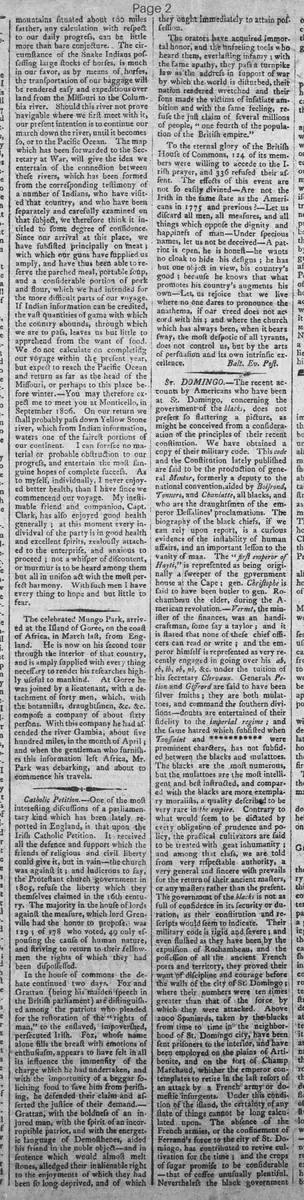
Catholic Petition.--One of the most interesting discussions of a parliamentary kind which has been lately reported in England, is that upon the Irish Catholic Petition. It received all the defence and support which the friends of religious and civil liberty could give it, but in vain-the church was against it; and ludicrous to say, the Protestant church government in 1805, refuse the liberty which they themselves claimed in the 16th century. The majority in the house of lords against the measure, which lord Grenville had the honor to propose, was 129; of 478 who voted, 49 only espousing the cause of human nature, and striving to return to their fellow men the rights of which they had been disposed. In the house of commons the debate continued two days. Fox and Grattan (being his maiden speech in the British parliament) distinguished among the patriots who pleaded for the restoration of the "rights of man," to the enslaved, impoverished, persecuted Irish. Fox, whose name alone fills the breast with emotions of enthusiasm, appears to have felt in all its influence the immensity of the charge which he had undertaken, and with the importunity of a beggar soliciting food to save him from perishing, he defended their claim and asserted the justice of their demand. Grattan, with the boldness of an injured man, with the spirit of an incorruptible patriot, and with the energetic language of Demosthenes, aided his friend in the noble object--and in sentences which would almost melt stones, alledged their inalienable right to the enjoyments of which they had been so long deprived, and of which they ought immediately to attain possession. The orators have acquired immortal honor, and the unfeeling tools who heard them, everlasting infamy; with the same apathy, they pass a turnpike law as the address in support of war by which the world is disturbed, their nation rendered wretched and their sons made the victims of insatiate ambition and with the same feeling. refuse the just claim of several millions of people, "one fourth of the population of the British empire." To the eternal glory of the British House of Commons, 124 of its members were willing to accede to the Irish prayer, and 336 refused their assent. The effects of this event are not so easily divined--Are not the Irish in the same state as the Americans in 1775 and previous?-Let us discard all men, all measures, and all things which oppose the dignity. and happiness of man--Under specious names, let us not be deceived-A patriot is open, he is honest-he wants no cloak to hide his designs : he has but one object in view, his country's good ; because he knows that what promotes his country's augments his own--Let, us rejoice that we live where no one dares to pronounce the anathema, if our creed does not accord with-his : and where the church which has always been, when it bears sway, the most despotic of all tyrants, does not control us, but by the arts of persuasion and its own intrinsic excellence.