Thank you for visiting SNEWPapers!
Sign up free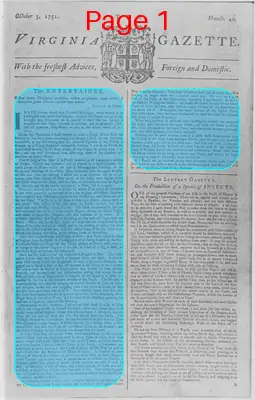
Literary
October 3, 1751
The Virginia Gazette
Richmond, Williamsburg, Richmond County, Virginia
What is this article about?
An essay challenging the common belief that dew falls from the sky, asserting instead that it rises as vapor from the heated earth and condenses into drops. Supported by experiments using tow bundles and glass plates on poles to observe moisture ascent.
Clipping
OCR Quality
98%
Excellent
Full Text
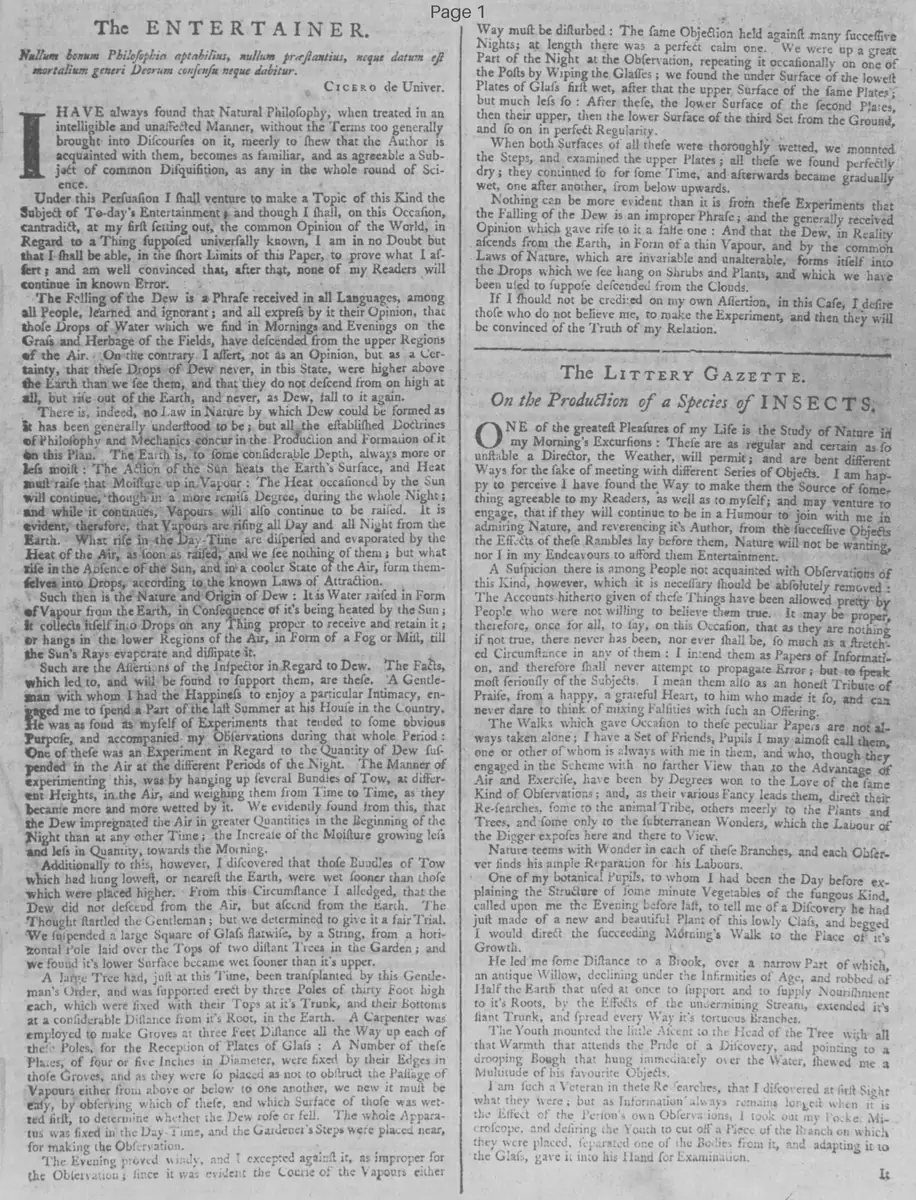
The ENTERTAINER.
Nullum bonum Philosophia aptabilius, nullum præstantius, neque datum e mortalium generi Deorum consensu neque dabitur.
Cicero de Univ.
I have always found that Natural Philosophy, when treated in an intelligible and unaffected Manner, without the Terms too generally brought into Discourses on it, merely to show that the Author is acquainted with them, becomes as familiar, and as agreeable a Subject of common Disquisition, as any in the whole round of Science.
Under this Persuasion I shall venture to make a Topic of this Kind the Subject of To-day's Entertainment; and though I shall, on this Occasion, contradict, at my first setting out, the common Opinion of the World, in Regard to a Thing supposed universally known, I am in no Doubt but that I shall be able, in the short Limits of this Paper, to prove what I assert; and am well convinced that, after that, none of my Readers will continue in known Error.
The Falling of the Dew is a Phrase received in all Languages, among all People, learned and ignorant; and all express by it their Opinion, that those Drops of Water which we find in Mornings and Evenings on the Grass and Herbage of the Fields, have descended from the upper Regions of the Air. On the contrary I assert, not as an Opinion, but as a Certainty, that these Drops of Dew never, in this State, were higher above the Earth than we see them, and that they do not descend from on high at all, but rise out of the Earth, and never, as Dew, fall to it again.
There is, indeed, no Law in Nature by which Dew could be formed as it has been generally understood to be; but all the established Doctrines of Philosophy and Mechanics concur in the Production and Formation of it on this Plan. The Earth is, to some considerable Depth, always more or less moist: The Action of the Sun heats the Earth's Surface, and Heat must raise that Moisture up in Vapour: The Heat occasioned by the Sun will continue, though in a more remiss Degree, during the whole Night; and while it continues, Vapours will also continue to be raised. It is evident, therefore, that Vapours are rising all Day and all Night from the Earth. What rise in the Day-Time are dispersed and evaporated by the Heat of the Air, as soon as raised, and we see nothing of them; but what rise in the Absence of the Sun, and in a cooler State of the Air, form themselves into Drops, according to the known Laws of Attraction.
Such then is the Nature and Origin of Dew: It is Water raised in Form of Vapour from the Earth, in Consequence of it's being heated by the Sun; it collects itself into Drops on any Thing proper to receive and retain it; or hangs in the lower Regions of the Air, in Form of a Fog or Mist, till the Sun's Rays evaporate and dissipate it.
Such are the Assertions of the Inspector in Regard to Dew. The Facts, which led to, and will be found to support them, are these. A Gentleman with whom I had the Happiness to enjoy a particular Intimacy, engaged me to spend a Part of the last Summer at his House in the Country. He was as fond as myself of Experiments that tended to some obvious Purpose, and accompanied my Observations during that whole Period:
One of these was an Experiment in Regard to the Quantity of Dew suspended in the Air at the different Periods of the Night. The Manner of experimenting this, was by hanging up several Bundles of Tow, at different Heights, in the Air, and weighing them from Time to Time, as they became more and more wetted by it. We evidently found from this, that the Dew impregnated the Air in greater Quantities in the Beginning of the Night than at any other Time; the Increase of the Moisture growing less and less in Quantity, towards the Morning
Additionally to this, however, I discovered that those Bundles of Tow which had hung lowest, or nearest the Earth, were wet sooner than those which were placed higher. From this Circumstance I alleged, that the Dew did not descend from the Air, but ascend from the Earth. The Thought startled the Gentleman; but we determined to give it a fair Trial. We suspended a large Square of Glass flatwise, by a String, from a horizontal Pole laid over the Tops of two distant Trees in the Garden; and we found it's lower Surface became wet sooner than it's upper.
A large Tree had, just at this Time, been transplanted by this Gentleman's Order, and was supported erect by three Poles of thirty Foot high each, which were fixed with their Tops at it's Trunk, and their Bottoms at a considerable Distance from it's Root, in the Earth. A Carpenter was employed to make Groves at three Feet Distance all the Way up each of these Poles, for the Reception of Plates of Glass: A Number of these Plates, of four or five Inches in Diameter, were fixed by their Edges in those Groves, and as they were so placed as not to obstruct the Passage of Vapours either from above or below to one another, we knew it must be easy, by observing which of these, and which Surface of those was wetted first, to determine whether the Dew rose or fell. The whole Apparatus was fixed in the Day-Time, and the Gardener's Steps were placed near, for making the Observation.
The Evening proved windy, and I excepted against it, as improper for the Observation; since it was evident the Course of the Vapours either Way must be disturbed: The same Objection held against many successive Nights; at length there was a perfect calm one. We were up a great Part of the Night at the Observation, repeating it occasionally on one of the Posts by Wiping the Glass; we found the under Surface of the lowest Plates of Glass first wet, after that the upper Surface of the same Plates; but much less so: After these, the lower Surface of the second Plates, then their upper, then the lower Surface of the third Set from the Ground, and so on in perfect Regularity.
When both Surfaces of all these were thoroughly wetted, we mounted the Steps, and examined the upper Plates; all these we found perfectly dry; they continued so for some Time, and afterwards became gradually wet, one after another, from below upwards.
Nothing can be more evident than it is from these Experiments that the Falling of the Dew is an improper Phrase; and the generally received Opinion which gave rise to it a false one: And that the Dew, in Reality ascends from the Earth, in Form of a thin Vapour, and by the common Laws of Nature, which are invariable and unalterable, forms itself into the Drops which we see hang on Shrubs and Plants, and which we have been used to suppose descended from the Clouds.
If I should not be credited on my own Assertion, in this Case, I desire those who do not believe me, to make the Experiment, and then they will be convinced of the Truth of my Relation.
Nullum bonum Philosophia aptabilius, nullum præstantius, neque datum e mortalium generi Deorum consensu neque dabitur.
Cicero de Univ.
I have always found that Natural Philosophy, when treated in an intelligible and unaffected Manner, without the Terms too generally brought into Discourses on it, merely to show that the Author is acquainted with them, becomes as familiar, and as agreeable a Subject of common Disquisition, as any in the whole round of Science.
Under this Persuasion I shall venture to make a Topic of this Kind the Subject of To-day's Entertainment; and though I shall, on this Occasion, contradict, at my first setting out, the common Opinion of the World, in Regard to a Thing supposed universally known, I am in no Doubt but that I shall be able, in the short Limits of this Paper, to prove what I assert; and am well convinced that, after that, none of my Readers will continue in known Error.
The Falling of the Dew is a Phrase received in all Languages, among all People, learned and ignorant; and all express by it their Opinion, that those Drops of Water which we find in Mornings and Evenings on the Grass and Herbage of the Fields, have descended from the upper Regions of the Air. On the contrary I assert, not as an Opinion, but as a Certainty, that these Drops of Dew never, in this State, were higher above the Earth than we see them, and that they do not descend from on high at all, but rise out of the Earth, and never, as Dew, fall to it again.
There is, indeed, no Law in Nature by which Dew could be formed as it has been generally understood to be; but all the established Doctrines of Philosophy and Mechanics concur in the Production and Formation of it on this Plan. The Earth is, to some considerable Depth, always more or less moist: The Action of the Sun heats the Earth's Surface, and Heat must raise that Moisture up in Vapour: The Heat occasioned by the Sun will continue, though in a more remiss Degree, during the whole Night; and while it continues, Vapours will also continue to be raised. It is evident, therefore, that Vapours are rising all Day and all Night from the Earth. What rise in the Day-Time are dispersed and evaporated by the Heat of the Air, as soon as raised, and we see nothing of them; but what rise in the Absence of the Sun, and in a cooler State of the Air, form themselves into Drops, according to the known Laws of Attraction.
Such then is the Nature and Origin of Dew: It is Water raised in Form of Vapour from the Earth, in Consequence of it's being heated by the Sun; it collects itself into Drops on any Thing proper to receive and retain it; or hangs in the lower Regions of the Air, in Form of a Fog or Mist, till the Sun's Rays evaporate and dissipate it.
Such are the Assertions of the Inspector in Regard to Dew. The Facts, which led to, and will be found to support them, are these. A Gentleman with whom I had the Happiness to enjoy a particular Intimacy, engaged me to spend a Part of the last Summer at his House in the Country. He was as fond as myself of Experiments that tended to some obvious Purpose, and accompanied my Observations during that whole Period:
One of these was an Experiment in Regard to the Quantity of Dew suspended in the Air at the different Periods of the Night. The Manner of experimenting this, was by hanging up several Bundles of Tow, at different Heights, in the Air, and weighing them from Time to Time, as they became more and more wetted by it. We evidently found from this, that the Dew impregnated the Air in greater Quantities in the Beginning of the Night than at any other Time; the Increase of the Moisture growing less and less in Quantity, towards the Morning
Additionally to this, however, I discovered that those Bundles of Tow which had hung lowest, or nearest the Earth, were wet sooner than those which were placed higher. From this Circumstance I alleged, that the Dew did not descend from the Air, but ascend from the Earth. The Thought startled the Gentleman; but we determined to give it a fair Trial. We suspended a large Square of Glass flatwise, by a String, from a horizontal Pole laid over the Tops of two distant Trees in the Garden; and we found it's lower Surface became wet sooner than it's upper.
A large Tree had, just at this Time, been transplanted by this Gentleman's Order, and was supported erect by three Poles of thirty Foot high each, which were fixed with their Tops at it's Trunk, and their Bottoms at a considerable Distance from it's Root, in the Earth. A Carpenter was employed to make Groves at three Feet Distance all the Way up each of these Poles, for the Reception of Plates of Glass: A Number of these Plates, of four or five Inches in Diameter, were fixed by their Edges in those Groves, and as they were so placed as not to obstruct the Passage of Vapours either from above or below to one another, we knew it must be easy, by observing which of these, and which Surface of those was wetted first, to determine whether the Dew rose or fell. The whole Apparatus was fixed in the Day-Time, and the Gardener's Steps were placed near, for making the Observation.
The Evening proved windy, and I excepted against it, as improper for the Observation; since it was evident the Course of the Vapours either Way must be disturbed: The same Objection held against many successive Nights; at length there was a perfect calm one. We were up a great Part of the Night at the Observation, repeating it occasionally on one of the Posts by Wiping the Glass; we found the under Surface of the lowest Plates of Glass first wet, after that the upper Surface of the same Plates; but much less so: After these, the lower Surface of the second Plates, then their upper, then the lower Surface of the third Set from the Ground, and so on in perfect Regularity.
When both Surfaces of all these were thoroughly wetted, we mounted the Steps, and examined the upper Plates; all these we found perfectly dry; they continued so for some Time, and afterwards became gradually wet, one after another, from below upwards.
Nothing can be more evident than it is from these Experiments that the Falling of the Dew is an improper Phrase; and the generally received Opinion which gave rise to it a false one: And that the Dew, in Reality ascends from the Earth, in Form of a thin Vapour, and by the common Laws of Nature, which are invariable and unalterable, forms itself into the Drops which we see hang on Shrubs and Plants, and which we have been used to suppose descended from the Clouds.
If I should not be credited on my own Assertion, in this Case, I desire those who do not believe me, to make the Experiment, and then they will be convinced of the Truth of my Relation.
What sub-type of article is it?
Essay
What themes does it cover?
Nature
What keywords are associated?
Dew Formation
Natural Philosophy
Vapor Ascent
Scientific Experiment
Condensation
Literary Details
Subject
On The Formation Of Dew
Form / Style
Prose Essay On Natural Philosophy
Key Lines
The Falling Of The Dew Is A Phrase Received In All Languages, Among All People, Learned And Ignorant; And All Express By It Their Opinion, That Those Drops Of Water Which We Find In Mornings And Evenings On The Grass And Herbage Of The Fields, Have Descended From The Upper Regions Of The Air. On The Contrary I Assert, Not As An Opinion, But As A Certainty, That These Drops Of Dew Never, In This State, Were Higher Above The Earth Than We See Them, And That They Do Not Descend From On High At All, But Rise Out Of The Earth, And Never, As Dew, Fall To It Again.
Such Then Is The Nature And Origin Of Dew: It Is Water Raised In Form Of Vapour From The Earth, In Consequence Of It's Being Heated By The Sun; It Collects Itself Into Drops On Any Thing Proper To Receive And Retain It; Or Hangs In The Lower Regions Of The Air, In Form Of A Fog Or Mist, Till The Sun's Rays Evaporate And Dissipate It.
Nothing Can Be More Evident Than It Is From These Experiments That The Falling Of The Dew Is An Improper Phrase; And The Generally Received Opinion Which Gave Rise To It A False One: And That The Dew, In Reality Ascends From The Earth, In Form Of A Thin Vapour, And By The Common Laws Of Nature, Which Are Invariable And Unalterable, Forms Itself Into The Drops Which We See Hang On Shrubs And Plants, And Which We Have Been Used To Suppose Descended From The Clouds.