Thank you for visiting SNEWPapers!
Sign up free
The Enquirer
Richmond, Henrico County, Virginia
What is this article about?
Extract from Dr. Cowdery's journal during American captivity in Tripoli, detailing daily events from August 10-30: prisoner mistreatment and petition to Bashaw, naval truces and bombardments by U.S. squadron under Commodore Preble, negotiations for ransom, deaths including Lt. Smith and Mr. Church, and local customs.
Clipping
OCR Quality
Full Text
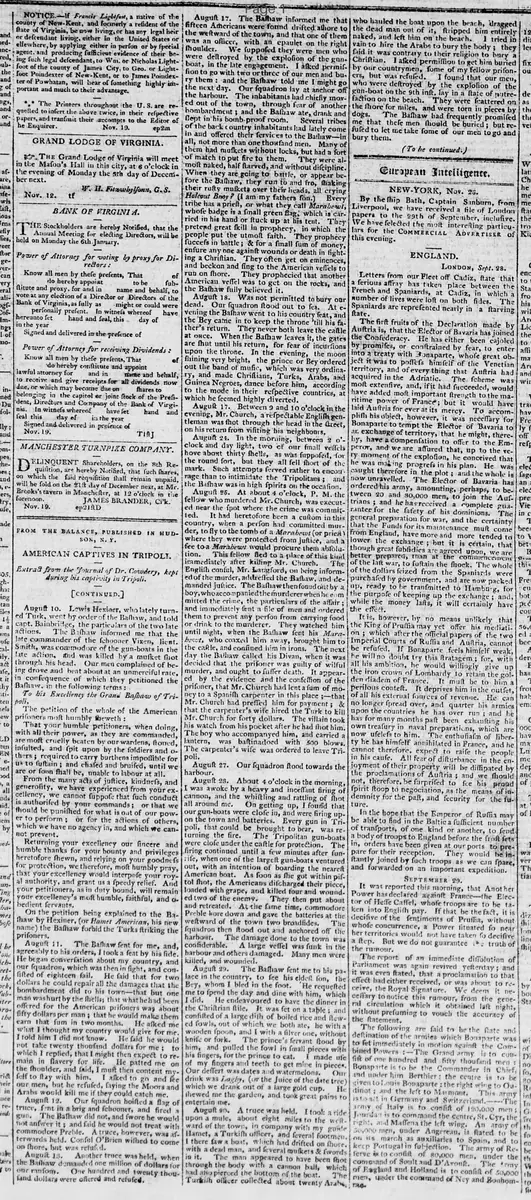
AMERICAN CAPTIVES IN TRIPOLI.
Extract from the Journal of Dr. Cowdery, kept during his captivity in Tripoli.
[Continued.]
August 10. Lewis Heinsner, who lately turned Turk, went by order of the Bashaw, and told capt. Bainbridge, the particulars of the two late actions.
The Bashaw informed me that the late commander of the schooner Vixen, lieut. Smith, was commodore of the gun-boats in the late action, and was killed by a musket shot through his head. Our men complained of being drove and beat about at an unmerciful rate, in consequence of which they petitioned the Bashaw, in the following terms:
To his Excellency the Grand Bashaw of Tripoli,
The petition of the whole of the American prisoners most humbly sheweth:
That your humble petitioners, when doing, with all their power, as they are commanded, are most cruelly beaten by our wardens, stoned, insulted, and spit upon by the soldiers and others: required to carry burthens impossible for us to sustain; and chased and bruised, until we are or soon shall be, unable to labour at all.
From the many acts of justice, kindness, and generosity, we have experienced from your excellency, we cannot suppose that such conduct is authorised by your commands; or that we should be punished for what is out of our power to perform; or for the actions of others, which we have no agency in, and which we cannot prevent.
Returning your excellency our sincere and humble thanks for your bounty and privileges heretofore shewn, and relying on your goodness for protection, we therefore, most humbly pray, that your excellency would interpose your royal authority, and grant us a speedy relief. And your petitioners, as in duty bound, will remain your excellency's most humble, faithful, and obedient servants.
On the petition being explained to the Bashaw by Heinsner, (or Hamet American, his new name) the Bashaw forbid the Turks striking the prisoners.
August 11. The Bashaw sent for me, and, agreeably to his orders, I took a seat by his side. He began conversation about my country, and our squadron, which was then in sight, and consisted of eighteen sail. He said that for two dollars he could repair all the damages that the bombardment did to his town-that but one man was hurt by the shells; that what he had been offered for the American prisoners was about fifty dollars per man; that he would make them earn that sum in two months. He asked me what I thought my country would give for me. I told him I did not know. He said he would not take twenty thousand dollars for me; to which I replied, that I might then expect to remain in slavery for life. He patted me on the shoulder, and said, I must then content myself to stay with him. I asked to go and see our men, but he refused, saying the Moors and Arabs would kill me if they could catch me.
August 12. Our squadron hoisted a flag of truce, sent in a brig and schooner, and fired a gun. The Bashaw did not, and swore he would not answer it: and said he would not treat with commodore Preble. A truce, however, was afterwards held. Consul O'Brien wished to come on shore, but was refused.
August 13. Another truce was held, when the Bashaw demanded one million of dollars for our ransom. One hundred and twenty thousand dollars were offered and refused.
August 17. The Bashaw informed me that fifteen Americans were found drifted ashore to the westward of the town, and that one of them was an officer, with an epaulet on the right shoulder. We supposed they were men who were destroyed by the explosion of the gun-boat, in the late engagement. I asked permission to go with two or three of our men and bury them: and the Bashaw told me I might go the next day. Our squadron lay at anchor off the harbour. The inhabitants had chiefly moved out of the town, through fear of another bombardment: and the Bashaw ate, drank and slept in his bomb-proof room. Several tribes of the back country inhabitants had lately come in and offered their services to the Bashaw--in all, not more than one thousand men. Many of them had muskets without locks, but had a sort of match to put fire to them. They were almost naked, half starved, and without discipline. When they are going to battle, or appear before the Bashaw, they run to and fro, shaking their rusty muskets over their heads, all crying Holeout Buoy? (I am my father's son.) Every tribe has a priest, or what they call Marabout, whose badge is a small green flag: which is carried in his hand or stuck up at his tent. They pretend great skill in prophecy, in which the people put the utmost faith. They prophecy success in battle; & for a small sum of money, insure any one against wounds or death in fighting a Christian. They often get on eminences, and beckon and sing to the American vessels to run on shore. They prophesied that another American vessel was to get on the rocks, and the Bashaw fully believed it.
August 18. Was not permitted to bury our dead. Our squadron stood out to sea. At evening the Bashaw went to his country seat, and the Bey came in to keep the throne 'till his father's return. They never both leave the castle at once. When the Bashaw leaves it, the gates are shut until his return, for fear of incursions upon the throne. In the evening, the moon shining very bright, the prince or Bey ordered out the band of music, which was very ordinary, and made Christians, Turks, Arabs, and Guinea Negroes, dance before him, according to the mode in their respective countries, at which he seemed highly diverted.
August 17. Between 9 and 10 o'clock in the evening, Mr. Church, a respectable English gentleman was shot through the head in the street, on his return from visiting his neighbours.
August 24. In the morning, between 2 o'clock and day light, two of our small vessels hove about thirty Shells, as was supposed, for the round fort, but they all fell short of the mark. Such attempts served rather to encourage than to intimidate the Tripolitans; and the Bashaw was in high spirits on the occasion.
August 26. At about 4 o'clock, P. M. the fellow who murdered Mr. Church, was executed near the spot where the crime was committed. It had heretofore been a custom in this country, when a person had committed murder, to fly to the tomb of a Marabout (or priest) where they were protected from justice, and a fee to a Marabout would procure them absolution. This fellow fled to a place of this kind immediately after killing Mr. Church. The English consul, Mr. Langford, on being informed of the murder, addressed the Bashaw, and demanded justice. The Bashaw then found out by a boy, who accompanied the murderer when he committed the crime, the particulars of the affair; and immediately sent a file of men and ordered them to prevent any person from carrying food or drink to the murderer. They watched him until night, when the Bashaw sent his Marabout, who coaxed him away, brought him to the castle, and confined him in irons. The next day the Bashaw called his Divan, when it was decided that the prisoner was guilty of wilful murder, and ought to suffer death. It appeared by the evidence and the confession of the prisoner, that Mr. Church had lent a sum of money to a Spanish carpenter in this place; that Mr. Church had pressed him for payment; & that the carpenter's wife hired the Turk to kill Mr. Church for forty dollars. The villain took his watch from his pocket after he had shot him. The boy who accompanied him, and carried a lantern, was bastinadoed with 500 blows. The carpenter's wife was ordered to leave Tripoli.
August 27. Our squadron stood towards the harbour.
August 28. About 4 o'clock in the morning, I was awoke by a heavy and incessant firing of cannon, and the whistling and rattling of shot all around me. On getting up, I found that our gun-boats were close in, and were firing upon the town and batteries. Every gun in Tripoli, that could be brought to bear, was returning the fire. The Tripolitan gun-boats were close under the castle for protection. The firing continued until a few minutes after sun-rise, when one of the largest gun-boats ventured out, with an intention of boarding the nearest American boat. As soon as he got within pistol shot, the Americans discharged their piece, loaded with grape, and killed four and wounded two of the enemy. They then put about and retreated. At the same time, commodore Preble bore down and gave the batteries at the westward of the town two broadsides. The squadron then stood out and anchored off the harbour. The damage done to the town was considerable. A large vessel was sunk in the harbour and others damaged. Many men were killed, and wounded.
August 29. The Bashaw sent me to his palace in the country, to see his eldest son, the Bey, whom I bled in the foot. He requested me to spend the day and dine with him, which I did. He endeavoured to have the dinner in the Christian style. It was set on a table: and consisted of a large dish of boiled rice and stewed fowls, out of which we both ate, he with a wooden spoon, and I with a silver one, without knife or fork. The prince's servant stood by him, and pulled the fowl in small pieces with his fingers, for the prince to eat. I made use of my fingers and teeth to get mine in pieces. Our dessert was dates and watermelons. Our drink was Lagby, (or the Juice of the date tree) which we drank out of a large gold cup. He shewed me the garden, and took great pains to entertain me.
August 30. A truce was held. I took a ride upon a mule, about eight miles to the westward of the town, in company with my guard Hamet, a Turkish officer, and several footmen. I there saw a boat, which had drifted on shore, with a dead man, and several muskets & swords in it. The man appeared to have been shot through the body with a cannon ball, which had also pierced the bottom of the boat. The Turkish officer collected about twenty Arabs, who hauled the boat upon the beach, dragged the dead man out of it, stripped him entirely naked, and left him on the beach. I tried in vain to hire the Arabs to bury the body; they said it was contrary to their religion to bury a Christian. I asked permission to get him buried by our countrymen, some of my fellow prisoners, but was refused. I found that our men, who were destroyed by the explosion of the gun-boat on the 9th inst. lay in a state of putrefaction on the beach. They were scattered on the shore for miles, and were torn in pieces by dogs. The Bashaw had frequently promised me that these men should be buried; but refused to let me take some of our men to go and bury them.
(To be continued.)
What sub-type of article is it?
What keywords are associated?
What entities or persons were involved?
Where did it happen?
Foreign News Details
Primary Location
Tripoli
Event Date
August 10 To 30
Key Persons
Outcome
lt. smith killed by musket shot; 15 americans drifted ashore dead from gun-boat explosion; mr. church murdered and murderer executed; tripoli gun-boat lost 4 killed, 2 wounded in engagement; considerable damage to tripoli town, vessels sunk, many killed and wounded; ransom demands of 1 million dollars refused, 120,000 offered.
Event Details
Dr. Cowdery's journal recounts daily life in captivity: prisoner petition against mistreatment granted by Bashaw; conversations on ransom and squadron; truces with failed negotiations; failed shelling and bombardment causing damage; murder of Mr. Church and execution; local Arab tribes and customs; refusal to bury American dead; dinner with Bey.