Thank you for visiting SNEWPapers!
Sign up free
Story
July 30, 1905
Daily Press
Newport News, Virginia
What is this article about?
The article details the artisanal industry in Hanoi, French Tonquin, where skilled workmen inlay mother-of-pearl into precious woods using division of labor, crude tools, and materials from local shellfish and mussels. The process involves design, cutting, trenching by children, and polishing, producing beautiful uncounterfeitable items.
Clipping
OCR Quality
95%
Excellent
Full Text
MOTHER OF PEARL.
The Industry of Inlaying It In Precious Woods.
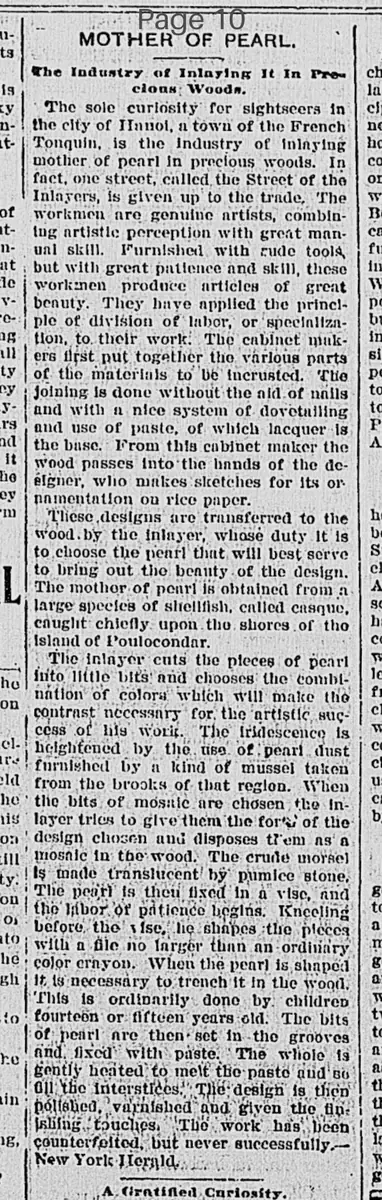
The sole curiosity for sightseers in the city of Hanoi, a town of the French Tonquin, is the industry of inlaying mother of pearl in precious woods. In fact, one street, called the Street of the Inlayers, is given up to the trade. The workmen are genuine artists, combining artistic perception with great manual skill. Furnished with crude tools but with great patience and skill, these workmen produce articles of great beauty. They have applied the principle of division of labor, or specialization, to their work: The cabinet makers first put together the various parts of the materials to be incrusted. The joining is done without the aid of nails and with a nice system of dovetailing and use of paste, of which lacquer is the base. From this cabinet maker the wood passes into the hands of the designer, who makes sketches for its ornamentation on rice paper. These designs are transferred to the wood by the inlayer, whose duty it is to choose the pearl that will best serve to bring out the beauty of the design. The mother of pearl is obtained from a large species of shellfish, called casque, caught chiefly upon the shores of the island of Poulo Condore. The inlayer cuts the pieces of pearl into little bits and chooses the combination of colors which will make the contrast necessary for the artistic success of his work. The iridescence is heightened by the use of pearl dust furnished by a kind of mussel taken from the brooks of that region. When the bits of mosaic are chosen the inlayer tries to give them the form of the design chosen and disposes them as a mosaic in the wood. The crude morsel is made translucent by pumice stone. The pearl is then fixed in a vise, and the labor of patience begins. Kneeling before the vise he shapes the pieces with a file no larger than an ordinary color crayon. When the pearl is shaped it is necessary to trench it in the wood. This is ordinarily done by children fourteen or fifteen years old. The bits of pearl are then set in the grooves and fixed with paste. The whole is gently heated to melt the paste and so fill up the interstices. The design is then polished, varnished and given the finishing touches. The work has been counterfeited, but never successfully. - New York Herald.
The Industry of Inlaying It In Precious Woods.
The sole curiosity for sightseers in the city of Hanoi, a town of the French Tonquin, is the industry of inlaying mother of pearl in precious woods. In fact, one street, called the Street of the Inlayers, is given up to the trade. The workmen are genuine artists, combining artistic perception with great manual skill. Furnished with crude tools but with great patience and skill, these workmen produce articles of great beauty. They have applied the principle of division of labor, or specialization, to their work: The cabinet makers first put together the various parts of the materials to be incrusted. The joining is done without the aid of nails and with a nice system of dovetailing and use of paste, of which lacquer is the base. From this cabinet maker the wood passes into the hands of the designer, who makes sketches for its ornamentation on rice paper. These designs are transferred to the wood by the inlayer, whose duty it is to choose the pearl that will best serve to bring out the beauty of the design. The mother of pearl is obtained from a large species of shellfish, called casque, caught chiefly upon the shores of the island of Poulo Condore. The inlayer cuts the pieces of pearl into little bits and chooses the combination of colors which will make the contrast necessary for the artistic success of his work. The iridescence is heightened by the use of pearl dust furnished by a kind of mussel taken from the brooks of that region. When the bits of mosaic are chosen the inlayer tries to give them the form of the design chosen and disposes them as a mosaic in the wood. The crude morsel is made translucent by pumice stone. The pearl is then fixed in a vise, and the labor of patience begins. Kneeling before the vise he shapes the pieces with a file no larger than an ordinary color crayon. When the pearl is shaped it is necessary to trench it in the wood. This is ordinarily done by children fourteen or fifteen years old. The bits of pearl are then set in the grooves and fixed with paste. The whole is gently heated to melt the paste and so fill up the interstices. The design is then polished, varnished and given the finishing touches. The work has been counterfeited, but never successfully. - New York Herald.
What sub-type of article is it?
Curiosity
What themes does it cover?
Social Manners
What keywords are associated?
Mother Of Pearl
Inlaying
Hanoi
Artisans
Tonquin
Precious Woods
Mother Of Pearl Mosaic
Where did it happen?
Hanoi, French Tonquin; Island Of Poulo Condore
Story Details
Location
Hanoi, French Tonquin; Island Of Poulo Condore
Story Details
Description of the industry in Hanoi where artisans inlay mother of pearl into precious woods using specialized labor division, from cabinet making to design, cutting, trenching, and polishing.