Thank you for visiting SNEWPapers!
Sign up free
Literary
June 10, 1846
Ypsilanti Sentinel
Ypsilanti, Washtenaw County, Michigan
What is this article about?
In 1827, the Morton family settles in Michigan's Kalamazoo area. Daughter Mary falls in love with neighbor Henry Brown. Indians attack the settlement, capturing Mary and her father. Henry pursues, kills the captors in revenge, and rescues them. Mary and Henry marry.
Clipping
OCR Quality
95%
Excellent
Full Text
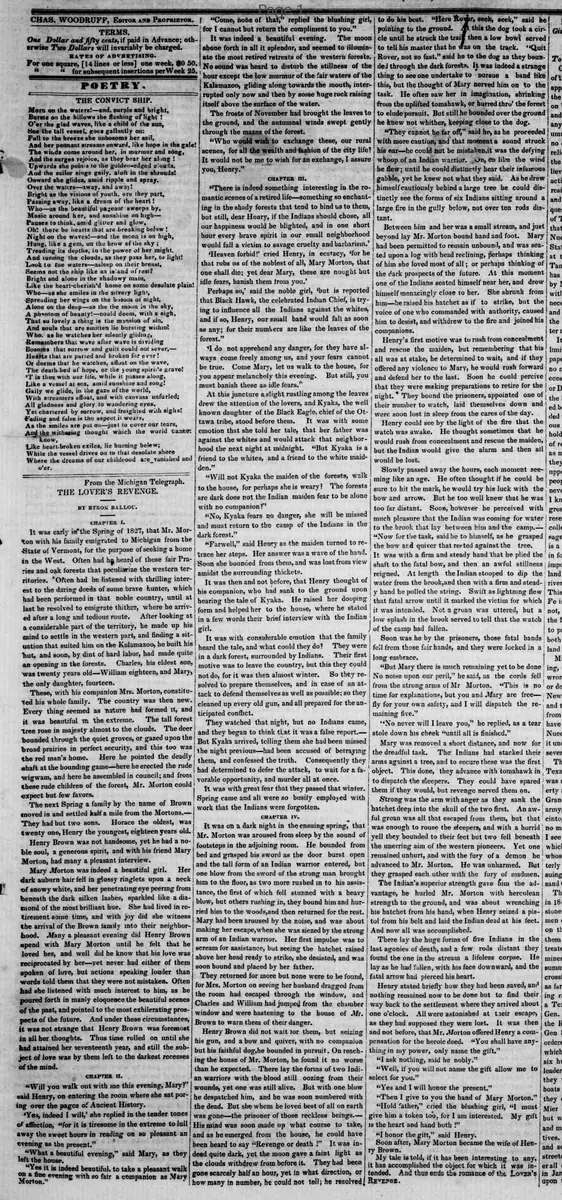
From the Michigan Telegraph.
THE LOVER'S REVENGE.
BY BYRON BALLOC.
CHAPTER I.
It was early in the Spring of 1827, that Mr. Morton with his family emigrated to Michigan from the State of Vermont, for the purpose of seeking a home in the West. Often had he heard of these fair Prairies and oak forests that peculiarize the western territories. Often had he listened with thrilling interest to the daring deeds of some brave hunter, which had been performed in that noble country, until at last he resolved to emigrate thither, where he arrived after a long and tedious route. After looking at a considerable part of the territory, he made up his mind to settle in the western part, and finding a situation that suited him on the Kalamazoo, he built his hut, and soon, by dint of hard labor, had made quite an opening in the forests. Charles, his eldest son, was twenty years old—William eighteen, and Mary, the only daughter, fourteen. These, with his companion Mrs. Morton, constituted his whole family. The country was then new. Every thing seemed as nature had formed it, and it was beautiful in the extreme. The tall forest tree rose in majesty almost to the clouds. The deer bounded through the quiet groves, or gazed upon the broad prairies in perfect security, and this too was the red man's home. Here he pointed the deadly shaft at the bounding game—here he erected the rude wigwam, and here he assembled in council; and from these rude children of the forest, Mr. Morton could expect but few favors.
The next Spring a family by the name of Brown moved in and settled half a mile from the Mortons.—They had but two sons. Horace the oldest, was twenty one, Henry the youngest, eighteen years old. Henry Brown was not handsome, yet he had a noble soul, a generous spirit, and with his friend Mary Morton, had many a pleasant interview. Mary Morton was indeed a beautiful girl. Her dark auburn hair fell in glossy ringlets upon a neck of snowy white, and her penetrating eye peering from beneath the dark silken lashes, sparkled like a diamond of the most brilliant hue. She had lived in retirement some time, and with joy did she witness the arrival of the Brown family into their neighborhood. Many a pleasant evening did Henry Brown spend with Mary Morton until he felt that he loved her, and well did he know that his love was reciprocated by her yet never had either of them spoken of love, but actions speaking louder than words told them that they were not mistaken. Often had she listened with much interest to him, as he poured forth in many eloquence the beautiful scenes of the past, and pointed to the most exhilarating prospects of the future. And under these circumstances, it was not strange that Henry Brown was foremost in all her thoughts. Thus time rolled on until she had attained her seventeenth year, and still the subject of love was by them left to the darkest recesses of the mind.
CHAPTER II.
"Will you walk out with me this evening, Mary?" said Henry, on entering the room where she sat poring over the pages of Ancient History.
"Yes, indeed I will," she replied in the tender tones of affection, "for it is tiresome in the extreme to lull away the sweet hours in reading on so pleasant an evening as the present."
"What a beautiful evening," said Mary, as they left the house.
"Yes it is indeed beautiful, to take a pleasant walk on a fine evening with so fair a companion as Mary Morton."
"Come, none of that," replied the blushing girl for I cannot but return the compliment to you."
It was indeed a beautiful evening. The moon shone forth in all its splendor, and seemed to illuminate the most retired retreats of the western forests. No sound was heard to disturb the stillness of the hour except the low murmur of the gentle waters of the Kalamazoo, gliding along towards the mouth, interrupted only now and then by some huge rock raising itself above the surface of the water. The frosts of November had brought the leaves to the ground, and the autumnal winds swept gently through the mazes of the forest.
"Who would wish to exchange these, our rural scenes, for all the wealth and fashion of the city life? It would not be me to wish for an exchange, I assure you, Henry."
CHAPTER III.
"There is indeed something interesting in the romantic scenes of a retired life—something so enchanting in the shady forests that tend to bind us to them, but still, dear Henry, if the Indians should choose, all our happiness would be blighted, and in one short hour every brave spirit in our small neighborhood would fall a victim to savage cruelty and barbarism."
"Heaven forbid!" cried Henry, in ecstasy, "for he that robs us of the noblest of all, Mary Morton, that one shall die: yet dear Mary, these are nought but idle fears, banish them from you."
"Perhaps so," said the noble girl, "but it is reported that Black Hawk, the celebrated Indian Chief, is trying to influence all the Indians against the whites, and if so, Henry, our small band would fall as soon as any; for their numbers are like the leaves of the forest."
"I do not apprehend any danger, for they have always come freely among us, and your fears cannot be true. Come Mary, let us walk to the house, for you appear melancholy this evening. But still, you must banish these as idle fears."
At this juncture a slight rustling among the leaves drew the attention of the lovers, and Kyaka, the well known daughter of the Black Eagle, chief of the Ottawa tribe, stood before them. It was with some emotion that she told her tale, that her father was against the whites and would attack that neighborhood the next night at midnight. "But Kyaka is a friend to the whites, and a friend to the white maiden."
"Will not Kyaka the maiden of the forests, walk to the house, for perhaps she is weary? The forests are dark does not the Indian maiden fear to be alone with no companion?"
"No, Kyaka fears no danger, she will be missed and must return to the camp of the Indians in the dark forest."
"Farewell," said Henry as the maiden turned to retrace her steps. Her answer was a wave of the hand. Soon she bounded from them, and was lost from view amidst the surrounding thickets.
It was then and not before, that Henry thought of his companion, who had sank to the ground upon hearing the tale of Kyaka. He raised her drooping form and helped her to the house, where he stated in a few words their brief interview with the Indian girl.
It was with considerable emotion that the family heard the tale, and what could they do? They were in a dark forest, surrounded by Indians. Their first motive was to leave the country, but this they could not do, for it was then almost winter. So they resolved to prepare themselves, and in case of an attack to defend themselves as well as possible: so they cleaned up every old gun, and all prepared for the anticipated conflict.
They watched that night, but no Indians came, and they began to think that it was a false report.—But Kyaka arrived, telling them she had been missed the night previous—had been accused of betraying them, and confessed the truth. Consequently they had determined to defer the attack, to wait for a favorable opportunity, and murder all at once.
It was with great fear that they passed that winter. Spring came and all were so busily employed with work that the Indians were forgotten.
CHAPTER IV.
It was on a dark night in the ensuing spring, that Mr. Morton was aroused from sleep by the sound of footsteps in the adjoining room. He bounded from bed and grasped his sword as the door burst open and the tall form of an Indian warrior entered, but one blow from the sword of the strong man brought him to the floor, as two more rushed in to his assistance, the first of which fell stunned with a heavy blow, but others rushing in, they bound him and hurried him to the woods, and then returned for the rest.
Mary had been aroused by the noise, and was about making her escape, when she was seized by the strong arm of an Indian warrior. Her first impulse was to scream for assistance, but seeing the hatchet raised above her head ready to strike, she desisted, and was soon bound and placed by her father.
They returned for more but none were to be found, for Mrs. Morton on seeing her husband dragged from the room had escaped through the window, and Charles and William had jumped from the chamber window and were hastening to the house of Mr. Brown to warn them of their danger.
Henry Brown did not wait for them, but seizing his gun, and a bow and quiver, with no companion but his faithful dog, he bounded in pursuit. On reaching the house of Mr. Morton, he found it no worse than he expected. There lay the forms of two Indian warriors with the blood still oozing from their wounds, yet one was still alive. But with one blow he despatched him, and he was soon numbered with the dead. But she whom he loved best of all on earth was gone—the prisoner of those reckless beings.—His mind was soon made up what course to take, and as he emerged from the house, he could have been heard to say "Revenge or death!" It was indeed quite dark, yet the moon gave a faint light as the clouds withdrew from before it. They had been gone scarcely half an hour, yet in what direction, or how many in number, he could not tell: he resolved to do his best. "Here Rover, seek, seek," said he pointing to the ground. At this the dog took a circle until he struck the trail then a low howl served to tell his master that he was on the track. "Quit Rover, not so fast," said he to the dog as they bounded through the dark forests. It was indeed a strange thing to see one undertake to pursue a band like this, but the thought of Mary nerved him on to the task. He often saw her in imagination, shrinking from the uplifted tomahawk, or hurried thro' the forest to elude pursuit. But still he bounded over the ground he knew not whither, keeping close to the dog.
"They cannot be far off," said he, as he proceeded with more caution, and that moment a sound struck his ear—he could not be mistaken, it was the defying whoop of an Indian warrior. On, on like the wind he flew: until he could distinctly hear their infamous gabble, yet he knew not what they said. As he drew himself cautiously behind a large tree he could distinctly see the forms of six Indians sitting around a large fire in the gully below, not over ten rods distant.
Between him and her was a small stream, and just beyond lay Mr. Morton bound hand and foot. Mary had been permitted to remain unbound, and was seated upon a log with head reclining, perhaps thinking of him she loved most of all; or perhaps thinking of the dark prospects of the future. At this moment one of the Indians seated himself near her, and drew himself menacingly close to her. She shrunk from him he raised his hatchet as if to strike, but the voice of one who commanded with authority, caused him to desist, and withdrew to the fire and joined his companions.
Henry's first motive was to rush from concealment and rescue the maiden, but remembering that his all was at stake, he determined to wait, and if they offered any violence to Mary, he would rush forward and defend her to the last. Soon he could perceive that they were making preparations to retire for the night. They bound the prisoners, appointed one of their number to watch, laid themselves down and were soon lost in sleep from the cares of the day.
Henry could see by the light of the fire that the watch was awake. He thought sometimes that he would rush from concealment and rescue the maiden, but the Indian would give the alarm and then all would be lost.
Slowly passed away the hours, each moment seeming like an age. He often thought if he could be sure to hit the mark, he would try his luck with the bow and arrow. But he too well knew that he was too far distant. Soon, however he perceived with much pleasure that the Indian was coming for water to the brook that lay between him and the camp.
"Now for the task," said he to himself, as he grasped the bow and quiver that rested against the tree. It was with a firm and steady hand that he plied the shaft to the fatal bow, and then an awful stillness reigned. At length the Indian stooped to dip the water from the brook, and then with a firm and steady hand he pulled the string. Swift as lightning flew that fatal arrow until it marked the victim for which it was intended. Not a groan was uttered, but a low splash in the brook served to tell that the watch of the camp had fallen.
Soon was he by the prisoners, those fatal bands fell from those fair hands, and they were locked in a long embrace.
"But Mary there is much remaining yet to be done No noise upon our peril," he said, as the cords fell from the strong arms of Mr Morton. "This is no time for explanations, but you and Mary are free—fly for your own safety, and I will dispatch the remaining five."
"No never will I leave you," he replied, as a tear stole down his cheek "until all is finished."
Mary was removed a short distance. and now for the dreadful task. The Indians had stacked their arms against a tree, and to secure these was the first object. This done, they advance with tomahawk in hand to dispatch the sleepers. They could have spared them if they would, but revenge nerved them on. Strong was the arm with anger as they sank the hatchet deep into the skull of the two first. An awful groan was all that escaped from them, but that was enough to rouse the sleepers, and with a horrid yell they bounded to their feet but two fell beneath the unerring aim of the western pioneers. Yet one remained unhurt, and with the fury of a demon he advanced to Mr. Morton, He was unharmed. But they grasped each other with the fury of madmen. The Indian's superior strength gave him the advantage, he hurled Mr. Morton with herculean strength to the ground, and was about wrenching his hatchet from his hand, when Henry seized a pistol from his belt and laid the Indian dead at his feet.
And now all was accomplished. There lay the huge forms of five Indians in the last agonies of death, and a few rods distant they found the one in the stream a lifeless corpse. He lay as he had fallen, with his face downward, and the fatal arrow had pierced his heart.
Henry stated briefly how they had been saved, and nothing remained now to be done but to find their way back to the settlement where they arrived about one o'clock. All were astonished at their escape as they had supposed they were lost. It was then and not before, that Mr. Morton offered Henry a compensation for the heroic deed. "You shall have anything in my power, only name the gift."
"I ask nothing," said he nobly.
"Well, if you will not name the gift allow me to select for you."
"Yes and I will honor the present."
"Then I give to you the hand of Mary Morton."
"Hold father," cried the blushing girl, "I must give him a token too, for I am interested. My gift is the heart and hand both!"
"I honor the gift," said Henry.
Soon after, Mary Morton became the wife of Henry Brown.
My tale is told, if it has been interesting to any, it has accomplished the object for which it was intended. And thus ends the romance of the Lover's REVENGE.
THE LOVER'S REVENGE.
BY BYRON BALLOC.
CHAPTER I.
It was early in the Spring of 1827, that Mr. Morton with his family emigrated to Michigan from the State of Vermont, for the purpose of seeking a home in the West. Often had he heard of these fair Prairies and oak forests that peculiarize the western territories. Often had he listened with thrilling interest to the daring deeds of some brave hunter, which had been performed in that noble country, until at last he resolved to emigrate thither, where he arrived after a long and tedious route. After looking at a considerable part of the territory, he made up his mind to settle in the western part, and finding a situation that suited him on the Kalamazoo, he built his hut, and soon, by dint of hard labor, had made quite an opening in the forests. Charles, his eldest son, was twenty years old—William eighteen, and Mary, the only daughter, fourteen. These, with his companion Mrs. Morton, constituted his whole family. The country was then new. Every thing seemed as nature had formed it, and it was beautiful in the extreme. The tall forest tree rose in majesty almost to the clouds. The deer bounded through the quiet groves, or gazed upon the broad prairies in perfect security, and this too was the red man's home. Here he pointed the deadly shaft at the bounding game—here he erected the rude wigwam, and here he assembled in council; and from these rude children of the forest, Mr. Morton could expect but few favors.
The next Spring a family by the name of Brown moved in and settled half a mile from the Mortons.—They had but two sons. Horace the oldest, was twenty one, Henry the youngest, eighteen years old. Henry Brown was not handsome, yet he had a noble soul, a generous spirit, and with his friend Mary Morton, had many a pleasant interview. Mary Morton was indeed a beautiful girl. Her dark auburn hair fell in glossy ringlets upon a neck of snowy white, and her penetrating eye peering from beneath the dark silken lashes, sparkled like a diamond of the most brilliant hue. She had lived in retirement some time, and with joy did she witness the arrival of the Brown family into their neighborhood. Many a pleasant evening did Henry Brown spend with Mary Morton until he felt that he loved her, and well did he know that his love was reciprocated by her yet never had either of them spoken of love, but actions speaking louder than words told them that they were not mistaken. Often had she listened with much interest to him, as he poured forth in many eloquence the beautiful scenes of the past, and pointed to the most exhilarating prospects of the future. And under these circumstances, it was not strange that Henry Brown was foremost in all her thoughts. Thus time rolled on until she had attained her seventeenth year, and still the subject of love was by them left to the darkest recesses of the mind.
CHAPTER II.
"Will you walk out with me this evening, Mary?" said Henry, on entering the room where she sat poring over the pages of Ancient History.
"Yes, indeed I will," she replied in the tender tones of affection, "for it is tiresome in the extreme to lull away the sweet hours in reading on so pleasant an evening as the present."
"What a beautiful evening," said Mary, as they left the house.
"Yes it is indeed beautiful, to take a pleasant walk on a fine evening with so fair a companion as Mary Morton."
"Come, none of that," replied the blushing girl for I cannot but return the compliment to you."
It was indeed a beautiful evening. The moon shone forth in all its splendor, and seemed to illuminate the most retired retreats of the western forests. No sound was heard to disturb the stillness of the hour except the low murmur of the gentle waters of the Kalamazoo, gliding along towards the mouth, interrupted only now and then by some huge rock raising itself above the surface of the water. The frosts of November had brought the leaves to the ground, and the autumnal winds swept gently through the mazes of the forest.
"Who would wish to exchange these, our rural scenes, for all the wealth and fashion of the city life? It would not be me to wish for an exchange, I assure you, Henry."
CHAPTER III.
"There is indeed something interesting in the romantic scenes of a retired life—something so enchanting in the shady forests that tend to bind us to them, but still, dear Henry, if the Indians should choose, all our happiness would be blighted, and in one short hour every brave spirit in our small neighborhood would fall a victim to savage cruelty and barbarism."
"Heaven forbid!" cried Henry, in ecstasy, "for he that robs us of the noblest of all, Mary Morton, that one shall die: yet dear Mary, these are nought but idle fears, banish them from you."
"Perhaps so," said the noble girl, "but it is reported that Black Hawk, the celebrated Indian Chief, is trying to influence all the Indians against the whites, and if so, Henry, our small band would fall as soon as any; for their numbers are like the leaves of the forest."
"I do not apprehend any danger, for they have always come freely among us, and your fears cannot be true. Come Mary, let us walk to the house, for you appear melancholy this evening. But still, you must banish these as idle fears."
At this juncture a slight rustling among the leaves drew the attention of the lovers, and Kyaka, the well known daughter of the Black Eagle, chief of the Ottawa tribe, stood before them. It was with some emotion that she told her tale, that her father was against the whites and would attack that neighborhood the next night at midnight. "But Kyaka is a friend to the whites, and a friend to the white maiden."
"Will not Kyaka the maiden of the forests, walk to the house, for perhaps she is weary? The forests are dark does not the Indian maiden fear to be alone with no companion?"
"No, Kyaka fears no danger, she will be missed and must return to the camp of the Indians in the dark forest."
"Farewell," said Henry as the maiden turned to retrace her steps. Her answer was a wave of the hand. Soon she bounded from them, and was lost from view amidst the surrounding thickets.
It was then and not before, that Henry thought of his companion, who had sank to the ground upon hearing the tale of Kyaka. He raised her drooping form and helped her to the house, where he stated in a few words their brief interview with the Indian girl.
It was with considerable emotion that the family heard the tale, and what could they do? They were in a dark forest, surrounded by Indians. Their first motive was to leave the country, but this they could not do, for it was then almost winter. So they resolved to prepare themselves, and in case of an attack to defend themselves as well as possible: so they cleaned up every old gun, and all prepared for the anticipated conflict.
They watched that night, but no Indians came, and they began to think that it was a false report.—But Kyaka arrived, telling them she had been missed the night previous—had been accused of betraying them, and confessed the truth. Consequently they had determined to defer the attack, to wait for a favorable opportunity, and murder all at once.
It was with great fear that they passed that winter. Spring came and all were so busily employed with work that the Indians were forgotten.
CHAPTER IV.
It was on a dark night in the ensuing spring, that Mr. Morton was aroused from sleep by the sound of footsteps in the adjoining room. He bounded from bed and grasped his sword as the door burst open and the tall form of an Indian warrior entered, but one blow from the sword of the strong man brought him to the floor, as two more rushed in to his assistance, the first of which fell stunned with a heavy blow, but others rushing in, they bound him and hurried him to the woods, and then returned for the rest.
Mary had been aroused by the noise, and was about making her escape, when she was seized by the strong arm of an Indian warrior. Her first impulse was to scream for assistance, but seeing the hatchet raised above her head ready to strike, she desisted, and was soon bound and placed by her father.
They returned for more but none were to be found, for Mrs. Morton on seeing her husband dragged from the room had escaped through the window, and Charles and William had jumped from the chamber window and were hastening to the house of Mr. Brown to warn them of their danger.
Henry Brown did not wait for them, but seizing his gun, and a bow and quiver, with no companion but his faithful dog, he bounded in pursuit. On reaching the house of Mr. Morton, he found it no worse than he expected. There lay the forms of two Indian warriors with the blood still oozing from their wounds, yet one was still alive. But with one blow he despatched him, and he was soon numbered with the dead. But she whom he loved best of all on earth was gone—the prisoner of those reckless beings.—His mind was soon made up what course to take, and as he emerged from the house, he could have been heard to say "Revenge or death!" It was indeed quite dark, yet the moon gave a faint light as the clouds withdrew from before it. They had been gone scarcely half an hour, yet in what direction, or how many in number, he could not tell: he resolved to do his best. "Here Rover, seek, seek," said he pointing to the ground. At this the dog took a circle until he struck the trail then a low howl served to tell his master that he was on the track. "Quit Rover, not so fast," said he to the dog as they bounded through the dark forests. It was indeed a strange thing to see one undertake to pursue a band like this, but the thought of Mary nerved him on to the task. He often saw her in imagination, shrinking from the uplifted tomahawk, or hurried thro' the forest to elude pursuit. But still he bounded over the ground he knew not whither, keeping close to the dog.
"They cannot be far off," said he, as he proceeded with more caution, and that moment a sound struck his ear—he could not be mistaken, it was the defying whoop of an Indian warrior. On, on like the wind he flew: until he could distinctly hear their infamous gabble, yet he knew not what they said. As he drew himself cautiously behind a large tree he could distinctly see the forms of six Indians sitting around a large fire in the gully below, not over ten rods distant.
Between him and her was a small stream, and just beyond lay Mr. Morton bound hand and foot. Mary had been permitted to remain unbound, and was seated upon a log with head reclining, perhaps thinking of him she loved most of all; or perhaps thinking of the dark prospects of the future. At this moment one of the Indians seated himself near her, and drew himself menacingly close to her. She shrunk from him he raised his hatchet as if to strike, but the voice of one who commanded with authority, caused him to desist, and withdrew to the fire and joined his companions.
Henry's first motive was to rush from concealment and rescue the maiden, but remembering that his all was at stake, he determined to wait, and if they offered any violence to Mary, he would rush forward and defend her to the last. Soon he could perceive that they were making preparations to retire for the night. They bound the prisoners, appointed one of their number to watch, laid themselves down and were soon lost in sleep from the cares of the day.
Henry could see by the light of the fire that the watch was awake. He thought sometimes that he would rush from concealment and rescue the maiden, but the Indian would give the alarm and then all would be lost.
Slowly passed away the hours, each moment seeming like an age. He often thought if he could be sure to hit the mark, he would try his luck with the bow and arrow. But he too well knew that he was too far distant. Soon, however he perceived with much pleasure that the Indian was coming for water to the brook that lay between him and the camp.
"Now for the task," said he to himself, as he grasped the bow and quiver that rested against the tree. It was with a firm and steady hand that he plied the shaft to the fatal bow, and then an awful stillness reigned. At length the Indian stooped to dip the water from the brook, and then with a firm and steady hand he pulled the string. Swift as lightning flew that fatal arrow until it marked the victim for which it was intended. Not a groan was uttered, but a low splash in the brook served to tell that the watch of the camp had fallen.
Soon was he by the prisoners, those fatal bands fell from those fair hands, and they were locked in a long embrace.
"But Mary there is much remaining yet to be done No noise upon our peril," he said, as the cords fell from the strong arms of Mr Morton. "This is no time for explanations, but you and Mary are free—fly for your own safety, and I will dispatch the remaining five."
"No never will I leave you," he replied, as a tear stole down his cheek "until all is finished."
Mary was removed a short distance. and now for the dreadful task. The Indians had stacked their arms against a tree, and to secure these was the first object. This done, they advance with tomahawk in hand to dispatch the sleepers. They could have spared them if they would, but revenge nerved them on. Strong was the arm with anger as they sank the hatchet deep into the skull of the two first. An awful groan was all that escaped from them, but that was enough to rouse the sleepers, and with a horrid yell they bounded to their feet but two fell beneath the unerring aim of the western pioneers. Yet one remained unhurt, and with the fury of a demon he advanced to Mr. Morton, He was unharmed. But they grasped each other with the fury of madmen. The Indian's superior strength gave him the advantage, he hurled Mr. Morton with herculean strength to the ground, and was about wrenching his hatchet from his hand, when Henry seized a pistol from his belt and laid the Indian dead at his feet.
And now all was accomplished. There lay the huge forms of five Indians in the last agonies of death, and a few rods distant they found the one in the stream a lifeless corpse. He lay as he had fallen, with his face downward, and the fatal arrow had pierced his heart.
Henry stated briefly how they had been saved, and nothing remained now to be done but to find their way back to the settlement where they arrived about one o'clock. All were astonished at their escape as they had supposed they were lost. It was then and not before, that Mr. Morton offered Henry a compensation for the heroic deed. "You shall have anything in my power, only name the gift."
"I ask nothing," said he nobly.
"Well, if you will not name the gift allow me to select for you."
"Yes and I will honor the present."
"Then I give to you the hand of Mary Morton."
"Hold father," cried the blushing girl, "I must give him a token too, for I am interested. My gift is the heart and hand both!"
"I honor the gift," said Henry.
Soon after, Mary Morton became the wife of Henry Brown.
My tale is told, if it has been interesting to any, it has accomplished the object for which it was intended. And thus ends the romance of the Lover's REVENGE.
What sub-type of article is it?
Prose Fiction
What themes does it cover?
Love Romance
War Peace
Nature
What keywords are associated?
Frontier Romance
Indian Attack
Lovers Revenge
Michigan Settlement
Heroic Rescue
Kalamazoo River
Ottawa Tribe
What entities or persons were involved?
By Byron Balloc.
Literary Details
Title
The Lover's Revenge.
Author
By Byron Balloc.
Subject
A Romance Of Love And Revenge On The Michigan Frontier
Key Lines
"Revenge Or Death!"
"Then I Give To You The Hand Of Mary Morton."
"Hold Father," Cried The Blushing Girl, "I Must Give Him A Token Too, For I Am Interested. My Gift Is The Heart And Hand Both!"
"I Honor The Gift," Said Henry.
And Thus Ends The Romance Of The Lover's Revenge.