Thank you for visiting SNEWPapers!
Sign up free
The Bismarck Tribune
Bismarck, Mandan, Burleigh County, Morton County, North Dakota
What is this article about?
Secretary Ickes states that the $65M Missouri River diversion project proposed by Sen. Nye is hindered by $15.5M already allocated for Fort Peck reservoir in Montana. The diversion aims to raise water levels for drought relief in ND, SD, MN, plus flood control and navigation. Backers from ND/SD push despite Fort Peck approval.
Clipping
OCR Quality
Full Text
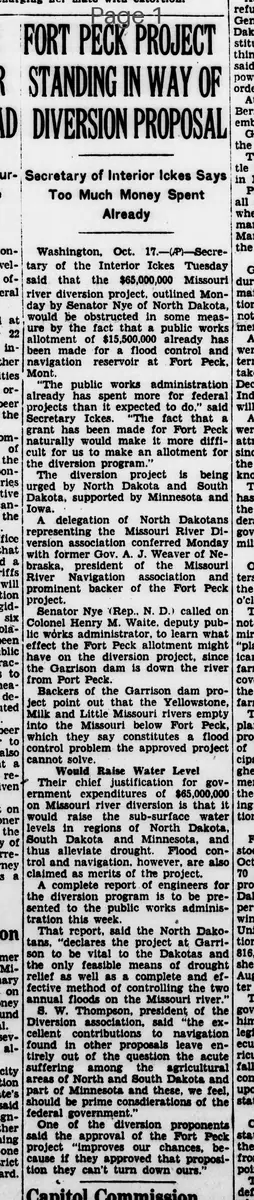
Secretary of Interior Ickes Says Too Much Money Spent Already
Washington, Oct. 17.-(AP)-Secretary of the Interior Ickes Tuesday said that the $65,000,000 Missouri river diversion project, outlined Monday by Senator Nye of North Dakota, would be obstructed in some measure by the fact that a public works allotment of $15,500,000 already has been made for a flood control and navigation reservoir at Fort Peck, Mont.
"The public works administration already has spent more for federal projects than it expected to do," said Secretary Ickes.
"The fact that a grant has been made for Fort Peck naturally would make it more difficult for us to make an allotment for the diversion program."
The diversion project is being urged by North Dakota and South Dakota, supported by Minnesota and Iowa.
A delegation of North Dakotans representing the Missouri River Diversion association conferred Monday with former Gov. A. J. Weaver of Nebraska, president of the Missouri River Navigation association and prominent backer of the Fort Peck project.
Senator Nye (Rep., N. D.) called on Colonel Henry M. Waite, deputy public works administrator, to learn what effect the Fort Peck allotment might have on the diversion project, since the Garrison dam is down the river from Fort Peck.
Backers of the Garrison dam project point out that the Yellowstone, Milk and Little Missouri rivers empty into the Missouri below Fort Peck which they say constitutes a flood control problem the approved project cannot solve.
Would Raise Water Level
Their chief justification for government expenditures of $65,000,000 on Missouri river diversion is that it would raise the sub-surface water levels in regions of North Dakota, South Dakota and Minnesota, and thus alleviate drought. Flood control and navigation, however, are also claimed as merits of the project.
A complete report of engineers for the diversion program is to be presented to the public works administration this week.
That report, said the North Dakotans, "declares the project at Garrison to be vital to the Dakotas and the only feasible means of drought relief as well as a complete and effective method of controlling the two annual floods on the Missouri river."
S. W. Thompson, president of the Diversion association, said "the excellent contributions to navigation found in other proposals leave entirely out of the question the acute suffering among the agricultural areas of North and South Dakota and part of Minnesota and these, we feel, should be prime considerations of the federal government."
One of the diversion proponents said the approval of the Fort Peck project "improves our chances, because if they approved that proposition they can't turn down ours."
What sub-type of article is it?
What keywords are associated?
What entities or persons were involved?
Where did it happen?
Domestic News Details
Primary Location
Washington
Event Date
Oct. 17
Key Persons
Outcome
the diversion project faces obstruction due to prior $15.5m allotment for fort peck; engineers' report to be presented this week supporting diversion for drought relief and flood control.
Event Details
Secretary Ickes indicates the Missouri River diversion project, costing $65M and urged by ND/SD with MN/IA support, is complicated by $15.5M already spent on Fort Peck reservoir for flood control and navigation. Sen. Nye consults officials; backers argue diversion addresses floods from tributaries below Fort Peck and raises subsurface water levels to alleviate drought. Delegation meets Weaver; report claims Garrison dam vital for Dakotas.