Thank you for visiting SNEWPapers!
Sign up free
Letter to Editor
March 17, 1774
The Virginia Gazette
Richmond, Williamsburg, Richmond County, Virginia
What is this article about?
In this witty rebuttal, the writer defends his inquiry into the literary rule that similes should 'run on all fours,' accuses his previous responder of evasion and mockery, and demands a proper explanation while referencing similes from Butler and Pope.
Clipping
OCR Quality
98%
Excellent
Full Text
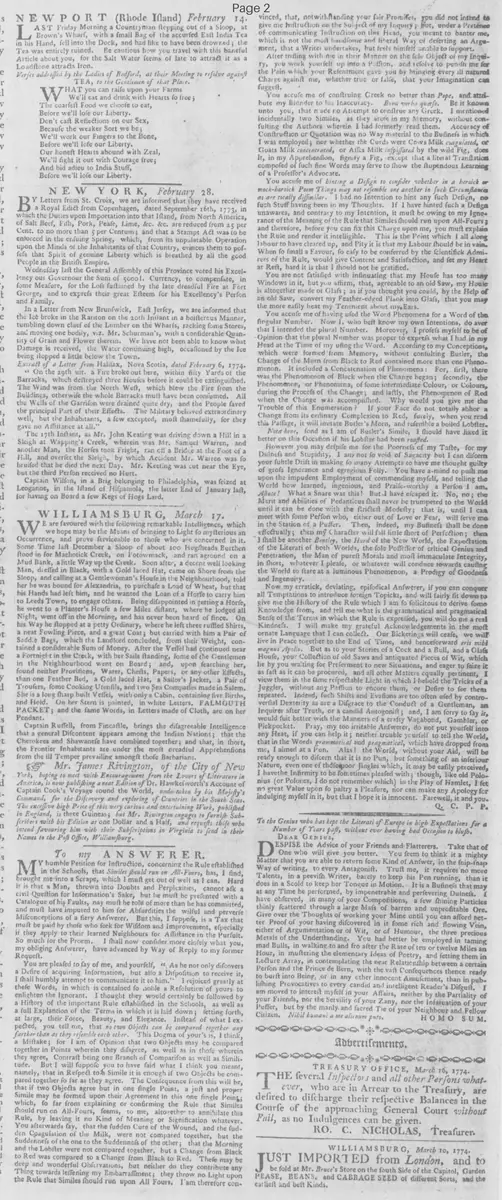
To my ANSWERER.
My humble Petition for Instruction, concerning the Rule established brought me into a Scrape, which I must get out of well as I can. Hard it is that a Man, thrown into Doubts and Perplexities, cannot ask a civil Question for Information's Sake, but he must be presented with a Catalogue of his Faults, nay must be told of more than he has committed, and must have imputed to him for Absurdities the wilful and perverse Misconceptions of a fiery Answerer. But this, I suppose, is a Tax that must be paid by those who seek for Wisdom and Improvement, especially if they apply to their learned Neighbours for Assistance in the Pursuit. So much for the Proem. I shall now consider more closely what you, my obliging Answerer, have advanced by Way of Reply to my former Request.
You are pleased to say of me, and yourself, "As he not only discovers a Desire of acquiring Information, but also a Disposition to receive it, I shall humbly attempt to communicate it to him." I rejoiced greatly at these Words, in which is contained so noble a Resolution of yours to enlighten the Ignorant. I thought they would certainly be followed by a History of the important Rule established in the Schools, as well as a full Explanation of the Terms in which it is laid down; setting forth, at large, their Force, Beauty, and Elegance. Instead of what I expected, you tell me, that no two Objects can be compared together any farther than as they resemble each other. This Dogma of yours is, I think, a Mistake; for I am of Opinion that two Objects may be compared together in Points wherein they disagree, as well as in those wherein they agree, Contrast being one Branch of Comparison as well as Similitude. But I will suppose you to have said what I think you meant, namely, that in Respect to a Simile it is enough if two Objects be compared together so far as they agree. The Consequence from this will be, that if two Objects agree but in one single Point, a just and proper Simile may be formed upon their Agreement in this one single Point; which, so far from explaining or confirming the Rule that Similes should run on All-Fours, seems, to me, altogether to annihilate this Rule, by leaving it no Kind of Meaning or Signification whatever.
You afterwards say, that the sudden Cure of the Wound, and the sudden Coagulation of the Milk, were not compared together, but the Suddenness of the one to the Suddenness of the other; that the Morning and the Lobster were not compared together, but a Change from Black to Red was compared to a Change from Black to Red. These may be deep and wonderful Observations, but neither do they contribute any Thing towards lessening my Embarrassment; they throw no Light upon the Rule that Similes should run upon All Fours, I am therefore convinced, that, notwithstanding your fair Promises, you did not intend to give me Instruction on the Subject of my Inquiry; but, under a Pretence of communicating Instruction on this Head, you meant to banter me, which is not the most handsome and liberal Way of deserting an Argument, that a Writer undertakes, but feels himself unable to support. After trifling with me in this Manner on the sole Object of my Inquiry, you work yourself up into a Passion, and resolve to punish me for the Pain which your Resentment gave you by bringing every ill natured Charge against me, whether true or false, that your Imagination can suggest.
You accuse me of construing Greek no better than Pope, and attribute my Blunder to his Inaccuracy. Bona verba quaeso. Be it known unto you, that I made no Attempt to construe any Greek. I mentioned incidentally two Similes, as they arose in my Memory, without consulting the Authors wherein I had formerly read them. Accuracy of Construction or Quotation was no Way material to the Business in which I was employed; nor whether the Curds were Cows Milk coagulated, or Goats Milk concentrated, or Asses Milk inspissated by the wild Fig, does it, in my Apprehension, signify a Fig, except that a literal Translation composed of such fine Words may serve to show the stupendous Learning of a Professor's Advocate.
You accuse me of hinting a Design to consider whether in a heroick or mock-heroick Poem Things may not resemble one another in such Circumstances as are totally dissimilar. I had no Intention to hint any such Design, no such Stuff having been in my Thoughts. If I have hinted such a Design unawares, and contrary to my Intention, it must be owing to my Ignorance of the Meaning of the Rule that Similes should run upon All-Fours; and therefore, before you can fix this Charge upon me, you must explain the Rule and render it intelligible. This is the Point which I all along labour to have cleared up, and Pity it is that my Labour should be in vain. When so small a Favour, so easy to be conferred by the scientifick Admirers of the Rule, would give Content and Satisfaction, and set my Heart at Rest, hard it is that I should not be gratified.
You are not satisfied with insinuating that my House has too many Windows in it, but you affirm, that, agreeable to an old Saw, my House is altogether made of Glass; as if you thought you could, by the Help of an old Saw, convert my Feather-edged Plank into Glass, that you may the more easily beat my Tenement about my Ears.
You accuse me of having used the Word Phenomena for a Word of the singular Number. Now I, who best know my own Intentions, do aver that I intended the plural Number. Moreover, I profess myself to be of Opinion that the plural Number was proper to express what I had in my Head at the Time of my using the Word. According to my Conceptions, which were formed from Memory, without consulting Butler, the Change of the Morn from Black to Red contained more than one Phenomenon. It included a Concatenation of Phenomena: For, first, there was the Phenomenon of Black when the Change began; secondly, the Phenomenon, or Phenomena, of some intermediate Colour, or Colours, during the Process of the Change; and lastly, the Phenomenon of Red when the Change was accomplished. Why would you give me the Trouble of this Enumeration?
If your Face do not totally abhor a Change from its ordinary Complexion to Red, surely, when you read this Passage, it will imitate Butler's Morn, and resemble a boiled Lobster. Nota bene, fond as I am of Butler's Simile, I should have liked it better on this Occasion if his Lobster had been roasted.
However you may despise me for the Poorness of my Taste, for my Dulness and Stupidity, I am not so void of Sagacity but I can discern your subtle Drift in making so many Attempts to have me thought guilty of gross Ignorance and egregious Folly. You have a mind to push me upon the impudent Employment of commending myself, and telling the World how learned, ingenious, and Praise-worthy a Person I am. A subtle Snare was this! But I have escaped it. No, no; the Merit and Abilities of Pedanticus shall never be trumpeted to the World until it can be done with the strictest Modesty; that is, until I can meet with some Person who, either out of Love or Fear, will serve me in the Station of a Puffer. Then, indeed, my Business shall be done effectually; then my Character will fall little short of Perfection; then I shall be another Bentley, the Hurd of the New World, the Expectation of the Literati of both Worlds, the sole Possessor of critical Genius and Penetration, the Man of purest Morals and most immaculate Integrity, in short, whatever I please, or whatever will conduce towards causing the World to stare at a luminous Phenomenon, a Prodigy of Goodness and Ingenuity.
Now my erratic, deviating, epistolary Answerer, if you can conquer all Temptations to introduce foreign Topicks, and will fairly sit down to give me the History of the Rule which I am so solicitous to derive some Knowledge from, and tell me what is the grammatical and pragmatical Sense of the Terms in which the Rule is expressed, you will do me a real Kindness. I will make my grateful Acknowledgements in the most ornate Language that I can collect. Our Bickerings will cease, we will live in Peace together to the End of Time, and henceforward eris mihi magnus Apollo. But as to your Stories of a Cock and a Bull, and a Glass House, your Collection of old Saws and antiquated Pieces of Wit, which lie by you waiting for Preferment to new Situations, and eager to seize it as fast as it can be procured, and all other Matters equally pertinent, I view them in the same respectable Light in which I behold the Tricks of a Juggler, without any Passion to encore them, or Desire to see them repeated. Indeed, such Shifts and Evasions are too often used by controversial Dexterity as are a Disgrace to the Conduct of a Gentleman, an Inquirer after Truth, or a candid Antagonist; and, I am sorry to say it, would suit better with the Manners of a crafty Vagabond, Gambler, or Pickpocket. Pray, my too irritable Answerer, do not put yourself into any Heat, if you can help it; neither trouble yourself to tell the World, that in the Words grammatical and pragmatical, which have dropped from me, I aimed at a Pun. Alas! the World, without your Aid, will be ready enough to discern that it is no Pun, but something of an inferior Nature, even one of those poor Jingles which, it may be easily perceived, I have the Infirmity to be sometimes pleased with; though, like old Polonius (or Polones, I do not remember which) in the Play of Hamlet, I set no great Value upon so paltry a Pleasure, nor can make any Apology for indulging myself in it, but that I hope it is innocent. Farewell, it and you.
Q. C. P. P.
My humble Petition for Instruction, concerning the Rule established brought me into a Scrape, which I must get out of well as I can. Hard it is that a Man, thrown into Doubts and Perplexities, cannot ask a civil Question for Information's Sake, but he must be presented with a Catalogue of his Faults, nay must be told of more than he has committed, and must have imputed to him for Absurdities the wilful and perverse Misconceptions of a fiery Answerer. But this, I suppose, is a Tax that must be paid by those who seek for Wisdom and Improvement, especially if they apply to their learned Neighbours for Assistance in the Pursuit. So much for the Proem. I shall now consider more closely what you, my obliging Answerer, have advanced by Way of Reply to my former Request.
You are pleased to say of me, and yourself, "As he not only discovers a Desire of acquiring Information, but also a Disposition to receive it, I shall humbly attempt to communicate it to him." I rejoiced greatly at these Words, in which is contained so noble a Resolution of yours to enlighten the Ignorant. I thought they would certainly be followed by a History of the important Rule established in the Schools, as well as a full Explanation of the Terms in which it is laid down; setting forth, at large, their Force, Beauty, and Elegance. Instead of what I expected, you tell me, that no two Objects can be compared together any farther than as they resemble each other. This Dogma of yours is, I think, a Mistake; for I am of Opinion that two Objects may be compared together in Points wherein they disagree, as well as in those wherein they agree, Contrast being one Branch of Comparison as well as Similitude. But I will suppose you to have said what I think you meant, namely, that in Respect to a Simile it is enough if two Objects be compared together so far as they agree. The Consequence from this will be, that if two Objects agree but in one single Point, a just and proper Simile may be formed upon their Agreement in this one single Point; which, so far from explaining or confirming the Rule that Similes should run on All-Fours, seems, to me, altogether to annihilate this Rule, by leaving it no Kind of Meaning or Signification whatever.
You afterwards say, that the sudden Cure of the Wound, and the sudden Coagulation of the Milk, were not compared together, but the Suddenness of the one to the Suddenness of the other; that the Morning and the Lobster were not compared together, but a Change from Black to Red was compared to a Change from Black to Red. These may be deep and wonderful Observations, but neither do they contribute any Thing towards lessening my Embarrassment; they throw no Light upon the Rule that Similes should run upon All Fours, I am therefore convinced, that, notwithstanding your fair Promises, you did not intend to give me Instruction on the Subject of my Inquiry; but, under a Pretence of communicating Instruction on this Head, you meant to banter me, which is not the most handsome and liberal Way of deserting an Argument, that a Writer undertakes, but feels himself unable to support. After trifling with me in this Manner on the sole Object of my Inquiry, you work yourself up into a Passion, and resolve to punish me for the Pain which your Resentment gave you by bringing every ill natured Charge against me, whether true or false, that your Imagination can suggest.
You accuse me of construing Greek no better than Pope, and attribute my Blunder to his Inaccuracy. Bona verba quaeso. Be it known unto you, that I made no Attempt to construe any Greek. I mentioned incidentally two Similes, as they arose in my Memory, without consulting the Authors wherein I had formerly read them. Accuracy of Construction or Quotation was no Way material to the Business in which I was employed; nor whether the Curds were Cows Milk coagulated, or Goats Milk concentrated, or Asses Milk inspissated by the wild Fig, does it, in my Apprehension, signify a Fig, except that a literal Translation composed of such fine Words may serve to show the stupendous Learning of a Professor's Advocate.
You accuse me of hinting a Design to consider whether in a heroick or mock-heroick Poem Things may not resemble one another in such Circumstances as are totally dissimilar. I had no Intention to hint any such Design, no such Stuff having been in my Thoughts. If I have hinted such a Design unawares, and contrary to my Intention, it must be owing to my Ignorance of the Meaning of the Rule that Similes should run upon All-Fours; and therefore, before you can fix this Charge upon me, you must explain the Rule and render it intelligible. This is the Point which I all along labour to have cleared up, and Pity it is that my Labour should be in vain. When so small a Favour, so easy to be conferred by the scientifick Admirers of the Rule, would give Content and Satisfaction, and set my Heart at Rest, hard it is that I should not be gratified.
You are not satisfied with insinuating that my House has too many Windows in it, but you affirm, that, agreeable to an old Saw, my House is altogether made of Glass; as if you thought you could, by the Help of an old Saw, convert my Feather-edged Plank into Glass, that you may the more easily beat my Tenement about my Ears.
You accuse me of having used the Word Phenomena for a Word of the singular Number. Now I, who best know my own Intentions, do aver that I intended the plural Number. Moreover, I profess myself to be of Opinion that the plural Number was proper to express what I had in my Head at the Time of my using the Word. According to my Conceptions, which were formed from Memory, without consulting Butler, the Change of the Morn from Black to Red contained more than one Phenomenon. It included a Concatenation of Phenomena: For, first, there was the Phenomenon of Black when the Change began; secondly, the Phenomenon, or Phenomena, of some intermediate Colour, or Colours, during the Process of the Change; and lastly, the Phenomenon of Red when the Change was accomplished. Why would you give me the Trouble of this Enumeration?
If your Face do not totally abhor a Change from its ordinary Complexion to Red, surely, when you read this Passage, it will imitate Butler's Morn, and resemble a boiled Lobster. Nota bene, fond as I am of Butler's Simile, I should have liked it better on this Occasion if his Lobster had been roasted.
However you may despise me for the Poorness of my Taste, for my Dulness and Stupidity, I am not so void of Sagacity but I can discern your subtle Drift in making so many Attempts to have me thought guilty of gross Ignorance and egregious Folly. You have a mind to push me upon the impudent Employment of commending myself, and telling the World how learned, ingenious, and Praise-worthy a Person I am. A subtle Snare was this! But I have escaped it. No, no; the Merit and Abilities of Pedanticus shall never be trumpeted to the World until it can be done with the strictest Modesty; that is, until I can meet with some Person who, either out of Love or Fear, will serve me in the Station of a Puffer. Then, indeed, my Business shall be done effectually; then my Character will fall little short of Perfection; then I shall be another Bentley, the Hurd of the New World, the Expectation of the Literati of both Worlds, the sole Possessor of critical Genius and Penetration, the Man of purest Morals and most immaculate Integrity, in short, whatever I please, or whatever will conduce towards causing the World to stare at a luminous Phenomenon, a Prodigy of Goodness and Ingenuity.
Now my erratic, deviating, epistolary Answerer, if you can conquer all Temptations to introduce foreign Topicks, and will fairly sit down to give me the History of the Rule which I am so solicitous to derive some Knowledge from, and tell me what is the grammatical and pragmatical Sense of the Terms in which the Rule is expressed, you will do me a real Kindness. I will make my grateful Acknowledgements in the most ornate Language that I can collect. Our Bickerings will cease, we will live in Peace together to the End of Time, and henceforward eris mihi magnus Apollo. But as to your Stories of a Cock and a Bull, and a Glass House, your Collection of old Saws and antiquated Pieces of Wit, which lie by you waiting for Preferment to new Situations, and eager to seize it as fast as it can be procured, and all other Matters equally pertinent, I view them in the same respectable Light in which I behold the Tricks of a Juggler, without any Passion to encore them, or Desire to see them repeated. Indeed, such Shifts and Evasions are too often used by controversial Dexterity as are a Disgrace to the Conduct of a Gentleman, an Inquirer after Truth, or a candid Antagonist; and, I am sorry to say it, would suit better with the Manners of a crafty Vagabond, Gambler, or Pickpocket. Pray, my too irritable Answerer, do not put yourself into any Heat, if you can help it; neither trouble yourself to tell the World, that in the Words grammatical and pragmatical, which have dropped from me, I aimed at a Pun. Alas! the World, without your Aid, will be ready enough to discern that it is no Pun, but something of an inferior Nature, even one of those poor Jingles which, it may be easily perceived, I have the Infirmity to be sometimes pleased with; though, like old Polonius (or Polones, I do not remember which) in the Play of Hamlet, I set no great Value upon so paltry a Pleasure, nor can make any Apology for indulging myself in it, but that I hope it is innocent. Farewell, it and you.
Q. C. P. P.
What sub-type of article is it?
Satirical
Persuasive
Philosophical
What keywords are associated?
Similes
All Fours Rule
Literary Criticism
Butler Simile
Pope Reference
Pedanticus
Grammatical Pragmatical
What entities or persons were involved?
Q. C. P. P.
To My Answerer.
Letter to Editor Details
Author
Q. C. P. P.
Recipient
To My Answerer.
Main Argument
the writer seeks a clear explanation of the rule that similes should 'run on all fours,' accuses the answerer of evading the question through mockery and irrelevant criticisms, and defends his own understanding and intentions.
Notable Details
References To Butler's Simile Of The Morning And Lobster
Mentions Pope's Greek Construction
Self Identification As Pedanticus
Allusions To Hamlet's Polonius And Classical Phrases Like 'Bona Verba Quaeso'