Thank you for visiting SNEWPapers!
Sign up free
Editorial
February 18, 1840
Southern Argus
Columbus, Lowndes County, Mississippi
What is this article about?
A critique of Mississippi legislators' experimental banking policies, including excessive charters, post notes, and recent repeals, which fueled speculation, debt, and economic ruin; advocates retrenchment and domestic production to remedy the state's $17M+ annual deficit.
Merged-components note: Merged editorial essay with quoted act text on banking legislation.
Clipping
OCR Quality
95%
Excellent
Full Text
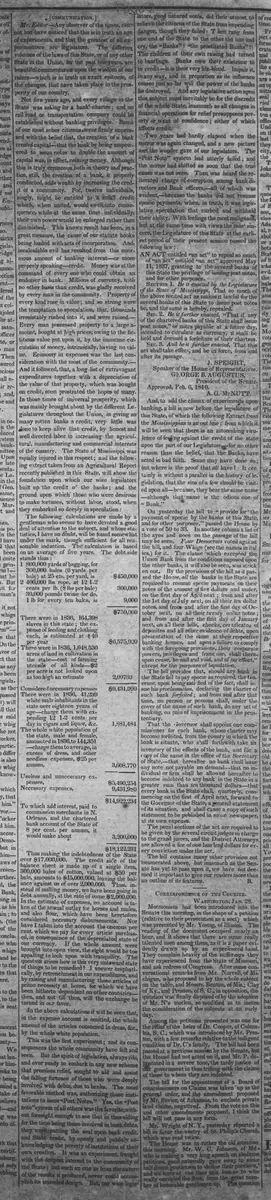
Mr. Editor—Any observer of the times, cannot but have noticed that this is in truth an age of experiments, and that the greatest of all experimenters are legislators. The different volumes of the laws of this State, or of any other State in the Union, for the past ten years, are beautiful commentaries upon the wisdom of our rulers—which is in truth an exact epitome, of the changes, that have taken place in the prosperity of our country.
Not five years ago, and every village in the State was asking for a bank charter; and no rail road or transportation company could be established without banking privileges. Some of our most sober citizens were firmly impressed with the belief that, the creation of a bank created capital—that the bank by being empowered to issue notes to double the amount of capital was, in effect, coining money. Although this is truly erroneous both in theory and practice, still, the creation of a bank, if properly conducted, adds wealth by increasing the credit of a community. For, twelve individuals singly, might be entitled to a small credit which, when united, would swell into consequence, while at the same time individually. their own power would be enlarged rather than diminished. This known result has been, in a great measure, the cause of our statute books being loaded with acts of incorporation. And, incalculable evil has resulted from this enormous amount of banking interest—or more properly speaking—credit. Money was at the command of every one who could obtain an endorser in bank. Millions of currency, with no other basis than credit, was gladly received by every man in the community. Property of every kind rose in value; and so strong were the temptation to speculation, that, thousands irresistibly rushed into it, and were ruined.— Every man possessed property to a large amount, bought at high prices, owing to the fictitious value put upon it, by the immense circulation of money, intrinsically, having no value. Economy in expenses was the last consideration with the most of the community.— And it followed, that, a long list of extravagant expenditures together with a depreciation of the value of that property, which was bought on credit, soon prostrated the hopes of many.
In those times of universal prosperity, which was mainly brought about by the different Legislatures throughout the Union, in giving so many rotten banks a credit, very little was done to keep alive that credit, by honest and well directed labor in increasing the agricultural, manufacturing and commercial interests of the country. The State of Mississippi was equally injured in this respect; and the following extract taken from an Agricultural Report recently published in this State, will show the foundation upon which our wise legislators built up the credit of the banks; and the ground upon which those who were desirous to make fortunes, without labor, stood, when they embarked so deeply in speculation:
The following calculations are made by a gentleman who seems to have devoted a good deal of attention to the subject, and whose statistics, I have no doubt, will be found somewhat under the mark, though sufficient for all reasonable induction. The calculation is based on an average of five years. The debt side stands thus:
800,000 yards of bagging, for 300,000 bales (6 yards per bale at 25 cts. per yard, is $450,000
400,000 lbs rope, at 12 1-2 cents per lb. (8 lbs per bale) $300,000
30,000 pounds twine for do, 1 lb for every ten bales, is $9,000
$759,000
There were in 1836. 164,398 slaves in this state; the expense of feeding and clothing each, is estimated at $40 per year $6,575,920
There were in 1836, 1,048,530 acres of land in cultivation in the state—cost of farming utensils of all kinds—$2 per acre is not looked upon as too high an estimate $2,097,060
Considered necessary expenses $9,431,990
There were in 1836, 41,239 white male inhabitants in the state over eighteen years of age—charge them with expending 12 1-2 cents per day in cigars and liquor, &c. $1,881,484
The whole white population of the state, male and female, amounted in 1836,to 144,351 -charge them to average, in excess of dress, and other needless expenses, $25 per annum, $3,603,770
Useless and unnecessary expenses, $5,490,254
Necessary expenses, 9,431,930
$14,922,234
To which add interest, paid to commission merchants in N. Orleans, and the chartered bank account of the State of 8 per cent. per annum, it would make about $3,200,000
$18,122,231
Thus making the indebtedness of the State over $17,000,000. The credit side of the balance sheet is made up of a single item, 300,000 bales of cotton, valued at $50 per bale, amounts to $15,000,000, leaving the balance against us of over 2,000,000. Thus, instead of making money, we have been going in debt annually, at the rate of some $2,000,000.
In the estimate of expenses, no account is taken of the annual outlay for horses and mules, and also flour, which have been heretofore considered necessary disbursements. Nor have I taken into the account the onerous per cent. which we pay for every article purchased, in consequence of the depreciated state of our currency. If the whole amount were brought into open view, the sight would be too appalling to look upon with tranquility. The question arises how is this very untoward state of things to be remedied! I answer emphatically, by retrenchment in our expenditures, and by raising and manufacturing those articles of prime necessity at home, for which we have been hitherto dependent on other countries then, and not till then, will the exchange be turned in our favor.
In the above calculations if will be seen that. in the expense account is omitted, the whole amount of the articles consumed in dress, &c. by the whole white population.
This was the first experiment; and its consequences the whole community have felt and seen. But the spirit of legislation, always rife, and ever ready to embark in any new scheme that promises relief, sought to aid and assist the falling fortunes of those who were deeply involved with debts, due to banks, The most favorable method was, authorizing those institutions to issue "Post Notes." Yes, the "Post note"system of all others was the favorite;without foresight enough to see that in thus aiding for the time being those involved in bank debts, they were putting the seal upon bank credit, and State credit, by openly and publicly acknowledging the poverty of institutions of their own creation. It was an experiment, fraught with the deepest interest to the community of the State; but such an one as from the nature of the results it produced, never could accomplish its intended design. But, our wise legis
lators, good natured souls, did their utmost to relieve the citizens of the State from impending danger, though they failed: Then rang from one end of the State to the other the hue and cry, the "Banks" ! "the prostituted Banks"!! The children of their own raising had turned to bantlings. Banks owe their existence to credit—it is their very life-blood. Impair it, in any way, and in proportion as its influence ceases just so far will the power of the banks be destroyed. And any legislative action upon this subject must inevitably be for the discredit of the whole State, inasmuch as all changes in financial operations for relief presupposes poverty or want of confidence; either of which affects credit.
Two years had hardly elapsed when the mirror was again changed, and a new picture met the wonder gaze of our legislators. The "Post Note" system had utterly failed; and the mirror had shifted so soon that the true cause was not seen. Then was heard the reiterated charge of corruption among bank directors and Bank officers,—all of which was evident,—because the banks did not resume specie payments, when, in truth, it was legislative speculation that curbed and withheld their ability. With feelings the most malignant, but at the same time with views the most sincere, the Legislature of this State at the earliest period of their present session passed the following law:
AN ACT entitled "an act" to repeal so much of "an act" entitled "an act" approved May 11, 1837, granting to the several banks of this State the privilege of issuing post notes, and for other purposes.
Section 1. Be it enacted by the Legislature of the State of Mississippi, That so much of the above recited act as makes it lawful for the several banks of this State to issue post notes be, and the same is hereby, repealed.
Sec. 2. Be it further enacted, "That if any of the chartered banks of this State shall issue post notes," or notes payable at a future day, intended to circulate as currency, it shall be held and deemed a forfeiture of their charters.
Sec. 3. And be it further enacted, That this act shall take effect, and be in force, from and after its passage.
J. SPEIGHT.
Speaker of the House of Representatives.
GEORGE B. AUGUSTUS.
President of the Senate.
Approved, Feb. 6, 1840.
A. G. McNUTT.
And, to add the climax of experiments upon banking, a bill is now before the legislature of this State, of which the following Extract from the Mississippian is an outline; from which it will be seen that there is an astonishing virulence of feeling against the credit of the state upon the part of our Legislators, for no other reason than the belief, that the Banks, have acted in bad faith. Some may have done so; but where is the proof that all have? It certainly is without a parallel in the history of legislation, that the sins of a few should be visited upon all—because, they bear the same name --although that name is the odious one of " Bank."
Not five years ago, and every village in the State was asking for a bank charter; and no rail road or transportation company could be established without banking privileges. Some of our most sober citizens were firmly impressed with the belief that, the creation of a bank created capital—that the bank by being empowered to issue notes to double the amount of capital was, in effect, coining money. Although this is truly erroneous both in theory and practice, still, the creation of a bank, if properly conducted, adds wealth by increasing the credit of a community. For, twelve individuals singly, might be entitled to a small credit which, when united, would swell into consequence, while at the same time individually. their own power would be enlarged rather than diminished. This known result has been, in a great measure, the cause of our statute books being loaded with acts of incorporation. And, incalculable evil has resulted from this enormous amount of banking interest—or more properly speaking—credit. Money was at the command of every one who could obtain an endorser in bank. Millions of currency, with no other basis than credit, was gladly received by every man in the community. Property of every kind rose in value; and so strong were the temptation to speculation, that, thousands irresistibly rushed into it, and were ruined.— Every man possessed property to a large amount, bought at high prices, owing to the fictitious value put upon it, by the immense circulation of money, intrinsically, having no value. Economy in expenses was the last consideration with the most of the community.— And it followed, that, a long list of extravagant expenditures together with a depreciation of the value of that property, which was bought on credit, soon prostrated the hopes of many.
In those times of universal prosperity, which was mainly brought about by the different Legislatures throughout the Union, in giving so many rotten banks a credit, very little was done to keep alive that credit, by honest and well directed labor in increasing the agricultural, manufacturing and commercial interests of the country. The State of Mississippi was equally injured in this respect; and the following extract taken from an Agricultural Report recently published in this State, will show the foundation upon which our wise legislators built up the credit of the banks; and the ground upon which those who were desirous to make fortunes, without labor, stood, when they embarked so deeply in speculation:
The following calculations are made by a gentleman who seems to have devoted a good deal of attention to the subject, and whose statistics, I have no doubt, will be found somewhat under the mark, though sufficient for all reasonable induction. The calculation is based on an average of five years. The debt side stands thus:
800,000 yards of bagging, for 300,000 bales (6 yards per bale at 25 cts. per yard, is $450,000
400,000 lbs rope, at 12 1-2 cents per lb. (8 lbs per bale) $300,000
30,000 pounds twine for do, 1 lb for every ten bales, is $9,000
$759,000
There were in 1836. 164,398 slaves in this state; the expense of feeding and clothing each, is estimated at $40 per year $6,575,920
There were in 1836, 1,048,530 acres of land in cultivation in the state—cost of farming utensils of all kinds—$2 per acre is not looked upon as too high an estimate $2,097,060
Considered necessary expenses $9,431,990
There were in 1836, 41,239 white male inhabitants in the state over eighteen years of age—charge them with expending 12 1-2 cents per day in cigars and liquor, &c. $1,881,484
The whole white population of the state, male and female, amounted in 1836,to 144,351 -charge them to average, in excess of dress, and other needless expenses, $25 per annum, $3,603,770
Useless and unnecessary expenses, $5,490,254
Necessary expenses, 9,431,930
$14,922,234
To which add interest, paid to commission merchants in N. Orleans, and the chartered bank account of the State of 8 per cent. per annum, it would make about $3,200,000
$18,122,231
Thus making the indebtedness of the State over $17,000,000. The credit side of the balance sheet is made up of a single item, 300,000 bales of cotton, valued at $50 per bale, amounts to $15,000,000, leaving the balance against us of over 2,000,000. Thus, instead of making money, we have been going in debt annually, at the rate of some $2,000,000.
In the estimate of expenses, no account is taken of the annual outlay for horses and mules, and also flour, which have been heretofore considered necessary disbursements. Nor have I taken into the account the onerous per cent. which we pay for every article purchased, in consequence of the depreciated state of our currency. If the whole amount were brought into open view, the sight would be too appalling to look upon with tranquility. The question arises how is this very untoward state of things to be remedied! I answer emphatically, by retrenchment in our expenditures, and by raising and manufacturing those articles of prime necessity at home, for which we have been hitherto dependent on other countries then, and not till then, will the exchange be turned in our favor.
In the above calculations if will be seen that. in the expense account is omitted, the whole amount of the articles consumed in dress, &c. by the whole white population.
This was the first experiment; and its consequences the whole community have felt and seen. But the spirit of legislation, always rife, and ever ready to embark in any new scheme that promises relief, sought to aid and assist the falling fortunes of those who were deeply involved with debts, due to banks, The most favorable method was, authorizing those institutions to issue "Post Notes." Yes, the "Post note"system of all others was the favorite;without foresight enough to see that in thus aiding for the time being those involved in bank debts, they were putting the seal upon bank credit, and State credit, by openly and publicly acknowledging the poverty of institutions of their own creation. It was an experiment, fraught with the deepest interest to the community of the State; but such an one as from the nature of the results it produced, never could accomplish its intended design. But, our wise legis
lators, good natured souls, did their utmost to relieve the citizens of the State from impending danger, though they failed: Then rang from one end of the State to the other the hue and cry, the "Banks" ! "the prostituted Banks"!! The children of their own raising had turned to bantlings. Banks owe their existence to credit—it is their very life-blood. Impair it, in any way, and in proportion as its influence ceases just so far will the power of the banks be destroyed. And any legislative action upon this subject must inevitably be for the discredit of the whole State, inasmuch as all changes in financial operations for relief presupposes poverty or want of confidence; either of which affects credit.
Two years had hardly elapsed when the mirror was again changed, and a new picture met the wonder gaze of our legislators. The "Post Note" system had utterly failed; and the mirror had shifted so soon that the true cause was not seen. Then was heard the reiterated charge of corruption among bank directors and Bank officers,—all of which was evident,—because the banks did not resume specie payments, when, in truth, it was legislative speculation that curbed and withheld their ability. With feelings the most malignant, but at the same time with views the most sincere, the Legislature of this State at the earliest period of their present session passed the following law:
AN ACT entitled "an act" to repeal so much of "an act" entitled "an act" approved May 11, 1837, granting to the several banks of this State the privilege of issuing post notes, and for other purposes.
Section 1. Be it enacted by the Legislature of the State of Mississippi, That so much of the above recited act as makes it lawful for the several banks of this State to issue post notes be, and the same is hereby, repealed.
Sec. 2. Be it further enacted, "That if any of the chartered banks of this State shall issue post notes," or notes payable at a future day, intended to circulate as currency, it shall be held and deemed a forfeiture of their charters.
Sec. 3. And be it further enacted, That this act shall take effect, and be in force, from and after its passage.
J. SPEIGHT.
Speaker of the House of Representatives.
GEORGE B. AUGUSTUS.
President of the Senate.
Approved, Feb. 6, 1840.
A. G. McNUTT.
And, to add the climax of experiments upon banking, a bill is now before the legislature of this State, of which the following Extract from the Mississippian is an outline; from which it will be seen that there is an astonishing virulence of feeling against the credit of the state upon the part of our Legislators, for no other reason than the belief, that the Banks, have acted in bad faith. Some may have done so; but where is the proof that all have? It certainly is without a parallel in the history of legislation, that the sins of a few should be visited upon all—because, they bear the same name --although that name is the odious one of " Bank."
What sub-type of article is it?
Economic Policy
Legal Reform
What keywords are associated?
Banking Experiments
Mississippi Economy
Post Notes
Speculation Ruin
State Debt
Legislative Reform
Credit System
What entities or persons were involved?
Mississippi Legislature
Banks
A. G. Mcnutt
J. Speight
George B. Augustus
Editorial Details
Primary Topic
Critique Of Experimental Banking Legislation In Mississippi
Stance / Tone
Critical Of Legislators' Banking Experiments And Advocacy For Retrenchment
Key Figures
Mississippi Legislature
Banks
A. G. Mcnutt
J. Speight
George B. Augustus
Key Arguments
Excessive Bank Charters Fueled Speculation And Ruin
Banks Create Credit But Over Issuance Led To Fictitious Prosperity
State's Annual Debt Exceeds $17m Due To Imports And Luxuries
Post Notes Failed To Relieve Debtors And Damaged Credit
Repeal Of Post Notes Acknowledges Institutional Poverty
Legislative Attacks On Banks Harm State Credit
Remedy Through Reduced Spending And Domestic Production