Thank you for visiting SNEWPapers!
Sign up free
The Plymouth Weekly Democrat
Plymouth, Marshall County, Indiana
What is this article about?
Senator James R. Doolittle's letter, dated January 27, 1868, to a conservative meeting at Cooper Institute in New York, denounces radical congressional bills that would strip the President of army command, subordinate the judiciary to Congress, and enable military despotism during Reconstruction, citing the McCardle case and Madison's writings to defend constitutional balance.
Clipping
OCR Quality
Full Text
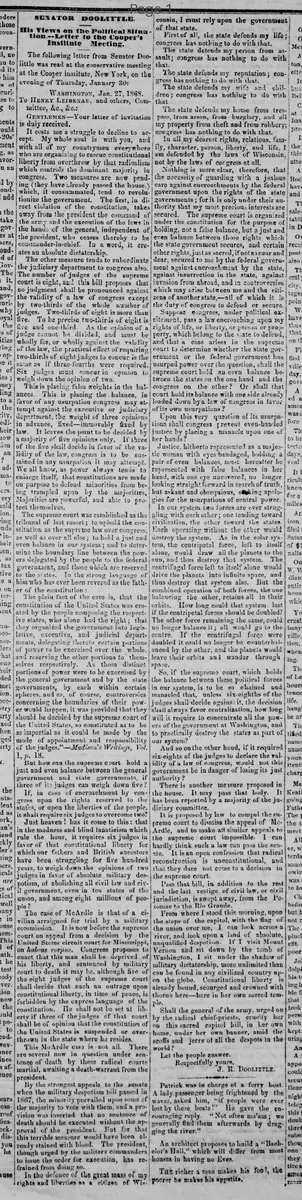
His Views on the Political Situation.--Letter to the Cooper's Institute Meeting.
The following letter from Senator Doolittle was read at the conservative meeting at the Cooper institute, New York, on the evening of Thursday, January 30:
WASHINGTON, Jan. 27, 1868.
To Henry Leibenau, and others, Committee, &c., &c.:
GENTLEMEN--Your letter of invitation is duly received.
It costs me a struggle to decline to accept. My whole soul is with you, and with all of my countrymen everywhere who are organizing to rescue constitutional liberty from overthrow by that radicalism which controls the dominant majority in congress. Two measures are now pending (they have already passed the house.) which, if consummated, tend to revolutionize the government. The first, in direct violation of the constitution, takes away from the president the command of the army and the execution of the laws in the hands of the general, independent of the president, who ceases thereby to be commander-in-chief. In a word, it creates an absolute dictatorship.
The other measure tends to subordinate the judiciary department to congress also. The number of judges of the supreme court is eight, and this bill proposes that no judgment shall be pronounced against the validity of a law of congress except by two-thirds of the whole number of judges. Two-thirds of eight is more than five. To be precise two-thirds of eight is five and one-third. As the opinion of a judge cannot be divided, and must be wholly for, or wholly against the validity of the law, the practical effect of requiring two-thirds of eight judges to concur is the same as if three-fourths were required. Six judges must concur in opinion to weigh down the opinion of two.
This is placing false weights in the balances. This is placing the balance, in favor of any usurpation congress may attempt against the executive or judiciary department, the weight of three opinions in advance, fixed-immovably fixed by law. It leaves the point to be decided by a majority of five opinions only. If three of the five shall decide in favor of the validity of the law, congress is to be sustained in any usurpation it may attempt.
We all know, as power always tends to enlarge itself, that constitutions are made on purpose to defend minorities from being trampled upon by the majorities. Majorities are powerful, and able to protect themselves.
The supreme court was established as the tribunal of last resort; to uphold the constitution as the supreme law over congress, as well as over all else; to hold a just and even balance in our system : and to determine the boundary line between the powers delegated by the people to the federal government, and those which are reserved to the states. In the strong language of him who has ever been revered as the father of the constitution :
The plain fact of the case is, that the constitution of the United States was created by the people composing the respective states, who alone had the right; that they organized the government into legislative, executive, and judicial departments, delegating thereto certain portions of power to be exercised over the whole, and reserving the other portions to themselves respectively. As those distinct portions of power were to be exercised by the general government and by the state governments, by each within certain spheres, and as, of course, controversies concerning the boundaries of their power would happen, it was provided that they should be decided by the supreme court of the United States, so constituted as to be as impartial as it could be made by the mode of appointment and responsibility of the judges."-Madison's Writings, Vol. 1, p. 18.
But how can the supreme court hold a just and even balance between the general government and state governments, if three of its judges can weigh down five? If, in case of encroachment by congress upon the rights reserved to the states, or upon the liberties of the people. it shall require six judges to overcome two?
Just heaven ! has it come to this: that in the madness and blind fanaticism which rule the hour, it requires six judges in favor of that constitutional liberty for which our fathers and British ancestors have been struggling for five hundred years, to weigh down the opinions of two judges in favor of absolute military despotism, of abolishing all civil law and civil government, even in ten states of the union, and among eight millions of people?
The case of McCardle is that of a civilian arraigned for trial by a military commission. It is now before the supreme court on appeal from a decision by the United States circuit court for Mississippi, on habeas corpus. Congress proposes to enact that this man shall be deprived of his liberty, and sentenced by military court to death it may be, although five of the eight judges of the supreme court shall decide that such an outrage upon constitutional liberty, in time of peace, is forbidden by the express language of the constitution. He shall not be set at liberty if three of the judges of that court shall be of opinion that the constitution of the United States is suspended or overthrown in the state where he resides.
This McCardle case is not all. There are several now in question under sentence of death by these radical courts martial, awaiting a death-warrant from the president.
By the strongest appeals to the senate when the military despotism bill passed in 1867, the minority prevailed upon some of the majority to vote with them, and a provision was inserted that no sentence of death should be executed without the approval of the president. But for that this terrible measure would have been already stained with blood. The president, though urged by the military commanders to issue the order or execution, has refrained from doing so.
In the defence of the great mass of my rights and liberties as a citizen of Wisconsin, I must rely upon the government of that state.
First of all, the state defends my life; congress has nothing to do with that.
The state defends my person from assault; congress has nothing to do with that.
The state defends my reputation; congress has nothing to do with that.
The state defends my wife and children; congress has nothing to do with that
The state defends my home from trespass, from arson, from burglary, and all my property from theft and from robbery; congress has nothing to do with that.
In all my dearest rights, relations, family, character, person, liberty, and life, I am defended by the laws of Wisconsin. not by the laws of congress at all.
Nothing is more clear, therefore, that the necessity of guarding with a jealous care against encroachments by the federal government upon the rights of the state governments ; for it is only under their authority that my most precious interests are secured. The supreme court is organized under the constitution for the purpose of holding, not a false balance, but a just and even balance between those rights which the state government secures, and certain other rights, just as sacred, if not so near and dear, secured to me by the federal government against encroachment by the state. against insurrection in the state, against invasion from abroad, and in controversies which may arise between me and the citizens of another state,-all of which it is the duty of congress to defend or secure.
Suppose congress, under political excitement, pass a law encroaching upon my rights of life, or liberty, or person or property, which belong to the state to defend and that a case arises in the supreme court to determine whether the state government or the federal government has usurped power over the question, shall the supreme court hold an even balance between the states on the one hand and the congress on the other? Or shall that court hold its balance with one side already loaded down by a law of congress in favor of its own usurpations?
Upon this very question of its usurpations shall congress prevent even-handed justice by placing a manacle upon one of her hands?
Justice, hitherto represented as a majestic woman with eyes bandaged, holding a pair of even balances, must hereafter be represented with false balances in her hand, with one eye uncovered, no longer looking straight forward in search of truth. but askant and obsequious, seeking apologies for the usurpations of central power.
In our system two forces are ever struggling with each other; one tending toward centralization, the other toward the states. Each operating without the other would destroy the system. As in the solar system, the centripetal force, left to itself alone, would draw all the planets to the sun, and thus destroy that system. The centrifugal force left to itself alone would drive the planets into infinite space, and thus destroy that system also. But the combined operation of both forces, the one balancing the other, retains all in their orbits. How long could that system last if the centripetal forces should be doubled? The other force remaining the same, could no longer balance it; all would go to the centre. If the centrifugal force were doubled it could no longer be counterbalanced by the other, and the planets would leave their orbits and wander through space.
So, if the supreme court, which holds the balance between these political forces in our system, is to be so changed and manacled that, unless six-eighths of the judges shall decide against it, the decision shall always favor centralization, how long will it require to concentrate all the powers of the government at Washington, and to practically destroy the states as part of our system?
And so on the other hand, if it required six-eighths of the judges to declare the validity of a law of congress, would not this government be in danger of losing its just authority?
There is another measure proposed in the house. It may pass that body. It has been reported by a majority of the judiciary committee.
It is proposed by law to compel the supreme court to dismiss the appeal of McCardle, and to make all similar appeals to the supreme court impossible. I can hardly think such a law can pass the senate. It is an open confession that radical reconstruction is unconstitutional, and that they dare not come to a decision in the supreme court.
Pass that bill, in addition to the rest and the last vestige of civil law, or civil jurisdiction, is swept away, from the Potomac to the Rio Grande.
From where I stood this morning, upon the steps of the capitol, with the flag of the union over me, I can look across a river, and look upon a land of absolute, unqualified despotism. If I visit Mount Vernon and sit down by the tomb of Washington, I sit under the shadow of military dictatorship, more unlimited than can be found in any civilized country upon the globe. Constitutional liberty is already bound, scourged and crowned with thorns here--here in her own sacred temple.
Shall the general of the army, urged on by the radical chief-priests, crucify her on this sacred capitol hill, in her own home, under her own banner, amid the scoffs and jeers of all the despots in the world?
Let the people answer.
Respectfully yours,
J. R. DOOLITTLE.
What sub-type of article is it?
What themes does it cover?
What keywords are associated?
What entities or persons were involved?
Letter to Editor Details
Author
J. R. Doolittle
Recipient
Henry Leibenau, And Others, Committee
Main Argument
congressional radical measures, including bills to remove the president's army command and require a supermajority of supreme court judges to invalidate laws, threaten to create military dictatorship and subordinate the judiciary, undermining constitutional liberty and state rights during reconstruction.
Notable Details