Thank you for visiting SNEWPapers!
Sign up free
Daily National Intelligencer
Washington, District Of Columbia
What is this article about?
Captain Nath. G. M. Senter's address to US Army officers urges perseverance in the war against Britain, attributing early defeats to inexperience, praising naval victories, decrying Indian atrocities on frontiers, and calling for patriotic unity under the president's leadership to preserve independence. (248 characters)
Merged-components note: Continuation of the same editorial article from the Native American, addressed to officers of the U.S. Army, spanning pages 2 and 3 with sequential reading order and continuous text flow.
Clippings
1 of 2
OCR Quality
Full Text
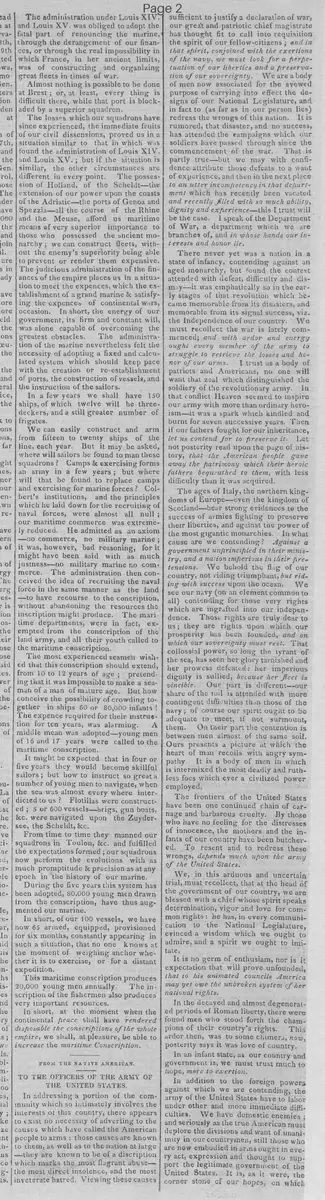
TO THE OFFICERS OF THE ARMY OF THE UNITED STATES.
In addressing a portion of the community which so intimately involves the interests of this country, there appears to exist no necessity of adverting to the causes which have called the American people to arms : those causes are known to them, as well as to the nation at large -they are known to be of a description which marks the most flagrant abuse-- the most direct insolence, and the most inveterate hatred. Viewing these causes sufficient to justify a declaration of war, our great and patriotic chief magistrate has thought fit to call into requisition the spirit of our fellow-citizens ; and in that spirit, conjoined with the exertions of the navy, we must look for a perpetuation of our liberties and a preservation of our sovereignty. We are a body of men now associated for the avowed purpose of carrying into effect the designs of our National Legislature, and in fact to (as far as in our person lies) redress the wrongs of this nation. It is rumored, that disaster, and no success, has attended the campaigns which our soldiers have passed through since the commencement of the war. That is partly true—but we may with confidence attribute those defeats to a want of experience, and then in the next place to an utter incompetency in that department which has recently been vacated and recently filled with so much ability. dignity and experience—this I trust will be the case. I speak of the Department of War, a department which we are branches of, and in whose hands our interests and honor lie.
There never yet was a nation in a state of infancy, contending against an aged monarchy, but found the contest attended with defeat, difficulty and dismay—it was emphatically so in the early stages of that revolution which became memorable from its disasters. and memorable from its signal success, viz. the Independence of our country. We must recollect the war is lately commenced; and with ardor and energy ought every member of the army to struggle to retrieve the losses und honor of our arms. I trust as a body of patriots and Americans, no one will want that zeal which distinguished the soldiery of the revolutionary army. In that conflict Heaven seemed to inspire our army with more than ordinary heroism—it was a spark which kindled and burnt for seven successive years. Then if our fathers fought for our inheritance, let us contend for to preserve it. Let not posterity read upon the page of history, that the American people gave away the patrimony which their heroic fathers bequeathed to them, with less difficulty than it was acquired.
The ages of Italy, the northern kingdoms of Europe—even the kingdom of Scotland—bear strong evidences to the success of armies fighting to preserve their liberties, and against the power of the most gigantic monarchies. In what cause are we contending? Against a government unprincipled in their ministry, and a nation imperious in their pretensions. We behold the flag of our country, not riding triumphant, but riding with success upon the ocean. We see our navy (on an element common to all contending for those very rights which are ingrafted into our independence. Those rights are truly dear to us; they are rights upon which our prosperity has been founded, and on which our sovereignty must rest. That colossal power, so long the tyrant of the sea, has seen her glory tarnished and her prowess defeated: her imperious dignity is sullied, because her fleet is vincible. Our part is different—our share of the toil is attended with more contingent difficulties than those of the navy; of course our spirit ought to be adequate to meet, if not surmount, them. On their part the contention is between men almost of the same soil. Ours presents a picture at which the heart of man recoils with angry sympathy It is a body of men in which is intermixed the most deadly and ruthless foes which ever a civilized power employed.
The frontiers of the United States have been one continued chain of carnage and barbarous cruelty. By those who have no feeling for the distresses of innocence, the mothers and the infants of our country have been butchered. To resent and to redress these wrongs, depends much upon the army of the United States.
We, in this arduous and uncertain trial, must recollect, that at the head of the government of our country, we are blessed with a chief whose spirit speaks determination, vigor and love for common rights: he has, in every communication to the National Legislature, evinced a wisdom which we ought to admire, and a spirit we ought to imitate.
It is no germ of enthusiasm, nor is it expectation that will prove unfounded, that to his animated councils America may yet owe the unbroken system of her national rights.
In the decayed and almost degenerated periods of Roman liberty, there were found men who stood forth the champions of their country's rights. This ardor then, was to some chimera, now, posterity says it was love of country.
In an infant state, as our country and government is, we must trust much to hope, more to exertion.
In addition to the foreign powers against which we are contending, the army of the United States have to labor under other and more immediate difficulties. We have domestic enemies ; and seriously as the true American must deplore the divisions and want of unanimity in our countrymen, still those who are now embodied in arms ought in every act, expression and thought to support the legitimate government of the United States. It is, as it were, the corner stone of our hopes, on which
On the present occasion, all our hopes are built on the determined redress of repeated insults. Let us all recall to our memory the hard distresses, the unconquered perseverance, the spirited love and toil which our fathers experienced in their way to Canada in the revolutionary war. Quebec was their aim—in effecting that object, those brave troops had to contend with incessant toil, hunger and deprivation. At that early period of the establishment of society in the New-England states, local obstacles intervened to impede their progress to the desired spot. But animated by those great spirits which sought to establish the freedom of their country, they pierced the wilderness, and but for the death of that exalted spirit General Montgomery, the American arms would have triumphed. At that tremendous battle my father fought—and I trust I shall never lose sight of his virtues and his love of country, if I hesitate for a moment in pursuing his precepts and his councils.
The organizing of the army is entrusted to a character of perhaps the greatest military experience in our country, and to him we look as to a pilot in this conflicting and tumultuous scene.
The resources of this country are still great and abundant—both as to wealth and population: and if we have confidence in the departments of government, they will have confidence in us. The views of our government are explicit and definite, they are for the support of those principles, and the enforcement of those pretensions which constitute the broad foundation of the independence and dignity of the United States.
From unanimity flows force, and from force effect—if this is the case, let every native and adopted American act in concert, to carry into execution those desirable wishes which the government have expressed in their public councils. The efforts which the government of Great-Britain made in the years of '75 and '79, incontestably prove that domination was the moving spring in all her councils; and that domination was directed to cramp the freedom and extinguish the colonial liberties of this union.
Since the period of 1783, her insulting spirit has been exhibited in every movement, and in every negociation which did not directly tend to infringe upon the public dignity of our country, and openly invite the government of America to war. You are all sensible to what a protracted length the late negociations have been carried; and uninviting as their friendship must be, still the wisdom of our country thought fit to leave every avenue open, and every principle uninfringed, in order to effect a settlement of difficulties, which should leave the sovereignty of the United States unimpaired and uninjured. The wisdom of our most distinguished statesman held out these views, and ever ought we to confide in the sincerity and virtue of those sentiments.
In the train of disasters, and amid the opposition which has marked those distinguished characters in New-England, let us all view it in that proper and dignified light which becomes men who are confident of the justness of the cause in which they contending. The undignified and contumelious philippics which have been pronounced on the floor of Congress, have greatly detracted from the character of that statesman, who so grossly insulted the government of his country, and the liberties which his countrymen enjoy. It is to be hoped he will retire from the councils of this nation covered with the odium and execration of his country. I speak this without fear and without restraint.
In the number of those who profess to be friends to the established order of our republic, and to the prevailing administration, we can discern some who possess an ardor and an enthusiasm which is highly honorable to the country which gave them birth.
In this afflicting and undecided scene let us all act with that righteous and manly conduct, which becomes the soldier, who is contending for his liberties and freedom—remembering that in the year 1783 our infant country compelled a powerful monarch to acknowledge our Independence, so let our spirit, our exertions, and our arms compel him to acknowledge that we are still free and independent.
NATH. G. M. SENTER,
Capt. 25th Regt. Infantry.
What sub-type of article is it?
What keywords are associated?
What entities or persons were involved?
Editorial Details
Primary Topic
Encouragement To Us Army Officers During The War
Stance / Tone
Patriotic Exhortation And Strong Support For The War Effort
Key Figures
Key Arguments