Thank you for visiting SNEWPapers!
Sign up free
Story
March 1, 1923
The Saratoga Sun
Saratoga, Carbon County, Wyoming
What is this article about?
President Harding proposes U.S. membership in the League of Nations' World Court with four reservations to avoid league obligations, surprising senators and likely delaying action until December. Secretary Hughes emphasizes the court's independence.
Clipping
OCR Quality
98%
Excellent
Full Text
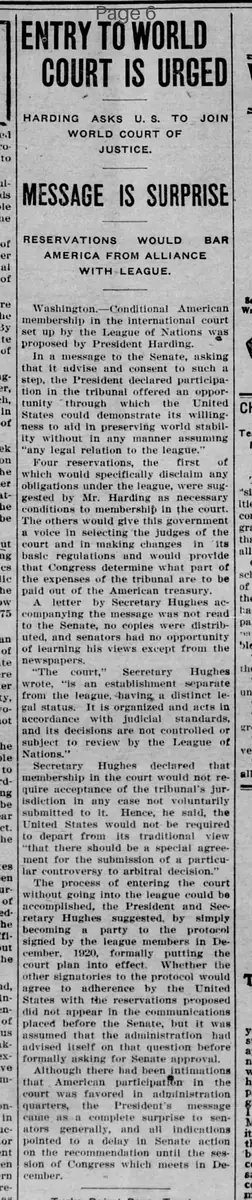
ENTRY TO WORLD COURT IS URGED
HARDING ASKS U. S. TO JOIN WORLD COURT OF JUSTICE.
MESSAGE IS SURPRISE
RESERVATIONS WOULD BAR AMERICA FROM ALLIANCE WITH LEAGUE.
Washington.—Conditional American membership in the international court set up by the League of Nations was proposed by President Harding. In a message to the Senate, asking that it advise and consent to such a step, the President declared participation in the tribunal offered an opportunity through which the United States could demonstrate its willingness to aid in preserving world stability without in any manner assuming "any legal relation to the league."
Four reservations, the first of which would specifically disclaim any obligations under the league, were suggested by Mr. Harding as necessary conditions to membership in the court. The others would give this government a voice in selecting the judges of the court and in making changes in its basic regulations and would provide that Congress determine what part of the expenses of the tribunal are to be paid out of the American treasury.
A letter by Secretary Hughes accompanying the message was not read to the Senate, no copies were distributed, and senators had no opportunity of learning his views except from the newspapers.
"The court," Secretary Hughes wrote, "is an establishment separate from the league, having a distinct legal status. It is organized and acts in accordance with judicial standards, and its decisions are not controlled or subject to review by the League of Nations."
Secretary Hughes declared that membership in the court would not require acceptance of the tribunal's jurisdiction in any case not voluntarily submitted to it. Hence, he said, the United States would not be required to depart from its traditional view "that there should be a special agreement for the submission of a particular controversy to arbitral decision."
The process of entering the court without going into the league could be accomplished, the President and Secretary Hughes suggested, by simply becoming a party to the protocol signed by the league members in December, 1920, formally putting the court plan into effect. Whether the other signatories to the protocol would agree to adherence by the United States with the reservations proposed did not appear in the communications placed before the Senate, but it was assumed that the administration had advised itself on that question before formally asking for Senate approval.
Although there had been intimations that American participation in the court was favored in administration quarters, the President's message came as a complete surprise to senators generally, and all indications pointed to a delay in Senate action on the recommendation until the session of Congress which meets in December.
HARDING ASKS U. S. TO JOIN WORLD COURT OF JUSTICE.
MESSAGE IS SURPRISE
RESERVATIONS WOULD BAR AMERICA FROM ALLIANCE WITH LEAGUE.
Washington.—Conditional American membership in the international court set up by the League of Nations was proposed by President Harding. In a message to the Senate, asking that it advise and consent to such a step, the President declared participation in the tribunal offered an opportunity through which the United States could demonstrate its willingness to aid in preserving world stability without in any manner assuming "any legal relation to the league."
Four reservations, the first of which would specifically disclaim any obligations under the league, were suggested by Mr. Harding as necessary conditions to membership in the court. The others would give this government a voice in selecting the judges of the court and in making changes in its basic regulations and would provide that Congress determine what part of the expenses of the tribunal are to be paid out of the American treasury.
A letter by Secretary Hughes accompanying the message was not read to the Senate, no copies were distributed, and senators had no opportunity of learning his views except from the newspapers.
"The court," Secretary Hughes wrote, "is an establishment separate from the league, having a distinct legal status. It is organized and acts in accordance with judicial standards, and its decisions are not controlled or subject to review by the League of Nations."
Secretary Hughes declared that membership in the court would not require acceptance of the tribunal's jurisdiction in any case not voluntarily submitted to it. Hence, he said, the United States would not be required to depart from its traditional view "that there should be a special agreement for the submission of a particular controversy to arbitral decision."
The process of entering the court without going into the league could be accomplished, the President and Secretary Hughes suggested, by simply becoming a party to the protocol signed by the league members in December, 1920, formally putting the court plan into effect. Whether the other signatories to the protocol would agree to adherence by the United States with the reservations proposed did not appear in the communications placed before the Senate, but it was assumed that the administration had advised itself on that question before formally asking for Senate approval.
Although there had been intimations that American participation in the court was favored in administration quarters, the President's message came as a complete surprise to senators generally, and all indications pointed to a delay in Senate action on the recommendation until the session of Congress which meets in December.
What sub-type of article is it?
Historical Event
What themes does it cover?
Justice
What keywords are associated?
World Court
Us Membership
Harding Proposal
League Reservations
Senate Surprise
What entities or persons were involved?
President Harding
Secretary Hughes
Where did it happen?
Washington
Story Details
Key Persons
President Harding
Secretary Hughes
Location
Washington
Event Date
December, 1920
Story Details
President Harding sends message to Senate proposing U.S. join World Court with reservations to avoid League ties, emphasizing independence and voluntary jurisdiction; surprises senators, delays expected.