Thank you for visiting SNEWPapers!
Sign up free
Letter to Editor
December 6, 1830
Lynchburg Virginian
Lynchburg, Virginia
What is this article about?
A parent critiques a prior letter on stable school tuition fees amid economic changes, arguing fees should remain steady for quality education and teacher pay, addressing class sizes, student classification, and economic realities in Virginia.
Clipping
OCR Quality
98%
Excellent
Full Text
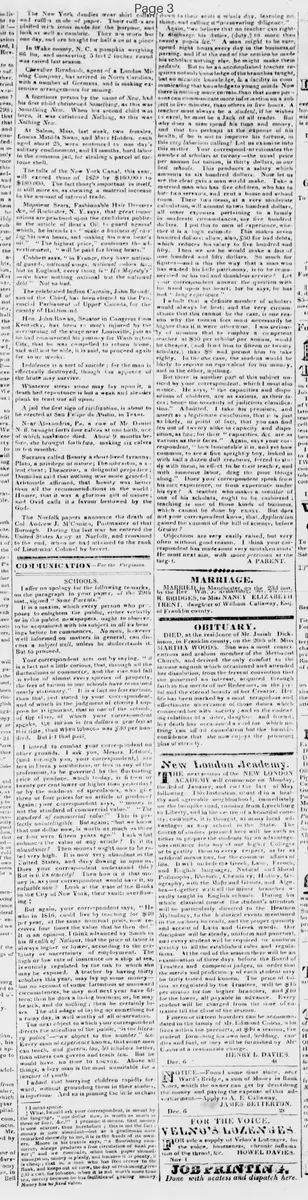
COMMUNICATION—For the Virginian.
SCHOOLS.
I offer no apology for the following remarks, on the paragraph in your paper, of the 29th inst., signed "Some Parents."
It is a maxim, which every person who proposes to enlighten the public, either verbally or in the public newspapers, ought to observe, to be acquainted with his subject in all its bearings before he commences. No man, however well informed on matters in general, can discuss a subject well, unless he understands it. But to proceed.
Your correspondent sets out by saying, "it is a fact not a little curious, that, through all the fluctuations of commerce, and the rise and fall in value of almost every species of property, the fees of tuition in our schools have remained nearly stationary." It is a fact no less curious, than that, just stated by your correspondent, and of which in the judgment of charity I suppose he is ignorant, that in one of the schools, of which your correspondent speaks, the tuition is ten dollars a year less at this time, than when tobacco was $3 per hundred. But let that pass.
I intend to combat your correspondent on other grounds. I ask you, Messrs. Editors, (and through you, your correspondent,) are fees in literary institutions, or fees in any of the professions, to be governed by the fluctuating price of produce, which to-day, is fifteen or twenty per cent lower or higher than yesterday? or by the madness of speculators, who give three or four prices for an article of produce? not the standard of commercial value. Again: your correspondent says, "money is the standard of commercial value!" This is perfectly unintelligible. But again; "but we know that one dollar now, is worth as much as three or four were fifteen years ago." I ask what enhances the value of any article? Is it its abundance? Then money ought now to be rated very high. It is now very abundant in the United States, and daily flowing in upon us. Does your correspondent understand this? But is it its scarcity? Then how is it that money is, as your correspondent would have it, so valuable now? Look at the state of the Banks in the City of New York, their vaults overflowing with $ . But again, your correspondent says, "He who in 1816, could live by teaching for $40 per year, at the same nominal price, now receives four times the value that he then did."
It is an opinion, I think advanced by Smith in his Wealth of Nations, that the price of labor is always higher or lower, according to the certainty or uncertainty of employment. The high or low rate of insurance on a ship at sea, is entirely regulated by the risk to which she may be exposed. A teacher by having thirty scholars this year, may lay up some money—but on account of some fortuitous or untoward circumstances, he may not next year have fifteen; then he does a losing business; or, he may be sick, and do nothing; then he certainly loses. The old adage of laying up something for a rainy day, is well worthy of all observation.
The next object to which your correspondent directs the attention of the public, "is the literary police"—"we object to the number." &c. Every man of experience knows, that some men can teach, and govern, too, 50 scholars better, than others can govern and teach ten. But he would have no time to lounge. Above all things, a lazy man is the most unsuitable for a teacher of youth.
I admit that hurrying children rapidly forward, without grounding them in their studies, is injurious. And so is pinning the little urchins down to their seats a whole day, learning nothing, and calling it "persevering diligence."
Again, "we believe that no teacher can rightly discharge his duties. (duty.) to more than twenty pupils &c." A man might to be sure, spend eight hours every day in the business of parging, and if at the end of the session he made his scholars nothing, else, he might make them pedants. But to be an accomplished teacher requires not only knowledge of the branches taught, but an accurate knowledge, & a facility in communicating that knowledge to young minds. Now there is nothing more certain, than that some persons can communicate more information on a subject in five minutes, than others in five hours. A teacher must always be a student, if he wishes to excel, he must be a Jack of all trades. But why does a man spend his time and money, and that too perhaps at the expense of his health, if he is not to improve his fortune, in this very laborious calling? Let us examine into this matter. Your correspondent estimates the number of scholars at twenty—the usual price per annum for tuition, is thirty dollars, in our best schools. This produces a salary which amounts to six hundred dollars. Now let us see the clear gain a man would make. Take a married man who has five children, who has to hire two servants, and rent a house and school room. These two items, at a very moderate calculation, will amount to two hundred dollars, all other expenses pertaining to a family in moderate circumstances, say five hundred dollars. I put this to men of experience, whether it is a high estimate. This makes seven hundred dollars: allow, also $50 for bad debts, which reduces his salary to five hundred and fifty. Then we see he would make a loss of one hundred and fifty dollars. So much for figures—and is this the way that a man who has wasted his little patrimony, is to be remunerated for his toil and thankless service? Let your correspondent answer the question with his hand upon his heart; for he says, he has had long experience.
I am of opinion that a definite number of scholars would always be best; and the very circumstance that this cannot be the case, is one reason why the tuition fees must necessarily be higher than if it were otherwise. I am seriously of opinion that to employ a competent teacher at $50 per scholar per annum, would be cheaper, (and limit him to fifteen or twenty scholars.) than $30 and permit him to take eighty. In the one case, the student would be likely to receive an equivalent for his money, and in the other, nothing.
But there is another part of this subject noticed by your correspondent, which I must also notice. He says, "the capacities and dispositions of children, are as various, as their faces; hence the necessity of judicious classification." Admitted. I take his premises, and assert as a legitimate conclusion, that it is just as likely, in point of fact, that you can find ten out of twenty alike in capacity and disposition, as two; for their "capacities. &c are as various as their faces." Again, says your correspondent, "how lamentable it is, and yet how common, to see a fine sprightly boy, linked in with half a dozen dull creatures, forced to study with them, in effect to be their teacher, and with immense labor, drag the poor things along." Does your correspondent speak from his own experience, or from experience under his eye? A teacher who makes a monitor of one of his scholars, ought to be cashiered: teaching is one of those kinds of business, which cannot be done by proxy. But does not your correspondent know, that Application gained the summit of the hill of science, before Genius?
Objections are very easily raised, but very often without good reason. I think your correspondent has made some very mistaken shots. He must next aim, with more precision at the target.
A PARENT.
SCHOOLS.
I offer no apology for the following remarks, on the paragraph in your paper, of the 29th inst., signed "Some Parents."
It is a maxim, which every person who proposes to enlighten the public, either verbally or in the public newspapers, ought to observe, to be acquainted with his subject in all its bearings before he commences. No man, however well informed on matters in general, can discuss a subject well, unless he understands it. But to proceed.
Your correspondent sets out by saying, "it is a fact not a little curious, that, through all the fluctuations of commerce, and the rise and fall in value of almost every species of property, the fees of tuition in our schools have remained nearly stationary." It is a fact no less curious, than that, just stated by your correspondent, and of which in the judgment of charity I suppose he is ignorant, that in one of the schools, of which your correspondent speaks, the tuition is ten dollars a year less at this time, than when tobacco was $3 per hundred. But let that pass.
I intend to combat your correspondent on other grounds. I ask you, Messrs. Editors, (and through you, your correspondent,) are fees in literary institutions, or fees in any of the professions, to be governed by the fluctuating price of produce, which to-day, is fifteen or twenty per cent lower or higher than yesterday? or by the madness of speculators, who give three or four prices for an article of produce? not the standard of commercial value. Again: your correspondent says, "money is the standard of commercial value!" This is perfectly unintelligible. But again; "but we know that one dollar now, is worth as much as three or four were fifteen years ago." I ask what enhances the value of any article? Is it its abundance? Then money ought now to be rated very high. It is now very abundant in the United States, and daily flowing in upon us. Does your correspondent understand this? But is it its scarcity? Then how is it that money is, as your correspondent would have it, so valuable now? Look at the state of the Banks in the City of New York, their vaults overflowing with $ . But again, your correspondent says, "He who in 1816, could live by teaching for $40 per year, at the same nominal price, now receives four times the value that he then did."
It is an opinion, I think advanced by Smith in his Wealth of Nations, that the price of labor is always higher or lower, according to the certainty or uncertainty of employment. The high or low rate of insurance on a ship at sea, is entirely regulated by the risk to which she may be exposed. A teacher by having thirty scholars this year, may lay up some money—but on account of some fortuitous or untoward circumstances, he may not next year have fifteen; then he does a losing business; or, he may be sick, and do nothing; then he certainly loses. The old adage of laying up something for a rainy day, is well worthy of all observation.
The next object to which your correspondent directs the attention of the public, "is the literary police"—"we object to the number." &c. Every man of experience knows, that some men can teach, and govern, too, 50 scholars better, than others can govern and teach ten. But he would have no time to lounge. Above all things, a lazy man is the most unsuitable for a teacher of youth.
I admit that hurrying children rapidly forward, without grounding them in their studies, is injurious. And so is pinning the little urchins down to their seats a whole day, learning nothing, and calling it "persevering diligence."
Again, "we believe that no teacher can rightly discharge his duties. (duty.) to more than twenty pupils &c." A man might to be sure, spend eight hours every day in the business of parging, and if at the end of the session he made his scholars nothing, else, he might make them pedants. But to be an accomplished teacher requires not only knowledge of the branches taught, but an accurate knowledge, & a facility in communicating that knowledge to young minds. Now there is nothing more certain, than that some persons can communicate more information on a subject in five minutes, than others in five hours. A teacher must always be a student, if he wishes to excel, he must be a Jack of all trades. But why does a man spend his time and money, and that too perhaps at the expense of his health, if he is not to improve his fortune, in this very laborious calling? Let us examine into this matter. Your correspondent estimates the number of scholars at twenty—the usual price per annum for tuition, is thirty dollars, in our best schools. This produces a salary which amounts to six hundred dollars. Now let us see the clear gain a man would make. Take a married man who has five children, who has to hire two servants, and rent a house and school room. These two items, at a very moderate calculation, will amount to two hundred dollars, all other expenses pertaining to a family in moderate circumstances, say five hundred dollars. I put this to men of experience, whether it is a high estimate. This makes seven hundred dollars: allow, also $50 for bad debts, which reduces his salary to five hundred and fifty. Then we see he would make a loss of one hundred and fifty dollars. So much for figures—and is this the way that a man who has wasted his little patrimony, is to be remunerated for his toil and thankless service? Let your correspondent answer the question with his hand upon his heart; for he says, he has had long experience.
I am of opinion that a definite number of scholars would always be best; and the very circumstance that this cannot be the case, is one reason why the tuition fees must necessarily be higher than if it were otherwise. I am seriously of opinion that to employ a competent teacher at $50 per scholar per annum, would be cheaper, (and limit him to fifteen or twenty scholars.) than $30 and permit him to take eighty. In the one case, the student would be likely to receive an equivalent for his money, and in the other, nothing.
But there is another part of this subject noticed by your correspondent, which I must also notice. He says, "the capacities and dispositions of children, are as various, as their faces; hence the necessity of judicious classification." Admitted. I take his premises, and assert as a legitimate conclusion, that it is just as likely, in point of fact, that you can find ten out of twenty alike in capacity and disposition, as two; for their "capacities. &c are as various as their faces." Again, says your correspondent, "how lamentable it is, and yet how common, to see a fine sprightly boy, linked in with half a dozen dull creatures, forced to study with them, in effect to be their teacher, and with immense labor, drag the poor things along." Does your correspondent speak from his own experience, or from experience under his eye? A teacher who makes a monitor of one of his scholars, ought to be cashiered: teaching is one of those kinds of business, which cannot be done by proxy. But does not your correspondent know, that Application gained the summit of the hill of science, before Genius?
Objections are very easily raised, but very often without good reason. I think your correspondent has made some very mistaken shots. He must next aim, with more precision at the target.
A PARENT.
What sub-type of article is it?
Persuasive
Informative
Social Critique
What themes does it cover?
Education
Economic Policy
Social Issues
What keywords are associated?
School Tuition
Teacher Compensation
Education Fees
Economic Fluctuations
Class Sizes
Virginia Schools
What entities or persons were involved?
A Parent
For The Virginian
Letter to Editor Details
Author
A Parent
Recipient
For The Virginian
Main Argument
responds to 'some parents' by arguing that school tuition fees should not fluctuate with produce prices or economic conditions, as they ensure quality teaching and fair compensation for educators; defends larger class sizes for capable teachers and critiques simplistic views on teacher economics and student classification.
Notable Details
References Adam Smith's Wealth Of Nations On Labor Prices
Discusses Money Abundance In Us Banks And Its Value
Calculates Teacher Net Income Showing Potential Loss At $30 Per Scholar
Critiques 'Literary Police' And Classification Of Students