Thank you for visiting SNEWPapers!
Sign up free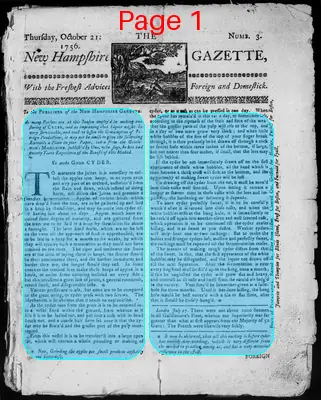
The New Hampshire Gazette
Portsmouth, Rockingham County, New Hampshire
What is this article about?
A letter to the publisher of the New Hampshire Gazette shares extracts from the Gentleman's Magazine on making superior cider. It details apple maturation in heaps, pressing, fermentation monitoring, and racking techniques to achieve sweet or rough cider, aiming to improve local production and reduce foreign liquor imports.
Clipping
OCR Quality
Full Text
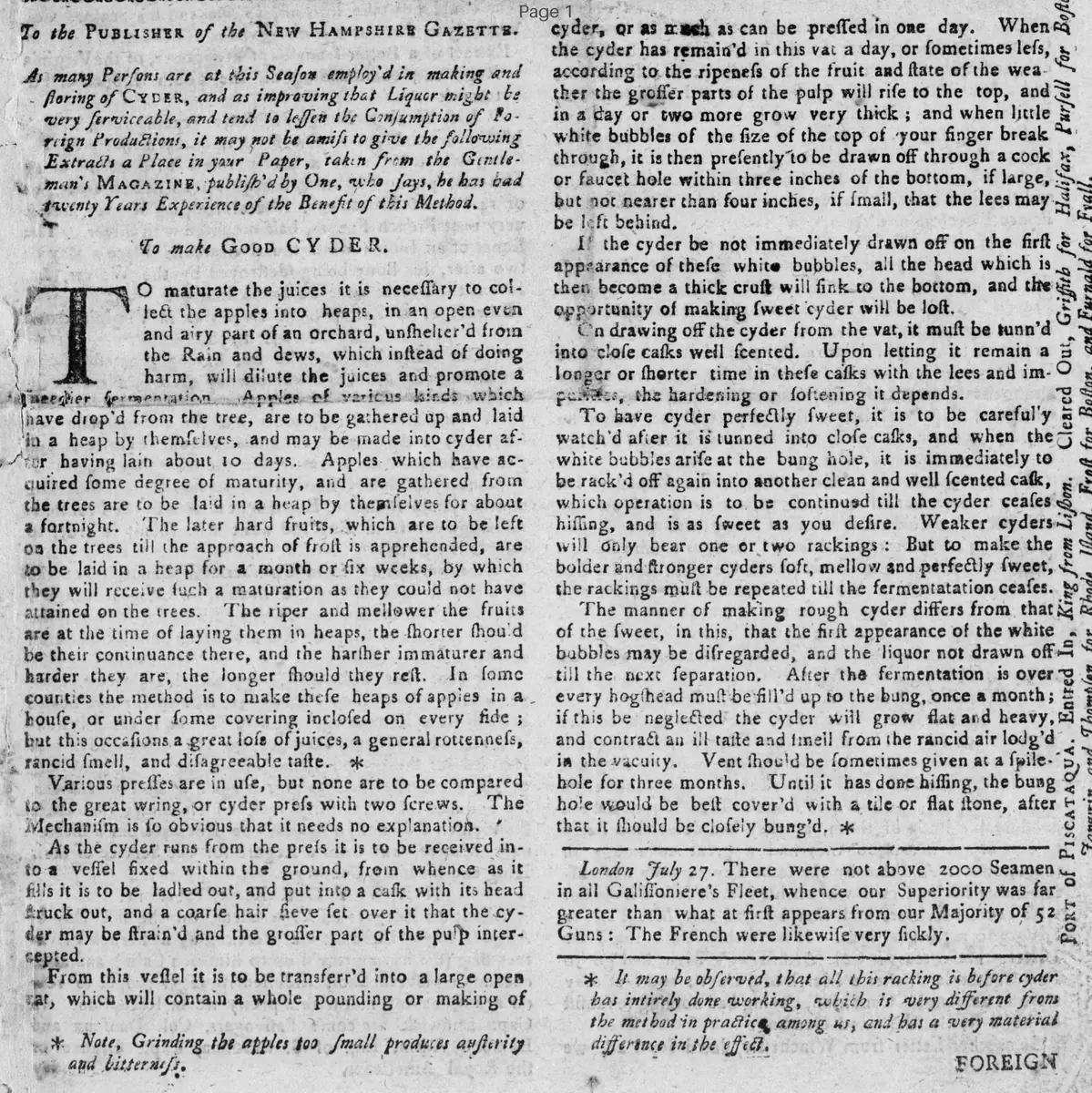
As many Persons are at this Season employ'd in making and storing of Cyder, and as improving that Liquor might be very serviceable, and tend to lessen the Consumption of Foreign Productions, it may not be amiss to give the following Extracts a Place in your Paper, taken from the Gentleman's Magazine, publish'd by One, who says, he has had twenty Years Experience of the Benefit of this Method.
To make Good Cyder.
To maturate the juices it is necessary to collect the apples into heaps, in an open even and airy part of an orchard, unshelter'd from the Rain and dews, which instead of doing harm, will dilute the juices and promote a faster Fermentation. Apples of various kinds which have dropt from the tree, are to be gathered up and laid in a heap by themselves, and may be made into cyder after having lain about 10 days. Apples which have acquired some degree of maturity, and are gathered from the trees are to be laid in a heap by themselves for about a fortnight. The later hard fruits, which are to be left on the trees till the approach of frost is apprehended, are to be laid in a heap for a month or six weeks, by which they will receive such a maturation as they could not have attained on the trees. The riper and mellower the fruits are at the time of laying them in heaps, the shorter should be their continuance there, and the harsher immaturer and harder they are, the longer should they rest. In some counties the method is to make these heaps of apples in a house, or under some covering enclosed on every side; but this occasions a great loss of juices, a general rottenness, rancid smell, and disagreeable taste.
Various presses are in use, but none are to be compared to the great wring, or cyder press with two screws. The Mechanism is so obvious that it needs no explanation.
As the cyder runs from the press it is to be received into a vessel fixed within the ground, from whence as it fills it is to be ladled out, and put into a cask with its head struck out, and a coarse hair sieve set over it that the cyder may be strained and the grosser part of the pulp intercepted.
From this vessel it is to be transferr'd into a large open vat, which will contain a whole pounding or making of cyder.
* Note, Grinding the apples too small produces austerity and bitterness.
The cyder has remain'd in this vat a day, or sometimes less, according to the ripeness of the fruit and state of the weather the grosser parts of the pulp will rise to the top, and in a day or two more grow very thick; and when little white bubbles of the size of the top of your finger break through, it is then presently to be drawn off through a cock or faucet hole within three inches of the bottom, if large: but not nearer than four inches, if small, that the lees may be left behind.
If the cyder be not immediately drawn off on the first appearance of these white bubbles, all the head which is then become a thick crust will sink to the bottom, and the opportunity of making sweet cyder will be lost.
In drawing off the cyder from the vat, it must be tunn'd into close casks well scented. Upon letting it remain a longer or shorter time in these casks with the lees and impurities, the hardening or softening it depends.
To have cyder perfectly sweet, it is to be carefully watch'd after it is tunn'd into close casks, and when the white bubbles arise at the bung hole, it is immediately to be rack'd off again into another clean and well scented cask, which operation is to be continued till the cyder ceases hissing, and is as sweet as you desire. Weaker cyder will only bear one or two rackings: But to make the bolder and stronger cyder soft, mellow and perfectly sweet, the rackings must be repeated till the fermentation ceases.
The manner of making rough cyder differs from that of the sweet, in this, that the first appearance of the white bubbles may be disregarded, and the liquor not drawn off till the next separation. After the fermentation is over every hogshead must be fill'd up to the bung once a month; if this be neglected the cyder will grow flat and heavy, and contract an ill taste and smell from the rancid air lodg'd in the vacuity. Vent should be sometimes given at a spile hole for three months. Until it has done hissing, the bung hole would be best cover'd with a tile or flat stone, after that it should be closely bung'd. *
* It may be observed, that all this racking is before cyder has entirely done working, which is very different from the method in practice among us, and has a very material difference in the effect.
What sub-type of article is it?
What themes does it cover?
What keywords are associated?
What entities or persons were involved?
Letter to Editor Details
Recipient
The Publisher Of The New Hampshire Gazette
Main Argument
sharing extracts from the gentleman's magazine on methods to make good cider by properly maturing apples, pressing, fermenting, and racking to produce sweet or rough varieties, which can improve local production and reduce consumption of foreign liquors.
Notable Details