Thank you for visiting SNEWPapers!
Sign up free
The Hillsborough Recorder
Hillsboro, Orange County, North Carolina
What is this article about?
British officers in Canada praise Capt. Hull's magnanimous conduct during the capture of HMS Guerriere, forgoing an easy rake to fight fairly. Commodore Barclay toasts Perry's humane treatment after Lake Erie defeat, later moved to tears recounting it. News arrives of Perry's death from fever abroad.
Clipping
OCR Quality
Full Text
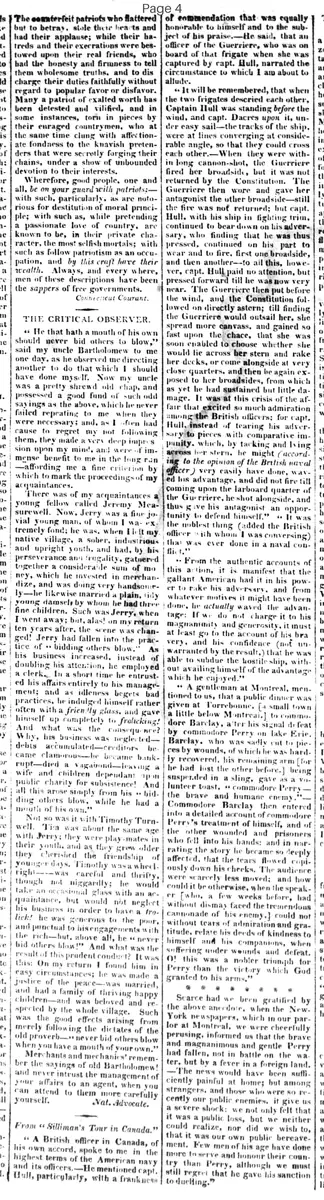
A British officer in Canada, of his own accord, spoke to me in the highest terms of the American navy and its officers. He mentioned Capt. Hull, particularly, with a frankness of commendation that was equally honorable to himself and to the subject of his praise. He said, that an officer of the Guerriere, who was on board of that frigate when she was captured by Capt. Hull, narrated the circumstance to which I am about to allude.
“It will be remembered, that when the two frigates descried each other, Captain Hull was standing before the wind, and Capt. Dacres upon it, under easy sail—the tracks of the ships were at lines converging at considerable angle, so that they could cross each other. When they were within long cannon-shot, the Guerriere fired her broadside, but it was not returned by the Constitution. The Guerriere then wore and gave her antagonist the other broadside—still the fire was not returned: but Capt. Hull, with his ship in fighting trim, continued to bear down on his adversary, who finding that he was thus pressed, continued on his part to wear and to fire, first one broadside, and then another—to all this, however, Capt. Hull paid no attention, but pressed forward till he was now very near. The Guerriere then put before the wind, and the Constitution followed on directly astern; till finding the Guerriere would outsail her, she spread more canvass, and gained so fast upon the chase, that she was soon enabled to choose whether she would lie across her stern and rake her decks, or come alongside at very close quarters, and then be again exposed to her broadsides, from which as yet he had sustained but little damage. It was at this crisis of the affair that excited so much admiration among the British officers; for Capt. Hull, instead of tearing his adversary to pieces with comparative impunity, which, by tacking and lying across her stern, he might (according to the opinion of the British naval officer) very easily have done, waived his advantage, and did not fire till coming upon the larboard quarter of the Guerriere, he shot alongside, and thus gave his antagonist an opportunity to defend himself." "It was the noblest thing (added the British officer with whom I was conversing) that was ever done in a naval contest."
From the authentic accounts of this action, it is manifest that the gallant American had it in his power to rake his adversary, and from whatever motives it might have been done, he actually waved the advantage: If we do not charge it to his magnanimity and generosity, it must at least go to the account of his bravery, and his confidence (not unwarranted by the result.) that he was able to subdue the hostile ship, without availing himself of the advantage which he enjoyed.
A gentleman at Montreal, mentioned to us, that a public dinner was given at Terrebonne, [a small town a little below Montreal] to Commodore Barclay, after his signal defeat by Commodore Perry on Lake Erie. Barclay, who was sadly cut to pieces by wounds, of which he was hardly recovered, his remaining arm [for he had lost the other before.] being suspended in a sling, gave as a volunteer toast, "Commodore Perry—the brave and humane enemy."
Commodore Barclay then entered into a detailed account of Commodore Perry's treatment of himself, and of the other wounded and prisoners who fell into his hands: and in narrating the story he became so deeply affected, that the tears flowed copiously down his cheeks. The audience were scarcely less moved: and how could it be otherwise, when the speaker [who, a few weeks before, had without dismay faced the tremendous cannonade of his enemy.] could not without tears of admiration and gratitude, relate his deed of kindness to himself and his companions, when suffering under wounds and defeat.
O! this was a nobler triumph for Perry than the victory which God granted to his arms.
Scarce had we been gratified by the above anecdote, when the New York newspapers, which in our parlor at Montreal, we were cheerfully perusing, informed us that the brave and magnanimous and gentle Perry had fallen, not in battle on the water, but by a fever in a foreign land.—The news would have been sufficiently painful at home; but among strangers, and those who were so recently our public enemies, it gave us a severe shock: we not only felt that it was a public loss, but we neither could realize, nor did we wish to, that it was our own public bereavement. Few men of his age have done more to serve and honour their country than Perry, although we must still regret that he gave his sanction to duelling.
Nat. Advocate.
What sub-type of article is it?
What themes does it cover?
What keywords are associated?
What entities or persons were involved?
Where did it happen?
Story Details
Key Persons
Location
Canada, At Sea, Lake Erie, Montreal, Terrebonne
Story Details
British officer praises Capt. Hull for waiving advantage to rake HMS Guerriere and instead closing for fair fight; Commodore Barclay toasts Perry as brave and humane after Lake Erie defeat, tearfully recounts Perry's kind treatment of wounded; news of Perry's death from fever abroad.