Thank you for visiting SNEWPapers!
Sign up free
Story
January 17, 1887
Springfield Daily Republic
Springfield, Clark County, Ohio
What is this article about?
Historical narrative of Clark County's early settlement through the life of Joanna Smith Miller, detailing her family's migration from New Jersey to Ohio in 1788, pioneer hardships, family histories, education, agriculture, and community developments up to the mid-19th century.
Clipping
OCR Quality
95%
Excellent
Full Text
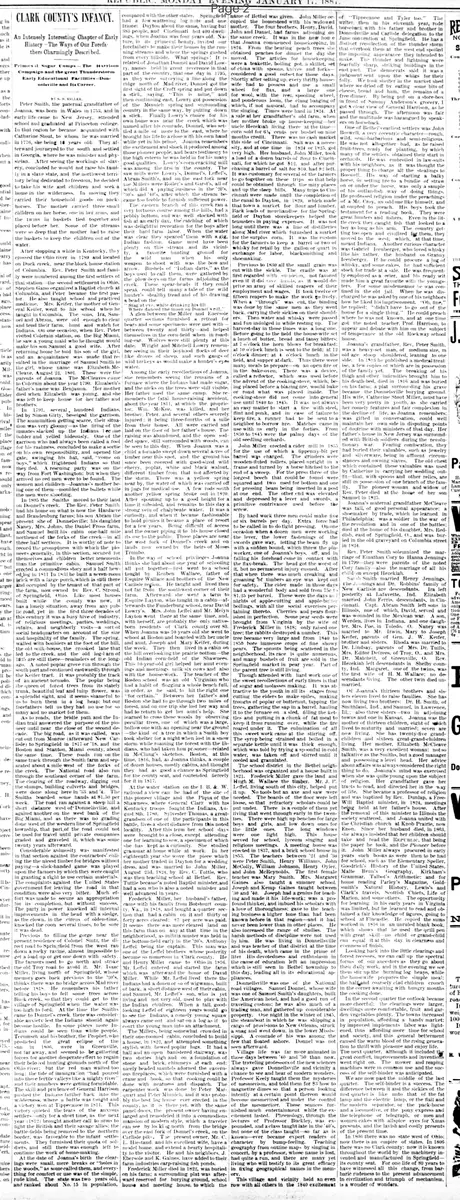
CLARK COUNTY'S INFANCY.
An Intensely Interesting Chapter of Early
History -The Ways of Our Forefathers
Charmingly Described.
Primary Sugar Camps - The Harrison
Campaign and the great Thunderstorm
Early Educational Facilities-Donnelsville
and Its Career.
BY S. S. MILLER.
Peter Smith, the paternal grandfather of
Joanna, was born in Wales in 1753, and in
early life came to New Jersey, attended
school and graduated at Princeton college.
In that region he became acquainted with
Catharine Stout, to whom he was married
in 1776, she being 18 years old. They afterward
journeyed to the south and settled
in Georgia, where he was minister and physician.
After seeing the workings of slavery,
concluded he would not raise his family
in a slave state, and the northwest territory
being dedicated to freedom, he decided
to take his wife and children and seek a
home in the wilderness. In moving they
carried their household goods on packhorses.
The mother carried three small
children on her horse, one in her arms, and
the twins in baskets tied together and
placed before her. Some of the streams
were so deep that the mother had to raise
the baskets to keep the children out of the
water.
After stopping a while in Kentucky, they
crossed the Ohio river in 1788 and located
on Duck creek, near the block house station
of Columbia. Rev. Peter Smith and family
were numbered among the first settlers of
that station—the second settlement in Ohio.
Stephen Gano organized a Baptist church at
Columbia, and Peter became the first pastor.
He also taught school and practiced
medicine. Mrs. Keifer, the mother of Gen.
Keifer, went to his school when he
taught in Columbia. The sons, Ira, Samuel
and Abram, were old enough to clear
and tend their farm, hunt and watch for
Indians. On one occasion, when Rev. Peter
visited Colerain station, on the Big Miami,
he saw a young maid who he thought would
make his son Samuel a good wife. After
returning home he told his son of the girl,
and an acquaintance was made that resulted
in the marriage of Samuel Smith to
the girl, whose name was Elizabeth McCleave,
August 23, 1801. These were the
parents of Joanna. The McCleaves came
to Colerain about the year 1800. Elizabeth's
father's name was Benjamin. Her mother
died when Elizabeth was young, and she
was left to keep house for her father and
brothers.
In 1791, several hundred Indians,
led by Simon Girty, besieged the garrison.
The ammunition getting scarce, their situation
was very gloomy—as the firing of the
inmates slacked up the Indians became
bolder and yelled hideously. One of the
garrison who had always been called a fool
for his rashness, concluded to make a sortie
on his own responsibility, and opened the
gate, swinging his hat, said, "come on
boys," which frightened Indians so that
they fled. A rescuing party was on the
way from Fort Washington; but when they
arrived no red men were to be found. The
women and children—Joanna's mother being
one of them—molded the bullets while
the men were shooting.
In 1805 the Smiths moved to their land
on Donnel's creek. The Rev. Peter Smith
had his home on what is now the Hardacre
and Brandenburg farms; his son Abram the
present site of Donnelsville; his daughter
Nancy, Mrs. Johns, the Daniel Fross farm,
and Samuel built his cabin one-half mile
northeast of the forks of the creek—in all
three half sections. It is worthy of note to
record the promptness with which the pioneers
generally, in this section, secured to
themselves and children better tenements
than the primitive cabin. Samuel Smith
erected a commodious story and a half hewed
log in 1811. In 1838 he built a seven-room
brick with a large porch, which is still there
and occupied by the tenant of that part of
the farm, now owned by Rev. C. Stroud,
of Springfield, Ohio. Like most houses
built while the county was new, it
has a lonely situation, away from any public
road, yet in the first three decades of
this century it was a busy hive of industry,
of religious meetings, parties, weddings,
infairs, and neighborly visits—a sort of
social headquarters on account of the size
and hospitality of the family. The spring,
walled with boulders at the foot of the hill,
the old milk-house, the crooked lane that
led to the creek, and the old log-barn of
1825 are still there—reminders of the long
ago. A noted poplar grove run through the
south part and continued eastwardly through
the Keifer tract. It was probably the track
of an ancient tornado. The poplar being
the queen of forest trees from its stately
trunk, beautiful leaf and tulip flower, was
a splendid sight, and it seems shameful to
us to burn them in a log heap; but our
forefathers tell us they had no use for so
many and no market for them.
As to roads, the bridle path and the Indian
trail answered the purpose of the pioneer
until near the close of the second decade.
The big road, as it was called, was
cut out from Monroe (afterward New Carlisle)
to Springfield in 1817 or '18, and the
Boston and Stanton, Miami county, about
the same time. These roads run on the
same track through the Smith farm and separated
about a mile west of the forks of
the creek. The National road also run
through the southeast corner of the farm.
The clearing of the roadway, digging out
the stumps, building culverts and bridges,
were done along here in '33 and '34. The
Smiths boarded some hands at $1.50 per
week. The road ran against a steep hill a
short distance west of Donnelsville, and
against another on the west bank of the
Big Miami, and as there was no grading
done west of the western line of Springfield
township, that part of the road could not
be used for travel until private companies
graded and graveled it, which was some
twenty years afterward.
Considerable animosity was manifested
in that section against the contractors' calling
the nicest timber for bridges without
paying—a slick-handed game was played
upon the farmers by which they were caught
in granting a right to use certain materials.
The complaints against the United States
government for leaving the road in that
condition were also very bitter. Much effort
was made to secure an appropriation
for its completion, but without success.
The party in power knocked all internal
improvements in the head with a sledge,
as the clown, in the circus of olden-time,
knocked the coon several times, to be sure
it was dead.
Previous to filling the gorge near the
present residence of Colonel Smits, the direct
road to Springfield from the west ran
down a rocky ravine, almost impossible to
get a load up or get one down with safety.
The farmers used to go north and strike
the old Troy road to avoid it. Mr. Isaac
Miller, living north of Springfield, whose
memory goes back previous to the 20's,
things there was no bridge across Mad river
before 1818. He remembers his father
telling his boys to fell some trees across
Buck creek, so that they could get to the
village of Springfield when the water was
too high to ford. At the time the Smiths
came to Donnel's creek, there was considerable
anxiety lest the Indians should again
become hostile. In some places more Indians
could be seen than white people.
Tecumseh and his brother, the Prophet, who
predicted the great eclipse of the
sun in 1806, were in Greenville,
not far away, and seemed to be gathering
forces for another desperate effort to regain
their beloved hunting grounds north of the
Ohio river; but the red man waited too
long; the tide of immigration "had poured
into these fertile valleys like a mighty river"
and their numbers were getting formidable.
The skill and prudence of General Harrison
pushed the Indians farther back into the
wilderness, where a battle was fought and
a victory won at Tippecanoe in 1811. This
victory quieted the fears of the anxious
settlers—only for a short time, as the next
year (1812) brought another call to arms to
fight the British and their savage allies; the
battle-fields being removed to the northern
border, was favorable to the infant settlements.
They furnished their quota of soldiers,
and still there was enough left to
continue the work of home-making.
At the date of Joanna's birth the clearings
were small, mere breaks or "holes in
the woods," as some called them, and everything
for comfort or use was of the simple,
rude kind. The state was two years old,
and ranked about No. 15 in population.
Springfield
had a few scattering log huts and one
frame; Dayton about the same, having but
383 people, and Cincinnati but 400 dwellings,
when Joanna was four years old. Nature,
in its primeval beauty, invited our
forefathers to make their homes by the running
streams and where the springs gushed
from every hillside. What springs! It is
related of Jonathan Donnel and David Lowry,
names held in great reverence in that
part of the country, that one day in 1795,
as they were surveying a line along the
ridge north of Mad river, Donnel got the
first sight of the Croft spring and put down
a stick, saying, "This is mine," and
then continuing east, Lowry got possession
of the Minnich spring and surrounding
country in the same way, by putting down
a stick. Finally Lowry's choice for his
own home was near the creek which was
named after his comrade, Donnel, who settled
a mile or more to the east, where he
brought his life to a close with his own hand
while yet in his prime. Joanna remembers
the excitement and shock it produced among
those pioneer people, and bears testimony to
the high esteem he was held in for his many
good qualities. Lowry's corn-cracking mill
was among the first in the county. The
saw mills were Lowry's, Donnel's, Leffel's,
Abram Smith's, and on the east fork near
the Mullers were Roller's and Garst's, all of
which did a paying business in the '20's,
'30's and '40's, after which the stream became
too feeble to furnish sufficient power.
The eastern branch of this creek ran a
very tortuous course among the hills, had a
pebbly bottom, and was well stocked with
fish at an early day, the catching of which
was delightful recreation for the boys after
their hard farm labor. When the water
was clear they speared them with a gig,
Indian fashion. Game must have been
plenty on this stream and its vicinity,
a favorite hunting ground for
the wild man when
his only weapon to shoot with was the bow and
arrow. Bushels of "Indian darts," as the
boys used to call them, were gathered by
the plow-boys on the farms adjoining the
creek. These spear-heads if they could
speak could tell many a tale of the wild
hunter's stealthy tread and of his drawing a
bead on the
"Stag at eve, while drinking his fill
Where danced the moon on Donnel's rill."
A glen between the Miller and Ebersole
quarter sections furnished a retreat for
bears and some specimens were met with—between
twenty and thirty—and helped
themselves in the corn-field when in roasting-ear.
Wolves were still plenty at this
date. Wright and Mitchell Lowry remember
seeing in their boyhood flocks of deer
like droves of sheep, and such gangs of
wild turkeys as would make a hunter's eyes
water.
Among the early recollections of Joanna,
she remembers seeing the remains of a
furnace where the Indians had made sugar,
and the nicks on the trees were still visible.
Her father used the same camp.
She remembers the fatal house-raising accident,
about the year 1811, at which the proprietor,
Wm. McKee, was killed, and her
brother, Peter, and several others severely
injured; it being three-fourths of a mile
from their house. All were carried and
laid on the floor of her father's house. The
raising was abandoned, and the open sodded
space, still surrounded with woods, can
be seen to this day. When Joanna was a
child a tornado swept down several acres of
timber near this spot, and the ground has
since been covered with good-sized wild
cherry, poplar, white and black walnut,
different timber from that not affected by
the storm. There was a yellow spring
near by, the water of which was carried off
in jugs for medical use. A few rods south
another yellow spring broke out in 1820.
After spouting up to a good height for a
time it subsided, and remains to this day a
strong vein of chalybeate water. It was a
curiosity, and when it became fashionable
to hold picnics it became a place of resort
for a few years. Being difficult of access
and the owner piping it to his house closed
its use to the public. Those places are near
the west fork of Donnel's creek and on
lands now owned by the heirs of Moses
Trumbo.
In the way of school privileges Joanna
thinks she had about one year of schooling
all put together—first went to a school
taught by Reuben Wallace, father of
Esquire Wallace and brothers of the New
Carlisle region. He taught and lived then
not far from the southwest corner of their
farm. Afterward she went a term to
Esquire Layton, who taught in a cabin—afterwards
the Funderburg school, near David
Lowry's. Mrs. John Leffel and Mr. Melvin
Layton went there at the same time, and,
with herself, are probably the only native
born residents of Clark county over 80.
When Joanna was 10 years old she went to
school at Boston and boarded with her uncle
and aunt, Joseph and Mary Keifer, during
the week. They then lived in a cabin on
the hill overlooking the prairie bottom—the
old Indian corn-field of the Shawnees.
This 10-year-old girl helped her aunt evenings
and mornings milk six cows and also
with the house-work. The teacher of the
Boston school was an old Virginian who
had a habit of flogging a whole bench full,
in order, as he said, to hit the right one
"for certain." Between her father's and
Boston she had to go through two miles of
forest, and on one trip she lost her way and
had to return to get her aunt's help. She
learned to cross these woods by observing
peculiar trees, one of which was a large,
hollow one with an opening near the ground
—the kind of a tree in which a Smith boy
took shelter for a night when lost in a snow
storm while roaming the forest with the Indians,
who had taken him prisoner—related
in McClung's sketches. Boston, at this
time, 1816, had, as Joanna thinks, a couple
of dozen houses, mostly cabins, and thought
they had as good a chance as Springfield
for the county seat, and contended fiercely
for it in 1817.
At the water station on the I. B. & W.
railroad a view can be had of the site of
this pioneer village and the Piqua of the
Shawnees, where General Clay with his
Kentucky troops fought the Indians, August
8th, 1780. Sylvester Thomas, a great
grandson of one of the participants in this
battle, lives a short distance from this noted
locality. After this term her school days
were brought to a close, except attending
one for learning to sew, a specimen of which
she has kept as a curiosity. She studied
grammar at home while at work. In her
eighteenth year she wove the piece which
her mother traded in Dayton for a wedding
dress, and was married to John Miller,
August 23d, 1824, by Rev. C. Tuttle, who
was then teaching school at Bethel. Rev.
Tuttle became a noted Baptist minister, and
had a son who is also a noted minister and
well advanced in years.
Frederick Miller, her husband's father,
came with his family from Botetourt county,
Va., in 1815, and bought a quarter section
that had a cabin on it and thirty or
forty acres cleared; $7 per acre was paid.
It seems there was more cleared land on
this farm than on any at that time in the
neighborhood, as militia muster was held in
the bottom-field early in the '20's, Anthony
Leffel being the captain. This man was
one of the Leffel brothers whose posterity
became so numerous in Clark county. He
and Henry Miller came to Ohio in 1816.
Mr. Leffel entered and started the farm
which was afterward the home of David
Miller. While Mr. Leffel lived there the
Indians had a dozen or so of wigwams, built
of bark, a short distance west of their cabin,
and Samuel, Mr. Leffel's son, who is yet
living and not very old, used to play with
the Indian children. When a tall, goodlooking
Leffel of eighteen years would go
to see the Indians, a comely young squaw
always came out and sat on a log as if to
court the young man into an attachment.
The Millers, being somewhat crowded in
their one-roomed cabin, concluded to build
a house, in 1822, and attempted something
stylish with hewed poplar logs. It had a
hall and an open banistered stairway, was
two stories high and on a foundation of
stone and brick, chimneys at each end;
nicely beaded mantels adorned the cavernous
fireplaces, which were furnished with a
crane and hook, so that cooking could be
done with neatness and dispatch. The
carpenter work was done by Peter Marquart
and Peter Minnich, and it was probably
the best log house ever erected in the
county, as it is there yet, with the same
panel doors, the present owner having enlarged
and remodeled it into a commodious
mansion of modern style, which a traveler
can see by looking north from the bridge
over the east fork of Donnel's creek, on the
Carlisle pike. The present owner, Mr. C.
L. Hiestand and his excellent wife, have a
model home, and extend a hearty hospitality
to the visitor. He and his neighbors, J.
Ebersole and K. Gaines, have added to their
farm industries carp-raising fish ponds.
Frederick Miller died in 1822, was buried
on his farm; a surrounding plat was afterward
reserved for burying ground, school
name of Bethel was given. John Miller occupied
the homestead with his widowed
mother. The four brothers, Henry, David,
John and Daniel, had farms adjoining on
the same creek. It was in the new house
that Joanna commenced housekeeping, in
1824. From the bearing peach trees she
obtained peaches for dinner the day she
moved. The articles for housekeeping
were a teakettle, boiling pot, a skillet, set
of china with spoons, knives and forks—considered
a good outset for those days.
Shortly after setting up, every thrifty housewife
had to possess and use a small
wheel for flax, and a large
one for wool, with the reel, spooling wheel,
and ponderous loom, the clang banging of
which, if not musical, had to accompany
the singing. Times were hard in 1834. At
a sale at her grandfather's old farm, when
her mother broke up housekeeping—her
uncle Hezekiah living there at the time—corn
sold for 6 cents per bushel on nine
months credit. There was no cash market
this side of Cincinnati. Salt was a necessity,
and at one time in 1824 or 1825, got
very high. Her husband, John Miller, took
a load of a dozen barrels of flour to Cincinnati,
for which he got $12, and after purchasing
a barrel of salt for $10, had $2 left.
It was customary for several of the farmers
to go together on these trips so that help
could be obtained through the miry places
and up the steep hills. Many trips to Cincinnati
were made until the completion of
the canal to Dayton, in 1829, which made
that town a market for flour and lumber.
Back loads of merchandise for the Springfield
or Dayton storekeepers helped the
teamsters in paying expenses. It was not
long until there was a line of distilleries
along Mad river which furnished a market
for the surplus corn. It was the custom
for the farmers to keep a barrel or two of
whisky for retail by the gallon or quart in
exchange for labor, blacksmithing and
shoemaking.
Previous to 1830 all the small grain was
cut with the sickle. The cradle was at first
regarded with suspicion, not favored
even if it did save hands, as it would deprive
an army of skilled reapers of their
employment and wages. It took twelve or
fifteen reapers to make the work go lively.
When a "through" was cut, the binding
was done by the same men as they went
back, carrying their sickles on their shoulders.
Then water and whisky were passed
and fun indulged in while resting up. The
harvest-day in those times was a long one.
Before going to the field the house-wife set
a lunch of butter, bread and tansy bitters;
at 7 o'clock the horn blows for breakfast;
at 10 o'clock lunch is sent to the field; at 12
o'clock dinner; at 4 o'clock lunch in the
field, and supper at dark. Thus there were
many meals to prepare on an open fire or
in the bake-oven. There was a device,
called a reflector, which was used before
the advent of the cooking-stove, which, being
placed before a blazing fire, would bake
or roast what was placed inside. The
cooking-stove did not come into general
use until 1840 to 1845. It was not always
an easy matter to start a fire with steel,
flint and punk, and in case of failure to
keep fire, a runner had to be sent to a
neighbor to borrow fire. Matches came in
use with us early in the forties. From
1830 to 1845 were the palmy days of the
old seedling orchards.
John Miller erected a cider mill in 1835
for the use of which a fippenny-bit per
barrel was charged. The grinders were
wooden-fluted rollers, placed upright in a
frame and turned by a horse hitched to the
end of a sweep. For the press three of the
largest beech that could be found were
squared and two used for bottom and one
for pressing beam being inserted in a post
at one end. The other end was elevated
and depressed by a lever and swords, a
primitive contrivance used before the
screw.
By hard work three men could make five
or six barrels per day. Extra force had
to be called in to do tight pressing. On one
occasion when a dozen men were working
the lever, the lower fastenings of the
swords gave way, letting the beam fly up
with a sudden bound, which threw the pin-worker,
one of Joanna's boys, off, and in
falling his forehead came in contact with
the flax-break. The head got the worst of
it, but no permanent injury ensued. After
that when there was much creaking and
groaning of timbers an eye was kept out
for safety. The cider made in those days
had a wonderful body and sold from 75c to
$1.25 per barrel. These were the days and
nights of apple-cutting and apple-butter
boilings, with all the social exercises pertaining
thereto. Cherries and pears flourished
in perfection. Some pear seeds were
brought from Virginia by the wife of
Frederick Miller in 1815; only raised one
tree; the rabbits destroyed a number. This
tree became very large and from 1840 to
1850 bore immense crops of fine showy
pears. The sprouts being scattered in the
neighborhood, its race is quite numerous,
and many bushels of fruit are sold in the
Springfield market in pear year. Part of
the parent tree is still living.
Though attended with hard work one of
the sweet recollections of early times is that
of sugar and molasses making. It was attractive
to the youth in all its stages from
cutting the elders to make spiles, making
troughs of poplar or butternut, tapping the
trees, gathering the sap in a barrel, hauling
it to the furnace on a sled, filling the kettles
and putting in a chunk of fat meat to
keep it from running over, while the fire
roared under it. The culmination of all
this sweet work came at the stirring off.
The syrup being strained and boiled in a
separate kettle until it was thick enough,
which was told by trying a spoonful in cold
water, was taken off and stirred until it
cooled and granulated.
The school district in the Bethel neighborhood
was organized and a house built in
1821. Frederick Miller gave the land and
Hugh M. Wallace the timber. Mr. J. I.
Leffel, living south of this city, helped put
it up. No tools but an axe and saw were
needed. The boards of the floor were left
loose, so that refractory scholars could be
put under. There is a couple of them yet
living that went through early in the twenties.
There were high up benches for large
boys and girls, and low down ones for
the little ones. The long windows
were one light high. This house
served for school, lyceum singing and
religious meetings. A meeting house was
erected in 1837, and a brick school house in
1853. The teachers between '21 and '30
were Peter Smith, Henry Williams, John
McColly, William Johnson, Henry Oyler,
and John McReynolds. The first female
teacher was Mary Smith. Mrs. Margaret
Gaines also taught a summer school.
Joseph and Kemp Gaines taught between
'30 and '40. Joseph had a genius for teaching
and made it his life-work; was a profound
thinker, and imbued his scholars with
a love of thoroughness; gave to the teaching
business a higher tone than had been
known before in that region—and it had
never been lower than in other places. He
also increased the range of studies. The
harsh methods of discipline were not used
by him. He was living in Donnellsville
and was teacher of that district at the time
of his death, which came in the prime of
life. His devotedness and enthusiasm in
the cause of education left an impression
which is still seen in Bethel township to
this day, leading all in its educational appliances.
Donnellsville was one of the National
road villages. Samuel Donnel, whose wife
was one of Samuel Smith's daughters, built
the American hotel, and had a good run of
traveling custom; he was also much of a
trading man, and gathered up considerable
property. One night in the winter of 1845,
the steamboat in which he was shipping a
cargo of provisions to New Orleans, struck
a snag and went down, in the lower Mississippi.
A comrade of his was among the
few that floated ashore. Donnel was not
seen afterward.
Village life was far more animated in
those days between '40 and '50 than now.
The traveling professors of the new sciences
always gave Donnellsville and vicinity a
chance to see and hear of modern wonders.
Professor Keely taught them the mysteries
of mesmerism, and told them for $3 how to
magnetize dimes so that a person looking
intently at a certain point thereon would
become mesmerized and under the control
of the mesmerizer. These seances furnished
much entertainment while the excitement
lasted. Phrenology, through the
lectures of Professor Buckley, was expounded,
and a class taught late in the '40's,
but none of the class taught—so far as is
known—ever became expert readers of
character by bump-feeling. Teaching
geography from outline maps by singing in
concert, by a professor, whose name is lost,
had quite a run, and there are many yet
living who will testify to its great efficacy
in fixing geographical names in the memory.
This village and vicinity held an even
row with all others in the 1840 excitement
of "Tippecanoe and Tyler too."
The writer, then in his eleventh year, rode
horseback with his father and brother in
Donnelsville and Carlisle delegation to the
June convention at Springfield. He has a
distinct recollection of the thunder storm
that overtook them at the west end spoiled
the imposing appearance they intended to
make. The thunder and lightning were
fearfully sharp, striking buildings in the
east part. The democrats said it was a
judgment sent upon the whigs for their
folly. We took shelter in the market shed
where we dried off by eating some bits of
cheese, bread and ham, the remains of a
free dinner. By being put on a store-box
in front of Sammy Anderson's grocery, I
got a clear view of General Harrison, as he
passed through. The afternoon was fair
and the multitude was harangued by speakers
on horseback.
One of Bethel's earliest settlers was John
Boswell, a very eccentric character—rough,
wild, semi-barbarous and semi-religious.
He was not altogether bad, as he raised
fruit-trees, ready for planting, by which many
of the settlers obtained their start in
orchards. He was embroiled in law-suits
with his neighbors, as it was thought the
proper thing to charge all the stealings to
Boswell. His way of starting a balky
horse, by setting fire to a bundle of straw
on or under the horse, was only a sample
of his outlandish way of doing things.
He professed religion under the preachings
of a Mr. Croy, an odd one like himself, and
attempted to preach. His boys took the
Testament for a reading book. They were
great hunters and fishers. Even in the little
creek they caught fish that looked to a
boy as long as his arm. The country getting
too open and civilized for them, they
moved to the west, which, at that time,
meant Indiana. Another curious character
was Gabriel Icenberger, who loved whisky
like his father, the husband of Granny
Icenberger. If he could procure a jug of
whisky, and some cakes, he had sufficient
stock for trade at a sale. He was frequently
employed as a crier, and his ready wit
made him a great favorite with the youngsters.
For some misdemeanor he was confined
in the old jail. When he was discharged
he was asked by one of his neighbors
how he liked his imprisonment. "Oh, fine,"
he replied; "didn't have to go out of the
house for a single thing." He could preach
where he was not known, and at one time
got the noted teacher, Prof. Harrison, to
appear and debate with him on the subject
of temperance at the old Rock way school
house.
Joanna's grandfather, Rev. Peter Smith,
was a heavy-set man, of medium size, in
old age stoop shouldered, leaning to one
side. In 1813 he published a medical treatise,
a few copies of which are in possession
of the family yet. The breaking of his
thigh and other infirmities brought him to
his death-bed, died in 1816 and was buried
on his farm; a plat surrounding his grave
became the Donnelsville burying ground.
His wife, Catherine Stout Smith, must have
been very pretty in youth, as she carried
her comely features and fair complexion in
the decline of life, as Joanna remembers;
was gifted in conversation, could well
maintain her own side in disputing points
of doctrine with ministers of that day. Her
father's house in New Jersey was surrounded
with British soldiers during the revolutionary
war. Fearing confiscation, they
had buried their valuables, such as jewelry
and silverware, being in affluent circumstances
and owning slaves. The old chest
which contained these valuables was used
by Catherine in carrying her wedding outfit—that,
with spoons and other relics, are
still in possession of one branch of the family.
The pioneer woman and widow of
Rev. Peter died at the home of her son
Samuel in 1825.
Joanna's maternal grandfather McCleave
was tall, of good personal appearance; a
shoemaker by trade, which he learned in
Philadelphia; was a soldier in the war of
the revolution and in one of the battles;
died at the home of his daughter, Mrs. Reddick,
east of Springfield, O., and was buried
in the old graveyard on Columbia street
in 1824.
Rev. Peter Smith solemnized the marriage
of Elnathan Cory to Hannah Jennings
in 1798—they were parents of the noted
Cory family—also the marriage of all his
children except Hezekiah.
Sarah Smith married Henry Jennings.
The Jennings and Dr. Robbins' family of
New Carlisle are descendants. Ira left
posterity at Lafayette, Ind. Elizabeth
married John Ferris, descendants, in Cincinnati.
Capt. Abram Smith left sons in
Illinois, one of which, David, served and
was wounded in the Mexican war. A son,
Werden, lives in Indiana, and one daughter,
Mrs. Poe, in Toledo, O. Nancy was
married to Mr. Irwin, Mary to Joseph
Keifer, parents of Gen. J. W. Keifer,
brother and sisters. Rhoda was married to
Dr. Lindsay, parents of Mrs. Dr. Tuttle,
Mrs. Editor Defrees, of Troy, O., and Mrs.
Dr. Matchett, of Greenville, O. Rev.
Hezekiah left descendants in Shelby county,
Ind. Margaret, one of the twins, was
the first wife of H. M. Wallace; no descendants
living. The other twin died unmarried.
Of Joanna's thirteen brothers and sisters
eleven lived to raise families. She has
now living two brothers: Dr. H. Smith, of
Smithland, Ind., and Samuel, in Lawrence,
Ill.; also three sisters—two in adjoining
towns and one in Kansas. Joanna was the
mother of thirteen children, eight of which
lived to maturity and married; seven are
now living. She has twenty-five grandchildren
and sixteen great-grandchildren
living. Her mother, Elizabeth McCleave
Smith, was a very excellent woman; not so
talkative as the Smiths, but a good manager
and possessing a level head. Her advice
about affairs was always considered the right
thing to do. Joanna's mind was exercised
when she was quite young upon the subject
of religion. Her grandfather gave her
tracts to read, and directed her in the way
of life. She became a professor of religion
and was baptized by Rev. Dunlap, a Freewill
Baptist minister, in 1824, meetings
being held at her father's house. After
the removal of this minister to Illinois the
society scattered, and Joanna united with
the Christian church at Knob Prairie, now
Enon. Since her husband died, in 1863,
she always insisted that her children should
take and read the REPUBLIC, that being
the paper he took, and the Pioneer before
it. John Miller always procured in early
years such books as were then to be had
for school, such as the Elementary Speller,
Goodrich's History of the United States,
Malte Brun's Geography, Kirkham's
Grammar, Talbot's Arithmetic; and for
home reading Parley's Magazine, Goldsmith's
Natural History, Lewis's and
Clark's travels, Scottish Chiefs, Life of
Marion, and some others. The opportunity
for learning in his early years in Virginia
was limited, but he learned to read and obtained
a fair knowledge of figures, going to
school at Fincastle. He copied the sums
worked in 1816 in an unruled blank book,
which shows that he used the quill pen
with great skill—no child or grand-child
can equal it at this day in clearness and
evenness of finish.
Looking back into the little clearings and
forest recesses, we can call up the spectral
forms of our ancestors as they go about
their daily work, and in the evening we see
them stir up the burning log heaps, while
the housewife prepares the simple meal;
the half-clad and coarsely clad children crouch
in the corner awaiting with hungry mouths
the cooking done.
In the second quarter the outlook became
more cheerful; the clearings were larger,
dwellings more comfortable, fruit and garden
vegetables plenty. The towns increased
in population, affording a handy market;
by improved implements labor was lightened,
thus affording more time for school
and society, and this general betterment
caused the warm blood of the rising generation
to thrill with pleasure and enjoy life.
The next quarter, although it included the
great conflict, improvements and inventions
went right on. The mower and reaping
machines were in common use and the success
of the self-binder was anticipated.
We are now past the middle of the last
quarter. The self-binder is a success. The
difference between it and the sickles of the
first quarter is like unto that of the fat
lamp and the electric lamp, or the flail and
the modern separator, or the pack-horse
and a locomotive, or the pony express and
the telephone or telegraph, or men and
women cakes with allspice eyes for Xmas
presents, and the lavish and costly presents
of the present time.
In 1806 there was no state west of Ohio;
now there is an empire of states. In 1806
there was no Clark county; now it is known
throughout the world by the machinery invented
and manufactured in Springfield—
its county seat. For one life of 80 years to
have witnessed all this change, from barbaric
rudeness to the present advancement
in civilization and triumph of mechanism
is a wonder of wonders.
An Intensely Interesting Chapter of Early
History -The Ways of Our Forefathers
Charmingly Described.
Primary Sugar Camps - The Harrison
Campaign and the great Thunderstorm
Early Educational Facilities-Donnelsville
and Its Career.
BY S. S. MILLER.
Peter Smith, the paternal grandfather of
Joanna, was born in Wales in 1753, and in
early life came to New Jersey, attended
school and graduated at Princeton college.
In that region he became acquainted with
Catharine Stout, to whom he was married
in 1776, she being 18 years old. They afterward
journeyed to the south and settled
in Georgia, where he was minister and physician.
After seeing the workings of slavery,
concluded he would not raise his family
in a slave state, and the northwest territory
being dedicated to freedom, he decided
to take his wife and children and seek a
home in the wilderness. In moving they
carried their household goods on packhorses.
The mother carried three small
children on her horse, one in her arms, and
the twins in baskets tied together and
placed before her. Some of the streams
were so deep that the mother had to raise
the baskets to keep the children out of the
water.
After stopping a while in Kentucky, they
crossed the Ohio river in 1788 and located
on Duck creek, near the block house station
of Columbia. Rev. Peter Smith and family
were numbered among the first settlers of
that station—the second settlement in Ohio.
Stephen Gano organized a Baptist church at
Columbia, and Peter became the first pastor.
He also taught school and practiced
medicine. Mrs. Keifer, the mother of Gen.
Keifer, went to his school when he
taught in Columbia. The sons, Ira, Samuel
and Abram, were old enough to clear
and tend their farm, hunt and watch for
Indians. On one occasion, when Rev. Peter
visited Colerain station, on the Big Miami,
he saw a young maid who he thought would
make his son Samuel a good wife. After
returning home he told his son of the girl,
and an acquaintance was made that resulted
in the marriage of Samuel Smith to
the girl, whose name was Elizabeth McCleave,
August 23, 1801. These were the
parents of Joanna. The McCleaves came
to Colerain about the year 1800. Elizabeth's
father's name was Benjamin. Her mother
died when Elizabeth was young, and she
was left to keep house for her father and
brothers.
In 1791, several hundred Indians,
led by Simon Girty, besieged the garrison.
The ammunition getting scarce, their situation
was very gloomy—as the firing of the
inmates slacked up the Indians became
bolder and yelled hideously. One of the
garrison who had always been called a fool
for his rashness, concluded to make a sortie
on his own responsibility, and opened the
gate, swinging his hat, said, "come on
boys," which frightened Indians so that
they fled. A rescuing party was on the
way from Fort Washington; but when they
arrived no red men were to be found. The
women and children—Joanna's mother being
one of them—molded the bullets while
the men were shooting.
In 1805 the Smiths moved to their land
on Donnel's creek. The Rev. Peter Smith
had his home on what is now the Hardacre
and Brandenburg farms; his son Abram the
present site of Donnelsville; his daughter
Nancy, Mrs. Johns, the Daniel Fross farm,
and Samuel built his cabin one-half mile
northeast of the forks of the creek—in all
three half sections. It is worthy of note to
record the promptness with which the pioneers
generally, in this section, secured to
themselves and children better tenements
than the primitive cabin. Samuel Smith
erected a commodious story and a half hewed
log in 1811. In 1838 he built a seven-room
brick with a large porch, which is still there
and occupied by the tenant of that part of
the farm, now owned by Rev. C. Stroud,
of Springfield, Ohio. Like most houses
built while the county was new, it
has a lonely situation, away from any public
road, yet in the first three decades of
this century it was a busy hive of industry,
of religious meetings, parties, weddings,
infairs, and neighborly visits—a sort of
social headquarters on account of the size
and hospitality of the family. The spring,
walled with boulders at the foot of the hill,
the old milk-house, the crooked lane that
led to the creek, and the old log-barn of
1825 are still there—reminders of the long
ago. A noted poplar grove run through the
south part and continued eastwardly through
the Keifer tract. It was probably the track
of an ancient tornado. The poplar being
the queen of forest trees from its stately
trunk, beautiful leaf and tulip flower, was
a splendid sight, and it seems shameful to
us to burn them in a log heap; but our
forefathers tell us they had no use for so
many and no market for them.
As to roads, the bridle path and the Indian
trail answered the purpose of the pioneer
until near the close of the second decade.
The big road, as it was called, was
cut out from Monroe (afterward New Carlisle)
to Springfield in 1817 or '18, and the
Boston and Stanton, Miami county, about
the same time. These roads run on the
same track through the Smith farm and separated
about a mile west of the forks of
the creek. The National road also run
through the southeast corner of the farm.
The clearing of the roadway, digging out
the stumps, building culverts and bridges,
were done along here in '33 and '34. The
Smiths boarded some hands at $1.50 per
week. The road ran against a steep hill a
short distance west of Donnelsville, and
against another on the west bank of the
Big Miami, and as there was no grading
done west of the western line of Springfield
township, that part of the road could not
be used for travel until private companies
graded and graveled it, which was some
twenty years afterward.
Considerable animosity was manifested
in that section against the contractors' calling
the nicest timber for bridges without
paying—a slick-handed game was played
upon the farmers by which they were caught
in granting a right to use certain materials.
The complaints against the United States
government for leaving the road in that
condition were also very bitter. Much effort
was made to secure an appropriation
for its completion, but without success.
The party in power knocked all internal
improvements in the head with a sledge,
as the clown, in the circus of olden-time,
knocked the coon several times, to be sure
it was dead.
Previous to filling the gorge near the
present residence of Colonel Smits, the direct
road to Springfield from the west ran
down a rocky ravine, almost impossible to
get a load up or get one down with safety.
The farmers used to go north and strike
the old Troy road to avoid it. Mr. Isaac
Miller, living north of Springfield, whose
memory goes back previous to the 20's,
things there was no bridge across Mad river
before 1818. He remembers his father
telling his boys to fell some trees across
Buck creek, so that they could get to the
village of Springfield when the water was
too high to ford. At the time the Smiths
came to Donnel's creek, there was considerable
anxiety lest the Indians should again
become hostile. In some places more Indians
could be seen than white people.
Tecumseh and his brother, the Prophet, who
predicted the great eclipse of the
sun in 1806, were in Greenville,
not far away, and seemed to be gathering
forces for another desperate effort to regain
their beloved hunting grounds north of the
Ohio river; but the red man waited too
long; the tide of immigration "had poured
into these fertile valleys like a mighty river"
and their numbers were getting formidable.
The skill and prudence of General Harrison
pushed the Indians farther back into the
wilderness, where a battle was fought and
a victory won at Tippecanoe in 1811. This
victory quieted the fears of the anxious
settlers—only for a short time, as the next
year (1812) brought another call to arms to
fight the British and their savage allies; the
battle-fields being removed to the northern
border, was favorable to the infant settlements.
They furnished their quota of soldiers,
and still there was enough left to
continue the work of home-making.
At the date of Joanna's birth the clearings
were small, mere breaks or "holes in
the woods," as some called them, and everything
for comfort or use was of the simple,
rude kind. The state was two years old,
and ranked about No. 15 in population.
Springfield
had a few scattering log huts and one
frame; Dayton about the same, having but
383 people, and Cincinnati but 400 dwellings,
when Joanna was four years old. Nature,
in its primeval beauty, invited our
forefathers to make their homes by the running
streams and where the springs gushed
from every hillside. What springs! It is
related of Jonathan Donnel and David Lowry,
names held in great reverence in that
part of the country, that one day in 1795,
as they were surveying a line along the
ridge north of Mad river, Donnel got the
first sight of the Croft spring and put down
a stick, saying, "This is mine," and
then continuing east, Lowry got possession
of the Minnich spring and surrounding
country in the same way, by putting down
a stick. Finally Lowry's choice for his
own home was near the creek which was
named after his comrade, Donnel, who settled
a mile or more to the east, where he
brought his life to a close with his own hand
while yet in his prime. Joanna remembers
the excitement and shock it produced among
those pioneer people, and bears testimony to
the high esteem he was held in for his many
good qualities. Lowry's corn-cracking mill
was among the first in the county. The
saw mills were Lowry's, Donnel's, Leffel's,
Abram Smith's, and on the east fork near
the Mullers were Roller's and Garst's, all of
which did a paying business in the '20's,
'30's and '40's, after which the stream became
too feeble to furnish sufficient power.
The eastern branch of this creek ran a
very tortuous course among the hills, had a
pebbly bottom, and was well stocked with
fish at an early day, the catching of which
was delightful recreation for the boys after
their hard farm labor. When the water
was clear they speared them with a gig,
Indian fashion. Game must have been
plenty on this stream and its vicinity,
a favorite hunting ground for
the wild man when
his only weapon to shoot with was the bow and
arrow. Bushels of "Indian darts," as the
boys used to call them, were gathered by
the plow-boys on the farms adjoining the
creek. These spear-heads if they could
speak could tell many a tale of the wild
hunter's stealthy tread and of his drawing a
bead on the
"Stag at eve, while drinking his fill
Where danced the moon on Donnel's rill."
A glen between the Miller and Ebersole
quarter sections furnished a retreat for
bears and some specimens were met with—between
twenty and thirty—and helped
themselves in the corn-field when in roasting-ear.
Wolves were still plenty at this
date. Wright and Mitchell Lowry remember
seeing in their boyhood flocks of deer
like droves of sheep, and such gangs of
wild turkeys as would make a hunter's eyes
water.
Among the early recollections of Joanna,
she remembers seeing the remains of a
furnace where the Indians had made sugar,
and the nicks on the trees were still visible.
Her father used the same camp.
She remembers the fatal house-raising accident,
about the year 1811, at which the proprietor,
Wm. McKee, was killed, and her
brother, Peter, and several others severely
injured; it being three-fourths of a mile
from their house. All were carried and
laid on the floor of her father's house. The
raising was abandoned, and the open sodded
space, still surrounded with woods, can
be seen to this day. When Joanna was a
child a tornado swept down several acres of
timber near this spot, and the ground has
since been covered with good-sized wild
cherry, poplar, white and black walnut,
different timber from that not affected by
the storm. There was a yellow spring
near by, the water of which was carried off
in jugs for medical use. A few rods south
another yellow spring broke out in 1820.
After spouting up to a good height for a
time it subsided, and remains to this day a
strong vein of chalybeate water. It was a
curiosity, and when it became fashionable
to hold picnics it became a place of resort
for a few years. Being difficult of access
and the owner piping it to his house closed
its use to the public. Those places are near
the west fork of Donnel's creek and on
lands now owned by the heirs of Moses
Trumbo.
In the way of school privileges Joanna
thinks she had about one year of schooling
all put together—first went to a school
taught by Reuben Wallace, father of
Esquire Wallace and brothers of the New
Carlisle region. He taught and lived then
not far from the southwest corner of their
farm. Afterward she went a term to
Esquire Layton, who taught in a cabin—afterwards
the Funderburg school, near David
Lowry's. Mrs. John Leffel and Mr. Melvin
Layton went there at the same time, and,
with herself, are probably the only native
born residents of Clark county over 80.
When Joanna was 10 years old she went to
school at Boston and boarded with her uncle
and aunt, Joseph and Mary Keifer, during
the week. They then lived in a cabin on
the hill overlooking the prairie bottom—the
old Indian corn-field of the Shawnees.
This 10-year-old girl helped her aunt evenings
and mornings milk six cows and also
with the house-work. The teacher of the
Boston school was an old Virginian who
had a habit of flogging a whole bench full,
in order, as he said, to hit the right one
"for certain." Between her father's and
Boston she had to go through two miles of
forest, and on one trip she lost her way and
had to return to get her aunt's help. She
learned to cross these woods by observing
peculiar trees, one of which was a large,
hollow one with an opening near the ground
—the kind of a tree in which a Smith boy
took shelter for a night when lost in a snow
storm while roaming the forest with the Indians,
who had taken him prisoner—related
in McClung's sketches. Boston, at this
time, 1816, had, as Joanna thinks, a couple
of dozen houses, mostly cabins, and thought
they had as good a chance as Springfield
for the county seat, and contended fiercely
for it in 1817.
At the water station on the I. B. & W.
railroad a view can be had of the site of
this pioneer village and the Piqua of the
Shawnees, where General Clay with his
Kentucky troops fought the Indians, August
8th, 1780. Sylvester Thomas, a great
grandson of one of the participants in this
battle, lives a short distance from this noted
locality. After this term her school days
were brought to a close, except attending
one for learning to sew, a specimen of which
she has kept as a curiosity. She studied
grammar at home while at work. In her
eighteenth year she wove the piece which
her mother traded in Dayton for a wedding
dress, and was married to John Miller,
August 23d, 1824, by Rev. C. Tuttle, who
was then teaching school at Bethel. Rev.
Tuttle became a noted Baptist minister, and
had a son who is also a noted minister and
well advanced in years.
Frederick Miller, her husband's father,
came with his family from Botetourt county,
Va., in 1815, and bought a quarter section
that had a cabin on it and thirty or
forty acres cleared; $7 per acre was paid.
It seems there was more cleared land on
this farm than on any at that time in the
neighborhood, as militia muster was held in
the bottom-field early in the '20's, Anthony
Leffel being the captain. This man was
one of the Leffel brothers whose posterity
became so numerous in Clark county. He
and Henry Miller came to Ohio in 1816.
Mr. Leffel entered and started the farm
which was afterward the home of David
Miller. While Mr. Leffel lived there the
Indians had a dozen or so of wigwams, built
of bark, a short distance west of their cabin,
and Samuel, Mr. Leffel's son, who is yet
living and not very old, used to play with
the Indian children. When a tall, goodlooking
Leffel of eighteen years would go
to see the Indians, a comely young squaw
always came out and sat on a log as if to
court the young man into an attachment.
The Millers, being somewhat crowded in
their one-roomed cabin, concluded to build
a house, in 1822, and attempted something
stylish with hewed poplar logs. It had a
hall and an open banistered stairway, was
two stories high and on a foundation of
stone and brick, chimneys at each end;
nicely beaded mantels adorned the cavernous
fireplaces, which were furnished with a
crane and hook, so that cooking could be
done with neatness and dispatch. The
carpenter work was done by Peter Marquart
and Peter Minnich, and it was probably
the best log house ever erected in the
county, as it is there yet, with the same
panel doors, the present owner having enlarged
and remodeled it into a commodious
mansion of modern style, which a traveler
can see by looking north from the bridge
over the east fork of Donnel's creek, on the
Carlisle pike. The present owner, Mr. C.
L. Hiestand and his excellent wife, have a
model home, and extend a hearty hospitality
to the visitor. He and his neighbors, J.
Ebersole and K. Gaines, have added to their
farm industries carp-raising fish ponds.
Frederick Miller died in 1822, was buried
on his farm; a surrounding plat was afterward
reserved for burying ground, school
name of Bethel was given. John Miller occupied
the homestead with his widowed
mother. The four brothers, Henry, David,
John and Daniel, had farms adjoining on
the same creek. It was in the new house
that Joanna commenced housekeeping, in
1824. From the bearing peach trees she
obtained peaches for dinner the day she
moved. The articles for housekeeping
were a teakettle, boiling pot, a skillet, set
of china with spoons, knives and forks—considered
a good outset for those days.
Shortly after setting up, every thrifty housewife
had to possess and use a small
wheel for flax, and a large
one for wool, with the reel, spooling wheel,
and ponderous loom, the clang banging of
which, if not musical, had to accompany
the singing. Times were hard in 1834. At
a sale at her grandfather's old farm, when
her mother broke up housekeeping—her
uncle Hezekiah living there at the time—corn
sold for 6 cents per bushel on nine
months credit. There was no cash market
this side of Cincinnati. Salt was a necessity,
and at one time in 1824 or 1825, got
very high. Her husband, John Miller, took
a load of a dozen barrels of flour to Cincinnati,
for which he got $12, and after purchasing
a barrel of salt for $10, had $2 left.
It was customary for several of the farmers
to go together on these trips so that help
could be obtained through the miry places
and up the steep hills. Many trips to Cincinnati
were made until the completion of
the canal to Dayton, in 1829, which made
that town a market for flour and lumber.
Back loads of merchandise for the Springfield
or Dayton storekeepers helped the
teamsters in paying expenses. It was not
long until there was a line of distilleries
along Mad river which furnished a market
for the surplus corn. It was the custom
for the farmers to keep a barrel or two of
whisky for retail by the gallon or quart in
exchange for labor, blacksmithing and
shoemaking.
Previous to 1830 all the small grain was
cut with the sickle. The cradle was at first
regarded with suspicion, not favored
even if it did save hands, as it would deprive
an army of skilled reapers of their
employment and wages. It took twelve or
fifteen reapers to make the work go lively.
When a "through" was cut, the binding
was done by the same men as they went
back, carrying their sickles on their shoulders.
Then water and whisky were passed
and fun indulged in while resting up. The
harvest-day in those times was a long one.
Before going to the field the house-wife set
a lunch of butter, bread and tansy bitters;
at 7 o'clock the horn blows for breakfast;
at 10 o'clock lunch is sent to the field; at 12
o'clock dinner; at 4 o'clock lunch in the
field, and supper at dark. Thus there were
many meals to prepare on an open fire or
in the bake-oven. There was a device,
called a reflector, which was used before
the advent of the cooking-stove, which, being
placed before a blazing fire, would bake
or roast what was placed inside. The
cooking-stove did not come into general
use until 1840 to 1845. It was not always
an easy matter to start a fire with steel,
flint and punk, and in case of failure to
keep fire, a runner had to be sent to a
neighbor to borrow fire. Matches came in
use with us early in the forties. From
1830 to 1845 were the palmy days of the
old seedling orchards.
John Miller erected a cider mill in 1835
for the use of which a fippenny-bit per
barrel was charged. The grinders were
wooden-fluted rollers, placed upright in a
frame and turned by a horse hitched to the
end of a sweep. For the press three of the
largest beech that could be found were
squared and two used for bottom and one
for pressing beam being inserted in a post
at one end. The other end was elevated
and depressed by a lever and swords, a
primitive contrivance used before the
screw.
By hard work three men could make five
or six barrels per day. Extra force had
to be called in to do tight pressing. On one
occasion when a dozen men were working
the lever, the lower fastenings of the
swords gave way, letting the beam fly up
with a sudden bound, which threw the pin-worker,
one of Joanna's boys, off, and in
falling his forehead came in contact with
the flax-break. The head got the worst of
it, but no permanent injury ensued. After
that when there was much creaking and
groaning of timbers an eye was kept out
for safety. The cider made in those days
had a wonderful body and sold from 75c to
$1.25 per barrel. These were the days and
nights of apple-cutting and apple-butter
boilings, with all the social exercises pertaining
thereto. Cherries and pears flourished
in perfection. Some pear seeds were
brought from Virginia by the wife of
Frederick Miller in 1815; only raised one
tree; the rabbits destroyed a number. This
tree became very large and from 1840 to
1850 bore immense crops of fine showy
pears. The sprouts being scattered in the
neighborhood, its race is quite numerous,
and many bushels of fruit are sold in the
Springfield market in pear year. Part of
the parent tree is still living.
Though attended with hard work one of
the sweet recollections of early times is that
of sugar and molasses making. It was attractive
to the youth in all its stages from
cutting the elders to make spiles, making
troughs of poplar or butternut, tapping the
trees, gathering the sap in a barrel, hauling
it to the furnace on a sled, filling the kettles
and putting in a chunk of fat meat to
keep it from running over, while the fire
roared under it. The culmination of all
this sweet work came at the stirring off.
The syrup being strained and boiled in a
separate kettle until it was thick enough,
which was told by trying a spoonful in cold
water, was taken off and stirred until it
cooled and granulated.
The school district in the Bethel neighborhood
was organized and a house built in
1821. Frederick Miller gave the land and
Hugh M. Wallace the timber. Mr. J. I.
Leffel, living south of this city, helped put
it up. No tools but an axe and saw were
needed. The boards of the floor were left
loose, so that refractory scholars could be
put under. There is a couple of them yet
living that went through early in the twenties.
There were high up benches for large
boys and girls, and low down ones for
the little ones. The long windows
were one light high. This house
served for school, lyceum singing and
religious meetings. A meeting house was
erected in 1837, and a brick school house in
1853. The teachers between '21 and '30
were Peter Smith, Henry Williams, John
McColly, William Johnson, Henry Oyler,
and John McReynolds. The first female
teacher was Mary Smith. Mrs. Margaret
Gaines also taught a summer school.
Joseph and Kemp Gaines taught between
'30 and '40. Joseph had a genius for teaching
and made it his life-work; was a profound
thinker, and imbued his scholars with
a love of thoroughness; gave to the teaching
business a higher tone than had been
known before in that region—and it had
never been lower than in other places. He
also increased the range of studies. The
harsh methods of discipline were not used
by him. He was living in Donnellsville
and was teacher of that district at the time
of his death, which came in the prime of
life. His devotedness and enthusiasm in
the cause of education left an impression
which is still seen in Bethel township to
this day, leading all in its educational appliances.
Donnellsville was one of the National
road villages. Samuel Donnel, whose wife
was one of Samuel Smith's daughters, built
the American hotel, and had a good run of
traveling custom; he was also much of a
trading man, and gathered up considerable
property. One night in the winter of 1845,
the steamboat in which he was shipping a
cargo of provisions to New Orleans, struck
a snag and went down, in the lower Mississippi.
A comrade of his was among the
few that floated ashore. Donnel was not
seen afterward.
Village life was far more animated in
those days between '40 and '50 than now.
The traveling professors of the new sciences
always gave Donnellsville and vicinity a
chance to see and hear of modern wonders.
Professor Keely taught them the mysteries
of mesmerism, and told them for $3 how to
magnetize dimes so that a person looking
intently at a certain point thereon would
become mesmerized and under the control
of the mesmerizer. These seances furnished
much entertainment while the excitement
lasted. Phrenology, through the
lectures of Professor Buckley, was expounded,
and a class taught late in the '40's,
but none of the class taught—so far as is
known—ever became expert readers of
character by bump-feeling. Teaching
geography from outline maps by singing in
concert, by a professor, whose name is lost,
had quite a run, and there are many yet
living who will testify to its great efficacy
in fixing geographical names in the memory.
This village and vicinity held an even
row with all others in the 1840 excitement
of "Tippecanoe and Tyler too."
The writer, then in his eleventh year, rode
horseback with his father and brother in
Donnelsville and Carlisle delegation to the
June convention at Springfield. He has a
distinct recollection of the thunder storm
that overtook them at the west end spoiled
the imposing appearance they intended to
make. The thunder and lightning were
fearfully sharp, striking buildings in the
east part. The democrats said it was a
judgment sent upon the whigs for their
folly. We took shelter in the market shed
where we dried off by eating some bits of
cheese, bread and ham, the remains of a
free dinner. By being put on a store-box
in front of Sammy Anderson's grocery, I
got a clear view of General Harrison, as he
passed through. The afternoon was fair
and the multitude was harangued by speakers
on horseback.
One of Bethel's earliest settlers was John
Boswell, a very eccentric character—rough,
wild, semi-barbarous and semi-religious.
He was not altogether bad, as he raised
fruit-trees, ready for planting, by which many
of the settlers obtained their start in
orchards. He was embroiled in law-suits
with his neighbors, as it was thought the
proper thing to charge all the stealings to
Boswell. His way of starting a balky
horse, by setting fire to a bundle of straw
on or under the horse, was only a sample
of his outlandish way of doing things.
He professed religion under the preachings
of a Mr. Croy, an odd one like himself, and
attempted to preach. His boys took the
Testament for a reading book. They were
great hunters and fishers. Even in the little
creek they caught fish that looked to a
boy as long as his arm. The country getting
too open and civilized for them, they
moved to the west, which, at that time,
meant Indiana. Another curious character
was Gabriel Icenberger, who loved whisky
like his father, the husband of Granny
Icenberger. If he could procure a jug of
whisky, and some cakes, he had sufficient
stock for trade at a sale. He was frequently
employed as a crier, and his ready wit
made him a great favorite with the youngsters.
For some misdemeanor he was confined
in the old jail. When he was discharged
he was asked by one of his neighbors
how he liked his imprisonment. "Oh, fine,"
he replied; "didn't have to go out of the
house for a single thing." He could preach
where he was not known, and at one time
got the noted teacher, Prof. Harrison, to
appear and debate with him on the subject
of temperance at the old Rock way school
house.
Joanna's grandfather, Rev. Peter Smith,
was a heavy-set man, of medium size, in
old age stoop shouldered, leaning to one
side. In 1813 he published a medical treatise,
a few copies of which are in possession
of the family yet. The breaking of his
thigh and other infirmities brought him to
his death-bed, died in 1816 and was buried
on his farm; a plat surrounding his grave
became the Donnelsville burying ground.
His wife, Catherine Stout Smith, must have
been very pretty in youth, as she carried
her comely features and fair complexion in
the decline of life, as Joanna remembers;
was gifted in conversation, could well
maintain her own side in disputing points
of doctrine with ministers of that day. Her
father's house in New Jersey was surrounded
with British soldiers during the revolutionary
war. Fearing confiscation, they
had buried their valuables, such as jewelry
and silverware, being in affluent circumstances
and owning slaves. The old chest
which contained these valuables was used
by Catherine in carrying her wedding outfit—that,
with spoons and other relics, are
still in possession of one branch of the family.
The pioneer woman and widow of
Rev. Peter died at the home of her son
Samuel in 1825.
Joanna's maternal grandfather McCleave
was tall, of good personal appearance; a
shoemaker by trade, which he learned in
Philadelphia; was a soldier in the war of
the revolution and in one of the battles;
died at the home of his daughter, Mrs. Reddick,
east of Springfield, O., and was buried
in the old graveyard on Columbia street
in 1824.
Rev. Peter Smith solemnized the marriage
of Elnathan Cory to Hannah Jennings
in 1798—they were parents of the noted
Cory family—also the marriage of all his
children except Hezekiah.
Sarah Smith married Henry Jennings.
The Jennings and Dr. Robbins' family of
New Carlisle are descendants. Ira left
posterity at Lafayette, Ind. Elizabeth
married John Ferris, descendants, in Cincinnati.
Capt. Abram Smith left sons in
Illinois, one of which, David, served and
was wounded in the Mexican war. A son,
Werden, lives in Indiana, and one daughter,
Mrs. Poe, in Toledo, O. Nancy was
married to Mr. Irwin, Mary to Joseph
Keifer, parents of Gen. J. W. Keifer,
brother and sisters. Rhoda was married to
Dr. Lindsay, parents of Mrs. Dr. Tuttle,
Mrs. Editor Defrees, of Troy, O., and Mrs.
Dr. Matchett, of Greenville, O. Rev.
Hezekiah left descendants in Shelby county,
Ind. Margaret, one of the twins, was
the first wife of H. M. Wallace; no descendants
living. The other twin died unmarried.
Of Joanna's thirteen brothers and sisters
eleven lived to raise families. She has
now living two brothers: Dr. H. Smith, of
Smithland, Ind., and Samuel, in Lawrence,
Ill.; also three sisters—two in adjoining
towns and one in Kansas. Joanna was the
mother of thirteen children, eight of which
lived to maturity and married; seven are
now living. She has twenty-five grandchildren
and sixteen great-grandchildren
living. Her mother, Elizabeth McCleave
Smith, was a very excellent woman; not so
talkative as the Smiths, but a good manager
and possessing a level head. Her advice
about affairs was always considered the right
thing to do. Joanna's mind was exercised
when she was quite young upon the subject
of religion. Her grandfather gave her
tracts to read, and directed her in the way
of life. She became a professor of religion
and was baptized by Rev. Dunlap, a Freewill
Baptist minister, in 1824, meetings
being held at her father's house. After
the removal of this minister to Illinois the
society scattered, and Joanna united with
the Christian church at Knob Prairie, now
Enon. Since her husband died, in 1863,
she always insisted that her children should
take and read the REPUBLIC, that being
the paper he took, and the Pioneer before
it. John Miller always procured in early
years such books as were then to be had
for school, such as the Elementary Speller,
Goodrich's History of the United States,
Malte Brun's Geography, Kirkham's
Grammar, Talbot's Arithmetic; and for
home reading Parley's Magazine, Goldsmith's
Natural History, Lewis's and
Clark's travels, Scottish Chiefs, Life of
Marion, and some others. The opportunity
for learning in his early years in Virginia
was limited, but he learned to read and obtained
a fair knowledge of figures, going to
school at Fincastle. He copied the sums
worked in 1816 in an unruled blank book,
which shows that he used the quill pen
with great skill—no child or grand-child
can equal it at this day in clearness and
evenness of finish.
Looking back into the little clearings and
forest recesses, we can call up the spectral
forms of our ancestors as they go about
their daily work, and in the evening we see
them stir up the burning log heaps, while
the housewife prepares the simple meal;
the half-clad and coarsely clad children crouch
in the corner awaiting with hungry mouths
the cooking done.
In the second quarter the outlook became
more cheerful; the clearings were larger,
dwellings more comfortable, fruit and garden
vegetables plenty. The towns increased
in population, affording a handy market;
by improved implements labor was lightened,
thus affording more time for school
and society, and this general betterment
caused the warm blood of the rising generation
to thrill with pleasure and enjoy life.
The next quarter, although it included the
great conflict, improvements and inventions
went right on. The mower and reaping
machines were in common use and the success
of the self-binder was anticipated.
We are now past the middle of the last
quarter. The self-binder is a success. The
difference between it and the sickles of the
first quarter is like unto that of the fat
lamp and the electric lamp, or the flail and
the modern separator, or the pack-horse
and a locomotive, or the pony express and
the telephone or telegraph, or men and
women cakes with allspice eyes for Xmas
presents, and the lavish and costly presents
of the present time.
In 1806 there was no state west of Ohio;
now there is an empire of states. In 1806
there was no Clark county; now it is known
throughout the world by the machinery invented
and manufactured in Springfield—
its county seat. For one life of 80 years to
have witnessed all this change, from barbaric
rudeness to the present advancement
in civilization and triumph of mechanism
is a wonder of wonders.
What sub-type of article is it?
Biography
Historical Event
Journey
What themes does it cover?
Family
Survival
Triumph
What keywords are associated?
Pioneer Settlement
Clark County History
Family Migration
Early Ohio Life
Sugar Camps
Indian Encounters
Educational Facilities
Donnelsville
Harrison Campaign
What entities or persons were involved?
Peter Smith
Catharine Stout
Samuel Smith
Elizabeth Mccleave
Joanna Smith Miller
John Miller
Frederick Miller
Jonathan Donnel
David Lowry
General Harrison
Tecumseh
Where did it happen?
Clark County, Ohio; Donnel's Creek; Springfield; Donnelsville; Columbia; Colerain
Story Details
Key Persons
Peter Smith
Catharine Stout
Samuel Smith
Elizabeth Mccleave
Joanna Smith Miller
John Miller
Frederick Miller
Jonathan Donnel
David Lowry
General Harrison
Tecumseh
Location
Clark County, Ohio; Donnel's Creek; Springfield; Donnelsville; Columbia; Colerain
Event Date
1788 1880s
Story Details
The article recounts the migration and settlement of the Smith and Miller families in early Ohio, detailing pioneer life, Indian encounters, farming practices, education, community building, and technological progress through Joanna's recollections.