Thank you for visiting SNEWPapers!
Sign up free
Letter to Editor
February 23, 1770
The New Hampshire Gazette And Historical Chronicle
Portsmouth, Greenland, Rockingham County, New Hampshire
What is this article about?
A satirical letter from a 'Cockney' traveler uses the analogy of feather-plucked geese in Lincolnshire to criticize British ministers for taxing and exploiting the people, likening them to goose keepers. It supports John Wilkes, liberty, and the Bill of Rights, with corrections by patriot and Parson Horne.
Clipping
OCR Quality
98%
Excellent
Full Text
From the LONDON GAZETTEER
To the PRINTER.
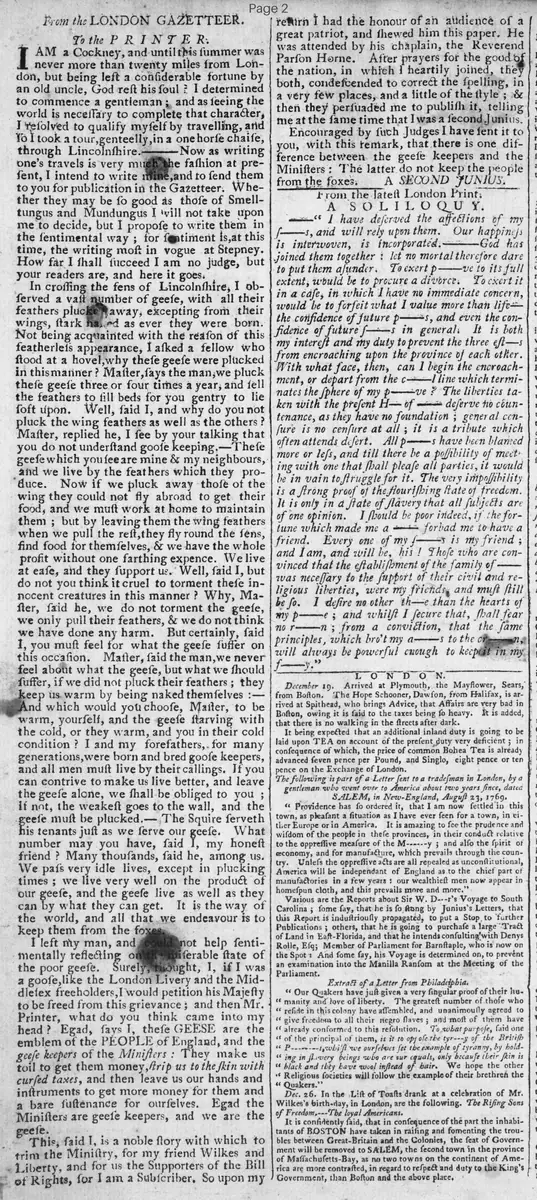
I am a Cockney, and until this summer was never more than twenty miles from London, but being left a considerable fortune by an old uncle, God rest his soul, I determined to commence a gentleman; and as seeing the world is necessary to complete that character, I resolved to qualify myself by travelling, and so I took a tour, genteelly, in a one horse chaise, through Lincolnshire. Now as writing one's travels is very much the fashion at present, I intend to write mine and to send them to you for publication in the Gazetteer. Whether they may be as good as those of Smellfungus and Mundungus I will not take upon me to decide, but I propose to write them in the sentimental way: for sentiment is, at this time, the writing most in vogue at Stepney. How far I shall succeed I am no judge, but your readers are, and here it goes.
In crossing the fens of Lincolnshire, I observed a vast number of geese, with all their feathers plucked away, excepting from their wings, stark naked as ever they were born. Not being acquainted with the reason of this featherless appearance, I asked a fellow who stood at a hovel, why these geese were plucked in this manner? Master, says the man, we pluck these geese three or four times a year; and sell the feathers to fill beds for you gentry to lie soft upon. Well, said I, and why do you not pluck the wing feathers as well as the others? Master, replied he, I see by your talking that you do not understand goose keeping. These geese which you see are mine & my neighbours, and we live by the feathers which they produce. Now if we pluck away those of the wing they could not fly abroad to get their food, and we must work at home to maintain them: but by leaving them the wing feathers when we pull the rest, they fly round the fens, find food for themselves, & we have the whole profit without one farthing expense. We live at ease, and they support us. Well, said I, but do not you think it cruel to torment these innocent creatures in this manner? Why, Master, said he, we do not torment the geese, we only pull their feathers, & we do not think we have done any harm. But certainly, said I, you must feel for what the geese suffer on this occasion. Master, said the man, we never feel about what the geese, but what we should suffer, if we did not pluck their feathers; they keep us warm by being naked themselves: And which would you choose, Master, to be warm, yourself, and the geese starving with the cold, or they warm, and you in their cold condition? I and my forefathers, for many generations, were born and bred goose keepers, and all men must live by their callings. If you can contrive to make us live better, and leave the geese alone, we shall be obliged to you; if not, then the weakest goes to the wall, and the geese must be plucked. The Squire serveth his tenants just as we serve our geese. What number may you have, said I, my honest friend? Many thousands, said he, among us. We pass very idle lives, except in plucking times; we live very well on the product of our geese, and the geese live as well as they can by what they can get. It is the way of the world, and all that we endeavour is to keep them from the foxes.
I left my man, and could not help sentimentally reflecting on the miserable state of the poor geese. Surely, thought I, if I was a goose, like the London Livery and the Middlesex freeholders, I would petition his Majesty to be freed from this grievance; and then Mr. Printer, what do you think came into my head? Egad, says I, these GEESE are the emblem of the PEOPLE of England, and the goose keepers of the MINISTERS: They make us toil to get them money, strip us to the skin with cursed taxes, and then leave us our hands and instruments to get more money for them and a bare sustenance for ourselves. Egad the Ministers are goose keepers, and we are the geese.
This, said I, is a noble story with which to trim the Ministry, for my friend Wilkes and Liberty, and for us the Supporters of the Bill of Rights, or I am a Subscriber. So upon my return I had the honour of an audience of a great patriot, and shewed him this paper. He was attended by his chaplain, the Reverend Parson Horne. After prayers for the good of the nation, in which I heartily joined, they both condescended to correct the spelling, in a very few places, and a little of the style; & then they persuaded me to publish it, telling me at the same time that I was a second Junius. Encouraged by such Judges I have sent it to you, with this remark, that there is one difference between the goose keepers and the Ministers: The latter do not keep the people from the foxes.
A SECOND JUNIUS.
To the PRINTER.
I am a Cockney, and until this summer was never more than twenty miles from London, but being left a considerable fortune by an old uncle, God rest his soul, I determined to commence a gentleman; and as seeing the world is necessary to complete that character, I resolved to qualify myself by travelling, and so I took a tour, genteelly, in a one horse chaise, through Lincolnshire. Now as writing one's travels is very much the fashion at present, I intend to write mine and to send them to you for publication in the Gazetteer. Whether they may be as good as those of Smellfungus and Mundungus I will not take upon me to decide, but I propose to write them in the sentimental way: for sentiment is, at this time, the writing most in vogue at Stepney. How far I shall succeed I am no judge, but your readers are, and here it goes.
In crossing the fens of Lincolnshire, I observed a vast number of geese, with all their feathers plucked away, excepting from their wings, stark naked as ever they were born. Not being acquainted with the reason of this featherless appearance, I asked a fellow who stood at a hovel, why these geese were plucked in this manner? Master, says the man, we pluck these geese three or four times a year; and sell the feathers to fill beds for you gentry to lie soft upon. Well, said I, and why do you not pluck the wing feathers as well as the others? Master, replied he, I see by your talking that you do not understand goose keeping. These geese which you see are mine & my neighbours, and we live by the feathers which they produce. Now if we pluck away those of the wing they could not fly abroad to get their food, and we must work at home to maintain them: but by leaving them the wing feathers when we pull the rest, they fly round the fens, find food for themselves, & we have the whole profit without one farthing expense. We live at ease, and they support us. Well, said I, but do not you think it cruel to torment these innocent creatures in this manner? Why, Master, said he, we do not torment the geese, we only pull their feathers, & we do not think we have done any harm. But certainly, said I, you must feel for what the geese suffer on this occasion. Master, said the man, we never feel about what the geese, but what we should suffer, if we did not pluck their feathers; they keep us warm by being naked themselves: And which would you choose, Master, to be warm, yourself, and the geese starving with the cold, or they warm, and you in their cold condition? I and my forefathers, for many generations, were born and bred goose keepers, and all men must live by their callings. If you can contrive to make us live better, and leave the geese alone, we shall be obliged to you; if not, then the weakest goes to the wall, and the geese must be plucked. The Squire serveth his tenants just as we serve our geese. What number may you have, said I, my honest friend? Many thousands, said he, among us. We pass very idle lives, except in plucking times; we live very well on the product of our geese, and the geese live as well as they can by what they can get. It is the way of the world, and all that we endeavour is to keep them from the foxes.
I left my man, and could not help sentimentally reflecting on the miserable state of the poor geese. Surely, thought I, if I was a goose, like the London Livery and the Middlesex freeholders, I would petition his Majesty to be freed from this grievance; and then Mr. Printer, what do you think came into my head? Egad, says I, these GEESE are the emblem of the PEOPLE of England, and the goose keepers of the MINISTERS: They make us toil to get them money, strip us to the skin with cursed taxes, and then leave us our hands and instruments to get more money for them and a bare sustenance for ourselves. Egad the Ministers are goose keepers, and we are the geese.
This, said I, is a noble story with which to trim the Ministry, for my friend Wilkes and Liberty, and for us the Supporters of the Bill of Rights, or I am a Subscriber. So upon my return I had the honour of an audience of a great patriot, and shewed him this paper. He was attended by his chaplain, the Reverend Parson Horne. After prayers for the good of the nation, in which I heartily joined, they both condescended to correct the spelling, in a very few places, and a little of the style; & then they persuaded me to publish it, telling me at the same time that I was a second Junius. Encouraged by such Judges I have sent it to you, with this remark, that there is one difference between the goose keepers and the Ministers: The latter do not keep the people from the foxes.
A SECOND JUNIUS.
What sub-type of article is it?
Satirical
Persuasive
Political
What themes does it cover?
Politics
Economic Policy
Social Issues
What keywords are associated?
Goose Analogy
Ministerial Criticism
Taxes
Wilkes
Liberty
Political Satire
Bill Of Rights
What entities or persons were involved?
A Second Junius.
To The Printer.
Letter to Editor Details
Author
A Second Junius.
Recipient
To The Printer.
Main Argument
the british people are like geese plucked of feathers (taxed) by ministers who profit while leaving them just enough to survive and produce more, calling for support of wilkes and liberty against this exploitation.
Notable Details
Goose Plucking Analogy For Taxation
References Smellfungus And Mundungus
Mentions Wilkes, Parson Horne, Bill Of Rights, Junius