Thank you for visiting SNEWPapers!
Sign up free
Story
January 12, 1915
The Mount Holly News
Mount Holly, Burlington County, New Jersey
What is this article about?
Entomologists in northern Ohio and Indiana warn farmers of grub worms from flying bugs that damage corn and other crops; recommend fall plowing and extra seeds to reduce losses from periodic infestations.
Clipping
OCR Quality
95%
Excellent
Full Text
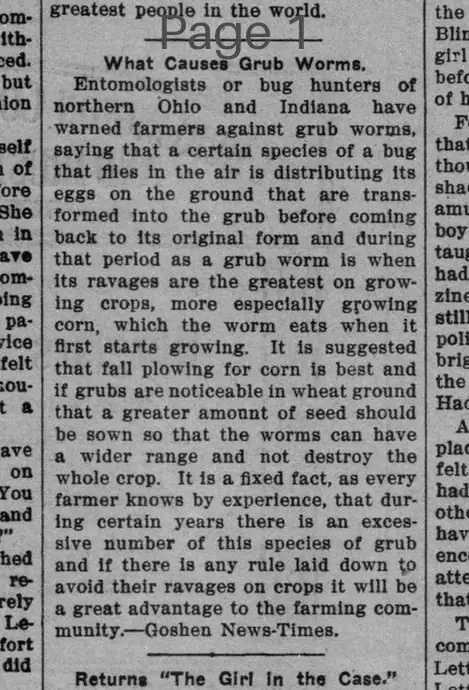
What Causes Grub Worms. Entomologists or bug hunters of northern Ohio and Indiana have warned farmers against grub worms, saying that a certain species of a bug that flies in the air is distributing its eggs on the ground that are transformed into the grub before coming back to its original form and during that period as a grub worm is when its ravages are the greatest on growing crops, more especially growing corn. which the worm eats when it first starts growing. It is suggested that fall plowing for corn is best and if grubs are noticeable in wheat ground that a greater amount of seed should be sown so that the worms can have a wider range and not destroy the whole crop. It is a fixed fact, as every farmer knows by experience. that during certain years there is an excessive number of this species of grub and if there is any rule laid down to avoid their ravages on crops it will be a great advantage to the farming community. Goshen News-Times.
What sub-type of article is it?
Curiosity
What themes does it cover?
Nature
Misfortune
What keywords are associated?
Grub Worms
Crop Damage
Corn Pests
Fall Plowing
Entomologists Warning
Where did it happen?
Northern Ohio And Indiana
Story Details
Location
Northern Ohio And Indiana
Story Details
Entomologists warn farmers about grub worms from a flying bug species that lay eggs on the ground, transforming into grubs that ravage growing crops, especially corn. Suggest fall plowing for corn and increased seed sowing in grub-affected wheat fields to mitigate damage. Notes periodic excessive grub populations and the value of rules to avoid crop ravages.