Thank you for visiting SNEWPapers!
Sign up free
Editorial
March 22, 1839
Southern Christian Advocate
Charleston, Charleston County, South Carolina
What is this article about?
Editorial critiques religious bigotry in Dr. Hook's sermon praising the Episcopal Church as America's sole defense against infidelity and fanaticism, endorsed by Bishop Doane. It defends pluralism, noting the church's small membership in New Jersey compared to Methodists.
Clipping
OCR Quality
98%
Excellent
Full Text
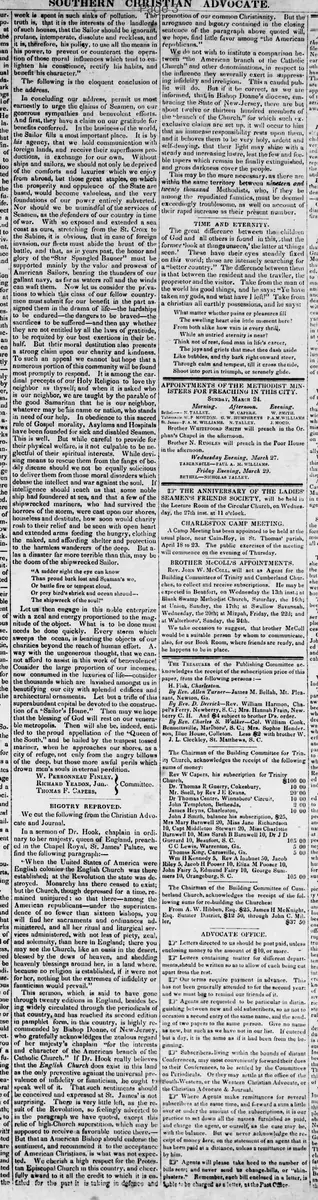
BIGOTRY REPROVED.
We cut the following from the Christian Advocate and Journal.
In a sermon of Dr. Hook, chaplain in ordinary to her majesty, queen of England, preached in the Chapel Royal, St. James' Palace, we find the following paragraph:-
"When the United States of America were English colonies the English Church was there established; at the Revolution the state was destroyed. Monarchy has there ceased to exist; but the Church, though depressed for a time, remained uninjured: so that there—among the American republicans—under the superintendence of no fewer than sixteen bishops, you will find her sacraments and ordinances administered, and all her ritual and liturgical services administered, with not less of piety, zeal, and solemnity, than here in England; there you may see the Church, like an oasis in the desert, blessed by the dews of heaven, and shedding heavenly blessings around her, in a land where, because no religion is established, if it were not for her, nothing but the extremes of infidelity or fanaticism would prevail."
This sermon, which is said to have gone through twenty editions in England, besides being widely circulated through the periodicals of that country, and has reached its second edition in pamphlet form, in this country, is highly recommended by Bishop Doane, of New Jersey, who gratefully acknowledges the zealous regard of her majesty's chaplain "for the interests and character of the American branch of the Catholic Church."
If Dr. Hook really believes that the English Church does exist in this land as the only preventive against the universal prevalence of infidelity or fanaticism, he ought to speak well of it. That such sentiments should be conceived and expressed at St. James' is not surprising. There is very little left, as the result of the Revolution, so feelingly adverted to in the paragraph we have quoted, except this relic of high-Church superstition, which may be supposed to receive a favorable notice there.
But that an American Bishop should endorse the sentiment, and recommend it to the acceptance of American Christians, is what was not expected. We cherish a high respect for the Protestant Episcopal Church in this country, and cheerfully award to it all the credit to which it is entitled for the part it is taking in defence and promotion of our common Christianity. But the arrogance and bigotry contained in the closing sentence of the paragraph above quoted will, we hope, find little favor among "the American republicans."
We do not wish to institute a comparison between "the American branch of the Catholic Church" and other denominations, in respect to the influence they severally exert in suppressing infidelity and irreligion. This a candid public will do. But if it be correct, as we are informed, that, in Bishop Doane's diocese, embracing the State of New Jersey, there are but about twelve or thirteen hundred members of the "branch of the Church," for which such exclusive claims are set up, it will occur to him that an immense responsibility rests upon them, and it behoves them to be very holy, ardent and self-denying, that their light may shine with a steady and increasing lustre, lest the few and feeble tapers which remain be finally extinguished, and gross darkness cover the people.
This may be the more necessary, as there are within the same territory between nineteen and twenty thousand Methodists, who, if they be among the repudiated fanatics, must be deemed exceedingly troublesome, as well on account of their rapid increase as their present number.
We cut the following from the Christian Advocate and Journal.
In a sermon of Dr. Hook, chaplain in ordinary to her majesty, queen of England, preached in the Chapel Royal, St. James' Palace, we find the following paragraph:-
"When the United States of America were English colonies the English Church was there established; at the Revolution the state was destroyed. Monarchy has there ceased to exist; but the Church, though depressed for a time, remained uninjured: so that there—among the American republicans—under the superintendence of no fewer than sixteen bishops, you will find her sacraments and ordinances administered, and all her ritual and liturgical services administered, with not less of piety, zeal, and solemnity, than here in England; there you may see the Church, like an oasis in the desert, blessed by the dews of heaven, and shedding heavenly blessings around her, in a land where, because no religion is established, if it were not for her, nothing but the extremes of infidelity or fanaticism would prevail."
This sermon, which is said to have gone through twenty editions in England, besides being widely circulated through the periodicals of that country, and has reached its second edition in pamphlet form, in this country, is highly recommended by Bishop Doane, of New Jersey, who gratefully acknowledges the zealous regard of her majesty's chaplain "for the interests and character of the American branch of the Catholic Church."
If Dr. Hook really believes that the English Church does exist in this land as the only preventive against the universal prevalence of infidelity or fanaticism, he ought to speak well of it. That such sentiments should be conceived and expressed at St. James' is not surprising. There is very little left, as the result of the Revolution, so feelingly adverted to in the paragraph we have quoted, except this relic of high-Church superstition, which may be supposed to receive a favorable notice there.
But that an American Bishop should endorse the sentiment, and recommend it to the acceptance of American Christians, is what was not expected. We cherish a high respect for the Protestant Episcopal Church in this country, and cheerfully award to it all the credit to which it is entitled for the part it is taking in defence and promotion of our common Christianity. But the arrogance and bigotry contained in the closing sentence of the paragraph above quoted will, we hope, find little favor among "the American republicans."
We do not wish to institute a comparison between "the American branch of the Catholic Church" and other denominations, in respect to the influence they severally exert in suppressing infidelity and irreligion. This a candid public will do. But if it be correct, as we are informed, that, in Bishop Doane's diocese, embracing the State of New Jersey, there are but about twelve or thirteen hundred members of the "branch of the Church," for which such exclusive claims are set up, it will occur to him that an immense responsibility rests upon them, and it behoves them to be very holy, ardent and self-denying, that their light may shine with a steady and increasing lustre, lest the few and feeble tapers which remain be finally extinguished, and gross darkness cover the people.
This may be the more necessary, as there are within the same territory between nineteen and twenty thousand Methodists, who, if they be among the repudiated fanatics, must be deemed exceedingly troublesome, as well on account of their rapid increase as their present number.
What sub-type of article is it?
Moral Or Religious
What keywords are associated?
Religious Bigotry
Episcopal Church
Infidelity
Fanaticism
Methodists
Bishop Doane
Dr Hook
What entities or persons were involved?
Dr. Hook
Bishop Doane
Protestant Episcopal Church
Methodists
Queen Of England
Editorial Details
Primary Topic
Reproof Of Religious Bigotry In Episcopal Church Claims
Stance / Tone
Critical Of Arrogance And Endorsement Of Exclusive Church Claims
Key Figures
Dr. Hook
Bishop Doane
Protestant Episcopal Church
Methodists
Queen Of England
Key Arguments
Dr. Hook's Sermon Portrays Episcopal Church As Sole Bulwark Against Infidelity In America
Bishop Doane Endorses The Sermon's Exclusive Claims
Such Bigotry Unexpected From American Bishop
Episcopal Church Small In New Jersey Compared To Methodists
Calls For Episcopal Members To Be Exemplary Given Their Claims