Thank you for visiting SNEWPapers!
Sign up free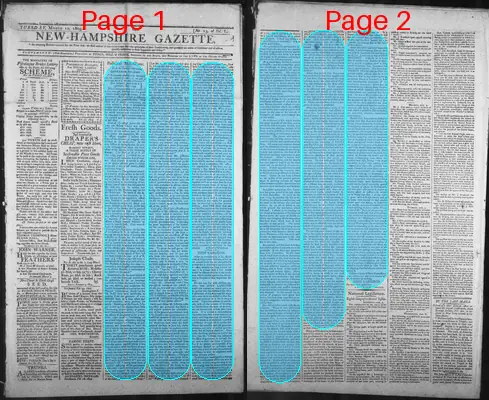
The New Hampshire Gazette
Portsmouth, Rockingham County, New Hampshire
What is this article about?
An editorial critiques New Hampshire Governor Gilman's political inconsistencies across issues like effigy burnings, French relations, press freedom, and federal harmony during Adams and Jefferson administrations, contrasting him unfavorably with consistent Republican John Langdon, urging his election as governor.
Merged-components note: Merged across columns and pages as continuation of the same political article critiquing Governor Gilman and praising John Langdon as an alternative.
Clippings
1 of 2
OCR Quality
Full Text
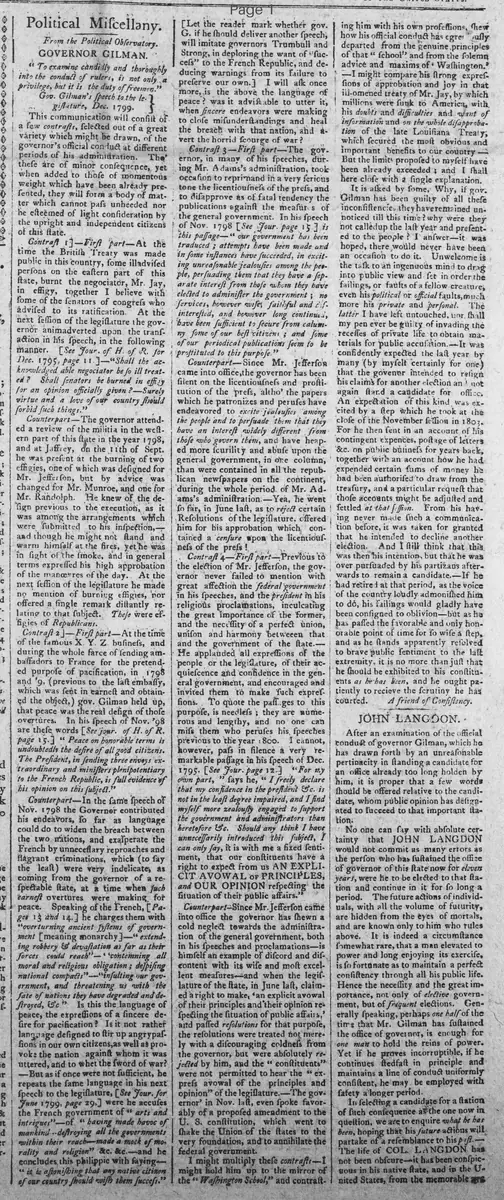
From the Political Observatory.
GOVERNOR GILMAN.
"To examine candidly and thoroughly
into the conduct of rulers, is not only a
privilege, but it is the duty of freemen."
Gov. Gilman's speech to the leg-
islature, Dec. 1799.
This communication will consist of
a few contrasts, selected out of a great
variety which might be drawn, of the
governor's official conduct at different
periods of his administration. These
are of minor consequence, yet
when added to those of momentous
weight which have been already pre-
sented, they will form a body of mat-
ter which cannot pass unheeded nor
be esteemed of light consideration by
the upright and independent citizens
of this state.
Contrast—First part—At the
time the British treaty was made
public in this country, some ill-advised
persons on the eastern part of this
state, burnt the negotiator, Mr. Jay,
in effigy, together I believe with
some of the senators of congress who
advised to its ratification. At the
next session of the legislature the gov-
ernor animadverted upon the tran-
action in his speech, in the following
manner. [See Jour. of H. of R. for
Dec. 1795, page 11.]—"Shall the ac-
knowledged able negotiator be so ill treat-
ed? Shall senators be burned in effigy
for an opinion officially given?—Surely
virtue and a love of our country should
forbid such things."
Counterpart—The governor attend-
ed a review of the militia in the west-
part of this state in the year 1798,
and at Jaffrey, on the 11th of Sept.
he was present at the burning of two
effigies, one of which was designed for
Mr. Jefferson, but by advice was
changed for Mr. Monroe, and one for
Mr. Randolph. He knew of the de-
sign previous to the execution, as it
was among the arrangements which
were submitted to his inspection,
and though he might not stand and
warm himself at the fires, yet he was
in sight of the smoke, and in general
terms expressed his high approbation
of the manœuvres of the day. At the
next session of the legislature he made
no mention of burning effigies, nor
offered a single remark distantly re-
lating to that subject. These were ef-
figies of Republicans.
Contrast 2—First part—At the time
of the famous X. Y. Z. business, and
during the whole farce of sending am-
bassadors to France for the pretended
purpose of pacification, in 1798
and '99, (previous to the last embassy,
which was sent in earnest and obtain-
ed the object,) gov. Gilman held up,
that peace was the real design of those
overtures. In his speech of Nov. '98
are these words See jour. of H. of R.
page 15. "Peace on honorable terms is
undoubtedly the desire of all good citizens.
The President, in sending three envoys ex-
traordinary and ministers plenipotentiary
to the French Republic, is full evidence of
his opinion on this subject."
Counterpart—In the same speech of
Nov. 1798 the Governor contributed
his endeavors, so far as language
could do to widen the breach between
the two nations, and exasperate the
French by unnecessary reproaches and
flagrant criminations, which (to say
the least) were very indelicate as
coming from the governor of a re-
spectable state, at a time when such
earnest overtures were making for
peace. Speaking of the French, Pa.
get 13 and 14. He charges them with
"overturning ancient systems of govern-
ment [meaning monarchy]—" extend-
ing robbery & devastation as far as their
forces could reach"—"contemning all
moral and religious obligation; despising
national compacts"—"insulting our gov-
ernment, and threatening us with the
fate of nations they have degraded and de-
stroyed, &c." "Is this the language of
peace, the expressions of a sincere de-
sire for pacification? Is it not rather
language designed to stir up angry pas-
sions in our own citizens, as well as pro-
voke the nation against whom it was
uttered, and to whet the sword of war?
—But as if once were not sufficient, he
repeats the same language in his next
speech to the legislature, [See Jour. for
June 1799, page 29,] where he accuses
the French government of "arts and
intrigues"—of "having made havoc of
mankind—destroying all the governments
within their reach—made a mock of mo-
rality and religion" &c. &c.—and he
concludes this philippic with saying—
"it is astonishing that any native citizen
of our country should wish them success."
Let the reader mark whether gov.
G. if he should deliver another speech,
will imitate governors Trumbull and
Strong, in deploring the want of suc-
cess to the French Republic, and de-
ducing warnings from its failure to
preserve our own. I will ask once
more, is the above the language of
peace? was it advisable to utter it,
when sincere endeavors were making
to close misunderstandings and heal
the breach with that nation, and a-
vert the horrid scourge of war?
Contrast 3—First part—The gov-
ernor, in many of his speeches, dur-
ing Mr. Adams's administration, took
occasion to reprimand in a very serious
tone the licentiousness of the press, and
to disapprove as of fatal tendency the
publications against the meaures of
the general government. In his speech
of Nov. 1798 [See Jour. page 15] is
this passage—"our government has been
traduced: attempts have been made and
in some instances have succeeded, in excit-
ing unreasonable jealousies among the peo-
ple, persuading them that they have a sep-
rate interest from those whom they have
elected to administer the government; no
services, however wise, faithful and dis-
interested, and however long continued
have been sufficient to secure from calum-
ny some of our best citizens; and some
of our periodical publications seem to be
prostituted to this purpose."
Counterpart—Since Mr. Jefferson
came into office, the governor has been
silent on the licentiousness and prostitu-
tion of the press, altho' the papers
which he patronizes and peruses have
endeavored to excite jealousies among
the people and to persuade them that they
have an interest widely different from
those who govern them, and have heap-
ed more scurrility and abuse upon the
general government, in one column,
than were contained in all the republican
newspapers on the continent,
during the whole period of Mr. Ad-
ams's administration.—Yea, he went
so far, in June last, as to reject certain
Resolutions of the legislature, offered
him for his approbation which con-
tained a censure upon the licentious-
ness of the press!
Contrast 4—First part—Previous to
the election of Mr. Jefferson, the gov-
ernor never failed to mention with
great affection the federal government
in his speeches, and the president in his
religious proclamations, inculcating
the great importance of the former,
and the necessity of a perfect union,
union and harmony between that
and the government of the state.—
He applauded all expressions of the
people or the legislature, of their ac-
quiescence and confidence in the gen-
eral government, and encouraged and
invited them to make such expres-
sions. To quote the pages to this
purpose, is needless; they are nume-
rous and lengthy, and no one can
miss them who peruses his speeches
previous to the year 1800. I cannot,
however, pass in silence a very re-
markable passage in his speech of Dec.
1795. [See Jour. page 12.] "For my
own part," says he, "I freely declare
that my confidence in the president &c. is
not in the least degree impaired, and I find
myself more zealously engaged to support
the government and administrators than
heretofore &c. Should any think I have
unnecessarily introduced this Subject, I
can only say, it is with me a fixed senti-
ment, that our constituents have a
right to expect from us AN EXPLICIT
AVOWAL OF PRINCIPLES.
and OUR OPINION respecting the
situation of their public affairs."
Counterpart—Since Mr. Jefferson came
into office the governor has shewn a
cold neglect towards the administra-
tion of the general government, both
in his speeches and proclamations—is
himself an example of discord and dis-
content with its wise and most excel-
lent measures—and when the legisla-
ture of the state, in June last, claim-
ed a right to make, 'an explicit avowal
of their principles and their opinion re-
specting the situation of public affairs,
and passed resolutions for that purpose,
the resolutions were treated not mere-
ly with a discouraging coldness from
the governor, but were absolutely re-
jected by him, and the "constituents"
were not permitted to hear the "ex-
plicit avowal of the principles and
opinion" of the legislature.—The gov-
ernor in Nov. last, even spoke favor-
ably of a proposed amendment to the
U. S. constitution, which went to
shake the Union of the states to the
very foundation, and to annihilate the
federal government.
I might multiply these contrasts
I might hold him up to the mirror of
the "Washington School," and contrast
ing him with his own professions, shew
how his official conduct has egregiously
departed from the genuine principles
of that "school" and from the solemn
advice and maxims of Washington.
—I might compare his strong expres-
sions of approbation and joy in that
ill-omened treaty of Mr. Jay, by which
millions were lost to America, with
his doubts and difficulties and want of
information and on the whole disapproba-
tion of the late Louisiana Treaty,
which secured the most obvious and
important benefits to our country—
But the limits proposed to myself have
been already exceeded; and I shall
here close with a single explanation.
It is asked by some, Why, if gov.
Gilman has been guilty of all these
inconsistencies they have remained un-
noticed till this time? why were they
not called up the last year and preent-
ed to the people? I answer—it was
hoped, there would never have been
an occasion to do it. Unwelcome is
the task to an ingenuous mind to drag
into public view and set in order the
failings, or faults of a fellow creature,
even his political or official faults, much
more his private and personal. The
latter I have left untouched, nor, shall
my pen ever be guilty of invading the
recesses of private life to obtain ma-
terials for public accusation.—It was
confidently expected the last year by
many (by myself certainly for one)
that the governor intended to resign
his claims for another election and not
again stand a candidate for office.
An expectation of this kind was ex-
cited by a step which he took at the
close of the November session in 1803.
For he then sent in an account of his
contingent expences, postage of letters
&c. on public business for years back,
together with an account how he had
expended certain sums of money he
had been authorized to draw from the
treasury, and a particular request that
those accounts might be adjusted and
settled at that session. From his hav-
ing never made such a communica-
tion before, it was taken for granted
that he intended to decline another
election. And I still think that this
was then his intention, but that he was
over persuaded by his partizans after-
wards to remain a candidate.—If he
had retired at that period, as the voice
of the country loudly admonished him
to do, his failings would gladly have
been consigned to oblivion—but as he
has passed the favorable and only hon-
orable point of time for so wise a step,
and as he stands apparently resolved
to brave public sentiment to the last
extremity, it is no more than just that
he should be exhibited to his constitu-
ents as he has been, and he ought pa-
tiently to receive the scrutiny he has
courted.
A friend of Consistency.
JOHN LANGDON.
After an examination of the official
conduct of governor Gilman, which he
has drawn forth by an unreasonable
pertinacity in standing a candidate for
an office already too long holden by
him, it is proper that a few words
should be offered relative to the candi-
date, whom public opinion has desig-
nated to succeed to that important sta-
tion.
No one can say with absolute cer-
tainty that JOHN LANGDON
would not commit as many errors as
the person who has sustained the office
of governor of this state now for eleven
years, were he to be elected to that sta-
tion and continue in it for so long a
period. The future actions of individ-
uals, with all the volume of futurity,
are hidden from the eyes of mortals.
and are known only to him who rules
above. It is indeed a circumstance
somewhat rare, that a man elevated to
power and long enjoying its exercise,
is so fortunate as to maintain a perfect
consistency through all his public life.
Hence the necessity and the great im-
portance, not only of elective govern-
ment, but of frequent elections. Gen-
erally speaking, perhaps one half of the
time that Mr. Gilman has sustained
the office of governor, is enough for
one man to hold the reins of power.
Yet if he proves incorruptible, if he
continues steadfast in principle and
maintains a line of conduct uniformly
consistent, he may be employed with
safety a longer period.
In electing a candidate for a station
of such consequence as the one now in
question, we are to enquire what he has
been, hoping that his future actions will
partake of a resemblance to his past.—
The life of COL. LANGDON has
not been obscure—it has been conpicu-
ous in his native state, and in the U.
ited States, from the memorable e
of 1774—and it can be truly said to be a life of consistency, of goodness and of glory. I shall not attempt a formal history—it is needless. A brief sketch must suffice.
As a gentleman, his politeness is distinguished—his manners are marked by a most agreeable urbanity and the strictest civility—his study is to make all happy in his presence, and to be of service to his fellow-creatures.
As a moral man, his life is without a blemish: and he exemplifies genuine Christianity in being just, loving mercy, and doing good to all men as he has opportunity. His religious principles partake of the liberality of the gospel of peace, and no sect has anything to apprehend from his elevation to power—a sacred maxim with him is, that all denominations should be equally protected, and permitted to worship God freely according to the dictates of conscience.
As to science, his education has been such as to fit him for the prompt and intelligent discharge of the duties of any station, however exalted—to execute every business which can possibly come before him—and to appear with honor in the eyes of the learned, of strangers, of other governments and of the world.
As to the arts of life, which involve the great interests of the state, and by which his fellow citizens subsist, they have been the pleasing subjects of his study, and he possesses a very thorough understanding of their nature and importance. The farmer and mechanic are venerated by him, and he views in them the stability and excellence of the state. Of commercial relations abroad, and the connexion of every occupation of the citizens at home, his knowledge is deep and extensive, the fruit of observation and long experience in public business. Altho' a hearty well-wisher to commerce, yet his maxim has ever been to hold it as the hand-maid, not as the mistress of Agriculture. If their interests were to clash in any particular, the Farmers were to be favored in preference to the merchants. Hence he has been a friend to the policy of the general government in deriving revenue by impost upon commerce, rather than by internal taxation upon mechanics and farmers.
As a soldier and patriot, Col. Langdon has given proof of his just claim to these characters. So early as the year 1774, he exposed his life to destruction, his estate to confiscation, and his name to the infamy of a rebel and traitor, by an act as heroic as any which graced the revolution which followed. I allude to his landing on the island at the mouth of Portsmouth harbor under the terror of British artillery, and bringing off the magazines deposited there, which were of such necessity at that period. His youth probably saved him from being enrolled in the honorable list of proscribed Patriots, with Samuel Adams and John Hancock.—He was early called to take an important part in the civil concerns of his country. This leads me to say, that,
As a patriot and statesman, few men have fairer claims to renown, or to the gratitude of his state and country, than Col. Langdon. In the times which tried men's souls, he stood firm in the councils of this state and in the old congress, (of which he was a member as early as 1775,) against the unjust and arbitrary measures of Great Britain, and in favor of the cause of America and human rights. Never was he known to flinch in the darkest periods of the revolution; but with an ardor, which no reverse of fortune could dampen, and nothing but death extinguish, he pleaded the justice of his country's cause, and pressed forward in pursuit of her independence, until it was obtained. In this contest, his sacrifices of property were great and heavy, but they were regarded as nothing in comparison with the noble object in view.
Nor did his labors cease with the revolution. When it was discovered that the blessings obtained by Independence, were in danger of being lost for want of a more efficient national government, Col. Langdon realized the importance of the crisis with vast concern: and when it was held doubtful, what the state of N. Hampshire would do on the subject, HE, with Nicholas Gilman, our senator lately elected to congress, (it is said, at their own private charge,) repaired to the grand convention at Philadelphia, and were the ONLY persons from this state who assisted in forming our present NATIONAL CONSTITUTION.
This instrument speaks more than volumes could do in praise of those statesmen: it is an eternal honor to the talents and political rectitude which framed it. Bright will those names go down to posterity, which are inscribed on that monument of wisdom, that matchless production of political skill, that palladium of our interests, and sheet-anchor of our safety.—Let me again remind the reader, that the ONLY names which stand subscribed to that instrument, from New-Hampshire,
are JOHN LANGDON and NICHOLAS GILMAN, two men whom the Republicans of this state delight to honor. Col. Langdon was the first who subscribed it, after Gen. WASHINGTON; and Mr. GILMAN was the second. The circumstances are at once creditable to those individuals, and to the cause by which they are supported. With what face can our opponents accuse us as enemies of the constitution, when our candidates for the highest honors were the men, and the only men from our state, who assisted to frame that constitution, and the first to subscribe it?
About that period, Col. Langdon was re-elected to the chief magistracy of this state, (having served one year before,) under the then title of President, but substantially the same office as that of Governor. In this capacity he officiated with great reputation to himself and benefit to the state: and it may be observed that the duties of that high station would not be new to him, should he now be elected to fill it. Hence the objection, that it is dangerous to change, is precluded.
When the constitution of the U. S. was ratified, which he had assisted to frame, Col. Langdon was appointed the first Senator from this state in congress; and he served two constitutional terms in that highly important and respectable station.—Interesting was the period that he was a member of the senate of the United States. In that body, as the constitutional depository of the secrets of administration, he became thoroughly acquainted with federal policy—under Mr. Adams he was witness to the unfolding of VIEWS and PLANS—he HEARD & SAW such things, as chilled his soul with horror, and induced him to take a resolute and determined stand against the obnoxious measures of that period, emphatically styled, the REIGN OF TERROR. He saw with grief. TORY principles triumphant: he heard Liberty decried and mocked, republicanism contemned, unjust distinctions advocated, the doctrine avowed that a public debt was a blessing. He saw every British principle, & even their very measures, against which we rebelled as colonies, attempted to be introduced. A stamp. act, a sedition law, an excise, exorbitant loans and taxes, the system of patronage, enhancement of public debt, war—in a word, every cause, which roused Americans to resist the tyranny of Britain, he saw either in full operation, or in a train to be introduced into this happy country. He heard things from the very lips of president Adams, which I think not proper to rehearse. In short, he saw the corruptest principles of European government advocated, and the dreadful form of such government hastening with rapid strides to subvert our free constitution and liberties, and to establish here the odious system of legalized inequality, high and low tyrants and vassals.
To the immortal honor of this PATRIOT, be it said, he proved incorruptible, incapable of being warped, incapable of renouncing the principles of FREEDOM, for which he fought, to which he had largely sacrificed—he stood firm and resisted the torrent which was to overwhelm the liberties of his country.—Consider reader, the circumstances in which Col. Langdon made this noble Stand: ALONE, as it were, amidst the members from New-England, he dared to be singular in the cause of the people, while he saw senators and representatives fall in with the current, who were either too feeble in nerve to resist, or too well pleased with the prospects before them to desire to stop the torrent. He nobly stood, when he knew the mighty delusion which was to be spread over the people by the host of his opponents, and expected to share the reproaches of his constituents and to forfeit his place and his honors.—I declare I hardly know which most to admire, the bravery & spirit shewn by Col. Langdon. in the revolution, against foreign oppression; or his manly resistance in congress against domestic;—his abhorrence of British tyranny; or his detestation of American.— It is the opinion of many, that the liberties of New. England, perhaps of the Union, owe their salvation to the firm and magnanimous stand made by Col. Langdon in the Senate of the United States, at that eventful crisis.
What possible motive, besides a pure love of his country, can be ascribed to this gentleman for the part he took in those ever memorable affairs which transpired at that period? His natural disposition is the reverse of petulance and contention; he had honors and emoluments to lose, and nothing to gain: to this day he is experiencing the ungrateful reward of his faithfulness and intrepidity, in the obloquies of the party he resisted, and their extreme exertions to keep him stripped of the honors he forfeited by his fidelity. No, not the semblance of a motive can be assigned for the bold and independent course he pursued through those extraordinary times, but the consciousness of rectitude and the pure attachment of his heart to the freedom
and happiness of his country. It is hoped the justice of that country will speedily reward him according to his merits, and the state benefit her own interests by placing him at the head of her affairs.
After this brief and very imperfect sketch, I would observe, that an obvious trait in the public life and character of Col. Langdon. is that of CONSISTENCY. Difficult as it is for men in conspicuous stations to maintain a perfect consistency thro' a long course of service, Col. Langdon has clearly maintained it. For more than THIRTY YEARS has he filled important public offices, and he is the same now that he was at the beginning, an ardent friend of LIBERTY, a firm and incorruptible advocate of the RIGHTS OF MANKIND. Never has he deviated in one instance from the doctrines on which America asserted her independence and achieved her freedom: he was a Whig then—he is a Republican now: then he abhorred the maxims of the tory cabinet of Britain—he has since abhorred the same maxims transplanted into the councils of America.—In short, he is a character with which a people is seldom blessed, AN UPRIGHT, STEADY, CONSISTENT STATESMAN.
Should Col. Langdon be elected to preside over this state as its first magistrate, it is presumed he would not be found signing amendments to the constitution at one period, and rejecting the same amendments (for weighty and solemn reasons) at another period—he would not be found tampering with the representatives of the people in favor of a particular Bank, and against another Bank, in order to save the politics of the state from ruin”—he would scorn and abhor the attempt to govern freemen by Bank influence, in preference to the noble sentiment of freedom—he would not be found recommending taxes when the treasury was full, saying “the people had ability to pay,” and omitting to recommend them when the treasury was empty (because no more Bank-shares were to be purchased)—he would not be found censuring the licentiousness of the press at one time, & withholding his censures at another when the press was a thousand times more licentious—he would not be found exclaiming against the burning of effigies at Portsmouth, and three years afterwards be present at burning effigies at Jaffrey—he would not be found expressing a strong desire for peace with a foreign nation, and at the same time venting the most abusive epithets upon that nation, to exasperate them and stir up war—he would not be found rejoicing in such a ruinous Treaty as that of Mr. Jay's, & disapproving one of immense benefits like that of Louisiana,—he would not be found professing discipleship to the “Washington school,” and practically counteracting the most earnest, advice of Washington—he would not be found recommending to the favor of heaven one president, and forgetting to mention another in his proclamations and prayers—he would not be found inculcating the strictest harmony between the federal and state governments at one time, and refusing to sanction the expressions of such harmony at another—in short, he would not be found in one part of his administration making every thing of the UNION of the states, cautioning against the most distant attempts to shake it or impair its principles, and afterwards bring forward with recommendations the resolutions of a madman in Massachusetts which aimed a deadly blow at that Union by clipping the vital chords which sustained it.
Fellow-citizens of New-Hampshire! your INTERESTS and your HONOR will be promoted by electing JOHN LANGDON for your next governor.
A FRIEND OF CONSISTENCY.
What sub-type of article is it?
What keywords are associated?
What entities or persons were involved?
Editorial Details
Primary Topic
Critique Of Governor Gilman's Inconsistencies And Endorsement Of John Langdon For New Hampshire Governor
Stance / Tone
Strongly Critical Of Gilman, Laudatory Of Langdon, Pro Republican
Key Figures
Key Arguments