Thank you for visiting SNEWPapers!
Sign up free
Ypsilanti Sentinel
Ypsilanti, Washtenaw County, Michigan
What is this article about?
Publication of diplomatic correspondence between US Secretary James Buchanan and Mexican Minister Domingo Ibarra on dispatching Nicholas P. Trist to negotiate peace treaty with Mexico; Mexico refers matter to Congress. Dated April 15 and June 22, 1847.
Clipping
OCR Quality
Full Text
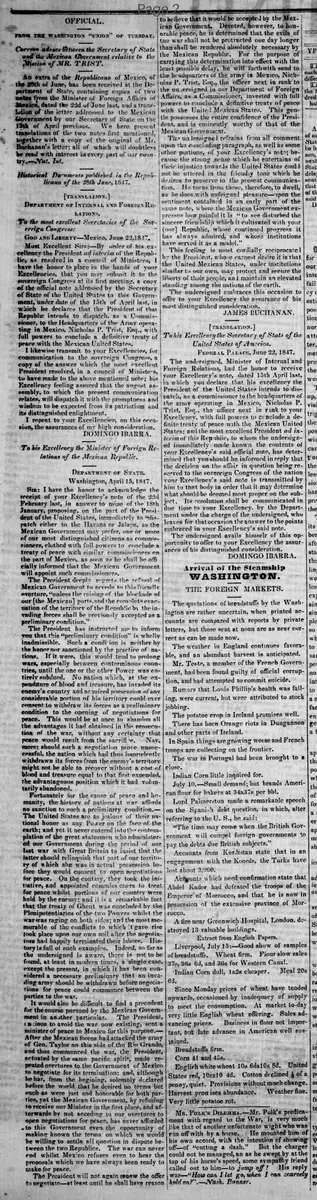
Correspondence between the Secretary of State and the Mexican Government relative to the Mission of MR. TRIST.
An extra of the Republicano of Mexico, of the 28th of June, has been received at the Department of State, containing copies of two notes from the Minister of Foreign Affairs of Mexico, dated the 22d of June last, and a translation of the letter addressed to the Mexican Government by our Secretary of State on the 15th of April previous. We here present translations of the two notes first mentioned, together with a copy of the original of Mr. Buchanan's letter: all of which will doubtless be read with interest in every part of our country.-N. Y. Int.
Historical Documents published in the Republicano of the 28th June, 1847.
[TRANSLATION.]
Department of Internal and Foreign Relations.
To the most excellent Secretaries of the Sovereign Congress:
GOD AND LIBERTY.-MEXICO, June 22, 1847.
Most Excellent Sirs:-
By order of his excellency the President ad interim of the Republic, as resolved in a council of Ministers, I have the honor to place in the hands of your Excellencies, that you may submit it to the sovereign Congress at its first meeting, a copy of the official note addressed by the Secretary of State of the United States to this Government, under date of the 15th of April last, in which he declares that the President of that Republic intends to dispatch, as a Commissioner, to the Headquarters of the Army operating in Mexico, Nicholas P. Trist, Esq., with full powers to conclude a definitive treaty of peace with the Mexican United States.
I likewise transmit to your Excellencies, for communication to the sovereign Congress, a copy of the answer which the most excellent President resolved, in a council of Ministers, to have made to the above mentioned note; his Excellency feeling assured that the august assembly, to which the present communication relates, will dispatch it with the promptness and wisdom to be expected from its patriotism and its distinguished enlightenment.
I repeat to your Excellencies, on this occasion, the assurances of my high consideration.
DOMINGO IBARRA.
To his Excellency the Minister of Foreign Relations of the Mexican Republic.
Department of State,
Washington, April 15, 1847.
Sir: I have the honor to acknowledge the receipt of your Excellency's note of the 22d February last, in answer to mine of the 18th January, proposing, on the part of the President of the United States, immediately to "dispatch either to the Havana or Jalapa, as the Mexican Government may prefer, one or more of our most distinguished citizens as commissioners, clothed with full powers to conclude a treaty of peace with similar commissioners on the part of Mexico, as soon as he shall be officially informed that the Mexican Government will appoint such commissioners."
The President deeply regrets the refusal of the Mexican Government to accede to this friendly overture, "unless the raising of the blockade of the Mexican ports, and the complete evacuation of the territory of the Republic by the invading forces shall be previously accepted as a preliminary condition,"
The President has instructed me to inform you that this "preliminary condition" is wholly inadmissible. Such a condition is neither by the honor nor sanctioned by the practice of nations. If it were, this would tend to prolong wars, especially between conterminous countries, until the one or the other Power was entirely subdued. No nation which, at the expenditure of blood and treasure, has invaded its enemy's country and acquired possession of any considerable portion of his territory, could ever consent to withdraw its forces as a preliminary condition to the opening of negotiations for peace. This would be at once to abandon all the advantages it had obtained in the prosecution of the war, without any certainty that peace would result from the sacrifice. Nay, more: should such a negotiation prove unsuccessful, the nation which had thus imprudently withdrawn its forces from the enemy's territory might not be able to recover, without a cost of blood and treasure equal to that first expended, the advantageous position which it had voluntarily abandoned.
Fortunately for the cause of peace and humanity, the history of nations at war affords no sanction to such a preliminary condition. The United States are as jealous of their national honor as any Power on the face of the earth; and yet it never entered into the contemplation of the great statesmen who administered our Government during the period of our first war with Great Britain to insist that the latter should relinquish that part of our territory of which she was in actual possession before they would consent to open negotiations for peace. On the contrary, they took the initiative, and appointed commissioners to treat for peace whilst portions of our country were held by the enemy: and it is a remarkable fact that the treaty of Ghent was concluded by the Plenipotentiaries of the two Powers whilst the war was raging on both sides; and the most memorable of the conflicts to which it gave rise took place upon our own soil after the negotiators had happily terminated their labors. History is full of such examples. Indeed, as far as the undersigned is aware, there is not to be found, at least in modern times, a single case, except the present, in which it has been considered a necessary preliminary that an invading army should be withdrawn before negotiations for peace could commence between the parties to the war.
It would also be difficult to find a precedent for the course pursued by the Mexican Government in another particular. The President, anxious to avoid the war now existing, sent a minister of peace to Mexico for this purpose. After the Mexican forces had attacked the army of Gen. Taylor on this side of the Rio Grande, and thus commenced the war, the President, actuated by the same pacific spirit, made repeated overtures to the Government of Mexico to negotiate for its termination: and, although he has, from the beginning, solemnly declared before the world that he desired no terms but such as were just and honorable for both parties, yet the Mexican Government, by refusing to receive our Minister in the first place, and afterwards by not acceding to our overtures to open negotiations for peace, has never afforded to this Government even the opportunity of making known the terms on which we would be willing to settle all questions in dispute between the two Republics. The war can never end whilst Mexico refuses even to hear the proposals which we have always been ready to make for peace.
The President will not again renew the offer to negotiate--at least until he shall have reason to believe that it would be accepted by the Mexican Government. Devoted, however, to honorable peace, he is determined that the evils of the war shall not be protracted one day longer than shall be rendered absolutely necessary by the Mexican Republic. For the purpose of carrying this determination into effect with the least possible delay, he will forthwith send to the headquarters of the army in Mexico, Nicholas P. Trist, Esq., the officer next in rank to the undersigned in our Department of Foreign Affairs, as a Commissioner, invested with full powers to conclude a definitive treaty of peace with the United Mexican States. This gentleman possesses the entire confidence of the President, and is eminently worthy of that of the Mexican Government.
The undersigned refrains from all comment upon the concluding paragraph, as well as some other portions, of your Excellency's note: because the strong sense which he entertains of their injustice towards the United States could not be uttered in the friendly tone which he desires to preserve in the present communication. He turns from these, therefore, to dwell, as he does with unfeigned pleasure, upon the sentiment contained in an early part of the same note, where the Mexican Government expresses how painful it is "to see disturbed the sincere friendship which it cultivated with your [our] Republic, whose continued progress it has always admired, and whose institutions have served it as a model."
This feeling is most cordially reciprocated by the President, whose earnest desire it is that the United Mexican States, under institutions similar to our own, may protect and secure the liberty of their people, and maintain an elevated standing among the nations of the earth.
The undersigned embraces this occasion to offer to your Excellency the assurance of his most distinguished consideration.
JAMES BUCHANAN.
[TRANSLATION.]
To his Excellency the Secretary of State of the United States of America.
FEDERAL PALACE, June 22, 1847.
The undersigned, Minister of Internal and Foreign Relations, had the honor to receive your Excellency's note, dated 15th April last, in which you declare that his excellency the President of the United States intends to dispatch, as a commissioner to the headquarters of the army operating in Mexico, Nicholas P. Trist, Esq., the officer next in rank to your Excellency, with full powers to conclude a definitive treaty of peace with the Mexican United States: and the most excellent President ad interim of this Republic, to whom the undersigned immediately made known the contents of your Excellency's said official note, has determined that you should be informed in reply that the decision on the affair in question being reserved to the sovereign Congress of the nation, your Excellency's said note is transmitted by him to that body in order that it may determine what should be deemed most proper on the subject. Its resolution shall be communicated in due time to your Excellency, by the Department under the charge of the undersigned, who leaves for that occasion the answer to the points embraced in your Excellency's said note.
The undersigned avails himself of this opportunity to offer to your Excellency the assurances of his distinguished consideration.
DOMINGO IBARRA.
What sub-type of article is it?
What keywords are associated?
What entities or persons were involved?
Where did it happen?
Foreign News Details
Primary Location
Mexico
Event Date
April 15, 1847 And June 22, 1847
Key Persons
Outcome
mexican government defers decision on us peace proposal to sovereign congress.
Event Details
The US Secretary of State informs Mexico of sending Nicholas P. Trist as commissioner with full powers to conclude a definitive peace treaty at army headquarters in Mexico, rejecting Mexico's precondition of withdrawing US forces. Mexico's Minister transmits the US note to Congress for resolution and withholds direct response.