Thank you for visiting SNEWPapers!
Sign up free
The New Hampshire Gazette
Portsmouth, Rockingham County, New Hampshire
What is this article about?
A letter to the New Hampshire Gazette criticizes a state law creating a literary fund from bank corporations, arguing it allows wealthy stockholders to avoid taxes, shifting burdens to the poor and farmers. The writer calls for equal taxation and warns of precedents like British oppression.
Merged-components note: The table contains the mathematical calculations referenced and detailed in the subsequent letter to the editor discussing banking taxes and their impact on towns like Portsmouth and Exeter.
Clipping
OCR Quality
Full Text
| Paid to establish | Pocketed by | |
| Ann. loss | like a fund. | stockholders |
| Portsmouth | 924 93 | 2,441 81 |
| Exeter | 101 70 | 268 48 |
| Concord | 54 68 | 144 35 |
| Epping | 34 40 | 89 36 |
| Stratham | 30 41 | 80 28 |
For the N. H. Gazette,
"Do not rich men oppress you?"
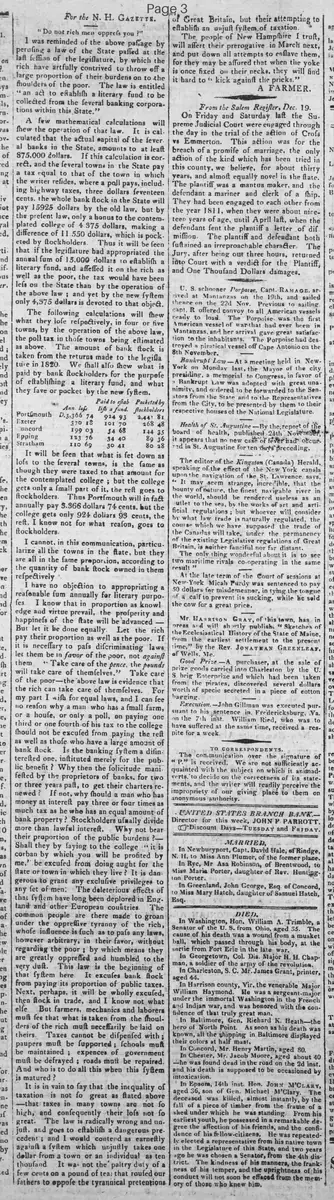
I was reminded of the above passage by perusing a law of the State passed at the last session of the legislature, by which the rich have artfully contrived to throw off a large proportion of their burdens on to the shoulders of the poor….The law is entitled "an act to establish a literary fund to be collected from the several banking corporations within this State."
A few mathematical calculations will show the operation of that law. It is calculated that the actual capital of the several banks in the State, amounts to at least $75,000 dollars. If this calculation is correct, and the several towns in the State pay a tax equal to that of the town in which the writer resides, where a poll pays, including highway taxes, three dollars seventeen cents, the whole bank stock in the State will pay $15,925 dollars by the old law, but by the present law, only a bonus to the contemplated college of $4,375 dollars, making a difference of $11,550 dollars, which is pocketed by stockholders. Thus it will be seen that if the legislature had appropriated the annual sum of 15,000 dollars to establish a literary fund, and assessed it on the rich as well as the poor, the tax would have been less on the State than by the operation of the above law; and yet by the new system only 4,375 dollars is devoted to that object.
The following calculations will show what they lose respectively, in four or five towns, by the operation of the above law, the poll tax in those towns being estimated as above. The amount of bank stock is taken from the returns made to the legislature in 1820. We shall also show what is paid by bank stockholders for the purpose of establishing a literary fund, and what they save or pocket by the new system.
It will be seen that what is set down as loss to the several towns, is the same as though they were taxed to that amount for the contemplated college; but the college gets only a small part of it, the rest goes to stockholders. Thus Portsmouth will in fact annually pay 3,366 dollars 74 cents, but the college gets only 924 dollars 93 cents, the rest, I know not for what reason, goes to stockholders.
I cannot, in this communication, particularize all the towns in the state, but they are all in the same proportion, according to the quantity of bank stock owned in them respectively.
I have no objection to appropriating a reasonable sum annually for literary purposes. I know that in proportion as knowledge and virtue prevail, the prosperity and happiness of the state will be advanced—But let it be done equally. Let the rich pay their proportion as well as the poor. If it is necessary to pass discriminating laws let them be in favor of the poor, not against them. "Take care of the pence, the pounds will take care of themselves." Take care of the poor—the above law is evidence that the rich can take care of themselves. For my part I wish for equal laws, and I can see no reason why a man who has a small farm, or a house, or only a poll, on paying one third or one fourth of his tax to the college should not be excused from paying the rest as well as those who have a large amount of bank stock. Is the banking system a disinterested one, instituted merely for the public benefit? Why then the solicitude manifested by the proprietors of banks, for two or three years past, to get their charters renewed? If not, why should a man who has money at interest pay three or four times as much tax as he who has an equal amount of bank property? Stockholders usually divide more than lawful interest. Why not bear their proportion of the public burdens?—Shall they by saying to the college "it is corban by which you will be profited by me,'' be excused from doing aught for the state or town in which they live? It is dangerous to grant any exclusive privileges to any set of men. The deleterious effects of that system have long been deplored in England and other European countries. The common people are there made to groan under the oppressive tyranny of the rich, whose influence is such as to pass any laws, however arbitrary, in their favor, without regarding the poor; by which means they are greatly oppressed and humbled to the very dust. This law is the beginning of that system here. It excuses bank stock from paying its proportion of public taxes. Next, perhaps, it will be wholly excused, then stock in trade, and I know not what else. But farmers, mechanics and laborers must see that what is taken from the shoulders of the rich must necessarily be laid on theirs. Taxes cannot be dispensed with: paupers must be supported; schools must be maintained; expenses of government must be defrayed; roads must be repaired. And who is to do all this when this system is matured?
It is in vain to say that the inequality of taxation is not so great as stated above—that taxes in many towns are not so high, and consequently their loss not so great. The law is radically wrong and unjust, and goes to establish a dangerous precedent; and I would contend as earnestly against a system which unjustly takes one dollar from a town or an individual as ten thousand. It was not the paltry duty of a few cents on a pound of tea: that roused our fathers to oppose the tyrannical pretensions of Great Britain, but their attempting to establish an unjust system of taxation.
The people of New Hampshire I trust, will assert their prerogative in March next, and put down all attempts to enslave them, for they may be assured that when the yoke is once fixed on their necks, they will find it hard to "kick against the pricks."
A FARMER.
What sub-type of article is it?
What themes does it cover?
What keywords are associated?
What entities or persons were involved?
Letter to Editor Details
Author
A Farmer.
Recipient
For The N. H. Gazette,
Main Argument
the new state law establishing a literary fund from banks unfairly exempts wealthy stockholders from taxes, shifting the burden to the poor and calling for equal taxation across all property types to prevent oppression of the lower classes.
Notable Details