Thank you for visiting SNEWPapers!
Sign up free
Gazette Of The United States, & Philadelphia Daily Advertiser
Philadelphia, Philadelphia County, Pennsylvania
What is this article about?
In a letter to the Connecticut Courant dated August 18, 1798, Senator Uriah Tracy corrects a published account of his Senate speech opposing postponement of a bill to declare void the US-France treaties, citing French violations and advocating for dissolution to enable defensive actions.
Clipping
OCR Quality
Full Text
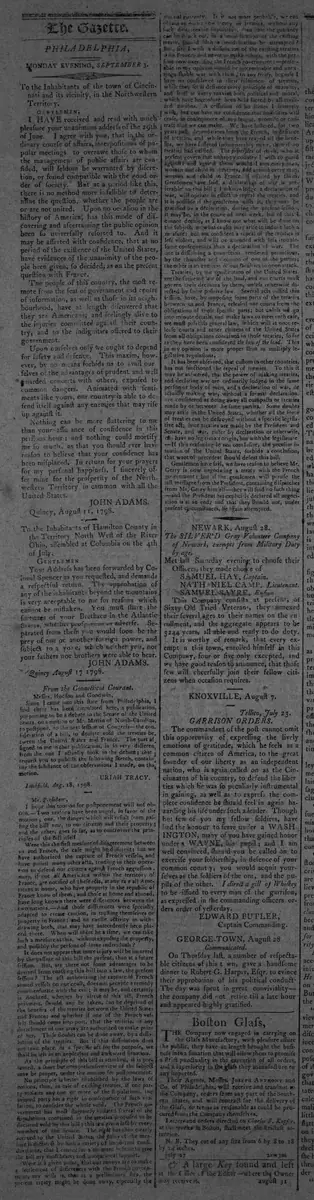
Messrs. Hudson and Goodwin,
Since I came into this state from Philadelphia, I find there has been circulated here, a publication, purporting to be a debate in the Senate of the United States, on a motion of Mr. Martin of North-Carolina, to postpone, to the next session of Congress--the consideration of a bill, to declare void the treaties between the United States and France. The part assigned to me in that publication, is so very different from the one I actually took in the debate; that I request you to publish the following sketch, containing the substance of the observations I made, on that motion.
URIAH TRACY.
Litchfield, Aug. 18, 1798.
Mr. President,
I hope this motion for postponement will not obtain.—Two reasons have been urged, in favor of the motion; one, the danger which will result from passing the bill now, to our citizens and their property; and the other, goes so far, as to controvert the principles of the bill itself
Were this the first measure of disagreement between us and France, the case might be different: but we have authorized the capture of French vessels, and have passed many other acts, tending in their operation to defend our citizens against French aggression: many, if not all Americans within the territory of France, are notified of these acts, at any rate all Americans at home, who have property in the republic of France know of them; and those at home and abroad, have long known there were differences between the two nations.—And those differences were peculiarly adapted to create caution, in trusting themselves or property in France; and to excite activity in withdrawing both, that may have antecedently been placed there. When will there be a time, we can take such a measure as this, without exposing the property, and possibly the persons of some individuals?.
It does not appear that more injury will be incurred by the passage of this bill the present, than at a future session. But, are there not some advantages to be derived from enacting this bill into a law, the present session? The act authorizing the capture of French armed vessels on our coast, does not provide a remedy commensurate with the evil; it may be, and certainly is doubted, whether by virtue of this act, French prisoners, should any be taken, can be deprived of The benefits of the treaties between the United States and France: and whether if one of the French vessels should come into port, that the militia, or any detachment of our army are authorized to make prize of her, These doubts can be done away, by a dissolution of the treaties. But if this dissolution does not take place, or a specific act for the purpose, we shall be left in an unpleasant and awkward situation.
As the principle of this bill is attacked, it is presumed, a Short but comprehensive view of the subject may be proper, under the motion or postponement.
No principle is better established by the laws of nations, than, in case of existing treaties, if one party violates any one or more of the stipulations, the injured party has a right in consequence of such violation, to consider the whole void. The French government has most flagrantly violated several of the stipulations contained in the treaties proposed to be declared void by this bill ; this is a given fact by every member of the Senate. The right has then clearly accrued to the United States, the policy of the measure is dictated by such a variety of important considerations, that I cannot for a moment hesitate to give the bill my most hearty and unequivocal support.
Were it a given point, that our envoys are to make a settlement of differences with the French government, my wish is, that as a preliminary step, the present treaty might be done away, especially the mutual guaranty. Is it not more probable, we can obtain an entire new treaty or treaties, without any such disagreeable Stipulations, than that the guaranty can be struck out, in a modification of the existing treaty, should such a modification be attempted?
But, sir, I wish a dissolution of the existing treaties with France, and never to make others, with the persons now exercising the French government;-preferable in my opinion would be interminable and unextinguishable war with them. to any treaty, because I have no confidence in their fulfilment of treaties, while they set at defiance every principle of morality, and scoff at every maxim both political and moral, , which have heretofore been held sacred by all civilized nations. a cessation of hostilities I sincerely wish, but can have no confidence that hostilities will cease, in consequence of any league, promise or contract that we can make. We have suffered, for two years past. declarations from the French, in defiance of treaties, and while they have reaped all the benefits, we have suffered incomparably more, than if no treaties had existed. The principles of those, who at present govern that unhappy country I wish to guard against and against them would I arm every man, woman and child in America, did against every man, woman and child in France, if allied by them.
Gentlemen have said, a declaration of war is preferable to this bill ; I acknowledge a declaration of war, will operate in effect to repeal the treaties, and it is possible if the gentlemen wish it, they may be gratified by a declaration, during the present session, it may be, in the course of next week, but of this I cannot decide, as I know not what will be done on the subject, or what causes may arise to induce such a measure: but am confident a repeal of the treaties is less violent, and will be attended with less troublesome consequences than a declaration of war. The one is dissolving a connection. rendered pernicious, by the character and violation of one of the parties; the other is an exertion of our faculties in open attack.
Treaties, by the constitution of the United States. are the supreme law of the land, and our courts must govern their decisions by them, unless otherwise directed by some positive law. Several acts passed this session, have, by opposing some parts of the treaties between us and France, released our courts from the obligations of those specific parts; but unless we go into minute details, and make laws to meet each case, we must pass this general law, w hich will at once release courts and other citizens of the United States from all obligations contained in those treaties, o far as they have been considered the law of the land. This in my opinion is more proper than to multiply legislative regulations.
It has been observed, that custom in-other countries, has not sanctioned the repeal of treaties. To this it may be answered, that the power of making treaties, and declaring war are ordinarily lodged in the same person or body of men, and a declaration of war, or actually making war, without a formal declaration. are considered as doing away all compacts or treaties made by or between .be same parties. Some doubts may arise in the United States, whether all the force of treaties can be destroyed without a specific legislative act: since treaties are made by the President and Senate, and war, either by declaration or otherwise, cn have no legitimate origin, but with the legislature --If this reasoning be not conclusive, the peculiar situation of the United States, forbids a conclusion, that want of precedent should defeat this bill.
Gentlemen have said, we have reason to believe Mr. Gerry is now negotiating a treaty with the French government: but if the gentlemen will peruse the last messages from the President, containing dispatches from Mr. Gerry himself-they will find no such thing —and the President has explicitly declared all negotiation is at an end; and that they should not, under present circumstances, be again attempted.
What sub-type of article is it?
What keywords are associated?
What entities or persons were involved?
Where did it happen?
Domestic News Details
Primary Location
United States Senate
Event Date
1798
Key Persons
Outcome
tracy supports the bill to declare treaties void, arguing it resolves legal doubts and is preferable to war declaration; no physical casualties mentioned.
Event Details
Senator Uriah Tracy provides a sketch of his Senate speech opposing postponement of a bill to void US-France treaties, citing prior US acts against French aggression, French violations of treaty stipulations, benefits of dissolution for captures and negotiations, and preference for no future treaties with current French government.