Thank you for visiting SNEWPapers!
Sign up free
The New York Journal, And Daily Patriotic Register
New York, New York County, New York
What is this article about?
Continuation of Mr. Martin's speech to Maryland Assembly opposing US Constitution's executive impeachment weaknesses and federal judiciary's dominance over state courts, admiralty cases, interstate disputes, and erosion of jury trials via appellate powers.
Clipping
OCR Quality
Full Text
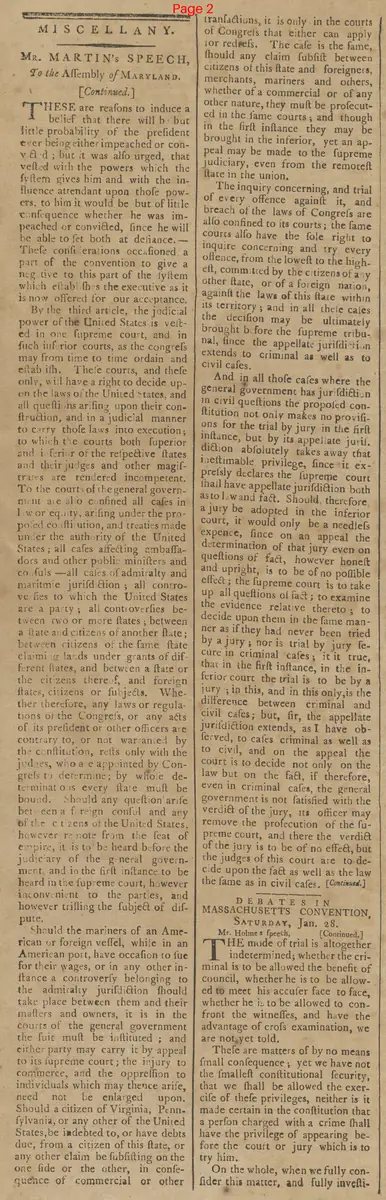
MR. MARTIN's SPEECH,
To the Assembly of MARYLAND.
[Continued.]
THESE are reasons to induce a little probability of the president ever being either impeached or convicted; but it was also urged, that vested with the powers which the system gives him and with the influence attendant upon those powers, to him it would be but of little consequence whether he was impeached or convicted, since he will be able to set both at defiance.
These considerations occasioned a part of the convention to give a negative to this part of the system which establishes the executive as it is now offered for our acceptance.
By the third article, the judicial power of the United States is vested in one supreme court, and in such inferior courts, as the congress may from time to time ordain and establish. These courts, and these only, will have a right to decide upon the laws of the United States, and all questions arising upon their construction, and in a judicial manner to carry those laws into execution; to which the courts both superior and inferior of the respective states and their judges and other magistrates are rendered incompetent.
To the courts of the general government are also confined all cases in law or equity, arising under the proposed constitution, and treaties made under the authority of the United States; all cases affecting ambassadors and other public ministers and consuls -- all cases of admiralty and maritime jurisdiction; all controversies to which the United States are a party; all controversies between two or more states; between a state and citizens of another state; between citizens of the same state claiming lands under grants of different states, and between a state or the citizens thereof, and foreign states, citizens or subjects. Whether therefore, any laws or regulations of the Congress, or any acts of its president or other officers are contrary to, or not warranted by the constitution, rests only with the judges, who are appointed by Congress to determine; by whose determination every state must be bound. Should any question arise between a foreign consul and any of the citizens of the United States, however remote from the seat of empire, it is to be heard before the judiciary of the general government, and in the first instance to be heard in the supreme court, however inconvenient to the parties, and however trifling the subject of dispute.
Should the mariners of an American or foreign vessel, while in an American port, have occasion to sue for their wages, or in any other instance a controversy belonging to the admiralty jurisdiction should take place between them and their masters and owners, it is in the courts of the general government the suit must be instituted; and either party may carry it by appeal to its supreme court; the injury to commerce, and the oppression to individuals which may thence arise, need not be enlarged upon.
Should a citizen of Virginia, Pennsylvania, or any other of the United States, be indebted to, or have debts due, from a citizen of this state, or any other claim be subsisting on the one side or the other, in consequence of commercial or other transactions, it is only in the courts of Congress that either can apply for redress. The case is the same, should any claim subsist between citizens of this state and foreigners, merchants, mariners and others, whether of a commercial or of any other nature, they must be prosecuted in the same courts; and though in the first instance they may be brought in the inferior, yet an appeal may be made to the supreme judiciary, even from the remotest state in the union.
The inquiry concerning, and trial of every offence against it, and breach of the laws of Congress are also confined to its courts; the same courts also have the sole right to inquire concerning and try every offence, from the lowest to the highest, committed by the citizens of any other state, or of a foreign nation, against the laws of this state within its territory; and in all these cases the decision may be ultimately brought before the supreme tribunal, since the appellate jurisdiction extends to criminal as well as to civil cases.
And in all those cases where the general government has jurisdiction in civil questions the proposed constitution not only makes no provision for the trial by jury in the first instance, but by its appellate jurisdiction absolutely takes away that inestimable privilege, since it expressly declares the supreme court shall have appellate jurisdiction both as to law and fact. Should, therefore, a jury be adopted in the inferior court, it would only be a needless expense, since on an appeal the determination of that jury even on questions of fact, however honest and upright, is to be of no possible effect; the supreme court is to take up all questions of fact; to examine the evidence relative thereto; to decide upon them in the same manner as if they had never been tried by a jury; nor is trial by jury secure in criminal cases; it is true, that in the first instance, in the inferior court the trial is to be by a jury; in this, and in this only, is the difference between criminal and civil cases: but, sir, the appellate jurisdiction extends, as I have observed, to cases criminal as well as to civil, and on the appeal the court is to decide not only on the law but on the fact, if therefore, even in criminal cases, the general government is not satisfied with the verdict of the jury, its officer may remove the prosecution to the supreme court, and there the verdict of the jury is to be of no effect, but the judges of this court are to decide upon the fact as well as the law the same as in civil cases. [Continued.]
What sub-type of article is it?
What keywords are associated?
What entities or persons were involved?
Where did it happen?
Domestic News Details
Primary Location
Maryland
Key Persons
Event Details
Mr. Martin delivers a speech to the Assembly of Maryland critiquing the proposed US Constitution's executive provisions on impeachment and conviction, and judicial provisions vesting power in federal courts, excluding state courts, covering various cases including admiralty, interstate disputes, and crimes, and undermining trial by jury through appellate jurisdiction.