Thank you for visiting SNEWPapers!
Sign up free
Evening Journal
Wilmington, New Castle County, Delaware
What is this article about?
Eyewitness Albert J. Leroy recounts the German siege of Liege using massive Krupp guns, which quickly reduced Belgian forts; reports atrocities including firing on Red Cross, using civilians as shields, and Belgian defiance despite threats. (214 characters)
Clipping
OCR Quality
Full Text
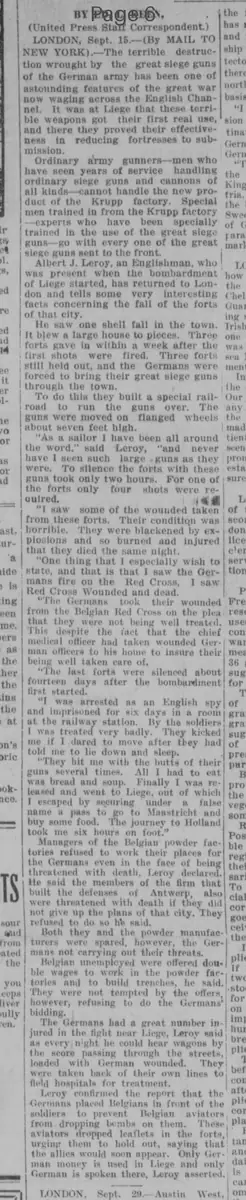
LONDON, Sept. 15.--(By MAIL TO NEW YORK.)--The terrible destruction wrought by the great siege guns of the German army has been one of astounding features of the great war now waging across the English Channel. It was at Liege that these terrible weapons got their first real use, and there they proved their effectiveness in reducing fortresses to submission.
Ordinary army gunners--men who have seen years of service handling ordinary siege guns and cannons of all kinds--cannot handle the new product of the Krupp factory. Special men trained in the Krupp factory--experts who have been specially trained in the use of the great siege guns--go with every one of the great siege guns sent to the front.
Albert J. Leroy, an Englishman, who was present when the bombardment of Liege started, has returned to London and tells some very interesting facts concerning the fall of the forts of that city.
He saw one shell fall in the town. It blew a large house to pieces. Three forts gave in within a week after the first shots were fired. Three forts still held out, and the Germans were forced to bring their great siege guns through the town.
To do this they built a special railroad to run the guns over. The guns were moved on flanged wheels about seven feet high.
"As a sailor I have been all around the world," said Leroy, "and never have I seen such large guns as they were. To silence the forts with these guns took only two hours. For one of the forts only four shots were required.
"I saw some of the wounded taken from these forts. Their condition was horrible. They were blackened by explosions and so burned and injured that they died the same night.
"One thing that I especially wish to state, and that is that I saw the Germans fire on the Red Cross. I saw Red Cross wounded and dead.
"The Germans took their wounded from the Belgian Red Cross on the plea that they were not being well treated. This despite the fact that the chief medical officer had taken wounded German officers to his home to insure their being well taken care of.
"The last forts were silenced about fourteen days after the bombardment first started.
"I was arrested as an English spy and imprisoned for six days in a room at the railway station. By the soldiers I was treated very badly. They kicked me if I dared to move after they had told me to lie down and sleep.
"They hit me with the butts of their guns several times. All I had to eat was bread and soup. Finally I was released and went to Liege, out of which I escaped by securing under a false name a pass to go to Maastricht and buy some food. The journey to Holland took me six hours on foot."
Managers of the Belgian powder factories refused to work their places for the Germans even in the face of being threatened with death, Leroy declared. He said the members of the firm that built the defenses of Antwerp also were threatened with death if they did not give up the plans of that city. They refused to do so he said.
Both they and the powder manufacturers were spared, however, the Germans not carrying out their threats.
Belgian unemployed were offered double wages to work in the powder factories and to build trenches, he said. They were not tempted by the offers, however, refusing to do the Germans bidding.
The Germans had a great number injured in the fight near Liege, Leroy said as every night he could hear wagons by the score passing through the streets, loaded with German wounded. They were taken back of their own lines to field hospitals for treatment.
Leroy confirmed the report that the Germans placed Belgians in front of the soldiers to prevent Belgian aviators from dropping bombs on them. These aviators dropped leaflets in the forts urging them to hold out, saying that the allies would soon appear. Only German money is used in Liege and only German is spoken there, Leroy asserted.
What sub-type of article is it?
What keywords are associated?
What entities or persons were involved?
Where did it happen?
Foreign News Details
Primary Location
Liege
Event Date
Bombardment Lasting About Fourteen Days
Key Persons
Outcome
three forts surrendered within a week; remaining forts silenced after fourteen days; many german wounded transported nightly; belgian wounded horribly injured, some died same night
Event Details
Albert J. Leroy, an Englishman present at the start of the bombardment of Liege, described the use of massive Krupp siege guns that required special training and were transported via a special railroad. The guns silenced the last forts in two hours, with one fort falling after four shots. He witnessed a shell destroy a house, Germans firing on the Red Cross, and poor treatment of prisoners. Belgians refused to work for Germans despite threats and offers. Germans used Belgians as shields against aviators, who dropped leaflets urging resistance.