Thank you for visiting SNEWPapers!
Sign up free
The New Hampshire Gazette And Historical Chronicle
Portsmouth, Greenland, Rockingham County, New Hampshire
What is this article about?
A critical letter addressed to Sir Francis Bernard accuses him of misrepresenting colonial intentions during the Stamp Act crisis and later revenue acts to inflame British-American relations, portraying him as an instrument of despotism under Lord Hillsborough's patronage. It references historical events like the repeal of the Stamp Act and Massachusetts' circular letter.
Merged-components note: Continuation of the letter criticizing Sir Francis Bernard, as the text flows directly from one component to the next.
Clipping
OCR Quality
Full Text
From a late ENGLISH PAPER, brought by the Packet.
To Sir Francis Bernard.
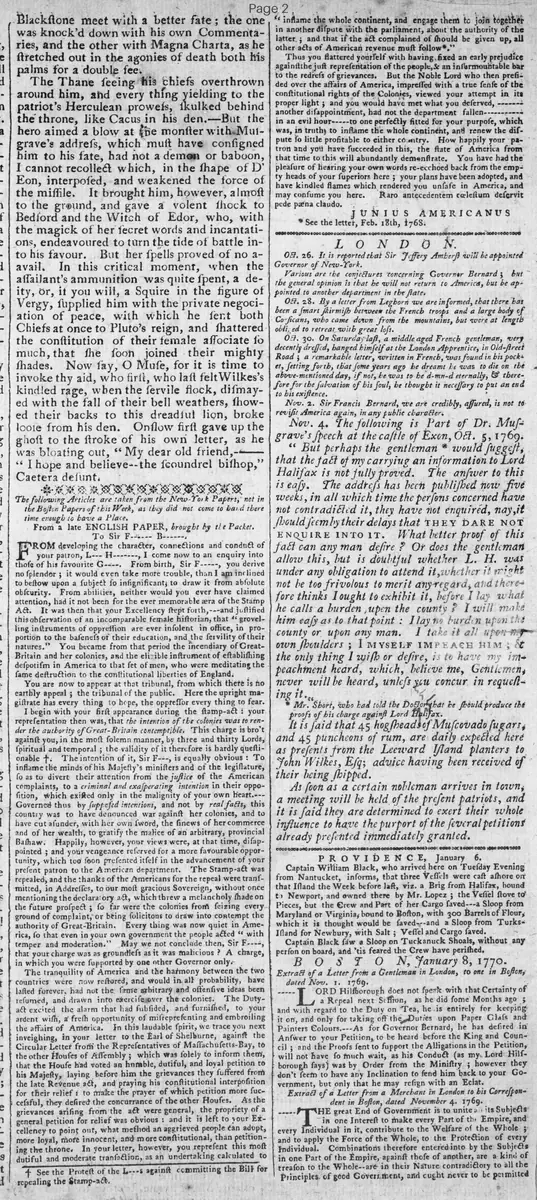
From developing the character, connections and conduct of your patron, Lord Hillsborough, I come now to an enquiry into those of his favourite Governor. From birth, Sir Francis, you derive no splendor; it would even take more trouble, than I am inclined to bestow upon a subject so insignificant; to draw it from absolute obscurity. From abilities, neither would you ever have claimed attention, had it not been for the ever memorable era of the Stamp Act. It was then that your Excellency stepped forth,--and justified this observation of an incomparable female historian, that "grovelling instruments of oppression are ever insolent in office, in proportion to the baseness of their education, and the servility of their natures." You became from that period the incendiary of Great-Britain and her colonies, and the eligible instrument of establishing despotism in America to that set of men, who were meditating the same destruction to the constitutional liberties of England:
You are now to appear at that tribunal, from which there is no earthly appeal; the tribunal of the public. Here the upright magistrate has every thing to hope, the oppressor every thing to fear. I begin with your first appearance during the stamp-act: your representation then was, that the intention of the colonies was to render the authority of Great-Britain contemptible. This charge is brought against you, in the most solemn manner, by three and thirty Lords, spiritual and temporal; the validity of it therefore is hardly questionable: The intention of it, Sir Francis, is equally obvious: To inflame the minds of his Majesty's ministers and of the legislature, so as to divert their attention from the justice of the American complaints, to a criminal and exasperating intention in their opposition, which existed only in the malignity of your own heart.--.
Governed thus by supposed intentions, and not by real facts, this country was to have denounced war against her colonies, and to have cut asunder, with her own sword, the sinews of her commerce and of her wealth, to gratify the malice of an arbitrary, provincial Bashaw. Happily, however, your views were, at that time, disappointed; and your vengeance reserved for a more favourable opportunity, which too soon presented itself in the advancement of your present patron to the American department. The Stamp-act was repealed, and the thanks of the Americans for the repeal were transmitted, in Address, to our most gracious Sovereign, without once mentioning the declaratory act, which threw a melancholy shade on the future prospect; so far were the colonies from seizing every ground of complaint, or being solicitous to draw into contempt the authority of Great-Britain. Every thing was now quiet in America, so that even in your own government the people acted "with temper and moderation." May we not conclude then, Sir Francis, that your charge was as groundless as it was malicious? A charge, in which you were supported by one other Governor only.
The tranquility of America and the harmony between the two countries were now restored, and would in all probability, have lasted forever, had not the same arbitrary and offensive ideas been resumed, and drawn into exercise over the colonies. The Duty act excited the alarm that had subsided, and furnished, to your ardent wish, a fresh opportunity of misrepresenting and embroiling the affairs of America. In this laudable spirit, we trace you next inveighing, in your letter to the Earl of Shelburne, against the Circular Letter from the Representatives of Massachusetts-Bay, to the other Houses of Assembly; which was solely to inform them, that the House had voted an humble, dutiful, and loyal petition to his Majesty, laying before him the grievances they suffered from the late Revenue act, and praying his constitutional interposition for their relief; to make the prayer of which petition more successful, they desired the concurrence of the other Houses. As the grievances arising from the act were general, the propriety of a general petition for relief was obvious: and it is left to your Excellency to point out, what method an aggrieved people can adopt, more loyal, more innocent, and more constitutional, than petitioning the throne. In your letter, however, you represent this most dutiful and moderate transaction, as an undertaking calculated to
See the Protest of the Lords against committing the Bill for repealing the Stamp-act.
inflame the whole continent, and engage them to join together in another dispute with the parliament, about the authority of the latter; and that if the act complained of should be given up, all other acts of American revenue must follow*.
Thus you flattered yourself with having fixed an early prejudice against the just representation of the people, & an insurmountable bar to the redress of grievances. But the Noble Lord who then presided over the affairs of America, impressed with a true sense of the constitutional rights of the Colonies, viewed your attempt in its proper light; and you would have met what you deserved, ----another disappointment, had not the department fallen-- in an evil hour-----to one perfectly fitted for your purpose, which was, in truth, to inflame the whole continent, and renew the dispute so little profitable to either country. How happily your patron and you have succeeded in this, the state of America from that time to this will abundantly demonstrate. You have had the pleasure of hearing your own words re-echoed back from the empty heads of your superiors here; your plans have been adopted, and have kindled flames which rendered you unsafe in America, and may consume you here. Raro antecedentem celestum deseruit pede paena claudo.
JUNIUS AMERICANUS
* See the letter, Feb. 18th, 1768.
What sub-type of article is it?
What themes does it cover?
What keywords are associated?
What entities or persons were involved?
Letter to Editor Details
Author
Junius Americanus
Recipient
Sir Francis Bernard
Main Argument
sir francis bernard is accused of maliciously misrepresenting american colonial actions during the stamp act and townshend duties to inflame british ministers against the colonies, aiming to establish despotism in america under lord hillsborough's patronage.
Notable Details