Thank you for visiting SNEWPapers!
Sign up free
Portland Gazette, And Maine Advertiser
Portland, Cumberland County, Maine
What is this article about?
Editorial presents a table of presidential administration expenditures from Washington to Madison, critiques the progressive increase in federal spending, questions fiscal prudence amid low stocks, and describes a 1816 House debate on Capitol works salaries as wasteful, drawing parallels to Queen Elizabeth's era and post-1688 England.
Merged-components note: The table lists presidential expenditures, which is directly discussed in the editorial on administration spending.
Clipping
OCR Quality
Full Text
|-------------|-------|--------------|
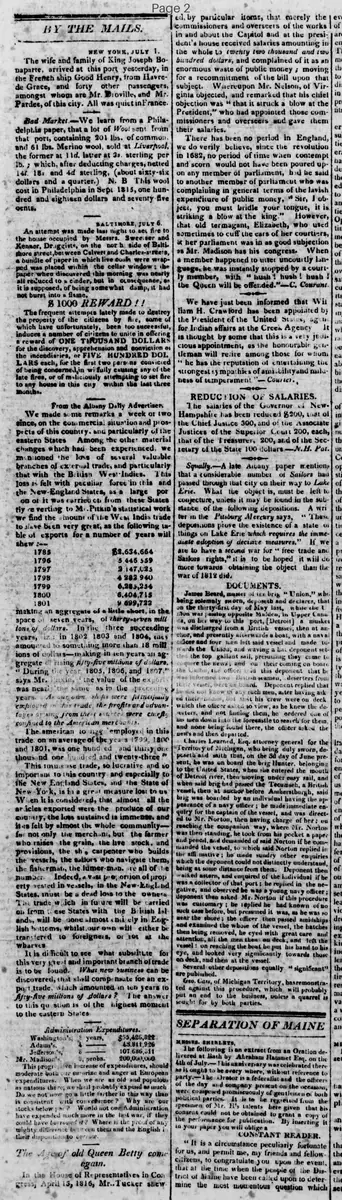
| Washington's | 8 years | $55,426,822 |
| Adams's | 4 | 43,811,926 |
| Jefferson's | 8 | 107,686,811 |
| Mr. Madison's | 8, proba. | 200,000,000 |
Administration Expenditures.
This progressive increase of expenditures, should moderate both our surprise and anger at European expenditures. When we are as old and populous as nations there; we shall probably expend as much. Do we not now go a little farther in this way than is consistent with convenience? Why are our stocks below par? Would not our Administration have expended much more in the last war, if they could have borrowed? Where is the proof of any weighty difference between them and the English in their disposition to borrow.
The Age of old Queen Bess comes again.
In the House of Representatives in Congress, April 13, 1816, Mr. Tucker shewed, by particular items, that merely the commissioners and overseers of the works in and about the Capitol and at the president's house received salaries amounting in the whole to twenty-two thousand six hundred dollars, and complained of it as an enormous waste of public money; moving for a recommitment of the bill upon that subject. Whereupon Mr. Nelson, of Virginia objected, and remarked that his chief objection was "that it struck a blow at the President," who had appointed those commissioners and overseers and gave them their salaries.
There has been no period in England, we do verily believe, since the revolution in 1688, no period of time when contempt and scorn would not have been poured upon any member of parliament, had he said to another member of parliament who was complaining in general terms of the lavish expenditure of public money, "Sir, I object, you must bridle your tongue, it is striking a blow at the king." However, that old termagant, Elizabeth, who used sometimes to cuff the ears of her courtiers, & her parliament was in as good subjection as Mr. Madison has his congress. When a member happened to utter uncourtly language, he was instantly stopped by a courtly member, with "hush! hush! hush! the Queen will be offended." -C. Courant
What sub-type of article is it?
What keywords are associated?
What entities or persons were involved?
Editorial Details
Primary Topic
Critique Of Increasing Federal Expenditures And Congressional Defense Of Spending
Stance / Tone
Critical Of Administration Waste And Subservience To Executive
Key Figures
Key Arguments