Thank you for visiting SNEWPapers!
Sign up free
Literary
December 3, 1849
The Republic
Washington, District Of Columbia
What is this article about?
Extract from Rev. Mr. Chapin's lecture on the ideal versus the actual, emphasizing the ideal's role in human culture, imagination, and elevating everyday labor through contemplation of nature and aspiration, urging youth to cherish ideals despite mockery.
Clipping
OCR Quality
95%
Excellent
Full Text
The Ideal and the Actual,
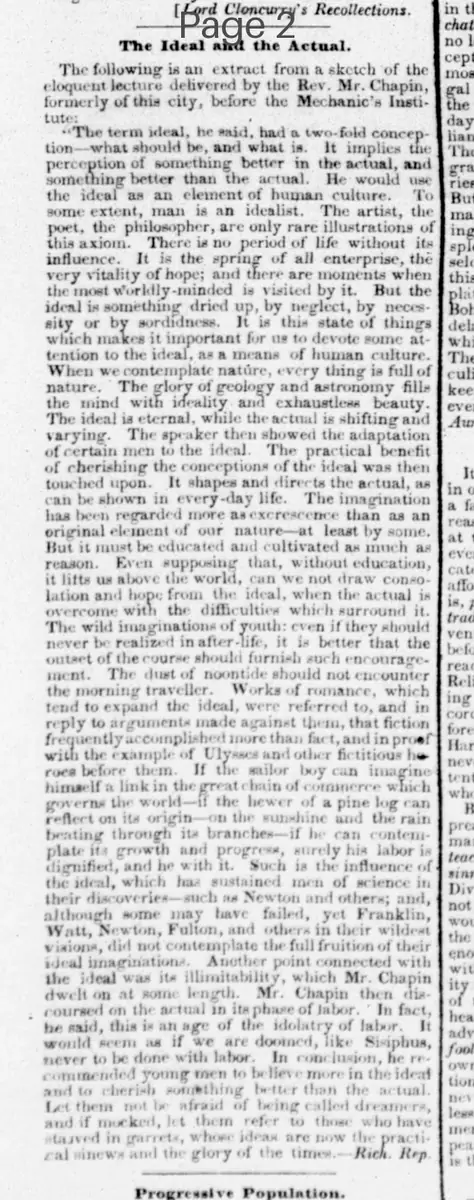
The following is an extract from a sketch of the eloquent lecture delivered by the Rev. Mr. Chapin, formerly of this city, before the Mechanic's Institute:
The term ideal, he said, had a two-fold conception—what should be, and what is. It implies the perception of something better in the actual, and something better than the actual. He would use the ideal as an element of human culture. To some extent, man is an idealist. The artist, the poet, the philosopher, are only rare illustrations of this axiom. There is no period of life without its influence. It is the spring of all enterprise, the very vitality of hope; and there are moments when the most worldly-minded is visited by it. But the ideal is something dried up, by neglect, by necessity or by sordidness. It is this state of things which makes it important for us to devote some attention to the ideal, as a means of human culture.
When we contemplate nature, every thing is full of nature. The glory of geology and astronomy fills the mind with ideality and exhaustless beauty. The ideal is eternal, while the actual is shifting and varying. The speaker then showed the adaptation of certain men to the ideal. The practical benefit of cherishing the conceptions of the ideal was then touched upon. It shapes and directs the actual, as can be shown in every-day life. The imagination has been regarded more as excrescence than as an original element of our nature—at least by some. But it must be educated and cultivated as much as reason. Even supposing that, without education, it lifts us above the world, can we not draw consolation and hope from the ideal, when the actual is overcome with the difficulties which surround it.
The wild imaginations of youth: even if they should never be realized in after-life, it is better that the outset of the course should furnish such encouragement. The dust of noontide should not encounter the morning traveller. Works of romance, which tend to expand the ideal, were referred to, and in reply to arguments made against them, that fiction frequently accomplished more than fact, and in proof with the example of Ulysses and other fictitious heroes before them. If the sailor boy can imagine himself a link in the great chain of commerce which governs the world—if the hewer of a pine log can reflect on its origin—on the sunshine and the rain beating through its branches—if he can contemplate its growth and progress, surely his labor is dignified, and he with it. Such is the influence of the ideal, which has sustained men of science in their discoveries—such as Newton and others; and, although some may have failed, yet Franklin, Watt, Newton, Fulton, and others in their wildest visions, did not contemplate the full fruition of their ideal imaginations. Another point connected with the ideal was its illimitability, which Mr. Chapin dwelt on at some length. Mr. Chapin then discoursed on the actual in its phase of labor. In fact, he said, this is an age of the idolatry of labor. It would seem as if we are doomed, like Sisyphus, never to be done with labor. In conclusion, he recommended young men to believe more in the ideal and to cherish something better than the actual. Let them not be afraid of being called dreamers, and if mocked, let them refer to those who have starved in garrets, whose ideas are now the practical sinews and the glory of the times.—Rich. Rep.
The following is an extract from a sketch of the eloquent lecture delivered by the Rev. Mr. Chapin, formerly of this city, before the Mechanic's Institute:
The term ideal, he said, had a two-fold conception—what should be, and what is. It implies the perception of something better in the actual, and something better than the actual. He would use the ideal as an element of human culture. To some extent, man is an idealist. The artist, the poet, the philosopher, are only rare illustrations of this axiom. There is no period of life without its influence. It is the spring of all enterprise, the very vitality of hope; and there are moments when the most worldly-minded is visited by it. But the ideal is something dried up, by neglect, by necessity or by sordidness. It is this state of things which makes it important for us to devote some attention to the ideal, as a means of human culture.
When we contemplate nature, every thing is full of nature. The glory of geology and astronomy fills the mind with ideality and exhaustless beauty. The ideal is eternal, while the actual is shifting and varying. The speaker then showed the adaptation of certain men to the ideal. The practical benefit of cherishing the conceptions of the ideal was then touched upon. It shapes and directs the actual, as can be shown in every-day life. The imagination has been regarded more as excrescence than as an original element of our nature—at least by some. But it must be educated and cultivated as much as reason. Even supposing that, without education, it lifts us above the world, can we not draw consolation and hope from the ideal, when the actual is overcome with the difficulties which surround it.
The wild imaginations of youth: even if they should never be realized in after-life, it is better that the outset of the course should furnish such encouragement. The dust of noontide should not encounter the morning traveller. Works of romance, which tend to expand the ideal, were referred to, and in reply to arguments made against them, that fiction frequently accomplished more than fact, and in proof with the example of Ulysses and other fictitious heroes before them. If the sailor boy can imagine himself a link in the great chain of commerce which governs the world—if the hewer of a pine log can reflect on its origin—on the sunshine and the rain beating through its branches—if he can contemplate its growth and progress, surely his labor is dignified, and he with it. Such is the influence of the ideal, which has sustained men of science in their discoveries—such as Newton and others; and, although some may have failed, yet Franklin, Watt, Newton, Fulton, and others in their wildest visions, did not contemplate the full fruition of their ideal imaginations. Another point connected with the ideal was its illimitability, which Mr. Chapin dwelt on at some length. Mr. Chapin then discoursed on the actual in its phase of labor. In fact, he said, this is an age of the idolatry of labor. It would seem as if we are doomed, like Sisyphus, never to be done with labor. In conclusion, he recommended young men to believe more in the ideal and to cherish something better than the actual. Let them not be afraid of being called dreamers, and if mocked, let them refer to those who have starved in garrets, whose ideas are now the practical sinews and the glory of the times.—Rich. Rep.
What sub-type of article is it?
Essay
What themes does it cover?
Moral Virtue
Nature
What keywords are associated?
Ideal
Actual
Human Culture
Imagination
Nature
Labor
Enterprise
Hope
What entities or persons were involved?
Rev. Mr. Chapin
Literary Details
Title
The Ideal And The Actual
Author
Rev. Mr. Chapin
Subject
Lecture Delivered Before The Mechanic's Institute
Form / Style
Extract From A Sketch Of An Eloquent Lecture
Key Lines
The Term Ideal, He Said, Had A Two Fold Conception—What Should Be, And What Is.
The Ideal Is Eternal, While The Actual Is Shifting And Varying.
This Is An Age Of The Idolatry Of Labor.
Let Them Not Be Afraid Of Being Called Dreamers, And If Mocked, Let Them Refer To Those Who Have Starved In Garrets, Whose Ideas Are Now The Practical Sinews And The Glory Of The Times.