Thank you for visiting SNEWPapers!
Sign up free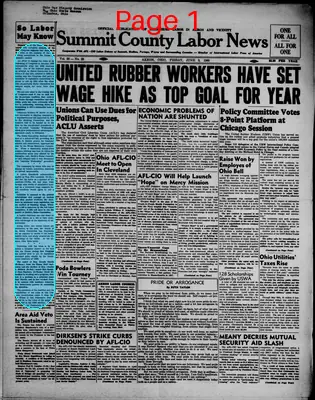
Story
June 3, 1960
Summit County Labor News
Akron, Summit County, Ohio
What is this article about?
Analysis of Democrats' frustrations in the 86th Congress due to obstructive House Rules Committee under Chairman Howard W. Smith, delaying key legislation like depressed-areas aid, school funding, and minimum wage bills, despite 1958 election mandate. Calls for rule changes to improve responsiveness.
Clipping

OCR Quality
100%
Excellent
Full Text
Experience of the Democrats during nearly two complete sessions of the 86th Congress suggests that changes in the rules or the makeup of the controlling committees in the House are urgently needed.
An effort to change the rules at the beginning of Congress in January 1959, immediately after the 1958 elections, failed. One of the rejected plans was an attempt by liberal Democrats to restore a 21-day rule, adopted in 1949 and lasting only one Congress, that gave to chairman of legislative committees the power to call up bills after the otherwise all-powerful Rules Committee had delayed action for more than three weeks.
We are now close to the waning days of Congress--and it can be said that the bi-partisan coalition that controls the House through committee and leadership posts has been extremely effective in postponing, watering down and threatening to kill a substantial body of legislation.
Chairman Howard W. Smith (D.Va.) was successful in denying clearance to a depressed-areas bill approved in 1959 by the Banking Committee, and the measure had to be hauled on to the floor by the complicated procedures of the so-called "calendar Wednesday," which give parliamentary advantages to opponents ready to filibuster.
The Rules Committee declined clearance of a school-aid bill, providing $4.4 billion in federal grants for teachers' salaries and construction, approved last year by the House Education Committee. When a drastically scaled-down measure offering less than $1 billion for construction alone was offered by the Education unit, Smith's Rules Committee still delayed until it was threatened with "calendar Wednesday" procedure.
The techniques by which bills may be delayed by hostile committee chairmen are almost innumerable.
A Labor Standards subcommittee headed by Rep. Phil Landrum (D.Ga.), who lent his name as a sponsor of the Landrum-Griffin bill last year, went through nine weeks of exhaustive hearings on a minimum wage measure before Landrum would agree to call a halt.
Landrum is opposed to the present enforcement and concept of various laws that protect workers; the slow down on minimum wage legislation was one method of handling things. Whenever a bill is approved by the full Labor Committee, it still will have to run the gantlet of Smith's Rules Committee.
A hostile chairman can also delay an official report on a bill to take maximum advantage of the approach of adjournment.
Along about two weeks before adjournment, in the past, Mr. Smith of the Rules Committee has frequently felt an urgency to return to his home-district farm and study extensively the well-being of his cattle. In his absence, time ticks away.
Tinkering with the rules is by no means a complete answer to the fact that the House during this Congress has proved slow to act on legislation promised quite clearly by the Democratic platform of 1956.
The ouster of Rep. Joseph Martin (R-Mass.) from his House GOP leadership and the election of Rep. Charles A. Halleck (R.Ind.) meant that Speaker Sam Rayburn (D-Texas) faced difficulties in working out a program. Halleck is a partisan in a grimmer sense than Martin, and he has worked closely in concert with southern conservative Democratic powers in controlling the situation.
The operation of the coalition and the exploitation of the rules in this Congress nevertheless make it clear that the House is less responsive than it should be to the voice of the people as expressed in the 1958 election. This is a problem for Democrats in Congress as well as for the country generally.
An effort to change the rules at the beginning of Congress in January 1959, immediately after the 1958 elections, failed. One of the rejected plans was an attempt by liberal Democrats to restore a 21-day rule, adopted in 1949 and lasting only one Congress, that gave to chairman of legislative committees the power to call up bills after the otherwise all-powerful Rules Committee had delayed action for more than three weeks.
We are now close to the waning days of Congress--and it can be said that the bi-partisan coalition that controls the House through committee and leadership posts has been extremely effective in postponing, watering down and threatening to kill a substantial body of legislation.
Chairman Howard W. Smith (D.Va.) was successful in denying clearance to a depressed-areas bill approved in 1959 by the Banking Committee, and the measure had to be hauled on to the floor by the complicated procedures of the so-called "calendar Wednesday," which give parliamentary advantages to opponents ready to filibuster.
The Rules Committee declined clearance of a school-aid bill, providing $4.4 billion in federal grants for teachers' salaries and construction, approved last year by the House Education Committee. When a drastically scaled-down measure offering less than $1 billion for construction alone was offered by the Education unit, Smith's Rules Committee still delayed until it was threatened with "calendar Wednesday" procedure.
The techniques by which bills may be delayed by hostile committee chairmen are almost innumerable.
A Labor Standards subcommittee headed by Rep. Phil Landrum (D.Ga.), who lent his name as a sponsor of the Landrum-Griffin bill last year, went through nine weeks of exhaustive hearings on a minimum wage measure before Landrum would agree to call a halt.
Landrum is opposed to the present enforcement and concept of various laws that protect workers; the slow down on minimum wage legislation was one method of handling things. Whenever a bill is approved by the full Labor Committee, it still will have to run the gantlet of Smith's Rules Committee.
A hostile chairman can also delay an official report on a bill to take maximum advantage of the approach of adjournment.
Along about two weeks before adjournment, in the past, Mr. Smith of the Rules Committee has frequently felt an urgency to return to his home-district farm and study extensively the well-being of his cattle. In his absence, time ticks away.
Tinkering with the rules is by no means a complete answer to the fact that the House during this Congress has proved slow to act on legislation promised quite clearly by the Democratic platform of 1956.
The ouster of Rep. Joseph Martin (R-Mass.) from his House GOP leadership and the election of Rep. Charles A. Halleck (R.Ind.) meant that Speaker Sam Rayburn (D-Texas) faced difficulties in working out a program. Halleck is a partisan in a grimmer sense than Martin, and he has worked closely in concert with southern conservative Democratic powers in controlling the situation.
The operation of the coalition and the exploitation of the rules in this Congress nevertheless make it clear that the House is less responsive than it should be to the voice of the people as expressed in the 1958 election. This is a problem for Democrats in Congress as well as for the country generally.
What sub-type of article is it?
Historical Event
What themes does it cover?
Justice
Misfortune
What keywords are associated?
Congressional Rules
Rules Committee
Legislative Delay
Democratic Platform
Howard Smith
School Aid Bill
Minimum Wage
What entities or persons were involved?
Howard W. Smith
Phil Landrum
Joseph Martin
Charles A. Halleck
Sam Rayburn
Where did it happen?
House Of Representatives
Story Details
Key Persons
Howard W. Smith
Phil Landrum
Joseph Martin
Charles A. Halleck
Sam Rayburn
Location
House Of Representatives
Event Date
86th Congress, 1959
Story Details
Democrats in the 86th Congress face delays and obstructions from the Rules Committee chaired by Howard W. Smith, blocking or weakening bills on depressed areas, school aid, and minimum wage, despite attempts to change rules and use alternative procedures.