Thank you for visiting SNEWPapers!
Sign up free
Herald Of The United States
Warren, Bristol County, Rhode Island
What is this article about?
Napoleon's letter to the King of Bavaria warns of Prussian armaments and calls for the Confederation of the Rhine to mobilize, with France providing 300,000 troops. Reports from Paris and Hamburg detail diplomatic exchanges, Prussian military movements under the King, Russian and Swedish preparations, and French troop reinforcements in Germany amid rising tensions in September 1806.
Merged-components note: Continuation of foreign news from France and Germany, including Napoleon's letter and Prussian movements.
Clipping
OCR Quality
Full Text
PARIS, SEPT. 27.
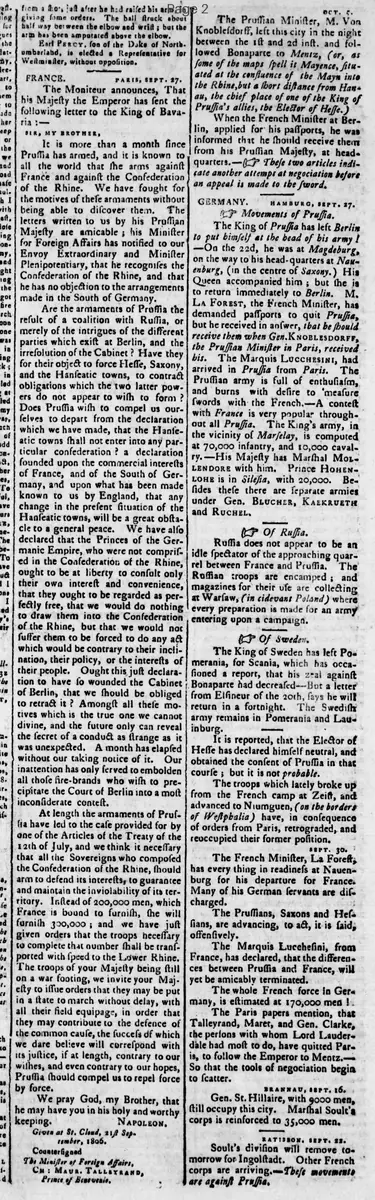
The Moniteur announces, That his Majesty the Emperor has sent the following letter to the King of Bavaria:
SIR, MY BROTHER,
It is more than a month since Prussia has armed, and it is known to all the world that the arms against France and against the Confederation of the Rhine. We have sought for the motives of these armaments without being able to discover them. The letters written to us by his Prussian Majesty are amicable; his Minister for Foreign Affairs has notified to our Envoy Extraordinary and Minister Plenipotentiary, that he recognizes the Confederation of the Rhine, and that he has no objection to the arrangements made in the South of Germany.
Are the armaments of Prussia the result of a coalition with Russia, or merely of the intrigues of the different parties which exist at Berlin, and the irresolution of the Cabinet? Have they for their object to force Hesse, Saxony, and the Hanseatic towns, to contract obligations which the two latter powers do not appear to wish to form?
Does Prussia wish to compel us ourselves to depart from the declaration which we have made, that the Hanseatic towns shall not enter into any particular confederation? a declaration founded upon the commercial interests of France, and of the South of Germany, and upon what has been made known to us by England, that any change in the present situation of the Hanseatic towns, will be a great obstacle to a general peace. We have also declared that the Princes of the Germanic Empire, who were not comprised in the Confederation of the Rhine, ought to be at liberty to consult only their own interest and convenience, that they ought to be regarded as perfectly free, that we would do nothing to draw them into the Confederation of the Rhine, but that we would not suffer them to be forced to do any act which would be contrary to their inclination, their policy, or the interests of their people. Ought this just declaration to have so wounded the Cabinet of Berlin, that we should be obliged to retract it? Amongst all these motives which is the true one we cannot divine, and the future only can reveal the secret of a conduct as strange as it was unexpected. A month has elapsed without our taking notice of it. Our inattention has only served to embolden all those fire-brands who wish to precipitate the Court of Berlin into a most inconsiderate contest.
At length the armaments of Prussia have led to the case provided for by one of the Articles of the Treaty of the 12th of July, and we think it necessary that all the Sovereigns who composed the Confederation of the Rhine, should arm to defend its interests, to guarantee and maintain the inviolability of its territory. Instead of 200,000 men, which France is bound to furnish, she will furnish 300,000; and we have just given orders that the troops necessary to complete that number shall be transported with speed to the Lower Rhine.
The troops of your Majesty being still on a war footing, we invite your Majesty to issue orders that they may be put in a state to march without delay, with all their field equipage, in order that they may contribute to the defence of the common cause, the success of which we dare believe will correspond with its justice, if at length, contrary to our wishes, and even contrary to our hopes, Prussia should compel us to repel force by force.
We pray God, my Brother, that he may have you in his holy and worthy keeping.
Napoleon.
Given at St. Cloud, 21st September, 1806.
Countersigned
The Minister of Foreign Affairs,
CH. MAUR. TALLEYRAND,
Prince of Beneventum.
The Prussian Minister, M. Von Knobelsdorff, left this city in the night between the 1st and 2d inst. and followed Bonaparte to Mentz, (or, as some of the maps spell it Mayence, situated at the confluence of the Main into the Rhine, but a short distance from Hanau, the chief place of one of the King of Prussia's allies, the Elector of Hesse.)
When the French Minister at Berlin, applied for his passports, he was informed that he should receive them from his Prussian Majesty, at headquarters.—( These two articles indicate another attempt at negotiation before an appeal is made to the sword.
GERMANY.
HAMBURG, SEPT. 27.
Movements of Prussia.
The King of Prussia has left Berlin to put himself at the head of his army! On the 22d, he was at Magdeburg, on the way to his head-quarters at Naumburg, (in the centre of Saxony.) His Queen accompanied him; but he is to return immediately to Berlin. M. La Forest, the French Minister, has demanded passports to quit Prussia, but he received in answer, that he should receive them when Gen. Knobelsdorff, the Prussian Minister in Paris, received his. The Marquis Lucchesini, had arrived in Prussia from Paris. The Prussian army is full of enthusiasm, and burns with desire to measure swords with the French. A contest with France is very popular throughout all Prussia. The King's army, in the vicinity of Magdeburg, is computed at 70,000 infantry, and 10,000 cavalry. —His Majesty has Marshal Mollendorf with him. Prince Hohenlohe is in Silesia, with 20,000. Besides these there are separate armies under Gen. Blucher, Kalkreuth and Rüchel.
Of Russia.
Russia does not appear to be an idle spectator of the approaching quarrel between France and Prussia. The Russian troops are encamped; and magazines for their use are collecting at Warsaw, (in ci-devant Poland) where every preparation is made for an army entering upon a campaign.
Of Sweden.
The King of Sweden has left Pomerania, for Scania, which has occasioned a report, that his zeal against Bonaparte had decreased—But a letter from Elsinore of the 20th, says he will return in a fortnight. The Swedish army remains in Pomerania and Lauenburg.
It is reported, that the Elector of Hesse has declared himself neutral, and obtained the consent of Prussia in that course; but it is not probable.
The troops which lately broke up from the French camp at Zeist, and advanced to Nimeguen, (on the borders of Westphalia) have, in consequence of orders from Paris, retrograded, and reoccupied their former position.
SEPT. 30.
The French Minister, La Forest; has every thing in readiness at Naumburg for his departure for France. Many of his German servants are discharged.
The Prussians, Saxons and Hessians, are advancing, to act, it is said; offensively.
The Marquis Lucchesini, from France, has declared, that the differences between Prussia and France, will yet be amicably terminated.
The whole French force in Germany, is estimated at 170,000 men.
The Paris papers mention, that Talleyrand, Maret, and Gen. Clarke. the persons with whom Lord Lauderdale had most to do, have quitted Paris, to follow the Emperor to Mentz.:
So that the tools of negotiation begin to scatter.
Brannau, Sept. 16.
Gen. St. Hilaire, with 8000 men, still occupy this city. Marshal Soult's corps is reinforced to 35,000 men.
Ratisbon, Sept. 22.
Soult's division will remove tomorrow for Ingolstadt. Other French corps are arriving.—These movements are against Prussia.
What sub-type of article is it?
What keywords are associated?
What entities or persons were involved?
Where did it happen?
Foreign News Details
Primary Location
Germany
Event Date
September 1806
Key Persons
Outcome
france to furnish 300,000 men instead of 200,000; prussian army near magdeburg: 70,000 infantry, 10,000 cavalry; prince hohenlohe in silesia with 20,000; french force in germany estimated at 170,000; marshal soult's corps reinforced to 35,000.
Event Details
Napoleon writes to the King of Bavaria expressing concern over unexplained Prussian armaments, questioning motives involving Russia, Berlin intrigues, or pressures on Hesse, Saxony, and Hanseatic towns. He invokes the Treaty of July 12, calling for the Confederation of the Rhine to arm in defense, with France providing 300,000 troops to the Lower Rhine and inviting Bavarian forces to join. Diplomatic moves include Prussian Minister Von Knobelsdorff following Napoleon to Mentz and reciprocal passport demands between French Minister La Forest and Prussian envoys. From Hamburg, reports detail King of Prussia moving to head his army at Naumburg via Magdeburg, with enthusiastic forces; Russian troops encamping and preparing at Warsaw; Swedish King temporarily leaving Pomerania but expected back; rumored Hessian neutrality; French troops retrograding from Nimeguen. Updates to Sept. 30 note La Forest preparing to leave, advancing Prussian, Saxon, and Hessian forces, optimistic diplomatic declarations by Lucchesini, French estimates at 170,000 in Germany, and negotiators following Napoleon to Mentz. Reports from Brannau and Ratisbon describe French occupations and movements toward Ingolstadt against Prussia.