Thank you for visiting SNEWPapers!
Sign up free
Story
June 16, 1895
The Norfolk Virginian
Norfolk, Virginia
What is this article about?
1895 interview with Émile Zola detailing his physical traits, disciplined writing routine producing the vast Rougon-Macquart series on heredity, rise from poverty, and potential novels on global cities like New York. (187 chars)
Clipping
OCR Quality
95%
Excellent
Full Text
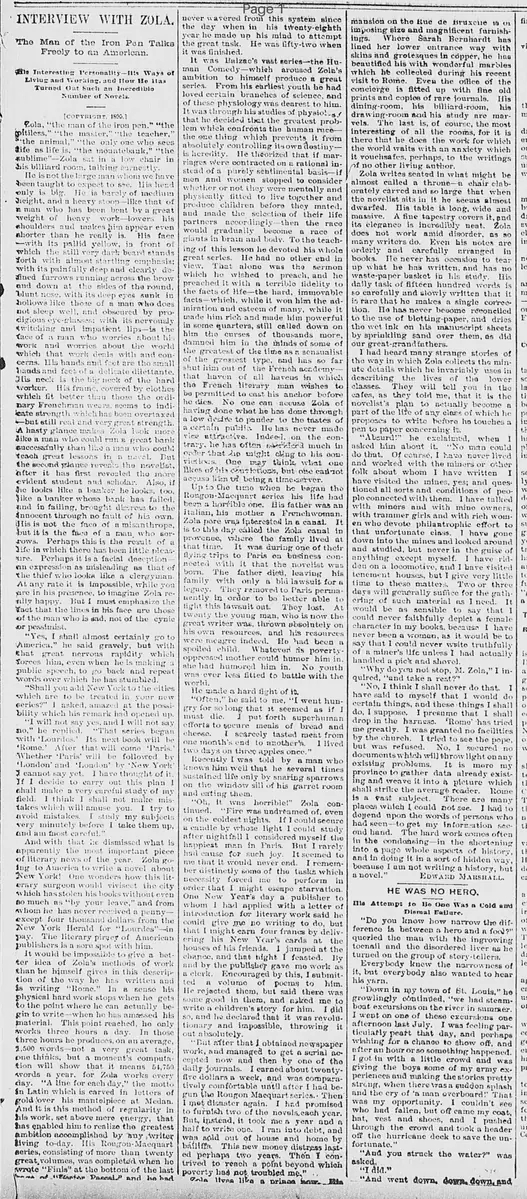
INTERVIEW WITH ZOLA.
The Man of the Iron Pen Talks Freely to an American.
His Interesting Personality—His Ways of Living and Working, and How He Has Turned Out Such an Incredible Number of Novels.
[COPYRIGHT, 1895.]
Zola, "the man of the iron pen," "the pitiless," "the master," "the teacher," "the animal," "the only one who sees life as life is," "the mountebank," "the sublime"—Zola sat in a low chair in his billiard room, talking earnestly.
He is not the large man whom we have been taught to expect to see. His head only is big. He is barely of medium height, and a heavy stoop—like that of a man who has been bent by a great weight of heavy work—lowers his shoulders and makes him appear even shorter than he really is. His face—with its pallid yellow, in front of which the still very dark beard stands forth with almost startling emphasis; with its painfully deep and clearly defined furrows running across the brow and down at the sides of the round, blunt nose; with its deep eyes sunk in hollows like those of a man who does not sleep well, and obscured by prodigious eye-glasses; with its nervously twitching and impatient lips—is the face of a man who worries about his work and worries about the world which that work deals with and concerns. His hands and feet are the small hands and feet of a delicate dilettante. His neck is the big neck of the hard worker. His frame, covered by clothes which fit better than those the ordinary Frenchman wears, seems to indicate strength which has been overtaxed but still real and very great strength.
A hasty glance makes Zola look more like a man who could run a great bank successfully than like a man who could teach great lessons in a novel. But the second glance reveals the novelist, after it has first revealed the more evident student and scholar. Also, if he looks like a banker he looks, too, like a banker whose bank has failed, and in failing, brought distress to the innocent through no fault of his own. His is not the face of a misanthrope, but it is the face of a man who sorrows. Perhaps this is the result of a life in which there has been little pleasure. Perhaps it is a facial deception—an expression as misleading as that of the thief who looks like a clergyman.
At any rate it is impossible, while you are in his presence, to imagine Zola really happy. But I must emphasize the fact that the lines in his face are those of the man who is sad, not of the cynic or pessimist.
"Yes, I shall almost certainly go to America," he said gravely, but with that great nervous rapidity which forces him, even when he is making a public speech, to go back and repeat words over which he has stumbled.
"Shall you add New York to the cities which are to be treated in your new series?" I asked, amazed at the possibility which his remark had opened up.
"I will not say yes, and I will not say no," he replied. "That series began with 'Lourdes.' Its next book will be 'Rome.' After that will come 'Paris.' Whether 'Paris' will be followed by 'London' and 'London' by 'New York' I cannot say yet. I have thought of it. If I decide to carry out this plan I shall make a very careful study of my field. I think I shall not make mistakes which will amuse you. I try to avoid mistakes. I study my subjects very minutely before I take them up, and am most careful."
And with that he dismissed what is apparently the most important piece of literary news of the year. Zola going to America to write a novel about New York! One wonders how this literary surgeon would vivisect the city which has stolen his books without even so much as "by your leave," and from whom he has never received a penny—except four thousand dollars from the New York Herald for "Lourdes"—in pay. The literary piracy of American publishers is a sore spot with him.
It would be impossible to give a better idea of Zola's methods of work than he himself gives in this description of the way he has written and is writing "Rome." In a sense his physical hard work stops when he gets to the point where he can actually begin to write—when he has amassed his material. This point reached, he only works three hours a day. In those three hours he produces, on an average, 1,500 words—not a very great task, one thinks, but a moment's computation will show that it means 54,750 words a year, for Zola works every day. "A line for each day," the motto in Latin which is carved in letters of gold over his mantelpiece at Medan.
And it is this method of regularity in his work, set above mere energy, that has enabled him to realize the greatest ambition accomplished by any writer living to-day. His Rougon-Macquart series, consisting of more than twenty great volumes, was completed when he wrote "Finis" at the bottom of the last page of "La Bête Humaine," and he has never wavered from this system since the day when in his twenty-eighth year he made up his mind to attempt the great task. He was fifty-two when it was finished.
It was Balzac's vast series—the Human Comedy—which aroused Zola's ambition to himself produce a great series. From his earliest youth he had loved certain branches of science, and of these physiology was dearest to him. It was through his studies of physiology that he decided that the greatest problem which confronts the human race—the one thing which prevents it from absolutely controlling its own destiny—is heredity. He theorized that if marriages were contracted on a rational instead of a purely sentimental basis—if men and women stopped to consider whether or not they were mentally and physically fitted to live together and produce children before they mated, and made the selection of their life partners accordingly—then the race would gradually become a race of giants in brain and body. To the teaching of this lesson he devoted his whole great series. He had no other end in view. That alone was the sermon which he wished to preach, and he preached it with a terrible fidelity to the facts of life—the hard, immovable facts—which, while it won him the admiration and esteem of many, while it made him rich and made him powerful in some quarters, still called down on him the curses of thousands more, damned him in the minds of some of the greatest of the time as a sensualist of the grossest type, and has so far shut him out of the French academy—that haven of all havens in which the French literary man wishes to be permitted to cast his anchor before he dies. No one can accuse Zola of having done what he has done through a low desire to pander to the tastes of a certain public. He has never made vice attractive. Indeed, on the contrary, he has often sacrificed much in order that he might cling to his convictions. One may think what one likes of his characters, but one cannot accuse him of being a time-server.
Up to the time when he began the Rougon-Macquart series his life had been a horrible one. His father was an Italian, his mother a Frenchwoman. Zola père was interested in a canal. It is to this day called the Zola canal in Provence, where the family lived at that time. It was during one of their flying trips to Paris on business connected with it that the novelist was born. The father died, leaving his family with only a big lawsuit for a legacy. They removed to Paris permanently in order to be better able to fight this lawsuit out. They lost. At twenty the young man, who is now the great writer, was thrown absolutely on his own resources, and his resources were meagre indeed. He had been a spoiled child. Whatever his poverty-oppressed mother could humor him in, she had humored him in. No youth was ever less fitted to battle with the world.
He made a hard fight of it.
"Often," he said to me, "I went hungry for so long that it seemed as if I must die. I put forth superhuman efforts to secure meals of bread and cheese. I scarcely tasted meat from one month's end to another's. I lived two days on three apples once."
Recently I was told by a man who knows him well that he several times sustained life only by snaring sparrows on the window sill of his garret room and eating them.
"Oh, it was horrible!" Zola continued. "Fire was undreamed of, even on the coldest nights. If I could secure a candle by whose light I could study after nightfall I considered myself the happiest man in Paris. But I rarely had cause for such joy. It seemed to me that it would never end. I remember distinctly some of the tasks which necessity forced me to perform in order that I might escape starvation. One New Year's day a publisher to whom I had applied with a letter of introduction for literary work said he could give me no writing to do, but that I might earn four francs by delivering his New Year's cards at the houses of his friends. I jumped at the chance, and that night I feasted. By and by the publisher gave me work as a clerk. Encouraged by this, I submitted a volume of poems to him. He rejected them, but said there was some good in them, and asked me to write a children's story for him. I did so, and he declared that it was revolutionary and impossible, throwing it out absolutely.
"But after that I obtained newspaper work, and managed to get a serial accepted now and then by one of the daily journals. I earned about twenty-five dollars a week, and was comparatively comfortable until after I had begun the Rougon-Macquart series. Then I met disaster again. I had promised to furnish two of the novels each year. But, instead, it took me a year and a half to write one. I ran into debt, and was sold out of house and home by bailiffs. This new money distress lasted perhaps two years. Then I contrived to reach a point beyond which poverty has not troubled me."
Zola lives like a prince at his handsome home on the Rue de Bruxelles, an imposing place of magnificent furnishings. Where Sarah Bernhardt has lined her lower entrance way with satyrs and grotesques in copper, he has beautified his with wonderful marbles which he collected during his recent visit to Rome. Even the office of the concierge is fitted up with fine old prints and copies of rare journals. His dining-room, his billiard-room, his drawing-room and his study are marvels. The last is, of course, the most interesting of all the rooms, for it is there that he does the work for which the world waits with an anxiety which it vouchsafes, perhaps, to the writings of no other living author.
Zola writes seated in what might be almost called a throne—a chair elaborately carved and so large that when the novelist sits in it he seems almost dwarfed. His table is long, wide and massive. A fine tapestry covers it, and its elegance is incredibly neat. Zola does not work amid disorder, as so many writers do. Even his notes are orderly and carefully arranged in books. He never has occasion to tear up what he has written, and has no waste-paper basket in his study. His daily task of fifteen hundred words is so carefully and slowly written that it is rare that he makes a single correction. He has never become reconciled to the use of blotting-paper, and dries the wet ink on his manuscript sheets by sprinkling sand over them, as did our great-grandfathers.
I had heard many strange stories of the way in which Zola collects the minute details which he invariably uses in describing the lives of the lower classes. They will tell you in the cafes, as they told me, that it is the novelist's plan to actually become a part of the life of any class of which he proposes to write before he touches a pen to paper concerning it.
"Absurd!" he exclaimed, when I asked him about it. "No man could do that. Of course, I have never lived and worked with the miners or other folk about whom I have written. I have visited the mines, yes; and questioned all sorts and conditions of people connected with them. I have talked with miners and with mine owners, with trainmen girls and with rich women who devote philanthropic effort to that unfortunate class. I have gone down into the mines and looked around and studied, but never in the guise of anything except myself. I have ridden on a locomotive, and I have visited tenement houses, but I give very little time to these matters. Two or three days will generally suffice for the gathering of such material as I need. It would be as sensible to say that I could never faithfully depict a female character in my books, because I have never been a woman, as it would be to say that I could never write truthfully of a miner's life unless I had actually handled a pick and shovel.
"Why do you not stop, M. Zola," I inquired, "and take a rest?"
"No, I think I shall never do that. I have said to myself that I would do certain things, and these things I shall do, I suppose. I presume that I shall drop in the harness. 'Rome' has tried me greatly. I was granted no facilities by the church. I tried to see the pope, but was refused. No, I secured no documents which will throw light on any existing problems. It is more my province to gather data already existing and weave it into a picture which shall strike the average reader. Rome is a vast subject. There are many places which I could not see. I had to depend upon the words of persons who had seen—to get my information secondhand. The hard work comes often in the condensing—in the shortening into a page whole aspects of history, and in doing it in a sort of hidden way, because I am not writing a history, but a novel."
EDWARD MARSHALL.
The Man of the Iron Pen Talks Freely to an American.
His Interesting Personality—His Ways of Living and Working, and How He Has Turned Out Such an Incredible Number of Novels.
[COPYRIGHT, 1895.]
Zola, "the man of the iron pen," "the pitiless," "the master," "the teacher," "the animal," "the only one who sees life as life is," "the mountebank," "the sublime"—Zola sat in a low chair in his billiard room, talking earnestly.
He is not the large man whom we have been taught to expect to see. His head only is big. He is barely of medium height, and a heavy stoop—like that of a man who has been bent by a great weight of heavy work—lowers his shoulders and makes him appear even shorter than he really is. His face—with its pallid yellow, in front of which the still very dark beard stands forth with almost startling emphasis; with its painfully deep and clearly defined furrows running across the brow and down at the sides of the round, blunt nose; with its deep eyes sunk in hollows like those of a man who does not sleep well, and obscured by prodigious eye-glasses; with its nervously twitching and impatient lips—is the face of a man who worries about his work and worries about the world which that work deals with and concerns. His hands and feet are the small hands and feet of a delicate dilettante. His neck is the big neck of the hard worker. His frame, covered by clothes which fit better than those the ordinary Frenchman wears, seems to indicate strength which has been overtaxed but still real and very great strength.
A hasty glance makes Zola look more like a man who could run a great bank successfully than like a man who could teach great lessons in a novel. But the second glance reveals the novelist, after it has first revealed the more evident student and scholar. Also, if he looks like a banker he looks, too, like a banker whose bank has failed, and in failing, brought distress to the innocent through no fault of his own. His is not the face of a misanthrope, but it is the face of a man who sorrows. Perhaps this is the result of a life in which there has been little pleasure. Perhaps it is a facial deception—an expression as misleading as that of the thief who looks like a clergyman.
At any rate it is impossible, while you are in his presence, to imagine Zola really happy. But I must emphasize the fact that the lines in his face are those of the man who is sad, not of the cynic or pessimist.
"Yes, I shall almost certainly go to America," he said gravely, but with that great nervous rapidity which forces him, even when he is making a public speech, to go back and repeat words over which he has stumbled.
"Shall you add New York to the cities which are to be treated in your new series?" I asked, amazed at the possibility which his remark had opened up.
"I will not say yes, and I will not say no," he replied. "That series began with 'Lourdes.' Its next book will be 'Rome.' After that will come 'Paris.' Whether 'Paris' will be followed by 'London' and 'London' by 'New York' I cannot say yet. I have thought of it. If I decide to carry out this plan I shall make a very careful study of my field. I think I shall not make mistakes which will amuse you. I try to avoid mistakes. I study my subjects very minutely before I take them up, and am most careful."
And with that he dismissed what is apparently the most important piece of literary news of the year. Zola going to America to write a novel about New York! One wonders how this literary surgeon would vivisect the city which has stolen his books without even so much as "by your leave," and from whom he has never received a penny—except four thousand dollars from the New York Herald for "Lourdes"—in pay. The literary piracy of American publishers is a sore spot with him.
It would be impossible to give a better idea of Zola's methods of work than he himself gives in this description of the way he has written and is writing "Rome." In a sense his physical hard work stops when he gets to the point where he can actually begin to write—when he has amassed his material. This point reached, he only works three hours a day. In those three hours he produces, on an average, 1,500 words—not a very great task, one thinks, but a moment's computation will show that it means 54,750 words a year, for Zola works every day. "A line for each day," the motto in Latin which is carved in letters of gold over his mantelpiece at Medan.
And it is this method of regularity in his work, set above mere energy, that has enabled him to realize the greatest ambition accomplished by any writer living to-day. His Rougon-Macquart series, consisting of more than twenty great volumes, was completed when he wrote "Finis" at the bottom of the last page of "La Bête Humaine," and he has never wavered from this system since the day when in his twenty-eighth year he made up his mind to attempt the great task. He was fifty-two when it was finished.
It was Balzac's vast series—the Human Comedy—which aroused Zola's ambition to himself produce a great series. From his earliest youth he had loved certain branches of science, and of these physiology was dearest to him. It was through his studies of physiology that he decided that the greatest problem which confronts the human race—the one thing which prevents it from absolutely controlling its own destiny—is heredity. He theorized that if marriages were contracted on a rational instead of a purely sentimental basis—if men and women stopped to consider whether or not they were mentally and physically fitted to live together and produce children before they mated, and made the selection of their life partners accordingly—then the race would gradually become a race of giants in brain and body. To the teaching of this lesson he devoted his whole great series. He had no other end in view. That alone was the sermon which he wished to preach, and he preached it with a terrible fidelity to the facts of life—the hard, immovable facts—which, while it won him the admiration and esteem of many, while it made him rich and made him powerful in some quarters, still called down on him the curses of thousands more, damned him in the minds of some of the greatest of the time as a sensualist of the grossest type, and has so far shut him out of the French academy—that haven of all havens in which the French literary man wishes to be permitted to cast his anchor before he dies. No one can accuse Zola of having done what he has done through a low desire to pander to the tastes of a certain public. He has never made vice attractive. Indeed, on the contrary, he has often sacrificed much in order that he might cling to his convictions. One may think what one likes of his characters, but one cannot accuse him of being a time-server.
Up to the time when he began the Rougon-Macquart series his life had been a horrible one. His father was an Italian, his mother a Frenchwoman. Zola père was interested in a canal. It is to this day called the Zola canal in Provence, where the family lived at that time. It was during one of their flying trips to Paris on business connected with it that the novelist was born. The father died, leaving his family with only a big lawsuit for a legacy. They removed to Paris permanently in order to be better able to fight this lawsuit out. They lost. At twenty the young man, who is now the great writer, was thrown absolutely on his own resources, and his resources were meagre indeed. He had been a spoiled child. Whatever his poverty-oppressed mother could humor him in, she had humored him in. No youth was ever less fitted to battle with the world.
He made a hard fight of it.
"Often," he said to me, "I went hungry for so long that it seemed as if I must die. I put forth superhuman efforts to secure meals of bread and cheese. I scarcely tasted meat from one month's end to another's. I lived two days on three apples once."
Recently I was told by a man who knows him well that he several times sustained life only by snaring sparrows on the window sill of his garret room and eating them.
"Oh, it was horrible!" Zola continued. "Fire was undreamed of, even on the coldest nights. If I could secure a candle by whose light I could study after nightfall I considered myself the happiest man in Paris. But I rarely had cause for such joy. It seemed to me that it would never end. I remember distinctly some of the tasks which necessity forced me to perform in order that I might escape starvation. One New Year's day a publisher to whom I had applied with a letter of introduction for literary work said he could give me no writing to do, but that I might earn four francs by delivering his New Year's cards at the houses of his friends. I jumped at the chance, and that night I feasted. By and by the publisher gave me work as a clerk. Encouraged by this, I submitted a volume of poems to him. He rejected them, but said there was some good in them, and asked me to write a children's story for him. I did so, and he declared that it was revolutionary and impossible, throwing it out absolutely.
"But after that I obtained newspaper work, and managed to get a serial accepted now and then by one of the daily journals. I earned about twenty-five dollars a week, and was comparatively comfortable until after I had begun the Rougon-Macquart series. Then I met disaster again. I had promised to furnish two of the novels each year. But, instead, it took me a year and a half to write one. I ran into debt, and was sold out of house and home by bailiffs. This new money distress lasted perhaps two years. Then I contrived to reach a point beyond which poverty has not troubled me."
Zola lives like a prince at his handsome home on the Rue de Bruxelles, an imposing place of magnificent furnishings. Where Sarah Bernhardt has lined her lower entrance way with satyrs and grotesques in copper, he has beautified his with wonderful marbles which he collected during his recent visit to Rome. Even the office of the concierge is fitted up with fine old prints and copies of rare journals. His dining-room, his billiard-room, his drawing-room and his study are marvels. The last is, of course, the most interesting of all the rooms, for it is there that he does the work for which the world waits with an anxiety which it vouchsafes, perhaps, to the writings of no other living author.
Zola writes seated in what might be almost called a throne—a chair elaborately carved and so large that when the novelist sits in it he seems almost dwarfed. His table is long, wide and massive. A fine tapestry covers it, and its elegance is incredibly neat. Zola does not work amid disorder, as so many writers do. Even his notes are orderly and carefully arranged in books. He never has occasion to tear up what he has written, and has no waste-paper basket in his study. His daily task of fifteen hundred words is so carefully and slowly written that it is rare that he makes a single correction. He has never become reconciled to the use of blotting-paper, and dries the wet ink on his manuscript sheets by sprinkling sand over them, as did our great-grandfathers.
I had heard many strange stories of the way in which Zola collects the minute details which he invariably uses in describing the lives of the lower classes. They will tell you in the cafes, as they told me, that it is the novelist's plan to actually become a part of the life of any class of which he proposes to write before he touches a pen to paper concerning it.
"Absurd!" he exclaimed, when I asked him about it. "No man could do that. Of course, I have never lived and worked with the miners or other folk about whom I have written. I have visited the mines, yes; and questioned all sorts and conditions of people connected with them. I have talked with miners and with mine owners, with trainmen girls and with rich women who devote philanthropic effort to that unfortunate class. I have gone down into the mines and looked around and studied, but never in the guise of anything except myself. I have ridden on a locomotive, and I have visited tenement houses, but I give very little time to these matters. Two or three days will generally suffice for the gathering of such material as I need. It would be as sensible to say that I could never faithfully depict a female character in my books, because I have never been a woman, as it would be to say that I could never write truthfully of a miner's life unless I had actually handled a pick and shovel.
"Why do you not stop, M. Zola," I inquired, "and take a rest?"
"No, I think I shall never do that. I have said to myself that I would do certain things, and these things I shall do, I suppose. I presume that I shall drop in the harness. 'Rome' has tried me greatly. I was granted no facilities by the church. I tried to see the pope, but was refused. No, I secured no documents which will throw light on any existing problems. It is more my province to gather data already existing and weave it into a picture which shall strike the average reader. Rome is a vast subject. There are many places which I could not see. I had to depend upon the words of persons who had seen—to get my information secondhand. The hard work comes often in the condensing—in the shortening into a page whole aspects of history, and in doing it in a sort of hidden way, because I am not writing a history, but a novel."
EDWARD MARSHALL.
What sub-type of article is it?
Biography
Personal Triumph
What themes does it cover?
Fortune Reversal
Triumph
Moral Virtue
What keywords are associated?
Emile Zola
Interview
Rougon Macquart
Heredity
Writing Process
Poverty To Success
What entities or persons were involved?
Zola
Edward Marshall
Where did it happen?
Paris, Rue De Bruxelles; Medan
Story Details
Key Persons
Zola
Edward Marshall
Location
Paris, Rue De Bruxelles; Medan
Event Date
1895
Story Details
An interview with Émile Zola describing his appearance, work methods, the Rougon-Macquart series focused on heredity, his impoverished youth, and plans for future novels including possible ones on America.