Thank you for visiting SNEWPapers!
Sign up free
Editorial
September 29, 1843
Alexandria Gazette
Alexandria, Alexandria County, District Of Columbia
What is this article about?
An editorial from Alexandria, D.C., on September 29, criticizes Daniel Webster for promoting Whig-aligned economic policies like fostering agriculture, manufactures, and internal improvements in a Rochester speech, yet distancing himself from the Whig party and advocating non-partisanship, arguing he should support the Whigs to advance these measures.
Clipping
OCR Quality
95%
Excellent
Full Text
ALEXANDRIA, D. C.
FRIDAY MORNING, SEPTEMBER 29.
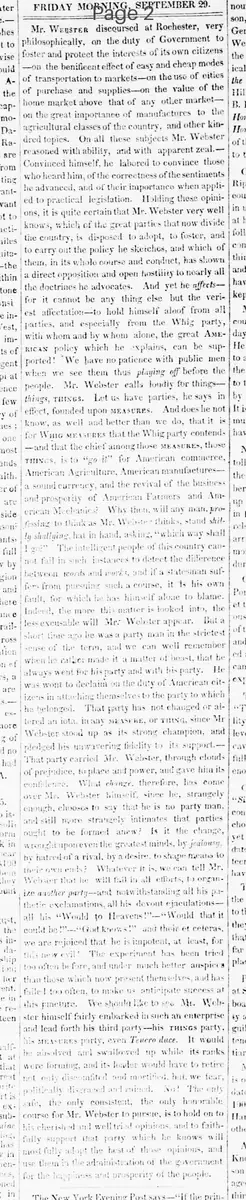
Mr. Webster discoursed at Rochester, very philosophically, on the duty of Government to foster and protect the interests of its own citizens—on the beneficent effect of easy and cheap modes of transportation to markets—on the use of cities of purchase and supplies—on the value of the home market above that of any other market—on the great importance of manufactures to the agricultural classes of the country, and other kindred topics. On all these subjects Mr. Webster reasoned with ability, and with apparent zeal.—Convinced himself, he labored to convince those who heard him, of the correctness of the sentiments he advanced, and of their importance when applied to practical legislation. Holding these opinions, it is quite certain that Mr. Webster very well knows, which of the great parties that now divide the country, is disposed to adopt, to foster, and to carry out the policy he sketches, and which of them, in its whole course and conduct, has shown a direct opposition and open hostility to nearly all the doctrines he advocates. And yet he affects—for it cannot be any thing else but the veriest affectation—to hold himself aloof from all parties, and especially from the Whig party, with whom and by whom alone, the great American policy which he explains, can be supported! We have no patience with public men when we see them thus playing off before the people. Mr. Webster calls loudly for things—things, Times. Let us have parties, he says in effect, founded upon Measures. And does he not know, as well and better than we do, that it is for Whig Measures that the Whig party contends—and that the chief among those Measures, those Things, is to "go it" for American commerce, American Agriculture, American manufactures—a sound currency, and the revival of the business and prosperity of American Farmers and American Mechanic? Why then, will any man, professing to think as Mr. Webster thinks, stand shilly-shallying, hat in hand, asking, "which way shall I go" The intelligent people of this country cannot fail in such instances to detect the difference between words and works, and if a statesman suffers from pursuing such a course, it is his own fault, for which he has himself alone to blame. Indeed, the more this matter is looked into, the less excusable will Mr. Webster appear. But a short time ago he was a party man in the strictest sense of the term, and we can well remember when he not only made it a matter of boast, that he always went for his party and with his party. He was wont to declaim on the duty of American citizens in attaching themselves to the party to which he belonged. That party has not changed or altered an iota, in any Measure or Thing, since Mr. Webster stood up as its strong champion, and pledged his unwavering fidelity to its support.—That party carried Mr. Webster, through clouds of prejudice, to place and power, and gave him its confidence. What change, therefore, has come over Mr. Webster himself, since he, strangely enough, chooses to say that he is no party man, and still more strangely intimates that parties ought to be formed anew? Is it the change, wrought upon even the greatest minds, by jealousy by hatred of a rival, by a desire, to shape means to his own ends? Whatever it is, we can tell Mr. Webster that he will fail in all efforts, to organize another party—and notwithstanding all his pathetic exclamations, all his devout ejaculations—all his "Would to Heavens!" "Would that it could be!" "God knows!", and their et ceteras. we are rejoiced that he is impotent, at least, for this new evil' The experiment has been tried too often before, and under much better auspices than those which now present themselves, and has failed too often, to make us anticipate success at this juncture. We should like to see Mr. Webster himself fairly embarked in such an enterprise and lead forth his third party—his Things party, his Measures party, even Measure duce. It would be absorbed and swallowed up while its ranks were forming, and its leader would have to retire not only discomfited and mortified, but, we fear, politically disgraced and ruined. No' The only safe, the only consistent, the only honorable course for Mr. Webster to pursue, is to hold on to his cherished and well-tried opinions, and to faithfully support that party which he knows will most fully adopt the best of those opinions, and use them in the administration of the government for the best happiness and prosperity of the people.
FRIDAY MORNING, SEPTEMBER 29.
Mr. Webster discoursed at Rochester, very philosophically, on the duty of Government to foster and protect the interests of its own citizens—on the beneficent effect of easy and cheap modes of transportation to markets—on the use of cities of purchase and supplies—on the value of the home market above that of any other market—on the great importance of manufactures to the agricultural classes of the country, and other kindred topics. On all these subjects Mr. Webster reasoned with ability, and with apparent zeal.—Convinced himself, he labored to convince those who heard him, of the correctness of the sentiments he advanced, and of their importance when applied to practical legislation. Holding these opinions, it is quite certain that Mr. Webster very well knows, which of the great parties that now divide the country, is disposed to adopt, to foster, and to carry out the policy he sketches, and which of them, in its whole course and conduct, has shown a direct opposition and open hostility to nearly all the doctrines he advocates. And yet he affects—for it cannot be any thing else but the veriest affectation—to hold himself aloof from all parties, and especially from the Whig party, with whom and by whom alone, the great American policy which he explains, can be supported! We have no patience with public men when we see them thus playing off before the people. Mr. Webster calls loudly for things—things, Times. Let us have parties, he says in effect, founded upon Measures. And does he not know, as well and better than we do, that it is for Whig Measures that the Whig party contends—and that the chief among those Measures, those Things, is to "go it" for American commerce, American Agriculture, American manufactures—a sound currency, and the revival of the business and prosperity of American Farmers and American Mechanic? Why then, will any man, professing to think as Mr. Webster thinks, stand shilly-shallying, hat in hand, asking, "which way shall I go" The intelligent people of this country cannot fail in such instances to detect the difference between words and works, and if a statesman suffers from pursuing such a course, it is his own fault, for which he has himself alone to blame. Indeed, the more this matter is looked into, the less excusable will Mr. Webster appear. But a short time ago he was a party man in the strictest sense of the term, and we can well remember when he not only made it a matter of boast, that he always went for his party and with his party. He was wont to declaim on the duty of American citizens in attaching themselves to the party to which he belonged. That party has not changed or altered an iota, in any Measure or Thing, since Mr. Webster stood up as its strong champion, and pledged his unwavering fidelity to its support.—That party carried Mr. Webster, through clouds of prejudice, to place and power, and gave him its confidence. What change, therefore, has come over Mr. Webster himself, since he, strangely enough, chooses to say that he is no party man, and still more strangely intimates that parties ought to be formed anew? Is it the change, wrought upon even the greatest minds, by jealousy by hatred of a rival, by a desire, to shape means to his own ends? Whatever it is, we can tell Mr. Webster that he will fail in all efforts, to organize another party—and notwithstanding all his pathetic exclamations, all his devout ejaculations—all his "Would to Heavens!" "Would that it could be!" "God knows!", and their et ceteras. we are rejoiced that he is impotent, at least, for this new evil' The experiment has been tried too often before, and under much better auspices than those which now present themselves, and has failed too often, to make us anticipate success at this juncture. We should like to see Mr. Webster himself fairly embarked in such an enterprise and lead forth his third party—his Things party, his Measures party, even Measure duce. It would be absorbed and swallowed up while its ranks were forming, and its leader would have to retire not only discomfited and mortified, but, we fear, politically disgraced and ruined. No' The only safe, the only consistent, the only honorable course for Mr. Webster to pursue, is to hold on to his cherished and well-tried opinions, and to faithfully support that party which he knows will most fully adopt the best of those opinions, and use them in the administration of the government for the best happiness and prosperity of the people.
What sub-type of article is it?
Partisan Politics
Economic Policy
What keywords are associated?
Daniel Webster
Whig Party
American System
Economic Policy
Political Parties
Manufactures
Agriculture
Internal Improvements
What entities or persons were involved?
Mr. Webster
Whig Party
Editorial Details
Primary Topic
Criticism Of Daniel Webster's Political Independence And Advocacy For Whig Economic Measures
Stance / Tone
Critical Of Webster's Non Partisanship And Supportive Of Whig Party Alignment
Key Figures
Mr. Webster
Whig Party
Key Arguments
Government Should Foster Citizens' Interests Through Transportation, Home Markets, And Manufactures
Whig Party Alone Supports These American Economic Policies
Webster's Aloofness From Parties Is Affectation And Inconsistent With His Past
Webster Should Join The Whig Party To Advance His Advocated Measures
Attempts To Form A New Party Based On Measures Will Fail