Thank you for visiting SNEWPapers!
Sign up free
Weekly Journal Miner
Prescott, Yavapai County, Arizona
What is this article about?
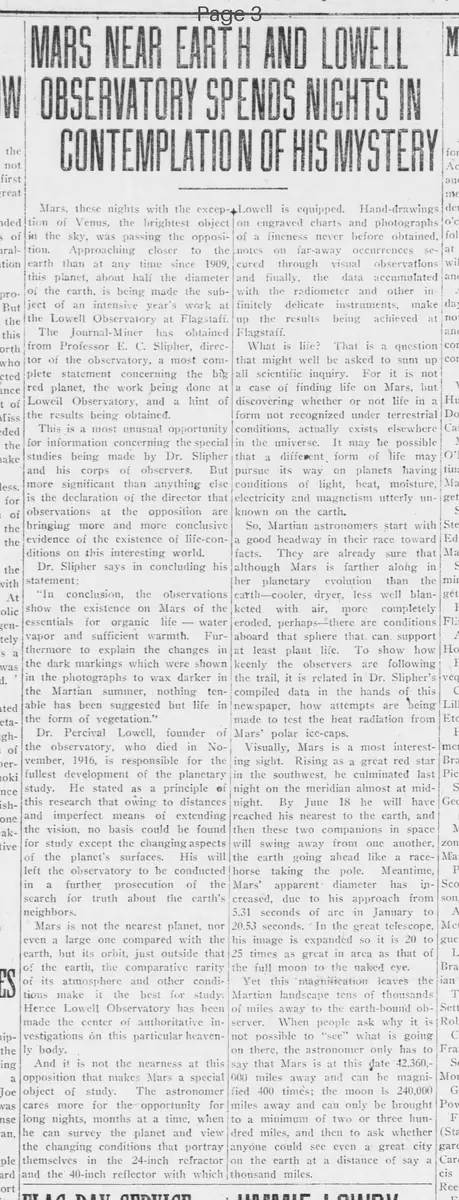
Article details observations of Mars at Lowell Observatory in Flagstaff, led by Dr. E. C. Slipher, providing evidence of water vapor, warmth, and vegetation suggesting life conditions on the planet. Founded by Percival Lowell, the observatory focuses on planetary studies during Mars' opposition.
Clipping
OCR Quality
Full Text
OBSERVATORY SPENDS NIGHTS IN
CONTEMPLATION OF HIS MYSTERY
of the earth, is being made the subject of an intensive year's work at the Lowell Observatory at Flagstaff.
The Journal-Miner has obtained from Professor E. C. Slipher, director of the observatory, a most complete statement concerning the big red planet, the work being done at Lowell Observatory, and a hint of the results being obtained.
Thus is a most unusual opportunity for information concerning the special studies being made by Dr. Slipher and his corps of observers.
But more significant than anything else is the declaration of the director that observations at the opposition are bringing more and more conclusive evidence of the existence of life-conditions on this interesting world.
Dr. Slipher says in concluding his statement:
"In conclusion, the observations show the existence on Mars of the essentials for organic life - water vapor and sufficient warmth. Furthermore to explain the changes in the dark markings which were shown in the photographs to wax darker in the Martian summer, nothing tenable has been suggested but life in the form of vegetation."
Dr. Percival Lowell, founder of the observatory, who died in November, 1916, is responsible for the fullest development of the planetary study. He stated as a principle of this research that owing to distances and imperfect means of extending the vision, no basis could be found for study except the changing aspects of the planet's surfaces. His will left the observatory to be conducted in a further prosecution of the search for truth about the earth's neighbors.
Mars is not the nearest planet, nor even a large one compared with the earth, but its orbit, just outside that of the earth, the comparative rarity of its atmosphere and other conditions make it the best for study. Hence Lowell Observatory has been made the center of authoritative investigations on this particular heavenly body.
And it is not the nearness at this opposition that makes Mars a special object of study. The astronomer cares more for the opportunity for long nights, months at a time, when he can survey the planet and view the changing conditions that portray themselves in the 24-inch refractor and the 40-inch reflector with which the observatory is equipped.
What is life? That is a question that might well be asked to sum up all scientific inquiry. For it is not a case of finding life on Mars, but discovering whether or not life in a form not recognized under terrestrial conditions, actually exists elsewhere in the universe. It may be possible that a different form of life may pursue its way on planets having conditions of light, heat, moisture, electricity and magnetism utterly unknown on the earth.
So, Martian astronomers start with a good headway in their race toward facts. They are already sure that although Mars is farther along in her planetary evolution than the earth-cooler, drier, less well blanketed with air, more completely eroded, perhaps--there are conditions aboard that sphere that can support at least plant life. To show how keenly the observers are following the trail, it is related in Dr. Slipher's compiled data in the hands of this newspaper, how attempts are being made to test the heat radiation from Mars' polar ice-caps.
Visually, Mars is a most interesting sight. Rising as a great red star in the southwest, he culminated last night on the meridian almost at midnight. By June 18 he will have reached his nearest to the earth, and then these two companions in space will swing away from one another, the earth going ahead like a race-horse taking the pole. Meantime, Mars' apparent diameter has increased, due to his approach from 5.31 seconds of arc in January to 20.53 seconds. In the great telescope, his image is expanded so it is 20 to 25 times as great in area as that of the full moon to the naked eye.
Yet this magnification leaves the Martian landscape tens of thousands of miles away to the earth-bound observer. When people ask why it is not possible to "see" what is going on there, the astronomer only has to say that Mars is at this date 42,360,000 miles away and can be magnified 400 times; the moon is 240,000 miles away and can only be brought to a minimum of two or three hundred miles, and then to ask whether anyone could see even a great city on the earth at a distance of say a thousand miles.
What sub-type of article is it?
What themes does it cover?
What keywords are associated?
What entities or persons were involved?
Where did it happen?
Story Details
Key Persons
Location
Lowell Observatory At Flagstaff
Event Date
Current Opposition, Nearest On June 18
Story Details
Intensive observations at Lowell Observatory reveal evidence of water vapor, sufficient warmth, and vegetation changes on Mars, indicating essentials for organic life. Founded by Percival Lowell, the observatory uses telescopes to study the planet's surface changes during opposition.